Showing posts with label suicide. Show all posts

Theresa Duncan and Jeremy Blake and Descents into Darkness


I found Theresa Duncan's blog of cultural criticism, The Wit of the Staircase while doing a search for the spelling of the phrase esprit d'escalier, "the wisdom of the staircase", meaning the things you wish you'd said after an argument, after slamming the door, on your way down the stairs or a couple of blocks down the street. Being cursed with fierce memory means that I have to make a conscious decision to pack away and dismiss other's (minor) faults and my own (major) sins, or else carry them around with me all day and night. This makes a phrase that describes regret more sympathetically than "coulda shoulda woulda" a useful thing to have.

Now I find out from New York magazine that Theresa Duncan killed herself, that her lover Jeremy Blake followed a week after. At first I was just going to move her link next to Molly Ivins', in memorium, still worth reading, with regrets for another intelligent stranger that shouldn't be dead, but is. People that make the world a better place in small or large ways keep dropping like flies, while shitheels go on crawling like roaches, leaking juices and polluting the world for days, even after being squashed. It must be a part of that plan for the world that says at any given time there are only thirty six tzadikkum, just and righteous people, who hold the world together with masking tape and mud and never know the value of their labor. Poisonous assholes, great and small, never get tired, while nature apparently puts a load limit on virtue.

According to the article, Duncan had been frustrated in her efforts to become an independent filmaker, which if you'd asked me, I coulda told you, Henry Slesar's description of "success in Hollywood" being enough for me. Add to that what Jim Harrison said: that a successful career in the arts faces about the same odds as an unlucky combat platoon, or a retirement community in Florida, with a few survivors breaking through and then attributing their success to inherent virtue and hard work instead of the vagaries of fate. Garrison Keillor wisely sneered at religious pundits who talk about Faith without ever really having to dig for it: "there's no one knows more about faith than an undiscovered artist." There's no one waiting for your next outburst, you have to feel energized enough to do the work, but not so energized you don't want to stay in your seat, you have to and believe that a project's worth finishing even if no one ever sees it, its value to the world roughly less than that fallen sumac tree that no one heard.

As connected as Theresa Duncan was in New York, even after her big break when her animated film The History of Glamour got national attention, it just wasn't enough to get a film made. I knew a guy who had the "option" picked up for a comedy script he wrote, thousands of dollars-- but six years later he was still waiting tables. Filmmaking, if you'da ast me (which you didn't), is art-by-committee: you need a lot of hands and a lot of money, and all kinds of trouble I don't need-- whereas when the power was out in Kalamazoo for more than three days, we managed somehow with a pencil and a flashlight. Theresa Duncan had at least one editor telling her to give up on film for now, and move into prose full time... but it tasked her. Zero Mostel, after he was blacklisted, just said Screw It and went on painting until the wheel turned around again. Worried about that day the Right finally transforms the United States into Chile, and we're all locked up with three hots and a cot in Guantanamo...? I'm the guy muttering, "Finally, I can get some work done."

Apparently for Duncan and Blake, their frustrations started turning into conspiracy theories about Scientologists who didn't want them to succeed. The natural process of finding out Who Your True Friends Are degenerated into making lists of Who Was Loyal and Who Was Part of the Conspiracy. No one can follow from the outside all the dark and lonely convolutions that lead a person to suicide, and according to New York, no one knows exactly when this beautiful couple drove off the main road until they were lost from sight.

Yeah, yeah, I was young and beautiful and doomed once, too. And yet, and yet, as I read on, I was surprised to find out that Theresa Duncan was a sister under the skin, another smart and literate kid from a small town (Lapeer, in her case) in Michigan, another talented writer unable to break into the world dominated by million dollar contracts for celebrity authors, which, in case you haven't figured out, means more than a thousand talented writers who will never be published at all because the corporation blew the budget on Sonnee Tufts' tell-all. She didn't want to be a fly-over, when silly people with much less to say are lionized in the cultural centers of New York and Los Angeles. We are mute, emasculated, unheard, drowned out by the shouting from Madison Avenue until we find some way to break a crack in the rock so the living water can flow through to bring water to the owls and the dragons. Add in chemical, genetic and situational depression, suicidal impulses, the frustration of having one eye in a kingdom of the blind (for example, I see from the papers that Norman Finkelstein was denied tenure by Depaul for getting into a pissing match with the Israeli lobby, his apparent sin being speaking truth to someone who buys ink by the barrellful). Add in the chronic anguish that can drive someone to a hasty decision simply to escape, baby, my credentials are on file. These are the things that Hamlet puts on his list of daily insults to the brain, next to the law's delay and the proud man's contumely.

There's a conversation in Long Day's Journey into Night between the compromised father and the ambitious son:
James: Yes, there's the makings of a poet in you all right
Edmund: The makings of a poet. I'm like a bum who asks for a cigarette: he doesn’t have the makings, he's only got the habit. I could never touch what I tried to tell you just now. I just stammered.

I've been luckier than poor Theresa Duncan (would she have chased those pills with whiskey if she'd known Jeremy Blake would follow her in? Was it an poorly thought-out impulse?) I was lucky enough to have a friend nearby who could warn me when I started to sound like a danger to myself. Non-depressives sometimes forget the nature of the disease: when you're down in a hole (hence, "depression") the only reality you can see is the side of the hole, with the patch of sunlight up above being something reserved for "winners" instead of "losers" like yourself. Reality is filtered through a delusion that even the most despicable human beings-- telemarketers, torturers, dog fight promoters-- are winners in the eyes of the world, while the most noble depressive is unworthy of life. The depressive appears lucid, even cheerful-- how many of us are full of jokes!-- but when those chemicals are acting up, there's a distortion of subjective reality that would make a schizophrenic call us crazy.

So include a little prayer for Thersa Duncan and Jeremy Blake and sad people everywhere, even, reportedly, the actor Owen Wilson, and for all the wayfarers looking for the soul of the world, the hobos Kerouac described as wearing two watches, the sun on one wrist and the moon on the other. Some of the very best people are exiles from the culture at large; you'll eat canned beans with the likes of Diogenes and Chu Yuan. But it's like all those times when you were maybe too drunk to drive but you made it home anyway, or went home with the wrong person but you managed not to drive your life into a ditch. If making a success as an artist requires the happiest of chances, so does being rescued from suicide, encountering this person instead of that, turning left instead of right on some dark corner on one dark night. I can remember a night when a photograph of Isak Dinesen's ancient face saved my life: I said, "she looks like I feel", and with nothing left but curiosity, I went home and read the only story by Dinesen I had in the house, and by chance it was a tale that had a particular blessing for me, and so I was saved. I've been rescued too many times by the luck of floating branches in the rushing current to ever sneer at someone else's nemesis.

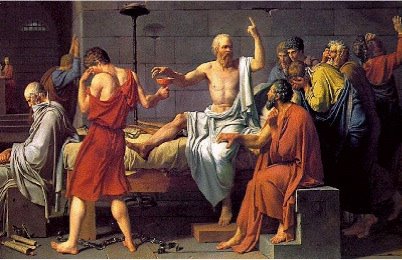
'Crito, we owe a rooster to Asclepius. Do pay it. Don't forget.'

The Supreme Court may grant the human animal the same consideration we would give a dying pet. Twice the people of Oregon have voted to let doctors prescribe a lethal dose of drugs for mentally competent, terminally ill patients who are within six months of dying. Those patients could then decide themselves whether or not to end their own lives. There were provisions to protect depressed patients from themselves (phew) and to save the wealthy elderly from over-anxious heirs.

Then the nipple-fearing Ashcroft and the mealy-mouth Gonzales decided that helping someone commit suicide by prescribing a narcotic would violate the Controlled Substances Act of 1970, and that assisting with a suicide is not a "legitimate medical purpose." If you use a baseball bat or a concrete overpass, that's your business. Just don't ask for anything certain and painless. Thanks for your help!

Today Diana Ross, excuse me, John Roberts and the Supremes voted 6-3 against the Attorney General in Gonzales v. Oregon (formerly Ashcroft v. Oregon). What happens now depends on who you ask. National Review even dug up the corpse of John Calhoun to equate Oregon's law with "state nullification" and Calhoun's defense of slavery.

See also: Supreme Court: The Kelo Decision

The Death of Saul Bellow

From his obit in the Times:
"Like their creator, Mr. Bellow's heroes were all head and all body both. They tended to be dreamers, questers or bookish intellectuals, but they lived in a lovingly depicted world of cranks, con men, fast-talking salesmen and wheeler-dealers....Mr. Bellow grew up reading the Old Testament, Shakespeare and the great 19th-century Russian novelists and always looked with respect to the masters, even as he tried to recast himself in the American idiom. A scholar as well as teacher, he read deeply and quoted widely, often referring to Henry James, Marcel Proust and Gustave Flaubert. But at the same time he was apt to tell a joke coined by Henny Youngman."

My favorite Saul Bellow novel-- by that, I mean the one I re-read the most, for comfort, guidance or stimulation-- is "Humboldt's Gift". I love the combination of high and low culture, from characters that should be played by Dennis Farina, Bruno Kirby (as Ron Cantibile) and John Cusak (as the young Charlie Citrine) to intellectual and philosophical flights and a central figure of Humboldt that would be played as-- I don't know, Zero Mostel as Harold Bloom? Don't forget Carole Raphaelle Davis as Charlie's footsie playing mistress Renata.
(Carole Raphaelle Davis played the Italian Wolfram and Hart representative in "The Girl In Question" one of the funniest episodes in any Whedon enterprise.)
Whenever I need bracing-- fairly often with melancholy Scots-Irish genes and only a dab of French sensuality-- I can turn to this from "Humboldt's Gift":
“For after all Humboldt did what poets in crass America are supposed to do. He chased ruin and death even harder than he had chased women. He blew his talent and health and reached home, the grave, in a dusty slide. He plowed himself under. Okay. So did Edgar Allan Poe, picked out of the Baltimore gutter. And Hart Crane over the side of a ship. And Jarrell falling in front of a car. And poor John Berryman jumping from a bridge. For some reason this awfulness is peculiarly appreciated by business and technological America. The country is proud of its dead poets. It takes terrific satifaction in the poets' testimony that the USA is too tough, too big, too much, too rugged, that American reality is overpowering. And to be a poet is a school thing, a skirt thing, a church thing. The weakness of the spiritual powers is proved in the childishness, madness, drunkenness, and despair of these martyrs. Orpheus moved stones and trees. But a poet can't perform a hysterectomy or send a vehicle out of the solar system. Miracle and power no longer belong to him. So poets are loved, but loved because they just can't make it here. They exist to light up the enormity of the tangle and JUSTIFY THE CYNICISM [emphasis mine] of those who say, "If I were not such a corrupt, unfeeling bastard, creep, thief, and vulture, I couldn't get through this either. Look at those good and tender and soft men, the best of us. They succumbed, poor loonies." (from HUMBOLDT'S GIFT)

The VanGoghs of this world are to get their reward in Heaven. Do we despise Andy Warhol for making self promotion and factory art production pay off? Or do we admire him as a trickster who sold the emperor new clothes? American as apple pie. Why is Elvis recycled constantly and Big Mama Thornton forgotten? Five bars of her "Hound Dog" will blow out any Elvis left in your system.
There is some truth in the complaint "'It's 'cause he's white!"-- there is more than one kind of "whiteness" in America. There is a kind of whiteness, blandness of the spirit that lets us stay asleep, pretends to be authentic but in fact doesn't upset anyone.
This was most evident in Pat Boone's covers of Little Richard; Elvis was an acceptable compromise to the culture between Boone and Big Mama.
Does anyone really believe that Elvis was "transgressive" because Ed Sullivan wouldn't show his hips moving? Censoring Elvis was a masterpiece of PR; nothing sells faster in America than shocking your grandma. When Elvis was swallowed up by Vegas, it was a fulfillment of prophecy.
Joss Whedon wondered if part of "Buffy's" artistic success was based on its unwillingness to not be "comfortable" relationship with the audience's expectations about genre.
Is this entirely the fault of capitalism and a world where perception is formed by advertising skills? A system that says the 40th most popular song or film or book in America is not as worthwhile artistically as the top ten?
They had the opposite problem in Soviet Russia, or Revolutionary France, where the "successful" artist was the one who pleased the most people in power. The painter David and his "Death of Marat" or "Liberty Leading the People"-- my god, he's got the chops still, but my god what a monster.
Power loves flattery; the crowd craves reassurance, even if it's a cynical rowd being reassured by "Sin City" that we indeed live in a corrupt world where beautiful noir women wear sidearms (and sleep with horribly scarred men.)
If we operate on a patronage system, do we cross our fingers and hope that the Medici just thrown money at us and leave us alone? The MacArthur grants are a good idea-- I love what John Sayles has done with his-- but you're still counting on knowing someone who knows someone who...
Maybe the best art in America is going to always be the stuff that relies on happy accident, like Louis Armstrong shooting off a gun on New Year's Eve, and then being sent to a Waif's Home where someone had donated a trumpet.
Or combinations of people coming together to mold "Citizen Kane" and "Casablanca".
Or the Hernandez Brothers making us "fall in love with ink and paper" because of the "Archie," Kirby and Ditko comics their mother brought home?
There is a great deal of the bird singing because it must in American art. Muddy Waters' voice carries across the fields and then transfers to success on the Chicago stage because it's in his nature.
We are not surprised when the scorpion stings the frog because "it's in his nature". Perhaps we shouldn't be surprised when the artist or the art form break through the rubble to reach the sun.
I've got it easy; nothing stops me from writing or drawing except a want of ink and paper. The frustration I feel is caused by not winning "The Smile of the World" as Warhol or the Beastie Boys have.
I would be a happier fellow if I concentrated on the work and let the selling. getting and spending take care of itself. My artistic frustrations should be based on whether I got the work done and done well, not whether it sells or not. I ought to be more concerned about craft, whether my sentences are polished or my drawings as anatomically skilled as they should be. And almost everyone you know, including yourself, is going to try and distract you from that. They don't know how else to measure your worth, except to ask if it's been published or not, if it's sold or not, and if so, how much has it sold?
It's a bit easier for musicians or magicians to focus their energy on craft and less on the audience. If I don't start worrying about the audience-- readers and editors-- I end up writing on the inside of a closet in my own blood, and in a language that only I can read.
The poor bastards i feel sorry for are those whose art depends on a group effort and lots of money: dancers, actors, playwrights, filmmakers... I knew a New York actor who was rejected three times for the same role in a play: the first time because he was "Too Young", the second time because he was "Too Old", and a third time because he looked "Too Young" again.
(Producers and directors ought to be licensed, like psychotherapists; their power their subconscious wields in American culture is frightening to behold.)
Bracing words from Saul Bellow, the streetwise zaydeh I never had-- except that by writing it down, he does indeed pass it on to those who need it.

"A great deal of intelligence can be invested in ignorance when the need for illusion is deep."

"Take our politicians: they're a bunch of yo-yos. The presidency is now a cross between a popularity contest and a high school debate, with an encyclopedia of cliches the first prize."

"You're all alone when you're a writer. Sometimes you just feel you need a humanity bath. Even a ride on the subway will do that. But it's much more interesting to talk about books. After all, that's what life used to be for writers: they talk books, politics, history, America. Nothing has replaced that."

"I discovered that rejections are not altogether a bad thing. They teach a writer to rely on his own judgment and to say in his heart of hearts, 'To hell with you.'"

"A man is only as good as what he loves."