Goodbye, Benjamin


Seventy years ago, the last known thylacine or Tasmanian Tiger died in the Hobart zoo on September 7th. The Aussies are remembering the anniversary as Threatened Species Day.

Rumors hold out hope that there may still be survivors out there in the forest. The Fortean Times reports an agreement among cryptozoologists that if a living thylacine is ever found, it will be kept secret to protect them from prying eyes.

Now E. O. Wilson is trying to talk sense about species diversity and the need to reverse the coming extinction event.

In one of his novels, John D. MacDonald imagined a character who became so disraught at the clearing of a nature preserve, she fell into a killing depression and catatonia. I tremble to think of the effect on my friends when the last wild tiger is killed to make medicine for a Chinaman's penis or a fur rug for a Russian gangster. At that point we might want to reconsider our rejection of the eco-terrorist's methods, but it won't bring back the thylacine or the last tiger.

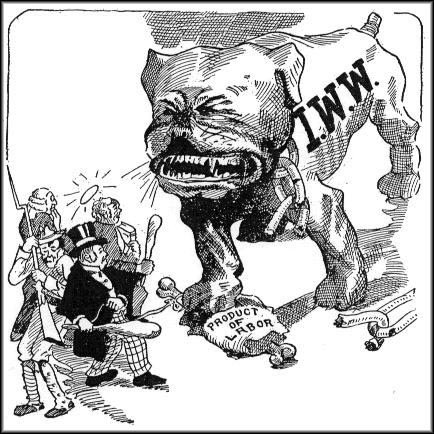
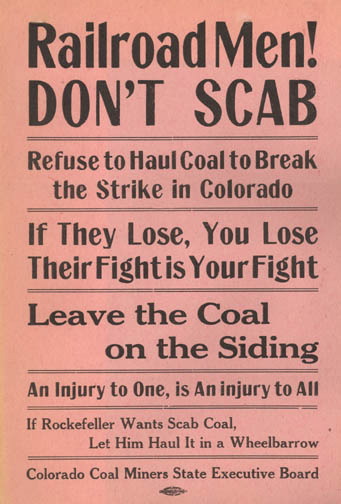
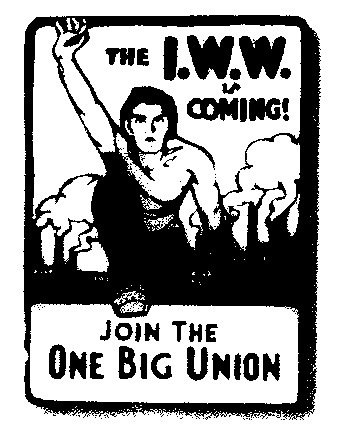
LABOR DAY: The Self-Hatred of the Working Class


I am still puzzled (though no longer surprised) by how often workers identify with their bosses' interests instead of their own. Union meetings are spent on back-biting, complaints against other union members and fighting over crumbs, while the CEO still takes the biggest piece of cheese.

Administrative executives are given car allowances, golden parachutes, retirement packages, arbitrary power-- and they fight tooth and nail against every pittance that might be spent on the business instead of themselves. This is supposed to be evidence of the Invisible Hand: the marketplace wouldn't be paying CEOs these high salaries if they weren't worth it. Forbes reports in April of 2005 that "the heads of America's 500 biggest companies received an aggregate 54% pay raise last year. As a group, their total compensation amounted to $5.1 billion, versus $3.3 billion in fiscal 2003."

Never mind workers' wages-- I'd settle for investment in infrastructure, in an improved work environment. It was a mistake when workers took cash instead of a seat on the board. We traded a boat in the driveway for our birthright.

Why don't working people laugh out loud at the annual call to abolish the estate tax? Only about 2% of all estates will ever be subject to the tax. "Death tax", the Republicans are intructed to call it, as though the IRS were taxing the right to die.

Years ago, I asked Doc Clark why so many people were eager to turn against each other to do favors for the powerful. "I guess people like to hang out with rich people; they think some of it might rub off on them," he said. Maybe that's part of it: a desire to curry favor, like the knights who murdered Beckett because they thought it would please the king. In the feudal south, my father remembers poor whites defending the landowner's interests against black sharecroppers, though the crackers would never see a dime themselves.

I've seen a head waiter tyrannize the wait staff because he thinks he owns the restaurant. Imagine his disappointment when the owners pass him over in favor of a relative. There's some kind of class-warfare version of the Stockholm syndrome going on, where the captive over-identfies with the kidnapper instead of his rescuers.

In 2001 the top 1% of households owned 33.4% of all privately held wealth. The next top 19% held 51%. That leaves (let me take off my socks, so I can count on my toes) 15.6% for the rest of us to fight over.

You probably know the stories of outrageous compensation for administrators and executives, the examples of waste better than I, and yet it's union members who are attacked in ads sponsored by something called The Center for Union Facts out of Washington, D.C. -- as if the employees had a voice in spending priorities or work conditions! Thus the Chamber of Commerce shows its true colors.

American workers fantasize that they have more in common with their employers than with other working stiffs. They haven't learned that even though you love your job, the job does not necessarily love you.

The collapse of Ford and GM under the weight of the health care system might knock some sense into us. The New Yorker has a remarkably clear piece on something called the"dependency ratio" that explains what's really going on when a company can't keep its promises to its workers, why China, India and even Ireland are outpacing us.

Instead of letting workers invest in a centralized health care and pension fund, the big corporations insisted on private funding for their employees. Now, after decades of improvements in manufacturing and a growing pool of retirees, there are fewer workers than there are dependents. Simply put, our old fear of socialism is catching up to us.

As Malcom Gladwell puts it: "This crisis is sometimes portrayed as the result of corporate America’s excessive generosity in making promises to its workers. But when it comes to retirement, health, disability, and unemployment benefits there is nothing exceptional about the United States: it is average among industrialized countries—more generous than Australia, Canada, Ireland, and Italy, just behind Finland and the United Kingdom, and on a par with the Netherlands and Denmark. The difference is that in most countries the government, or large groups of companies, provides pensions and health insurance. The United States, by contrast, has over the past fifty years followed the lead of Charlie Wilson and the bosses of Toledo and made individual companies responsible for the care of their retirees. It is this fact, as much as any other, that explains the current crisis. In 1950, Charlie Wilson [the CEO] was wrong, and Walter Reuther [the union guy] was right."

It was the bosses that shot themselves in the ass. And Joe Hill, God bless him, has the last grim laugh.

"The Preacher and the Slave" by Joe Hill

Long-haired preachers come out every night,
Try to tell you what's wrong and what's right;
But when asked how 'bout something to eat
They will answer in voices so sweet:

CHORUS: You will eat, by and by,
In that glorious land above the sky;
Work and pray, live on hay,
You'll get pie in the sky when you die

And the Starvation Army they play,
And they sing and the clap and they pray,
Till they get all your coin on the drum,
Then they tell you when you're on the bum:

CHORUS: You will eat, by and by,
In that glorious land above the sky;
Work and pray, live on hay,
You'll get pie in the sky when you die

Holy Rollers and Jumpers come out
And they holler, they jump and they shout
Give your money to Jesus, they say,
He will cure all diseases today.

If you fight hard for children and wife-
Try to get something good in this life-
You're a sinner and bad man, they tell,
When you die you will sure go to hell.

Workingmen of all countries, unite
Side by side we for freedom will fight
When the world and it's wealth we have gained
To the grafters we'll sing this refrain:

You will eat, by and by,
When you've learned how to cook and how to fry;
Chop some wood, 'twill do you good
Then you'll eat in the sweet by and by.

Joe Hill, 1879-1915

FASCIST IS AS FASCIST DOES

If right-wingers are too quick to use epithets against an argument they don't like, the left is just as guilty for throwing the word "fascist" around too quickly.

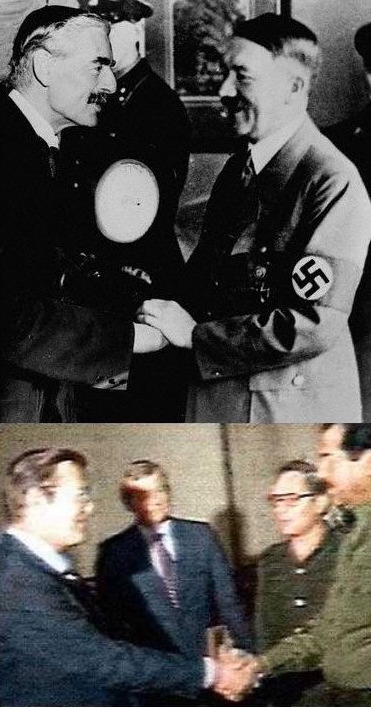
Now the White House speechwriters are tossing the f-bomb around on a PR offensive featuring the president talking to the VA--tough crowd, gutsy move. Apparently he's asking the rest of us to help him clean up the mess he himself made, a familiar litany in this man's life. The Donald (Rumsfeld) is using it too, talking about "a new type of fascism" and honking about appeasement, the broad hint being that anyone who opposes Rumsfeld must be an appeaser and a Very Bad Person.

Rove’s Republicans must have been concerned that the left still had one powerful word left in their quiver. Now every neo-con from Bush to Rumsfeld to Tony Snow to Rick “I didn't think I was going to talk about "man on dog" with a United States senator”Santorum to Majority Leader Bill “Cat Killer” Frist is evoking the shade of Chamberlain at Munich.

I try to stay close to the word's etymology: those who emulate a bundle of sticks or "fasces", a political organization wherein the individual is subordinate to the state, and things get damned uncomfortable for the sticks that don't quite fit.

The irony is that nothing resembles modern fascism quite so much as the Bush administration’s insistence on a monolithic point of view. The Japanese phrase “the nail that sticks up gets hammered down,” fairly describes the national dialogue during the rush to invade Iraq. Digby’s Hullabaloo has called them on it, and the Los Angeles Times are drop kicking the analogy as well. The Christian Science Monitor lets the word speak for itself. If this propaganda initiative fails, I wonder what vile phrase the Rover Boys will next tie to their test balloons.

Keith Olbermann has articulated as well as anyone why we refer to this administration as "fascistic”. I first saw Olbermann as a hockey reporter on ESPN, and still miss the phrase “drop the chalupa”, but an essay like this is worth his disappearance into the shadows of MSNBC.

COMMONPLACE QUOTATIONS for AUGUST, 2006

"Public interest is clear in this matter. It is the upholding of the Constitution. . . . It was never the intent of the framers to give the president such unfettered control. (U.S. District Court Judge Anna Diggs Taylor of Michigan)

***
“One judge in Michigan has done what 535 members of Congress have so abysmally failed to do.” (NYT editorial)

***

“Socrates asked: what do a beautiful woman, a beautiful vase and a beautiful bed have in common? His answer: the idea of beauty. My question is: what do extremist ideologies like the communism or Nazism of yesteryear and the Islamism of today have in common? After all, they support ostensibly very different ideals – the superior race, mankind united in socialism, the community of Muslim believers, the Umma. Tomorrow, it could be altogether different ideals: some theological, some scientific, others racist. But the common characteristic is nihilism.
“The root element is the attitude that anything goes, particularly when with regard to ordinary people: I can do whatever I want, without scruples. Goehring put it like this: my consciousness is Adolf Hitler. Bolsheviks said: man is made of iron. And the Islamists whom I visited in Algeria said that you have the right to kill little Muslim children, in order to save them.
“....Religion is only the cloth, the excuse and the justification. What is essential is the practice. For there is a direct connection between the Islamic suicide bomber and the general serving under Franco who shouted out in front of the University of Salamanca: “Long live death!” This is the connection that I was trying to grasp.”
(André Glucksmann, in a terrific interview considering Bin Laden in the light of Dostoevsky’s “The Possessed”)

***
“Strategic bombing has been a failed military concept for ninety years, and yet air forces all over the world keep doing it. ... You have to hunt like a network to defeat a network. Israel focused on bombing against Hezbollah, and, when that did not work, it became more aggressive on the ground. The definition of insanity is continuing to do the same thing and expecting a different result.” (John Arquilla, defense analyst at the Naval Postgraduate School, quoted by Seymour Hersch in The New Yorker August 21, 2006)

***
The Geek Heirarchy

***
“How in the hell could a man enjoy being awakened at 6:30 a.m. by an alarm clock, leap out of bed, dress, force-feed, shit, brush teeth and hair, and fight traffic to get to a place where essentially you made lots of money for somebody else and were asked to be grateful for the opportunity to do so?” (Charles Bukowski in “Factotum)

***
“[During the Cuban Missile Crisis] Kennedy was deeply influenced by Barbara Tuchman's classic, "The Guns of August," which recounted how a seemingly isolated event 92 summers ago -- an assassination in Sarajevo by a Serb terrorist -- set off a chain reaction that led in just a few weeks to World War I. There are vast differences between that August and this one. But Tuchman ended her book with a sentence that resonates in this summer of crisis: "The nations were caught in a trap, a trap made during the first thirty days out of battles that failed to be decisive, a trap from which there was, and has been, no exit."
Preventing just such a trap must be the highest priority of American policy. Unfortunately, there is little public sign that the president and his top advisers recognize how close we are to a chain reaction, or that they have any larger strategy beyond tactical actions. (Richard Holbrooke, The Washington Post

***
“Ralph Giordano, a German writer and, by the way, a Jew, has noted that Mr. Grass was only 6 when Adolf Hitler was invited to become Germany’s chancellor. (The overused phrase “seizure of power” badly distorts what happened around Jan. 30, 1933, the date of the Führer’s accession. A coup d’ état would have been bad enough; that Hitler’s appointment was perfectly legal only makes it worse for German history.) And Mr. Giordano has asked, reasonably enough, “What else could he have done during that time in the face of the Nazis’ all-powerful propaganda apparatus?” And answers his own question: “Nothing.”.... It is not that a public personality should get a free ride simply for being famous, let alone popular. Herbert von Karajan may have been an outstanding conductor of the Berlin Philharmonic, but this would not erase the fact that he joined the Nazi party twice — these were the acts of an adult, after all. The uncomfortable question that remains for Mr. Grass is this: Why did he keep this interlude as a servant of the regime so tight a secret? .... I am not Mr. Grass’s analyst, nor have I ever met him. But it seems to me that he failed to come forward all these years simply because he was too ashamed.” (op-ed by Peter Gay in the New York Times

***
(Ward Sutton in The Village Voice)
***

"All obstructions to the execution of the laws, all combinations and associations, under whatever plausible character, with the real design to direct, control, counteract, or awe the regular deliberation and action of the constituted authorities, are destructive of this fundamental principle, and of fatal tendency.
“They serve to organize faction, to give it an artificial and extraordinary force; to put, in the place of the delegated will of the nation the will of a party, often a small but artful and enterprising minority of the community; and, according to the alternate triumphs of different parties, to make the public administration the mirror of the ill-concerted and incongruous projects of faction, rather than the organ of consistent and wholesome plans digested by common counsels and modified by mutual interests.
“....Real patriots who may resist the intrigues of the favorite are liable to become suspected and odious, while its tools and dupes usurp the applause and confidence of the people, to surrender their interests."
(George Washington)

***

".... The snakes will reveal themselves to be not a counter-Phallus, but rather an expression of the rage of the Medusa, the radical queer postcolonial feminine. What is at stake here is not a battle between "snakes" and the "plane," but rather the contest between transgressive Oedipalized subjectivity (memorably described by Jackson's line, "there's motherf---- snakes on the motherf---- plane") and the anti-Oedipal, serpentine, body-machine complex...."
(A Pre-Reading of "Snakes on a Plane" by Amardeep Singh)

***

“... And I’ve been killing my way to the truth ever since.”
(Marv, in Frank Miller’s “Sin City”)