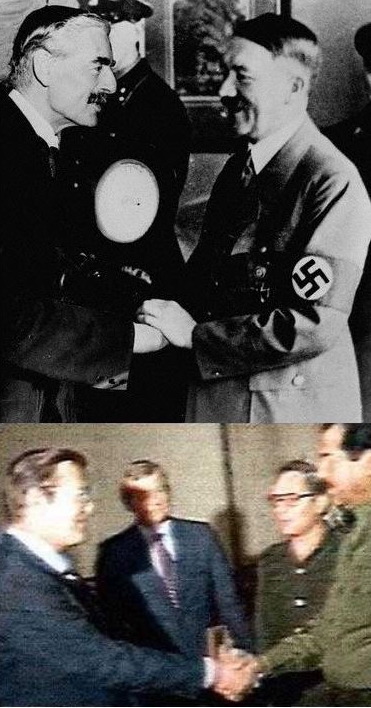
Donald Rumsfeld shaking hands with Saddam Hussein in 1983, when we supported Hussein in his war against Iran.
Col. Lawrence Wilkerson, USA (RET.) former Chief of Staff, Department of State, 2002-2005, retired Army colonel and former director of the Marine Corps War College:
"I would say that we have courted disaster, in Iraq, in North Korea, in Iran, generally with regard to domestic crises like Katrina, Rita - and I could go on back. We haven't done very well on anything like that in a long time."
Lawrence Wilkerson transcript "...If something comes along that is truly serious, truly serious, something like a nuclear weapon going off in a major American city, or something like a major pandemic, you are going to see the ineptitude of this government in a way that will take you back to the Declaration of Independence."
"...I stop on 26 January 2005. I don’t know what the case is today; I wish I did. But the case that I saw for four-plus years was a case that I have never seen in my studies of aberrations, bastardizations, perturbations, changes to the national security decision-making process. What I saw was a cabal between the vice president of the United States, Richard Cheney, and the secretary of Defense, Donald Rumsfeld on critical issues that made decisions that the bureaucracy did not know were being made. And then when the bureaucracy was presented with the decision to carry them out, it was presented in a such a disjointed, incredible way that the bureaucracy often didn’t know what it was doing as it moved to carry them out.
"Read George Packer’s book, 'The Assassin’s Gate', if you haven’t already. George Packer, a New Yorker – reporter for the New Yorker, has got it right. I just finished it, and I usually put marginalia in a book, but let me tell you, I had to get extra pages to write on. (Laughter.) And I wish I had been able to help George Packer write that book. In some places I could have given him a hell of a lot more specifics than he’s got. (Laughter.) But if you want to read how the Cheney-Rumsfeld cabal flummoxed the process, read that book. And of course there are other names in there: Undersecretary of Defense Douglas Feith, whom most of you probably know Tommy Franks said was the stupidest blankety, blank man in the world. He was. (Laughter.) Let me testify to that. He was. Seldom in my life have I met a dumber man. (Laughter.) And yet – and yet – and yet, after the secretary of State agrees to a $40 billion department rather than a $30 billion department having control, at least in the immediate post-war period in Iraq, this man is put in charge. Not only is he put in charge, he is given carte blanche to tell the State Department to go screw itself in a closet somewhere. Now, that’s not making excuses for the State Department; that’s telling you how decisions were made and telling you how things got accomplished.
"In so many ways I wanted to believe for four years that what I was seeing – as an academic now – what I was seeing was an extremely weak national security advisor, and an extremely powerful vice president, and an extremely powerful in the issues that impacted him secretary of Defense – remember, a vice president who has been secretary of Defense too and obviously has an inclination that way, and also has known the secretary of Defense for a long time, and also is a member of what Dwight Eisenhower warned about – God bless Eisenhower – in 1961 in his farewell address, the military industrial complex – and don’t you think they aren’t among us today – in a concentration of power that is just unparalleled. It all happened because of the end of the Cold War. Harlan will tell you how many contractors who did billion dollars or so business with the Defense Department did we have in 1988 and how many do we have now? And they’re always working together.
"If one of them is a lead on the satellite program – I hope there’s some Lockheed and Grumman and others here today, Raytheon – if one of them is a lead on satellites, the others are subs. And they’ve learned their lesson; they’re in every state. They’ve got every congressman, every senator. They’ve got it covered. Now, that’s not to say that they aren’t smart businessmen. They are – and women – they are. But it’s something we should be looking at, something we should be looking at.
"So you’ve got this collegiality there between the secretary of Defense and the vice president, and you’ve got a president who is not versed in international relations and not too much interested in them either. And so it’s not too difficult to make decisions in this what I call Oval Office cabal, and decisions often that are the opposite of what you’d thought were made in the formal process. Now, let’s get back to Dr. Rice again. For so long I said, yeah, Rich, you’re right – Rich being Undersecretary of State Richard Armitage – it is a dysfunctional process. And to myself I said, okay, put on your academic hat; who’s causing this? Well, the national security adviser. Even if the framers didn’t envision that position, even if it’s not subject to confirmation by the Senate, the national security advisor should be doing a better job. Now I’ve come to a different conclusion, and after reading Packer’s book I found additional information, or confirmation for my opinion, I think. I think it was more a case of – in some cases there was real dysfunctionality – there always is – but in most cases it was Dr. Rice made a decision, she made a decision – and this is all about people again because people in essence are the government. She made a decision that she would side with the president to build her intimacy with the president.
"And so what we had was a situation where the national security advisor, seen in the evolution over some half-century since the act as the balancer or the person who would make sure all opinions got to the president, the person who would make sure that every dissent got to the president that made sense – not every one but the ones that made sense – actually was a part of the problem, and probably on many issues sided with the president and the vice president and the secretary of Defense. And so what you had – and here I am the academic again – you had this incredible process where the formal process, the statutory process, the policy coordinating committee, the deputies committee, the principal’s committee, all camouflaged – the dysfunctionality camouflaged the efficiency of the secret decision-making process.
And so we got into Iraq, and so George Packer quotes Richard Haas in his book as saying, “To this day I still don’t know why we went to war in Iraq.” I can go through all the things we listed, from WMD to human rights to – I can go through it – terrorism, but I really can’t sit here and tell you, George, why we went to war in Iraq. And there are so many decisions. Why did we wait three years to talk to the North Koreans? Why did we wait four-plus years to say we at least back the EU-3 approach to Iran? Why did we create the national director of intelligence and add further to the bureaucracy, which was what caused the problem in the first place? The problem is not sharing information. The problem is not that we don’t have enough feet on the ground or enough people collecting intelligence or enough $40 billion eyes in the sky – national technical means. That’s not the problem. The problem is our people don’t share. ...
"That is not what this administration did for four years. Instead it made decisions in secret, and now I think it is paying the consequences of having made those decisions in secret. But far more telling to me is America is paying the consequences. You and I and every other citizen like us is paying the consequences, whether it is a response to Katrina that was less than adequate certainly, or whether it is the situation in Iraq, which still goes unexplained. You know, if I had the time I could stand up here today I think and make a strategic case for why we are in Iraq and why we have to stay there and we have to get it right. As Winston Churchill said, “America will always do the right thing, after exhausting all other possibilities.” (Laughter.) Well, we need to get busy and exhaust them and do the right thing.
"We can’t leave Iraq. We simply can’t. I can make that case. No one in this administration has made that case. They have simply pontificated. That’s all they’ve done. Now, I’m not evaluating the decision to go to war. That’s a different matter. But we’re there, we’ve done it, and we cannot leave. I would submit to you that if we leave precipitously or we leave in a way that doesn’t leave something there we can trust, if we do that, we will mobilize the nation, put 5 million men and women under arms and go back and take the Middle East within a decade. That’s what we’ll have to do. So why not get it right now? Why not get it right now? I don’t see any signs, other than signs of desperation – that is to say, the polls are falling, people are finally listening, to a certain extent, to the evidence that’s building up, and so people are getting desperate. And so Dr. Rice gets some more flexibility, some more leeway, and we do this and we do that; that looks diplomatic. But I don’t see anything that looks coordinated because I think the decisions are still being made essentially in that small group.
"And I’ll finish just by bringing it down screechingly to the ground and tell you that the detainee abuse issue is just such a concrete example of what I’ve just described to you, that 10 years from now or so when it’s really, really put to the acid test, ironed out and people have looked at it from every angle, we are going to be ashamed of what we allowed to happen. I don’t know how many people saw the “Frontline” documentary last night – very well done, I thought, but didn’t get anywhere near the specifics that need to be shown, that need to come out, that need to say to the American people, this is not us, this is not the way we do business in the world. Of course we have criminals, of course we have people who violate the law of war, of course we had My Lai, of course we had problems in the Korean War and in World War II. My father-in-law was involved in the Malmédy massacre and the retaliation of U.S. troops in Belgium. He told me some stories before he died that made my blood curdle about American troops killing Germans.
"But these are not -- I won’t say isolated incidents; these are incidents that are understandable and that ultimately, at one time or another, we came to deal with. I don’t think, in our history, we’ve ever had a presidential involvement, a secretarial involvement, a vice-presidential involvement, an attorney general involvement in telling our troops essentially carte blanche is the way you should feel. You should not have any qualms because this is a different kind of conflict. Well, I’ll admit that. I’ll admit that. I don’t want to see any of these people ever released from prison if they’re truly terrorists. I don’t want to see them released because I know what they’ll do. I’m a former military man, 31 years in the Army. They will go out and they will try to kill me and my buddies, again and again, and some of you people, too.
"So I understand the radical change in the nature of our enemy, but that doesn’t mean we make a radical change in the nature of America. But that’s what we did, and we did it in private. ... And we knew that things weren’t the way they should be, and as former soldiers, we knew that you don’t have this kind of pervasive attitude out there unless you’ve condoned it – unless you’ve condoned it. And whether you did it explicitly or not is irrelevant. If you did it at all, indirectly, implicitly, tacitly – you pick the word – you’re in trouble because that slippery slope is truly slippery, and it will take years to reverse the situation, and we’ll probably have to grow a new military.
"We may have to do that anyway because my army right now is truly in bad shape – truly in bad shape. And I’m not talking about the billions and billions of dollars of equipment it’s burning up in Iraq at a rate 10 or 15 times the rate its life cycle said it should be burned up at, but I’m also talking about when you have officers who have to hedge the truth, NCOs who have to hedge the truth. They start voting with their feet, as they did in Vietnam, my war. They come home and they tell their wife they’ve got to go back for the third tour and the fourth tour and the wife says, uh-uh, or the husband says, uh-uh, and all of a sudden your military begins to unravel.
".... Yes, I have paid a price, and it’s a high price for me. I’ve paid the price that Colin Powell and I see eye to eye a lot less than we used to. Now, that’s not to say that that wasn’t the case a lot of times anyway. The great respect I have for the man emanates as much from his ability to tolerate me in my many dissenting opinions as it does for any leadership qualities that he’s otherwise shown me, which were manifold. But at the end, I actually was physically thrown out of his office on one occasion, and that was a first in 16 years.
"It showed, I think, his exasperation and it showed his tolerance level had sunk considerably for dissenting opinions. He’s not happy – I think that’s fair to say – with my speaking out because – and I admire this in him too – he is the world’s most loyal soldier and feels that his inveterate optimism is right and that we will overcome these problems. And I share that. However, I feel like as a citizen and as a person very much concerned with the military – it was my old home – I need to speak out."
 (And some days it takes more Stones than others...) Where Mythical Bestiary meets Contemporary Culture and Chews On Its Leg Until Covered with Slobber.