"All the Stones the Builders Rejected"  (And some days it takes more Stones than others...) Where Mythical Bestiary meets Contemporary Culture and Chews On Its Leg Until Covered with Slobber.
Lena Horne
I'm guessing most tributes to Lena Horne will include the 1943 version of "Stormy Weather", but it's interesting to compare that young girl's intuitive understanding with a bluesier version sung later in life. Not a false caesura in either version, by the way, which ought to teach pop idols the difference between genuine emotion and sentiment, but probably won't.
The other two songs, "Moon River" and "It's Not Easy Being Green", I posted for myself. I'd like to know what went through her head while rehearsing "Green". With that voice and those impossible cheekbones, this woman could have run the table as Hollywood's Cleopatra, Shakespeare's Dark Lady, Sally Hemings or the Queen of Sheba-- but in that benighted time, she couldn't even hang on to the part of Julie in Showboat. The studio cast Ava Gardner in the "controversial" role of a "high yellow gal" passing for white in order to marry the man she loved.
So Lena finally said to hell with Hollywood, went home to New York and became a chanteuse instead. Ironically this was a winning decision: Hollywood discards its leading ladies quickly, whereas jazz and blues singing, like painting, rewards longevity and depth.

Commonplace Book, April: Sensitive Redheads, Richard Pryor, What Wonder Woman Represents and Too Much Twee in Literature
“He had seen society in its three great phases—Obedience, Struggle and Revolt... and he hesitated in his choice. Obedience was dull, Revolt impossible, Struggle hazardous.”
(Balzac, Pere Goriot)
“He who will not reason is a bigot; he who cannot is a fool; and he who dares not is a slave.”
(William Drummond, some old Scotsman)
“Something nice this way comes. It begins with the awful—whether it’s as enormous as the Holocaust or the World Trade Center or as intimate as family dysfunction or the death of a loved one—and then finds comfort. None of this Anna on the tracks, Emma in the dumps, or depressing Father Zosima’s corpse smells stuff; that’s sooo 19th century. ...
Instead, let’s just book passage on a gentle, healing voyage. Sound trite? It is, but it’s apparently the literature of our time as exemplified by Jonathan Safran Foer, Myla Goldberg, Nicole Krauss, and Dave Eggers, along with everything McSweeney’s, the magazine founded by Eggers.”
(Melvin Jules Bukiet , ”Wonder Bread” in The American Scholar)

“In American popular culture, the private detective is a unique heroic figure: champion of last resort for the vulnerable client, a knight-errant for hire, bringing rough or poetic justice to cases unserved by more official powers that be. [Robert Parker] wrote dialogue that at once informed, amused and gave a sense of character; and he conjured characters a reader wanted to spend more time with—especially Spenser, a fixed point in a footloose world, take him or leave him. A pragmatist whose ethics were situational. A tough and decent type who did what needed to be done in the service of a moral cause, affirming the worth of the individual regardless of race, sexual orientation, social status, age or occupation. He made timeless points that need to be remade every generation, in a society ever able to find ways to betray the public and private trust.”
(Obituary by Tom Nolan in the Wall Street Journal)
“As Juke [on a 1974 Lily Tomlin special], Richard Pryor gave one of his relatively few great performances in a project that he had not written or directed. He made use of the poignancy that marks all of his great comedic and dramatic performances, and of the vulnerability—the pathos cradling his sharp wit—that had seduced people into loving him in the first place.... The concert films are excellent examples of what the Village Voice critic Carrie Rickey once described as Pryor’s ability to “scare us into laughing at his demons—our demons—exorcising them through mass hyperventilation.”... Taken together, the concert films show the full panorama of Pryor’s moods: brilliant, boring, insecure, demanding, misogynist, racist, playful, and utterly empathetic.... Pryor embodied the voice of injured humanity. A satirist of his own experience, he revealed what could be considered family secrets—secrets about his past, and about blacks in general, and about his relationship to the black and white worlds he did and did not belong to.”
(Hilton Als profile of Richard Pryor in The New Yorker
“So Wonder Woman counts among one of the very few superhero genre characters that are legitimately a gift to young women. She is not a character to be marketed to young men. Marston assured the company the boys would read as well, but she's custom designed for young women. For god's sake, she's a princess who talks to animals. Her entire supporting cast, with the exception of one blockheaded love interest, was women. She is a character made with little girls in mind.
The bondage urban legend always struck me as a mean-spirited attempt to rob us of that. To strip her of all innocent and generous beginnings in favor of something uber-sexualized. To say that we weren't worth our own superhero princess, she had to be secretly aimed at young men. That she was really meant for boys. It's a way to steal Wonder Woman, and claim she wasn't ever stolen.
To be honest, that's why I've always felt they had trouble with her. She is a female-oriented character that they keep marketing to a widely male audience.” (Ragnell on her blog Written World”

“I think that's a big part of it — she COULD tear someone's head off, she COULD destroy a country if she chose. But she would consider that a failure as a warrior for peace. The death of an enemy is not victory to her. I love that stuff. I think it's a far better blueprint for the future than most of the action hero stuff out there right now.
But there are a million reasons. I love that she's the DC universe's premiere badass. I love that she was giving messages of the power of womanhood in the 40's, you know, decades before Buffy or Xena or Lara Croft. And there's a part of me that loves the pegasi and the princess-ness of it all, and all the trappings of Paradise Island. She's just brilliantly conceived. And I like her with a dry sense of humor, while we're at it. The sisterhood aspect of the Amazons is tremendously compelling to me. Who wouldn't love to have that many sisters who loved you AND carried bladed weapons?”
(Gail Simone, current writer on Wonder Wonan, in an interview at After Ellen)
“If you have men who will exclude any of God's creatures from the shelter of compassion and pity, you will have men who deal likewise with their fellow men.”
(Saint Francis)
“The largest single survey to date of serial killers found: 36 percent admitted to committing animal cruelty as children; 46 percent admitted to committing animal cruelty as adolescents; 36 percent admitted to committing animal cruelty as adults.”
(Human Society of the United States)
“When John Paul II appointed Cardinal Ratzinger head of the department that watches over theological orthodoxy (the Congregation for the Doctrine of the Faith, or CDF), it was in full confidence that he would curb the proliferating dissidents, not least the liberation theologians of South America who argued that sin could often mean not wrongdoing by individual moral agents, but the injustice of social and political structures leading to poverty and oppression. He soon earned himself the sobriquet "the Pope's Rottweiler". Theologians guilty of unorthodoxy were summoned to his inquisitorial office: some were deprived of their teaching licences, and others were excommunicated.
... Benedict... continues to think of the abuse as a spiritual lapse, rather than a psychological, social and criminal problem. Priestly pedophile abuse, in his view, is a failure of priesthood, a failure of holiness, asceticism and piety. ... The cause of the crisis, he said, had been secularism, and the temptations secularism has posed to the holiness of priests. The innocent majority of priests in Ireland... are infuriated by Benedict's implied exculpation of the Vatican and the papacy.”
(John Cornwell in The New Statesman)
“Scientists suspect that small inherited predispositions are either enhanced or suppressed by experience, and computer models show that tiny discrepancies at the start can become enormous over time, through feedback loopings of positive reinforcement. Evidence is also emerging that certain physical setpoints affect temperament globally. Notable among such setpoints is the relative rate at which one’s nervous system processes sensory information.
“There are low information processors who don’t attend much to their environment and bulldoze through life,” said David Sloan Wilson of the State University of New York at Binghamton. “Then there are the sensitive ones who are always taking things in, which can be good because information is valuable, but it can also be overwhelming.”
Studies of highly sensitive people show their delicacy is “domain general,” Dr. Wilson said. Not only are they “exceptionally moved by symphonies” and find graphic depictions of violence “too hard to bear,” but they are also sensitive to drugs like caffeine, and their skin is easily irritated by the wrong soap, sunscreen and fabric. Highly sensitive pigs squeal a lot; highly sensitive people feel a lot. Sure, it’s painful at times. But just switch on some Bach and I’ll squeal my thanks for thin skin.”
(Natalie Angierin The New York Times)
“Most TV comics trade in brand-name jokes or jokes that play off physical stereotypes. They don’t question their culture so much as pander to its insatiable hunger for distraction. But [Bill] Hicks’ mischievous flights of fantasy bring the audience back to reality with a thump. Hicks is a kind of ventriloquist of his contradictory nature, letting voices and sound effects act out both his angst and his appetites.... He started writing and performing his jokes as an alienated thirteen-year-old in Houston in 1975, and, by his own count, for the last five years he has been performing about two hundred and sixty-five days a year, sometimes doing as many as three two-hour gigs a night. Few contemporary comics or actors have such an opportunity to get their education in public.”
(Profile of the late Bill Hicks by John Lahr in The New Yorker)
(Balzac, Pere Goriot)
“He who will not reason is a bigot; he who cannot is a fool; and he who dares not is a slave.”
(William Drummond, some old Scotsman)
“Something nice this way comes. It begins with the awful—whether it’s as enormous as the Holocaust or the World Trade Center or as intimate as family dysfunction or the death of a loved one—and then finds comfort. None of this Anna on the tracks, Emma in the dumps, or depressing Father Zosima’s corpse smells stuff; that’s sooo 19th century. ...
Instead, let’s just book passage on a gentle, healing voyage. Sound trite? It is, but it’s apparently the literature of our time as exemplified by Jonathan Safran Foer, Myla Goldberg, Nicole Krauss, and Dave Eggers, along with everything McSweeney’s, the magazine founded by Eggers.”
(Melvin Jules Bukiet , ”Wonder Bread” in The American Scholar)
“In American popular culture, the private detective is a unique heroic figure: champion of last resort for the vulnerable client, a knight-errant for hire, bringing rough or poetic justice to cases unserved by more official powers that be. [Robert Parker] wrote dialogue that at once informed, amused and gave a sense of character; and he conjured characters a reader wanted to spend more time with—especially Spenser, a fixed point in a footloose world, take him or leave him. A pragmatist whose ethics were situational. A tough and decent type who did what needed to be done in the service of a moral cause, affirming the worth of the individual regardless of race, sexual orientation, social status, age or occupation. He made timeless points that need to be remade every generation, in a society ever able to find ways to betray the public and private trust.”
(Obituary by Tom Nolan in the Wall Street Journal)
“As Juke [on a 1974 Lily Tomlin special], Richard Pryor gave one of his relatively few great performances in a project that he had not written or directed. He made use of the poignancy that marks all of his great comedic and dramatic performances, and of the vulnerability—the pathos cradling his sharp wit—that had seduced people into loving him in the first place.... The concert films are excellent examples of what the Village Voice critic Carrie Rickey once described as Pryor’s ability to “scare us into laughing at his demons—our demons—exorcising them through mass hyperventilation.”... Taken together, the concert films show the full panorama of Pryor’s moods: brilliant, boring, insecure, demanding, misogynist, racist, playful, and utterly empathetic.... Pryor embodied the voice of injured humanity. A satirist of his own experience, he revealed what could be considered family secrets—secrets about his past, and about blacks in general, and about his relationship to the black and white worlds he did and did not belong to.”
(Hilton Als profile of Richard Pryor in The New Yorker
“So Wonder Woman counts among one of the very few superhero genre characters that are legitimately a gift to young women. She is not a character to be marketed to young men. Marston assured the company the boys would read as well, but she's custom designed for young women. For god's sake, she's a princess who talks to animals. Her entire supporting cast, with the exception of one blockheaded love interest, was women. She is a character made with little girls in mind.
The bondage urban legend always struck me as a mean-spirited attempt to rob us of that. To strip her of all innocent and generous beginnings in favor of something uber-sexualized. To say that we weren't worth our own superhero princess, she had to be secretly aimed at young men. That she was really meant for boys. It's a way to steal Wonder Woman, and claim she wasn't ever stolen.
To be honest, that's why I've always felt they had trouble with her. She is a female-oriented character that they keep marketing to a widely male audience.” (Ragnell on her blog Written World”
“I think that's a big part of it — she COULD tear someone's head off, she COULD destroy a country if she chose. But she would consider that a failure as a warrior for peace. The death of an enemy is not victory to her. I love that stuff. I think it's a far better blueprint for the future than most of the action hero stuff out there right now.
But there are a million reasons. I love that she's the DC universe's premiere badass. I love that she was giving messages of the power of womanhood in the 40's, you know, decades before Buffy or Xena or Lara Croft. And there's a part of me that loves the pegasi and the princess-ness of it all, and all the trappings of Paradise Island. She's just brilliantly conceived. And I like her with a dry sense of humor, while we're at it. The sisterhood aspect of the Amazons is tremendously compelling to me. Who wouldn't love to have that many sisters who loved you AND carried bladed weapons?”
(Gail Simone, current writer on Wonder Wonan, in an interview at After Ellen)
“If you have men who will exclude any of God's creatures from the shelter of compassion and pity, you will have men who deal likewise with their fellow men.”
(Saint Francis)
“The largest single survey to date of serial killers found: 36 percent admitted to committing animal cruelty as children; 46 percent admitted to committing animal cruelty as adolescents; 36 percent admitted to committing animal cruelty as adults.”
(Human Society of the United States)
“When John Paul II appointed Cardinal Ratzinger head of the department that watches over theological orthodoxy (the Congregation for the Doctrine of the Faith, or CDF), it was in full confidence that he would curb the proliferating dissidents, not least the liberation theologians of South America who argued that sin could often mean not wrongdoing by individual moral agents, but the injustice of social and political structures leading to poverty and oppression. He soon earned himself the sobriquet "the Pope's Rottweiler". Theologians guilty of unorthodoxy were summoned to his inquisitorial office: some were deprived of their teaching licences, and others were excommunicated.
... Benedict... continues to think of the abuse as a spiritual lapse, rather than a psychological, social and criminal problem. Priestly pedophile abuse, in his view, is a failure of priesthood, a failure of holiness, asceticism and piety. ... The cause of the crisis, he said, had been secularism, and the temptations secularism has posed to the holiness of priests. The innocent majority of priests in Ireland... are infuriated by Benedict's implied exculpation of the Vatican and the papacy.”
(John Cornwell in The New Statesman)
“Scientists suspect that small inherited predispositions are either enhanced or suppressed by experience, and computer models show that tiny discrepancies at the start can become enormous over time, through feedback loopings of positive reinforcement. Evidence is also emerging that certain physical setpoints affect temperament globally. Notable among such setpoints is the relative rate at which one’s nervous system processes sensory information.
“There are low information processors who don’t attend much to their environment and bulldoze through life,” said David Sloan Wilson of the State University of New York at Binghamton. “Then there are the sensitive ones who are always taking things in, which can be good because information is valuable, but it can also be overwhelming.”
Studies of highly sensitive people show their delicacy is “domain general,” Dr. Wilson said. Not only are they “exceptionally moved by symphonies” and find graphic depictions of violence “too hard to bear,” but they are also sensitive to drugs like caffeine, and their skin is easily irritated by the wrong soap, sunscreen and fabric. Highly sensitive pigs squeal a lot; highly sensitive people feel a lot. Sure, it’s painful at times. But just switch on some Bach and I’ll squeal my thanks for thin skin.”
(Natalie Angierin The New York Times)
“Most TV comics trade in brand-name jokes or jokes that play off physical stereotypes. They don’t question their culture so much as pander to its insatiable hunger for distraction. But [Bill] Hicks’ mischievous flights of fantasy bring the audience back to reality with a thump. Hicks is a kind of ventriloquist of his contradictory nature, letting voices and sound effects act out both his angst and his appetites.... He started writing and performing his jokes as an alienated thirteen-year-old in Houston in 1975, and, by his own count, for the last five years he has been performing about two hundred and sixty-five days a year, sometimes doing as many as three two-hour gigs a night. Few contemporary comics or actors have such an opportunity to get their education in public.”
(Profile of the late Bill Hicks by John Lahr in The New Yorker)
Commonplace Book: The Music of O'Carolan, What Art Students Really Need, Bullies, the Perils of "Self Esteem" and Reckless Women
"This next one's called 'Fanny Power'. Fanny was the daughter of O'Carolan's patron and he wrote this piece for her wedding. I wanted you to hear it because I didn't want you to think there was only one perfect melody in the world."
.... Sarah was surprised to see that his eyes were moist. "She must have been very beautiful."
He looked at her. "Who?" And his voice was suddenly wary.
"Why, Fanny." Sarah sighed. "Three is magic in the old man's music, if it can move us to tears for the beauty of a woman two centuries dead."
"Ah, yes, Fanny." There was a distant look in Red's eyes and she sensed the sadness in his voice. "I suppose she was. Beautiful, that is. But beauty is in the eye of the beholder, you know; and O'Carolan was blind."
(In the Country of the Blind by Michael Flynn)
“We live in a country where a black who wants to help poor people buy insurance is regularly referred to as a Nazi, so I guess anything is possible.”
(Comment on Wonkette)

“For a student, creativity should be the last lesson. If it’s there, let it be, but for the moment learn—look—absorb—study.... A discipline achieved early on should be as automatic as breathing or talking. And the discipline of drawing is the finest. A savage two or three years is imperative. No creativity. Drawing forces you to look and an artist needs to do that more than anything short of thinking... Then give yourself a break and waste a year in total anarchy. ... Is it not possible for art schools to re-establish themselves as protectors of values? ... Purity of intention should be a guiding maxim. The moment we decide to enter an art school, we should feel that we have taken our Hippocratic oath to see it through. We are doctors of the spirit—and if an operation is necessary, then it must be performed. “ (Ralph Steadman, Comics Journal interview)

“The Chicago pol in the Oval has had to learn one of the great American truths: You’ve got to slap the bully in the face.”
(Maureen Dowd)
“Sex diarist Belle de Jour has claimed that nothing in her background had any bearing on her decision to become a prostitute. On her website her father's recent public admission that he'd slept with dozens of prostitutes during her adolescence was denied any importance. The facts were not disputed. She just doesn't want anyone thinking they impaired her ability to freely choose sexual slavery, à la Susan Street, while still calling the shots. This belief has made women reckless. Belle's assertion in one of her memoirs that she became a prostitute because she "couldn't remember the reasons not to" suggest that she has forgotten, or more likely repressed, the physical and psychological risks. Paradoxically, this generation of women is more vulnerable than any of its forbears. Women's refusal to acknowledge any weakness has made them easy prey.”
(Charlotte Raven, “How the New Feminism Went Wrong”)
“... Although it is ironic that for a guy [David Frum] who was wrong on pretty much everything and still kept his job, the one time the guy gets fired, it is because he is right.”
(Comment by “Manchu Candidate” on David Frum’s resignation from the American Enterprise Institute, at Wonkette)
“One has only to go into a prison, or at least a prison of the kind in which I used to work, to see the most revoltingly high self-esteem among a group of people (the young thugs) who had brought nothing but misery to those around them, largely because they conceived of themselves as so important that they could do no wrong. “
(Theodore Dalrymple)
.... Sarah was surprised to see that his eyes were moist. "She must have been very beautiful."
He looked at her. "Who?" And his voice was suddenly wary.
"Why, Fanny." Sarah sighed. "Three is magic in the old man's music, if it can move us to tears for the beauty of a woman two centuries dead."
"Ah, yes, Fanny." There was a distant look in Red's eyes and she sensed the sadness in his voice. "I suppose she was. Beautiful, that is. But beauty is in the eye of the beholder, you know; and O'Carolan was blind."
(In the Country of the Blind by Michael Flynn)
“We live in a country where a black who wants to help poor people buy insurance is regularly referred to as a Nazi, so I guess anything is possible.”
(Comment on Wonkette)
“For a student, creativity should be the last lesson. If it’s there, let it be, but for the moment learn—look—absorb—study.... A discipline achieved early on should be as automatic as breathing or talking. And the discipline of drawing is the finest. A savage two or three years is imperative. No creativity. Drawing forces you to look and an artist needs to do that more than anything short of thinking... Then give yourself a break and waste a year in total anarchy. ... Is it not possible for art schools to re-establish themselves as protectors of values? ... Purity of intention should be a guiding maxim. The moment we decide to enter an art school, we should feel that we have taken our Hippocratic oath to see it through. We are doctors of the spirit—and if an operation is necessary, then it must be performed. “ (Ralph Steadman, Comics Journal interview)
“The Chicago pol in the Oval has had to learn one of the great American truths: You’ve got to slap the bully in the face.”
(Maureen Dowd)
“Sex diarist Belle de Jour has claimed that nothing in her background had any bearing on her decision to become a prostitute. On her website her father's recent public admission that he'd slept with dozens of prostitutes during her adolescence was denied any importance. The facts were not disputed. She just doesn't want anyone thinking they impaired her ability to freely choose sexual slavery, à la Susan Street, while still calling the shots. This belief has made women reckless. Belle's assertion in one of her memoirs that she became a prostitute because she "couldn't remember the reasons not to" suggest that she has forgotten, or more likely repressed, the physical and psychological risks. Paradoxically, this generation of women is more vulnerable than any of its forbears. Women's refusal to acknowledge any weakness has made them easy prey.”
(Charlotte Raven, “How the New Feminism Went Wrong”)
“... Although it is ironic that for a guy [David Frum] who was wrong on pretty much everything and still kept his job, the one time the guy gets fired, it is because he is right.”
(Comment by “Manchu Candidate” on David Frum’s resignation from the American Enterprise Institute, at Wonkette)
“One has only to go into a prison, or at least a prison of the kind in which I used to work, to see the most revoltingly high self-esteem among a group of people (the young thugs) who had brought nothing but misery to those around them, largely because they conceived of themselves as so important that they could do no wrong. “
(Theodore Dalrymple)
V for Valerie, V for Vendetta
"It seems strange that my life should end in such a terrible place, but for three years I had roses and apologized to no one."

The character of Valerie answers the question "Why we fight" in Alan Moore and David Lloyd's V for Vendetta, dramatized here:
If Valerie is the heart of the thing, my other favorite scene never appeared in the film -- a film Alan Moore sniffed at as "a thwarted and frustrated and largely impotent American liberal fantasy of someone with American liberal values standing up against a state run by neoconservatives— which is not what the comic V for Vendetta was about."
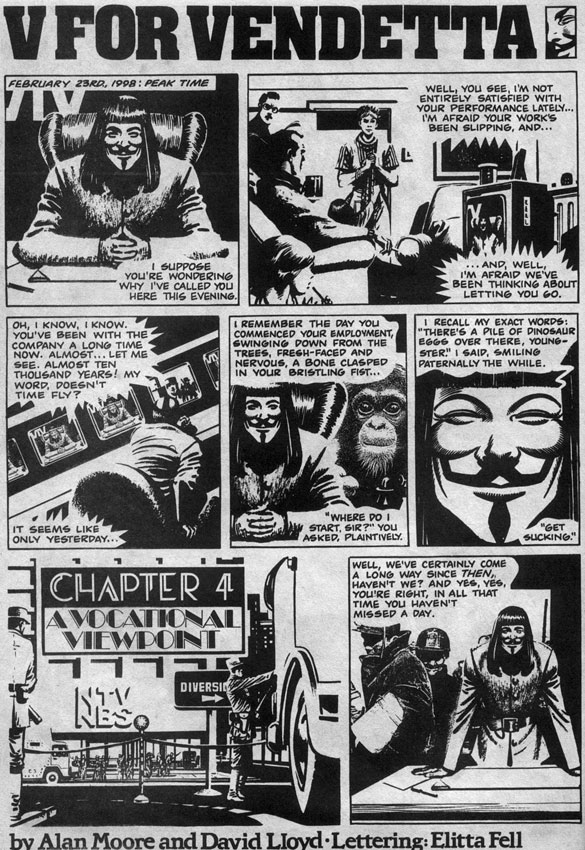
My other favorite is a sequence showing V speaking over a pirate broadcast to the audience of a fascist "news" program. As he speaks, the screen shows scenes of human misbehavior, some straight to the point, some ironic. It's more Jonathon Swift than Orwell-- it's Alan Moore, actually, and it might be the kind of literature you can only pull off in a comic, giving you time to consider the justapostion of word and image. It's the kind of dark laughter Twain used to pull off in The War Prayer and Letters from the Earth, and the kind of thing I don't ask anyone but myself to laugh at, but you might:
Good evening, London. I thought it time we had a little talk. Are you sitting comfortably? Then I'll begin... I suppose you're wondering why I've called you here this evening. Well, you see, I'm not entirely satisfied with your performance lately... I'm afraid your work's been slipping and... and well, I'm afraid we've been thinking about letting you go.
 Oh, I know, I know. You've been with the company a long time now. Almost... let me see. Almost ten thousand years! My word, doesn't time fly? It seems like only yesterday... I remember the day you commenced your employment, swinging down from the trees, fresh-faced and nervous, a bone clasped in your bristling fist... "Where do I start, sir?", you asked, plaintively. I recalled my exact words: "There's a pile of dinosaur eggs over there, youngster", I said, smiling paternally all the while. "Get sucking".
Well, we've certainly come a long way since then, haven't we? And yes, yes, you're right, in all that time you haven't missed a day. Well done, thou good and faithful servant.
Also, please don't think I've forgotten about your outstanding service record, or about all of the invaluable contributions that you've made to the company... Fire, the wheel, agriculture... It's an impressive list, old-timer. A jolly impressive list. Don't get me wrong. But... well, to be frank, we've had our problems too.
There's no getting away from it. Do you know what I think a lot of it stems from? I'll tell you... It's your basic unwillingness to get on in the company. You don't seem to want to face up to any real responibility. To be your own boss.
Lord knows you've been given plenty of opportunities... We've offered you promotion time and time again, and each time you've turned us down. "I couldn't handle the work, Guv'Nor", you wheedled. "I know my place".
To be frank, you're not trying, are you? You see, you've been standing still for far too long, and its starting to show in your work... And, I might add, in your general standard of behavior. The constant bickering on the factory floor has not escaped my attention... nor the recent bouts of rowdiness in the staff canteen.
Then of course there's... Hmm. Well, I didn't really want to have to bring this up, but... Well, you see, I've been hearing some disturbing rumors about your personal life. No, never you mind who told me. No names, no pack drill... I understand you are unable to get on with your spouse. I hear that you argue. I am told that you shout. Violence has been mentioned. I am reliably informed that you always hurt the one your love... the one you shouldn't hurt at all.
And what about the children, its always the children who suffer, as you're well aware. Poor little mites. What are they to make of it? What are they to make of all your bullying, your despair, your cowardice and all your fondly nurtured bigotries? Really, its not good enough, is it?
And its no good blaming the drop in work standards on and management either... though to be sure, the management is very bad. In fact, let us not mince words... The Management is terrible!
We've had a string of embezzelers, frauds, liars and lunatics making a string of catastrophic decisions. This is plain fact. But who elected them?
It was you! You who elected these people! You who gave them the power to make your decisions for you! While I'll admit that anyone can make a mistake once, to go on making the same lethal errors century after century seems to me nothing short of deliberate.
You have encouraged these malicious incompetents, who have made your working life a shambles. You have accepted without question their senseless orders. You have allowed them to fill your workspace with dangerous and unproven machines.
You could have stopped them. All you had to say was "No". You have no spine. You have no pride. You are no longer an asset to the company.
I will, however, be generous. You will be granted two years to show me some improvement in your work. If at the end of that time you are still unwilling to make a go of it... you're fired.
That will be all. You may return to your labors.
(Alan Moore, V for Vendetta)
"It was believed afterward that the man was a lunatic, because there was no sense in what he said." (Twain)
The character of Valerie answers the question "Why we fight" in Alan Moore and David Lloyd's V for Vendetta, dramatized here:
If Valerie is the heart of the thing, my other favorite scene never appeared in the film -- a film Alan Moore sniffed at as "a thwarted and frustrated and largely impotent American liberal fantasy of someone with American liberal values standing up against a state run by neoconservatives— which is not what the comic V for Vendetta was about."
My other favorite is a sequence showing V speaking over a pirate broadcast to the audience of a fascist "news" program. As he speaks, the screen shows scenes of human misbehavior, some straight to the point, some ironic. It's more Jonathon Swift than Orwell-- it's Alan Moore, actually, and it might be the kind of literature you can only pull off in a comic, giving you time to consider the justapostion of word and image. It's the kind of dark laughter Twain used to pull off in The War Prayer and Letters from the Earth, and the kind of thing I don't ask anyone but myself to laugh at, but you might:
Good evening, London. I thought it time we had a little talk. Are you sitting comfortably? Then I'll begin... I suppose you're wondering why I've called you here this evening. Well, you see, I'm not entirely satisfied with your performance lately... I'm afraid your work's been slipping and... and well, I'm afraid we've been thinking about letting you go.
Oh, I know, I know. You've been with the company a long time now. Almost... let me see. Almost ten thousand years! My word, doesn't time fly? It seems like only yesterday... I remember the day you commenced your employment, swinging down from the trees, fresh-faced and nervous, a bone clasped in your bristling fist... "Where do I start, sir?", you asked, plaintively. I recalled my exact words: "There's a pile of dinosaur eggs over there, youngster", I said, smiling paternally all the while. "Get sucking". Well, we've certainly come a long way since then, haven't we? And yes, yes, you're right, in all that time you haven't missed a day. Well done, thou good and faithful servant.
Also, please don't think I've forgotten about your outstanding service record, or about all of the invaluable contributions that you've made to the company... Fire, the wheel, agriculture... It's an impressive list, old-timer. A jolly impressive list. Don't get me wrong. But... well, to be frank, we've had our problems too.
There's no getting away from it. Do you know what I think a lot of it stems from? I'll tell you... It's your basic unwillingness to get on in the company. You don't seem to want to face up to any real responibility. To be your own boss.
Lord knows you've been given plenty of opportunities... We've offered you promotion time and time again, and each time you've turned us down. "I couldn't handle the work, Guv'Nor", you wheedled. "I know my place".
To be frank, you're not trying, are you? You see, you've been standing still for far too long, and its starting to show in your work... And, I might add, in your general standard of behavior. The constant bickering on the factory floor has not escaped my attention... nor the recent bouts of rowdiness in the staff canteen.
Then of course there's... Hmm. Well, I didn't really want to have to bring this up, but... Well, you see, I've been hearing some disturbing rumors about your personal life. No, never you mind who told me. No names, no pack drill... I understand you are unable to get on with your spouse. I hear that you argue. I am told that you shout. Violence has been mentioned. I am reliably informed that you always hurt the one your love... the one you shouldn't hurt at all.
And what about the children, its always the children who suffer, as you're well aware. Poor little mites. What are they to make of it? What are they to make of all your bullying, your despair, your cowardice and all your fondly nurtured bigotries? Really, its not good enough, is it?
And its no good blaming the drop in work standards on and management either... though to be sure, the management is very bad. In fact, let us not mince words... The Management is terrible!
We've had a string of embezzelers, frauds, liars and lunatics making a string of catastrophic decisions. This is plain fact. But who elected them?
It was you! You who elected these people! You who gave them the power to make your decisions for you! While I'll admit that anyone can make a mistake once, to go on making the same lethal errors century after century seems to me nothing short of deliberate.
You have encouraged these malicious incompetents, who have made your working life a shambles. You have accepted without question their senseless orders. You have allowed them to fill your workspace with dangerous and unproven machines.
You could have stopped them. All you had to say was "No". You have no spine. You have no pride. You are no longer an asset to the company.
I will, however, be generous. You will be granted two years to show me some improvement in your work. If at the end of that time you are still unwilling to make a go of it... you're fired.
That will be all. You may return to your labors.
(Alan Moore, V for Vendetta)
"It was believed afterward that the man was a lunatic, because there was no sense in what he said." (Twain)
Subscribe to:
Posts (Atom)