Showing posts with label political philosophy. Show all posts

Commonplace Book: Readings, August 2011


“The plague of publishing these days is to mistake ubiquity for significance.”
-- Arts and Letters Daily and Alexander Nazaryan on Knotted: How the Necktie Changed the World. and other such titles

***
“I was turning 40 and thinking, Oh dear, I'm probably going to have one of those midlife crisis things which always just bore the hell out of everybody. So it would probably be better if, rather than just having a midlife crisis, I just went completely screaming mad and declared myself to be a magician. That would, at least, be more colorful. So, I announced, on the night of my 40th birthday party — probably after more beers than I should have had — that, ''from this point on, I'm going to become a magician.'' And then the next morning you have to think, Oh, what have I said now? Are we going to have to go through with this? So I had to go about finding out what a magician was and what they did.
.... The mystics all seem to want to go straight to the Godhead; the magicians tend to be more curious. They want to explore all of the other aspects of the universe. For me, there is very little difference between magic and art. To me, the ultimate act of magic is to create something from nothing: It's like when the stage magician pulls the rabbit from the hat. And then you can turn that idea into a film, a book, a painting, a piece of music, something that other people can experience. That in itself is stunning. And I suppose this is one of the reasons I got into magic, because I was tired of ducking that question that people always ask writers, which is, '’Where do you get your ideas from?’''

-- Alan Moore

***
“my family use to go see him [“Macho Man” Randy Savage] in his early career at hazard ky. my aunt loved leaping lenny. they wrested one time and the loser had to painted yellow.of couse macho man won.my aunt jumped up and ran to the ring.she was half way under the bottom ring where lenny was laying so she grabbed hold of him.she was calling macho names.he said come on old woman.she ended up with yellow paint all over her and two police officers had her by the legs trying to pull her out of the ring. everybody there was dying laughing at her. she almost went to jail, but macho man talked to the police to keep her from going to jail, so he was a good man.”
-- comment by msireta on news of Randy (Poffo) Savage’s death by natural causes

***
“Just by virtue of walking into a theater to see a movie called Transformers, I'm fully agreeing with just dispensing with a the laws of physics and accepting that nobody can tell which $200,000 car is a Transformer, for the same reason that James Bond is a secret agent who tells everyone his full name and drives around in the flashiest car he can. The problem is that it doesn't stop there. The movie brings things up as major plot points that are immediately contradicted, and even the internal logic of a movie about giant robots from space isn't consistent. ... You can make every allowance for it, you can talk about how it's about giant robots so it doesn't have to have logic or how it's for kids and they're dumb anyway, and you're still left with the core problem. Nothing makes sense, even from one scene to the next, and everyone's an asshole, so there's no reason to be interested or to care who lives or who dies.”

-- Chris Sims

***


Guillermo del Toro: In the next 10 years, we're going to see all the forms of entertainment—film, television, video, games, and print—melding into a single-platform "story engine." The Model T of this new platform is the PS3. The moment you connect creative output with a public story engine, a narrative can continue over a period of months or years. It's going to rewrite the rules of fiction.

Wired: It sounds like you're talking about an entirely new form of storytelling.
Guillermo del Toro:Think about the way oral tradition became written word—how what we know about Achilles was written many, many years after it made its way around the world with different names and different types of heroes. That can happen when you allow content to keep propagating itself through different kinds of platforms and engines—when you permit it to be retold with a promiscuous form of mythology. You see it when people create their own avatars in games and transfigure their game worlds.

Wired: How is that interactivity going to change Hollywood—and the way directors like you make movies?
Guillermo del Toro: [Legendary B-movie producer] Samuel Arkoff once told me there are only 10 great stories. That's where the engine and promiscuity come in. Hollywood thinks art is like Latin in the Middle Ages—only a few should know it, only a few should speak it. I don't think so.

-- Guillermo del Toro in Wired

***


“Many parts of sub-Saharan Africa are a libertarian's paradise. The region as a whole is a low-tax utopia....Rather than unleashing entrepreneurship, this low rate of taxation means that basic public services like health, education, and pothole filling are starved of funding. The physical infrastructure on which a modern economy rests like roads, courts and the police are missing....people are free to protect their own families, and indeed they are forced to.”

-- Francis Fukuyama, The Origins of Political Order

Francis Fukuyama Discovers the Limits of Francis Fukuyama

Francis Fukayama came late to the party. Still, the Lord loves a prodigal, no matter his rolling in the mud with neo-conservatives before he got here:
"What was truly troubling, however, was that the collapse undermined the fundamental moral justification for material inequality in a politically egalitarian society. Basic to the legitimacy of market capitalism is the efficient market hypothesis—that is, the notion that in a truly competitive market everyone earns something close to his or her “social” rate of return. This means, in other words, that if your investment banker earns 100,000 times as much as your plumber, it’s because he or she is contributing roughly 100,000 times as much to society’s total pool of wealth.
The crisis made it glaringly obvious that the efficient market hypothesis was wrong: Oversized returns were flowing to innovative financial entrepreneurs who, in their avidity to create new and more complex financial instruments and products, were destroying rather than creating value for society as a whole."


No shit, Sherlock.

Let me get this straight; it took two wars and an economic collapse for a tenured professor to realize what my sharecropping ancestors knew in their bones?
(Link) View more John Mc Clane Sound Clips and Bruce Willis Sound Clips
Francis Fukuyama is the fellow who announced "The End of History" in 1989, after Russia lost the Cold War. This made him a lot of friends among fans of Ronald Reagan. He later explained that what he really meant was an end to interpreting history as having a goal, as Hegel, Marx and apocalyptic Christians do.
I could almost buy his equivocation, but Fukuyama's inner Pangloss never knows when to shut up: "... while earlier forms of government were characterized by grave defects and irrationalities that led to their eventual collapse, liberal democracy was arguably free from such fundamental internal contradictions." Say wha--? Democracy (or republicanism, if you prefer Latin to Greek) is chock-full of "fundamental internal contradictions"-- that's why Lincoln warned that democracies are inclined to self-destruction; why Churchill called democracy the worst except for all the others. You're a hard man indeed if you can see the dead at Fredericksburg or Wounded Knee as nothing more than a perfect system correcting itself. Call me Manichean, but I still see history as a struggle between forces of creation and destruction, Thanatos and Eros. It only takes a moment for a soldier to kill Archimedes.


I am not calling for F.F. to start wearing an IWW shirt and become a neo-socialist. I just want him to discover that there might be a reason the left feels pissed off and pissed on. And this does give me another excuse to assign the reading of Kipling's "Gods of the Copybook Headings", despite its misuse by the odious Beck, unable to recognize himself in its warnings.

I would not bother with this if Francis were just another Wanker Like Me with a blog. But this guy is a paid lecturer in the if-you-have-to-ask-you-can't-afford-it range. Francis Fukuyama has made a spectacular career out of being wrong, but being wrong in a way that flatters the masters of our world.
I'm all in favor of being wrong and making grand barroom pronouncements-- as a storyteller and a reader, I embrace six impossible things before breakfast, hoping to unearth those poetic truths that "burn like cold iron", as Lewis said of Tolkein. We bohemians (cough slackers cough) are, after all the secret legislators of the world. But when I wear a history teacher's hat, I have to answer "I don't know" a dozen times a day, puzzling innocents who think a mastery of trivia and telling anecdote is the same as knowing "everything", then try to turn the things I don't know into a problem for them, like a cat giving kittens a crippled mouse to bat around. But my foibles don't end in a body count, as Fukuyama's did when he signed William Kristol's letter urging regime change in Iraq.

It may be that a repentant Francis is trying to find his way home, to move the bead of isn't-it-pretty-to-think-so a bit closer to what is. He's just about the only neoconservative I can stand to read without gagging, certainly the only one capable of conceding that he might be wrong, and any sign of enlightenment is to be cherished-- for this thy brother was lost, and is found. So, my turn to make a pronouncement, though the thoughts of Francis Fukuyama are worth 100,000 of mine, and it's a truism the ancient Chu Yuan knew in his drowned bones: No courtier ever went broke by telling the bosses what they want to hear.

The Democrats Deserve to Lose

Yes, I'm in that kind of a radical mood tonight, after a day of striving against ignorance. The Democrats are about to turn our country over to the Ratfuckers (who, as Yeats warned, are filled with a passionate intensity)... and worst of all, the Democrats deserve to lose. They spent two years trying to accommodate people who want to see us dead, somehow believing that right-wingers will one day compromise. The Obama administration tried to please everyone and ended by pleasing no one.

A wise punk rocker once said, "The Nazis used to say 'when I hear the word culture, I reach for my gun.' The trouble with a liberal is that when someone mentions guns, he reaches for his culture." Let us call ourselves radicals, let us pick up the mantle of the great Progressives, let us be petit-bourgeois anarchists, but please let us not be "liberals" any longer, who have confirmed themselves as callow wankers who cringe and waffle if only the bullies will leave them alone. We do not abandon this word to the dust-bin of history because of its debasement by the right, but we scorn the word 'liberal' because of it's debasement by the left. Imagine Harry Truman or Harvey Milk or Tony Benn in the same situations as Reid and Pelosi and you'll see what I mean.

I have spent almost 20 years in an incremental effort to make children a little less mean, a little more curious, a little less bullying, cannier about con-men, broader-minded, more willing to be themselves and allow others to do the same, less willing to settle for the world as it is-- and if right wingers do everything they can to drag us back to 1905*, well, that's to be expected-- but it's been 20 years without any help from "liberal" academics. They are mostly accomplished at "deploring conditions", something done from a distance and at a higher salary.

* [ 1905 is an arbitrary point chosen as the year before the Pure Food and Drug Act was passed, child labor was still en vogue, Plessy v. Ferguson was de rigeur, Harper's Weekly was calling Governor Altgeld a Communist and apparently, Reagan Republicans think they would have been as happy as pigs in shit.]

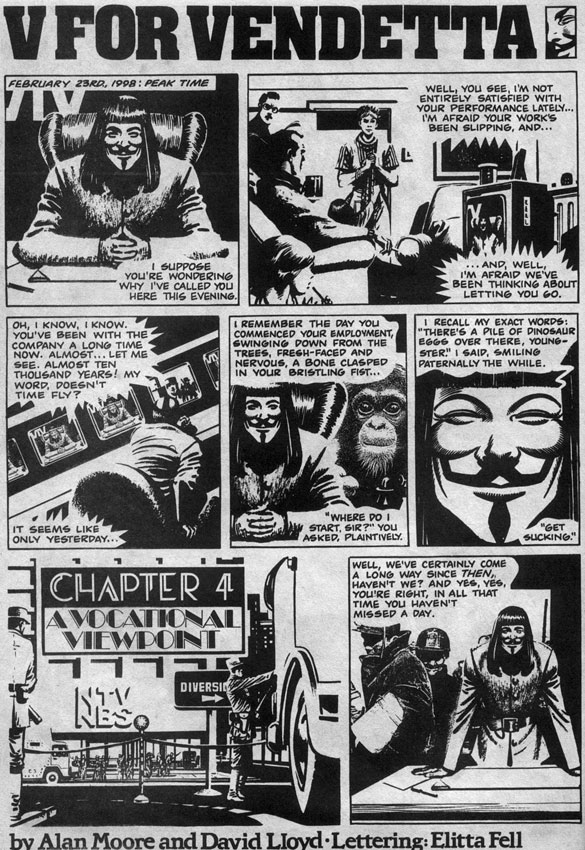
Attached please find (again) my favorite monologues from Alan Moore's V for Vendetta. The second monologue, in which he warns the human race that if their performance doesn't improve, he's going to have to let them go...

"It seems strange that my life should end in such a terrible place, but for three years I had roses and apologized to no one."


The character of Valerie answers the question "Why we fight" in Alan Moore and David Lloyd's V for Vendetta, dramatized here:


If Valerie is the heart of the thing, my other favorite scene never appeared in the film -- a film Alan Moore sniffed at as "a thwarted and frustrated and largely impotent American liberal fantasy of someone with American liberal values standing up against a state run by neoconservatives— which is not what the comic V for Vendetta was about."

My other favorite is a sequence showing V speaking over a pirate broadcast to the audience of a fascist "news" program. As he speaks, the screen shows scenes of human misbehavior, some straight to the point, some ironic. It's more Jonathon Swift than Orwell-- it's Alan Moore, actually, and it might be the kind of literature you can only pull off in a comic, giving you time to consider the justapostion of word and image. It's the kind of dark laughter Twain used to pull off in The War Prayer and Letters from the Earth, and the kind of thing I don't ask anyone but myself to laugh at, but you might:

Good evening, London. I thought it time we had a little talk. Are you sitting comfortably? Then I'll begin... I suppose you're wondering why I've called you here this evening. Well, you see, I'm not entirely satisfied with your performance lately... I'm afraid your work's been slipping and... and well, I'm afraid we've been thinking about letting you go.
Oh, I know, I know. You've been with the company a long time now. Almost... let me see. Almost ten thousand years! My word, doesn't time fly? It seems like only yesterday... I remember the day you commenced your employment, swinging down from the trees, fresh-faced and nervous, a bone clasped in your bristling fist... "Where do I start, sir?", you asked, plaintively. I recalled my exact words: "There's a pile of dinosaur eggs over there, youngster", I said, smiling paternally all the while. "Get sucking".
Well, we've certainly come a long way since then, haven't we? And yes, yes, you're right, in all that time you haven't missed a day. Well done, thou good and faithful servant.
Also, please don't think I've forgotten about your outstanding service record, or about all of the invaluable contributions that you've made to the company... Fire, the wheel, agriculture... It's an impressive list, old-timer. A jolly impressive list. Don't get me wrong. But... well, to be frank, we've had our problems too.
There's no getting away from it. Do you know what I think a lot of it stems from? I'll tell you... It's your basic unwillingness to get on in the company. You don't seem to want to face up to any real responibility. To be your own boss.
Lord knows you've been given plenty of opportunities... We've offered you promotion time and time again, and each time you've turned us down. "I couldn't handle the work, Guv'Nor", you wheedled. "I know my place".
To be frank, you're not trying, are you? You see, you've been standing still for far too long, and its starting to show in your work... And, I might add, in your general standard of behavior. The constant bickering on the factory floor has not escaped my attention... nor the recent bouts of rowdiness in the staff canteen.
Then of course there's... Hmm. Well, I didn't really want to have to bring this up, but... Well, you see, I've been hearing some disturbing rumors about your personal life. No, never you mind who told me. No names, no pack drill... I understand you are unable to get on with your spouse. I hear that you argue. I am told that you shout. Violence has been mentioned. I am reliably informed that you always hurt the one your love... the one you shouldn't hurt at all.
And what about the children, its always the children who suffer, as you're well aware. Poor little mites. What are they to make of it? What are they to make of all your bullying, your despair, your cowardice and all your fondly nurtured bigotries? Really, its not good enough, is it?
And its no good blaming the drop in work standards on and management either... though to be sure, the management is very bad. In fact, let us not mince words... The Management is terrible!
We've had a string of embezzelers, frauds, liars and lunatics making a string of catastrophic decisions. This is plain fact. But who elected them?
It was you! You who elected these people! You who gave them the power to make your decisions for you! While I'll admit that anyone can make a mistake once, to go on making the same lethal errors century after century seems to me nothing short of deliberate.
You have encouraged these malicious incompetents, who have made your working life a shambles. You have accepted without question their senseless orders. You have allowed them to fill your workspace with dangerous and unproven machines.
You could have stopped them. All you had to say was "No". You have no spine. You have no pride. You are no longer an asset to the company.
I will, however, be generous. You will be granted two years to show me some improvement in your work. If at the end of that time you are still unwilling to make a go of it... you're fired.
That will be all. You may return to your labors.

(Alan Moore, V for Vendetta)


"It was believed afterward that the man was a lunatic, because there was no sense in what he said." (Twain)

Commonplace Book of Quotations, August 2010

"I find film in its modern form to be quite bullying. It spoon-feeds us, which has the effect of watering down our collective cultural imagination. It is as if we are freshly hatched birds looking up with our mouths open waiting for Hollywood to feed us more regurgitated worms. The 'Watchmen' film sounds like more regurgitated worms. I for one am sick of worms. Can't we get something else? Perhaps some takeout? Even Chinese worms would be a nice change."
(Alan Moore)

“If you are superman, let me be forever animal.”
(artist and occultist Austin Spare in a 1936 letter to Adolf Hitler, responding to Hitler’s request that Spare paint Hitler’s portrait)

“A GREETING FROM THE NINETEENTH TO THE TWENTIETH CENTURY.
I bring you the stately nation named Christendom, returning, bedraggled, besmirched, and dishonored, from pirate raids in Kiao-Chou, Manchuria, South Africa, and the Philippines, with her soul full of meanness, her pocket full of boodle, and her mouth full of pious hypocrisies. Give her soap and towel, but hide the looking-glass.”
(Mark Twain, New Years, 1900)

“As a (semi-) reformed fanboy myself, you’d think I’d be celebrating... yet I find this rise to dominance both confusing and ironic, no more so than when fanboys shout down opposition to something they collectively adore. .. Not only is this wrongheaded, it’s the exact opposite of the fanboy ethos.... You loved what you loved, in part, because it spoke directly to you, and in part because most other people didn’t feel the same way... [and] if there is one thing the Internet is good for, it’s bringing together like-minded people, then convincing them that their opinion is the only valid one in existence. Psychologists call this “group polarization,” a tendency for people who agree to gather and prod each other toward further extremism. This has long been evident on political blogs, but it’s true in cultural criticism as well...Once the outcast underdogs, fanboys have become the new bullies.”
(Adam Sternberg in New York


“Charlemagne [columnist for The Economist, not the Holy Roman Emperor] doesn't always work for me, but he did this week, boy howdy. (I've never used that phrase before; I'm trying it out.) His column focuses on explaining something that Americans probably don't fully grasp, which is that Europe's tendency towards limiting the work week and lowering the retirement age came not out of laziness or me-me-meism, but from a general belief that these were the goals of a civilized society when they had escaped the basics of food/shelter problems for a large enough group. Throw a hand to the unfortunate, and try to get to a place where most people didn't have to work crazy hours. Take longer vacations. Chill the fuck out. It's a solid piece of wistful writing, even when it smacks of a little bit of blind optimism.”
(Tucker Stone)

“The reason that Europeans struggle to accept the need to work more, and get less from the state is that it seems to signal an abrupt reversal of the decades-long advance towards an ever-more civilised society: in short, the end of progress..... By progressively shrinking the number of hours worked a week, or years worked over a lifetime, society seemed to be rolling towards some sort of ideal, with vin rosé and deckchairs on the beach for all. This fits France’s sense of secular, revolutionary History, carrying the country forward, however fitfully, like an “endless cortege proceeding towards the light”, in the words of Jules Ferry, a 19th-century educationalist. Even President Nicolas Sarkozy, usually averse to abstract nouns, has spoken of “the politics of civilisation” and asked economists to measure output in terms of happiness, not just growth.
Put simply, if Europe stands for something, it is decent treatment for all. To this way of thinking, to guarantee a comfortable retirement is akin to banning child labour or giving women the vote: not optional perks, but badges of a civilised society. Such social preferences are what Europe is for, and what makes it different from America. Europe may no longer be a global power, or have much military muscle. Its churches may be empty, its spiritual fibre weak. It may not boast much cutting-edge innovation or economic growth. But it knows how to look after its sick and elderly, take a long lunch break and abandon the office in August. The cold realisation that time is up, and that such progress is over, prompts anger, denial and shock.”
(“Charlemagne” in The Economist)

“The difference between actors and comedians is that actors are symmetrical, physically, and comedians are lopsided.”
(Martin Brown)

“The human form, with its endless racial and genetic variations, is only one template for beauty which suffers from the changing tastes of passing eras - our views on horses and orchids have remained relatively static.” (Jay Stebly on the article “The Phenomenology of Ugly)

Smile or Die


Through a friend of my friend Shannon McRae, this wonderful animation of Barabara Ehrenreich's explication of the Happy People...
I suppose my first encounter with the Happy People would have been in the 1970s. There had been experiments like the attempt to levitate the Pentagon, or my friend Tom's Whole Earth theories about mucus, but these thought experiments harmed no one and made great theater; most of us still understood the difference between reality and make believe.
By 1976, the year Tom Wolfe published "The Me Decade", there was real money changing hands for the power of positive thinking. I knew some Erhard Seminar Training graduates intimately, and learned that my skepticism was not just a buzzkill, but a hindrance to any progress. I nodded and demurred while a honest-to-stereotype yuppie complained that his mother's cancer was "her own damn fault". She had given herself cancer-- not by cigarettes or swimming in chemicals, but by bad, cancer-causing thoughts.
I dodged repeated invitations to attend an est seminar, and instead went looking for Chicago theater while my girlfriend spent her money becoming more "real"-- ironic phrase, now that I think of it. I'm not bitter about never getting real with Werner Erhard; instead I attended a performance by the Japanese Grand Kabuki its own self.
Here Ehrenreich points out that the "think and grow rich" con doesn't just take foolish people's money anymore; it now contributes to our collective delusion. Hell, it's one of the building blocks.

From Peasant to Yeoman to Peasant Again, in Three Generations

“We’re becoming peasants again. Most of us. There’s the money people and the people around them, and then there’s you. But the rest of us, we’re peasants.” (A character in Adam Haslett’s short story “Night Walk”)

As the Man with No Name told Tuco, “there's two kinds of people, my friend: those with loaded guns and those who dig. You dig." If Great-Granda couldn’t afford the suit of armor, or wasn’t ruthless enough to take it by force, you probably belong to a peasant family. Sharecropper grandparents, in my case, first generation to go to college.

Most of us were peasants, peons (a painfully acute sobriquet), and then the Black Death killed so many of us that our labor had to be paid for, and some of the peasants became yeomen, and things got marginally better. We were no longer subject to the random cruelty of the baron’s bastard sons or the droit de seigneur , and even a cat could look at a king. Small scale, the craftsman selling shoes or ironware, started lifting us out of peasantry.

By the time Adam Smith noticed the phenomenon, religious dissenters from the Church of England-- unable to send their sons to the posh Oxford and Cambridge—started technical schools. The new technologies made their children better skilled and more valuable than any spare aristocrat. The stout yeoman bought respectability by marrying aristocrats, as sure as Jenny Jerome’s American father married her off (with substantial dowry) to Lord Randolph Churchill.

A specter was haunting capitalism— not the specter of communism, though that would have its day as a way for the more rapacious peasants, like Stalin and Mao, to prey upon their own kind. No, this was the specter of the corporation: a moneyed collective that will prove every bit as destructive to our species as Mao and Stalin’s collective farms were to the individual.

These business cooperatives-- call them “corporations”-- are mercantile guilds gone mad. Corporation is to small businessman as labor union is to laborer. It seems an obvious corollary-- but instead, corporations paint themselves as defenders of individual liberty, while the labor union-- defender of a peasants’ fair share of profit and health-- is a tyrannical, slovenly mob. And the peasants ate it up, repeated it among themselves, voted against their own self-interest. If the corporate paradigm said shit was sugar, then crackers would be asking for a spoon.

Remember Heinlein's novel Friday in which corporations replaced the nation-states, even waged war on one another? I remember shaking my head at how far out the old man had become, almost as goofy as that time he predicted a religious dictatorship scrapping the Constitution of the United States.

Now I’m wondering if the modern corporation and the Corporate Man signal a return to the days of the pyramid builders. They’re all very proud of the culture that they’ve built, a cathedral built for no god but Mammon. Humans don’t like admitting they’re being played for a sucker, so the pyramid builder, he who sells his labor to a corporation, romanticizes his raison de’etre like a man romanticizes his mistress.

V for Valerie, V for Vendetta

"It seems strange that my life should end in such a terrible place, but for three years I had roses and apologized to no one."


The character of Valerie answers the question "Why we fight" in Alan Moore and David Lloyd's V for Vendetta, dramatized here:


If Valerie is the heart of the thing, my other favorite scene never appeared in the film -- a film Alan Moore sniffed at as "a thwarted and frustrated and largely impotent American liberal fantasy of someone with American liberal values standing up against a state run by neoconservatives— which is not what the comic V for Vendetta was about."

My other favorite is a sequence showing V speaking over a pirate broadcast to the audience of a fascist "news" program. As he speaks, the screen shows scenes of human misbehavior, some straight to the point, some ironic. It's more Jonathon Swift than Orwell-- it's Alan Moore, actually, and it might be the kind of literature you can only pull off in a comic, giving you time to consider the justapostion of word and image. It's the kind of dark laughter Twain used to pull off in The War Prayer and Letters from the Earth, and the kind of thing I don't ask anyone but myself to laugh at, but you might:

Good evening, London. I thought it time we had a little talk. Are you sitting comfortably? Then I'll begin... I suppose you're wondering why I've called you here this evening. Well, you see, I'm not entirely satisfied with your performance lately... I'm afraid your work's been slipping and... and well, I'm afraid we've been thinking about letting you go.
Oh, I know, I know. You've been with the company a long time now. Almost... let me see. Almost ten thousand years! My word, doesn't time fly? It seems like only yesterday... I remember the day you commenced your employment, swinging down from the trees, fresh-faced and nervous, a bone clasped in your bristling fist... "Where do I start, sir?", you asked, plaintively. I recalled my exact words: "There's a pile of dinosaur eggs over there, youngster", I said, smiling paternally all the while. "Get sucking".
Well, we've certainly come a long way since then, haven't we? And yes, yes, you're right, in all that time you haven't missed a day. Well done, thou good and faithful servant.
Also, please don't think I've forgotten about your outstanding service record, or about all of the invaluable contributions that you've made to the company... Fire, the wheel, agriculture... It's an impressive list, old-timer. A jolly impressive list. Don't get me wrong. But... well, to be frank, we've had our problems too.
There's no getting away from it. Do you know what I think a lot of it stems from? I'll tell you... It's your basic unwillingness to get on in the company. You don't seem to want to face up to any real responibility. To be your own boss.
Lord knows you've been given plenty of opportunities... We've offered you promotion time and time again, and each time you've turned us down. "I couldn't handle the work, Guv'Nor", you wheedled. "I know my place".
To be frank, you're not trying, are you? You see, you've been standing still for far too long, and its starting to show in your work... And, I might add, in your general standard of behavior. The constant bickering on the factory floor has not escaped my attention... nor the recent bouts of rowdiness in the staff canteen.
Then of course there's... Hmm. Well, I didn't really want to have to bring this up, but... Well, you see, I've been hearing some disturbing rumors about your personal life. No, never you mind who told me. No names, no pack drill... I understand you are unable to get on with your spouse. I hear that you argue. I am told that you shout. Violence has been mentioned. I am reliably informed that you always hurt the one your love... the one you shouldn't hurt at all.
And what about the children, its always the children who suffer, as you're well aware. Poor little mites. What are they to make of it? What are they to make of all your bullying, your despair, your cowardice and all your fondly nurtured bigotries? Really, its not good enough, is it?
And its no good blaming the drop in work standards on and management either... though to be sure, the management is very bad. In fact, let us not mince words... The Management is terrible!
We've had a string of embezzelers, frauds, liars and lunatics making a string of catastrophic decisions. This is plain fact. But who elected them?
It was you! You who elected these people! You who gave them the power to make your decisions for you! While I'll admit that anyone can make a mistake once, to go on making the same lethal errors century after century seems to me nothing short of deliberate.
You have encouraged these malicious incompetents, who have made your working life a shambles. You have accepted without question their senseless orders. You have allowed them to fill your workspace with dangerous and unproven machines.
You could have stopped them. All you had to say was "No". You have no spine. You have no pride. You are no longer an asset to the company.
I will, however, be generous. You will be granted two years to show me some improvement in your work. If at the end of that time you are still unwilling to make a go of it... you're fired.
That will be all. You may return to your labors.

(Alan Moore, V for Vendetta)


"It was believed afterward that the man was a lunatic, because there was no sense in what he said." (Twain)

Commonplace Book of Readings, July 2009

“There are some people with a vested interest in the world as it is, because that’s the world they have power over.” -- Alan Moore
***
“People who read Empire of the Sun have often said to me, ‘What a strange life, how unusual,’ and I say to them, actually, the life I led in Shanghai before and during the Second World War was not strange; it wasn’t unusual. The majority of the people on this planet today and for most of this century and previous centuries have always lived lives much closer to the way I lived than to, say, the comfortable suburbs of Western Europe and North America. It is here where I live today that is very strange by the world’s standards. Civil war, famine, flood, drought, poverty, disease are the norms of human experience.” -- J.G. Ballard in a BBC interview.
***
“Conservatives are only funny when they don’t mean to be. How many fucking times do we have to say this?”
-- Comment by “Aquannissiwamissoo” on Wonkette
***

“This reflection on another girl’s morality is interesting, because however much our heroine revels in her naughtiness—and she does revel—she is at pains to tell us that she is not promiscuous like the other girls. Even in this genre, which is almost explicitly about how we shouldn’t judge the naked girl on the stage, we find the same judgment, the same innate, catty, female dividing of the world into sluts and non-sluts, that takes place in the rest of the world.” – Katie Roiphe on stripper’s memoirs in Double-X
***
“Popular artists, then faced with the corporate control of the popular media, have a choice: like Harvey Pekar, they can say exactly what they think about the times in which we live and thus remain at the margins of culture, at best only a cult figure, or, like Letterman, they can swallow their reservations and move to the spot-lit center of the culture, while remaining at the margins of the discourse about what is really going on.”
-- James Hynes, In These Times
***
“I had, by then, abandoned all pretence of work… I could not write or even, by that time, read. Words made no sense to me. I made no sense to me so how could I make sense to anyone else? If journalism is about anything, it is about making sense of the world in which we live. Words, sense, the very reason that kept me moored and anchored to the world had abandoned me. I was lost and that loss was catastrophic. Who are you when you are no longer who you are? What do you do with a self that is no longer your self? If you don’t know who you are, how do you go on living? If you cannot live as yourself, who and what is it that you are living for?” -- Sally Brampton, Shoot the Damn Dog
***
“You bid me rouse myself. Go, bid a man paralytic in both arms rub them briskly together, and that will cure him. Alas! That I cannot move my arms is my complaint.” – Coleridge, in a letter on writer’s block, 1804.
***
“Just how bad will August be, because of the Republicans and various anti-reform special interest groups? Imagine the Brooks Brothers Riot, but happening every day, across the country, for the entire month. Just health insurance employees being dispatched in plainclothes to town halls, so as to shout nonsense at congressmen and senators trying to inform their constituents about health care reform. CALLING IT NOW: Most obnoxious month in American history! Maybe.” – Wonkette, week of August 1st, 2009
***
“The experience of the poor… comes to resemble that of a rat in a cage scrambling to avoid erratically administered electric shocks.” – Barbara Ehrenreich
***
“It’s the sinking sensation that the American game is rigged — that, as the president typically put it a month after his inauguration, the system is in hock to “the interests of powerful lobbyists or the wealthiest few” who have “run Washington far too long.” …. What disturbs Americans of all ideological persuasions is the fear that almost everything, not just government, is fixed or manipulated by some powerful hidden hand, from commercial transactions as trivial as the sales of prime concert tickets to cultural forces as pervasive as the news media. It’s a cynicism confirmed almost daily by events.” -- Frank Rich, The New York Times
***
“A growing body of research shows that people with red hair need larger doses of anesthesia and often are resistant to local pain blockers like Novocaine…. Researchers believe redheads are more sensitive to pain because of a mutation in a gene that affects hair color. In people with brown, black and blond hair, the gene, for the melanocortin-1 receptor, produces melanin. But a mutation in the MC1R gene results in the production of a substance called pheomelanin that results in red hair and fair skin. The MC1R gene belongs to a family of receptors that include pain receptors in the brain, and as a result, a mutation in the gene appears to influence the body’s sensitivity to pain. A 2004 study showed that redheads require, on average, about 20 percent more general anesthesia than people with dark hair or blond coloring. And in 2005, researchers found that redheads are more resistant to the effects of local anesthesia, such as the numbing drugs used by dentists. In the latest study, the researchers tested for the MC1R gene variant, finding it in 65 of 67 redheads and in 20 of 77 people with brown or black hair.” – Tara Parker Pope, The New York Times
***
In the political jargon of those days, the word ‘intellectual’ was an insult. It indicated someone who did not understand life and was cut off from the people…. The invasion of Bohemia by the Russian army, whose occupation of the country had affected everything, had been for her a signal of a new life, out of the ordinary. She saw that people who ranked above her (and everyone ranked above her) were being deprived, on the slightest allegation, of their powers, their positions, their jobs, and their bread, and that excited her; she started to denounce people herself.
"So why is she still a gatekeeper? Why wasn't she promoted?"
The mechanic smiled. "She can't count to ten. They can't find another job for her. All they can do is let her go on denouncing people. For her, that's a promotion!" ….
The mechanic leaned over the engine again and said: "In Wenceslaus Square, in Prague, a guy is throwing up. Another guy comes up to him, pulls a long face, shakes his head, and says: 'I know just what you mean.'”
-- Milan Kundera, The Book of Laughter and Forgetting

"I will not be pushed, filed, stamped, indexed, briefed, debriefed or numbered."


The summer I was 11 or 12, Animal World with Bill Burrud was on CBS, and of course I watched that. Immediately after was another summer replacement show, a British series called The Prisoner, created by and starring Patrick McGoohan. And now Pat tells me Patrick McGoohan has died at age 80.
From the opening credits, I was entranced, stolen away to Faery by paranoid elves. I didn't understand half the things that were being said, like a kid overhearing an argument between grown-ups, but The Prisoner crawled into my bones and became part of my soul. Orwell had an intellectual understanding of the modern state in Animal Farm and 1984, but McGoohan understood it intuitively. "If you want a vision of the future, imagine a boot stamping on a human face - forever."
1984 caught that in prose, Animal Farm has the power of fable, but The Prisoner was poetry. And this Winston Smith was an Irishman, a combination of anger and wit that was going to be a lot harder for Them to step on.
Apparently it started with an anecdote about a village populated by retired spies, a community of people who knew too many secrets for the government to ever let them out of its sight. You could tell your more literal minded friends that The Prisoner was a sequel to McGoohan's Danger Man series (Secret Agent over here). What was that line in the Johnny Rivers theme for Secret Agent? They've given you a number, and taken 'way your name.
What if the The Village had a sinister purpose? What if John Drake was taken prisoner, who knows by what side? Whose side was anyone on? An old naturalist Andre Gregory met told him that the modern metropolis was a model for the new concentration camp, where the prisoners police themselves and are very proud of the prison they've built around themselves.

It just occurred to me how often Number Six is a trickster hero, for all the storms of anger and secret agent fisticuffs: situation hopeless, no escape, keeping one step ahead of a crooked house and a sardonic smile that he saved for himself.

Sometimes it was "Invictus" staged by Dali, and sometimes the metaphor was more obvious. A Wild West episode was banned in America because Number Six's refusal to carry a gun might be seen as a rebuke to the war in Vietnam, which tells us more about Americans than it does about The Prisoner. The last episode descended into Magical Mystery Tour indulgence, but what the hell. The damage was already done.
All I knew, God break my bones but never bend me, was which side I was going to be on whenever forced to choose between bully or underdog, between the push-button mentality and the human act. I am not a number; I am a free man. And let them laugh. As Gordon Lightfoot suggested, if we cannot beat the Devil, we can try to give him a few unpleasant memories.

My Political Manifesto , or, "Lookit the Nut Wit' Da Sign!"


The BBC is talking about the death at age 91 of Helen Gavronsky Suzman, apparently the best known Caucasian anti-apartheid activist in South Africa. I've never heard of her before this, but something she said in a recording struck me as so simple and profound that I'd like to attach it to any description of my politics.

It's weird that Americans don't have "politics" the way Europeans do; there's even a bestseller making the rounds about how we vote with our gut and not with our heads. (The thought that our stomachs have a brain almost as powerful as our cerebrum is a scary thought I'll save for a science-fiction story). This is what happens in a culture when schools function as employment agencies for coaches, and you let them teach civics and history as a seat-warming exercise-- before you scoff, I knew at least one high-school librarian who spent his day drawing up football plays.

I was complimented by a French Swiss once and I had to tell him that I really wasn't that smart, but just had the habit (unusual for an American, apparently) of thinking about why I believe what I believe.


Before this, I've been content with Brendan Behan's summary, that I first read at a bar in Chicago: "I have a total irreverence for anything connected with society except that which makes the roads safer, the beer stronger, the food cheaper and the old men and old women warmer in the winter and happier in the summer." This sums up the goals of good government, and implies the need to build a lasting peace (which, despite the chest thumping of warriors, will always be harder to build than war. Emotionally and materially cheaper in the long run, though.)

But there was something missing, that kept this from being a complete political manifesto, at least for me. Behan's phrase tells us what to build, and leaves policy up to us, but doesn't deal with the Problem of Evil, the killer ape within, what Jungians call the Shadow (and for once, I'm not talking about Lamont Cranston). This is the oversight that collapses philosophical anarchism (what do we do with those who won't co-exist peacefully?). James Madison addressed the problem in The Federalist Papers: "If men were angels, no government would be necessary." Our refusal to acknowledge the shadow killed the Sixties just as dead as CIA-sponsored drugs-- the Summer of Love was stabbed to death at Altamont, chopped into pieces by the Manson family, and shoved in a trunk by the Unicorn Killer. What, then, must we do?

I look through my other rule books: Camus, Confucius, Orwell and Paolo Friere, and re-read the political attitudes etched in my bones, in The Once and Future King, Travis McGee and the superheroes, Pogo and Heinlein and Hannah Arendt, Angel and "Rumpole of the Bailey". All these things have shaped my thinking, help me define my moral compass (buy me a Guinness and I'll go on for hours), but there's no simple phase that can fit on a sign and still be understood out of context. Even Travis McGee admits that his own manifesto, a banner embroidered by countless maidens, keeps trailing on the ground and getting stepped on.

Suzman to the rescue this morning, one last note of a grace from a woman I never heard of. Here, then, is the Helen Suzman amendment to the Brendan Behan manifesto. It was a simple answer (with profound implications) to the question of what started her on her long road :

"I hate bullies and I like simple justice."

Bring the Cute: Panda Diplomacy and the Charm Offensive


In a better world of my own design (I’m avoiding the word “utopia”—you see how that worked out for Thomas More) conflicts between nations are resolved by pandas, snow leopards and lemurs. (There are other components to my plan: reseeding the primeval forest from Maryland to the Mississippi, restocking free-range bison from the Mississippi to the Rockies, a guillotine on Madison Avenue as a warning to publicists, and secluding Dick Cheney and his Eurasian counterparts in Death Valley or the Rub' al Khali, where they can fight their own goddamn wars to their hearts content— but hey, it’s Christmas, so in the interests of Peace, I limit myself to the Cute Animal Problem.)

After years of negotiations, China is making a gift of two giant pandas to Taiwan named Tuan Tuan and Yuan Yuan. (Please note that on this blog, we will distinguish from the red panda, Ailurus fulgens.)

This is the first success after ten failed attempts at panda diplomacy between China and Taiwan since 1992. Even their names were problematic-- Taiwan wanted pandas named "Independence" maybe "Friendly Harmony", but "Reunion" and "Unify"--? Fahgeddaboutit! See, if the pandas are on "loan" from mainland China, per international wildlife statutes, then Taiwan is being treated as an independent state (yay), but that also means the taxpayers of Taiwan will have to pay Beijing for the privilege of having pandas (boo)... but if Taiwan accepts the pandas as a "gift" from the mainland, then that implies Taiwan is a province within China, and not an independent entity.

I thank the Baby Jesus that this was all about cute little fuzzballs (see illustration) and not about bombs or anxious refugees. No panda skipped a meal or worried about hidden training camps. I'm a Confucian, not a utopian; it's all about incremental changes, chipping away for a lifetime at the stones in my passway until they turn to pebbles and someday, Lord, turn to sand. As Melissa Etheridge said when deciding to let Rick Warren say the goddamn prayer. "Maybe if they get to know us, they wont fear us." There is a paranoid streak in Taiwan that won't give an inch to the pandas-- beware that cuteness, for it hides the dragon's claw-- but it was interesting to me that Taiwanese editorials blame the KMT for selling them out, since it was the Kuomintang that started all the trouble in the first place-- Sterling Seagrave's The Soong Dynasty is a good place to start on our dysfunctional relationships in that part of the world. Still, and I cannot say this enough, better to be sniping about pandas than about invasion plans and missiles.

Mock if you will, but more serious thinkers than me prefer cultural exchanges-- cute critters, Peace Corps volunteers, well-digging, road building, Habitat for Humanity and NGOs like Doctors without Borders-- to the bullying, bombs and puppet dictators we’ve used instead of diplomacy for the last fifty years. Richard Vague, for example, believes that sending 30,000 more troops to Afghanistan will not solve anyone’s problems: “…That is the last thing we need to do… The trouble is that we could defeat the Taliban, al-Qaeda and the warlords in Afghanistan again and again, but unless someone provides a viable economic path forward for the broad citizenry there, it won't matter. They'll just come back."

Here's to a year when the ascendant voices will not be those of the hysterical and the violent, but the protectors and the sharers and the builders. "Yes, it is bread we fight for, but we fight for roses too." Just a world where we can all smile at unconcerned, roly-poly pandas, joy without logos and without fear of either the madman in the crowd or the imperial satellites above.

Learning to Take "Yes" for an Answer

This is how I plan to dress if I'm ever invited to the White House. So we're sitting at the big table with the grown-ups, and Barack is choosing his cabinet, and pundits I used to think of as intelligent (smarter than a Republican anyway) are already bitching about the choices. Welcome to the difference between bitching and governing, a moral struggle the Grover Nyquists and Gingriches never grappled with at all.

I'm no fan of the Clinton years either (and a digression here to explain why I don't like them would only give the Clintons what they want)but damnit, the only Democrats younger than Clark Clifford who can find the White House washrooms all worked for the Clinton administration. So deal with it. I was going to use a Lyndon Johnson quotation here: "It's probably better to have him inside the tent pissing out, than outside pissing in," but Sam Donaldson, comfortable millionaire and bloviator, already beat me to it, the cost of my procrastination.

The complaint assumes that a wonk who worked for President Clinton will still follow Clinton-era policies under an Obama administration. In my own small experience with bureaucracies, I've seen teachers and nurses who bitch and moan about policy as a matter of course learn to prosper and produce after a change in administration, like desert plants waiting, begging for the rain. This is a chance to shine.

I asked an acquaintance, a professor of political science with experience in city planning, economic development, and capital budgeting-- hence the only person I know with more than barroom expertise in economics-- what she thought of Obama's picks for dealing with the crisis. Her opinion, mixed with backstage talk from a relative at the Fed, was that the Obama appointments are mildly disappointing, uncontroversial, but probably politically "safe".

I wonder if the so-called "carping from the left" is real, or if this is just another manufactured pissing match invented by columnists who would rather write about sexy conflict than how in the hell we're going to budget the rebuilding of bridges and schools. Me, I'm just happy to exult in feeling that the president is smarter than I am, better organized and hipper than I am, and can be trusted to hire really, really smart and well-intentioned people. Yes, this is me, the perpetual outsider, sighing like a fractious dog who's finally had the thorn removed from his paw.

The challenge for the progressive left has little to do with who's at the top of the agency, except as they affect the climate. Here's the challenge: whether you're interested in housing the homeless or protecting our groundwater or teaching a child the difference between bullshit and biscuits, we are finally in an environment that is friendly towards problem solving instead of actively hostile. What are we going to do in the lame duck session?

Obama Secures His Kryptonian Base


"Contrary to the rumors that you've heard," Obama told the Al Smith memorial crowd, "I was not born in a manger. I was actually born on Krypton and sent here by my father, Jor-el, to save the planet Earth."
He had my vote after the New York Review profile, and then his ability to think in more than one dimension in Dreams from my Father cemented me there-- but it's nice to have a shout out from the candidate to the guys down the comic book shop; see, it's getting the little things right in the joke, like the name of Superman's father, that showed attention to the sensitivity of fanboys.
Does this mean Eisner award winners invited to the White House, like the other literary prize winners and sports teams? You could do worse than Brian K. Vaughan, Paul Chadwick and a few others as part of a "kitchen cabinet". And while we're at it, why the implicit sneer at "comic book morality"? I thought I'd outgrown it, but after years of thought, reading and experience, I find myself returning. This "comic book morality", after all, proves out better for the world than the realpolitik of Kissinger and the other manicured sociopaths, or the opportunists and apologists for capitalism, or a fake Christianity so full of prejudice, xenophobia and tin-horn pharisees it hardly seems to deserve the name.

When Bear Stearns Dove, and Lehman Spasmed, Who Then Was the Gentleman?


Writing about high finance is way beyond my pay grade, and my indifference to Wall Street drama is surpassed only by capitalism's indulgent contempt and incomprehension for what I do--
But now investment banks are failing, and the Merrill Lynch bull has been eaten by Bank of America, and they come crawling to the taxpayers for a bailout, so damnit, I'm going to say something.
Capitalism, or more specifically, the pursuit of profit, has inspired a great deal of harm [insert obligatory but-communism-was-much-much-worse boilerplate here]. One of the most pernicious is its insistence that all-- all!-- must get on the capitalist train and serve the Invisible Hand or be run over. Minimum wage lackeys, folks losing their homes, artists, teachers, soldiers reduced to food stamps, sweatshop workers, firemen, cops-- except when they're needed-- poor dopes, they should have wised up to the way the world works, accepted that money talks and bullshit walks. The working class that maintains the great cities like San Francisco or New York can't afford to live there.
Their great-grandfathers had the same pious contempt for the Indians, and African slaves before that: serves 'em right for being hunter-gatherers, and if the Africans didn't want to build our infrastructure, they shouldn't have let themselves be kidnapped in the first place.
Now the shoe is on the other foot. The Servants of the Invisible Hand have had a thirty-year spree, with Ronald Reagan and the rest (I include Clinton in this) looking the other way while they Built Wealth, with no serious regulation and devil take the hindmost. The problem is fundamental: this "wealth" is mostly a game of three-card monte, money moved from here to there; "real" wealth would include a sound infrastructure, roads and bridges, concrete and steel, manufacturing here instead of overseas, and schools that produce human capital for the future instead of fighting an intellectual holding battle.

Apparently they've gotten themselves in a whole mess of trouble, and even people whose job it is to know this stuff, like the Treasury Secretary or Christopher Dodd on the Banking Committee, are flummoxed. I was going to say "standing around with their dicks in their hand", but "flummoxed" was classier.
If Fannie Mae and Freddie Mac were an elderly couple about to lose their home, the response from capitalism's gatekeepers would be a loud "Fuck you. Your fault. Now hurry up and die." Instead we are expected to reach in our pockets and bail out the investment bankers. The bohemians, teachers, soldiers, firemen, cops and minimum wage lackeys will chip in and bail them out with whatever tax money is left over from Bush's wars. The thing the losers understand, that capitalism's servants don't seem to get, is that if you want to live in a civil society, then when someone's in trouble, even an arrogant rich asshole, it's in everyone's interest to grit our teeth and bail their sorry asses out. They can go back to spitting in our eye the next time the market goes up.

Benny and the Cat Club


One of my summer projects was to find a little brother or sister for Doc, badly in need of a playmate after the loss of Sophie, an incomprehensible divorce, and the I-Want-to-Be-an-Only-Kitty truculence of his older sister Phoebe.
So here is Lord Tony Benn, formerly 2nd Viscount of Stansgate, known as Benny, a graduate of Kalamazoo Animal Rescue. By the second day of his arrival, he and Doc were practicing cat-fu and grooming each other. Even Phoebe is willing to let the kitten share one corner of the bed or walk past her in the hall without hysterics-- some of the time. Benny is a sunny little guy who litter trained instantly and taught himself (and me) to play fetch. He's still enough of a kitten to suckle noisily on a paw or a blanket and knead my tender flesh when he naps by my side, purring and oblivious to my screams. Most wonderfully, he has Sophie's talent for making me laugh at least once a day.

I was amazed to hear from Kalamazoo Animal Rescue that it's more difficult to place black cats; I would've thought they were everyone's first choice. My cat vet, Dr. Seeley Rotigel, put me in touch with KAR and they really are a bargain in addition to their virtues as animal rescuers: Benny arrived already neutered, wormed, de-flead twice and with all his vaccinations, at a cost much lower than I could have managed adopting on my own.

Benn (two n's please, in keeping with his namesake, the great British Labour MP Tony Benn) is shown here only after some difficulty, as he insisted on coming closer and blocking the lens every time I took out the camera. For the uninitiated, the other Tony Benn is shown here below, and in spite of his inability to jump five times his own height from a crouch, he talks beautifully about democracy, the health of the citizen, and the ways of the world in general. Ees a life-ah changer.

Japan's Longest Day: Wishful Thinking, and Mass Murder from a Plane Named After the Pilot's Mother


It's the anniversary of Hiroshima and Nagasaki, and I've little to add to the library of meditation on what it all means-- except that if you've never read Japan's Longest Day the English translation of research done by Kazutoshi Hando and The Pacific War Research Society, it will remove any hope that the Japanese government would have surrendered without the bombing. Indeed, the book makes clear that the hawks in control of the Japanese government had no intention of stopping even after Hiroshima and Nagasaki, even when they themselves admitted that the war was lost.
The people of the United States have a knack of forgetting our own talent for mass murder while scolding other nations for their bestial habits, and it may be that shame over the treatment of Africans and the aboriginals creates a chink in our mental armor when it comes to thinking about World War Two. It's an easy hit to make Americans flinch when playing poker over the development of nuclear weapons.
It was the hope of Leo Szilard and others at the time that Japan would surrender if the power of the weapon was demonstrated on an abandoned island. Truman-- funny how he never pretended that his "advisors" were somehow responsible for anything more than advice in making his decision-- was working with the facts of what had just happened on Okinawa (more people died on Okinawa than at Hiroshima and Nagasaki) and appeared certain to happen on the mainland. Szilard and a generation of physicists after him moved into biology and peace activism after the bombs were dropped, and now biology and recombinant DNA are on the brink of creating an extinction-level weapon just as splitting the atom did.
This is going to call for more sophistication than the wishful thinking shown by doves and hawks, who seem to recite two extremes: that we can force everyone to love us by bombing people who don't love us, or that we make everyone love us by appealing to their higher nature even if they wish us harm. But technology outruns social evolution. "We are as gods," as Stewart Brand said, "and we might as well get good at it."

Commonplace Book: Current Reading


“If there is sin against life, it consists… in hoping for another life and in eluding the implacable grandeur of this life.”
-- Albert Camus

“The irony is that you have to be somebody before anybody listens to you,” he said. “I wasn’t an expert when I was an expert, and now that I’m not an expert, I’m an expert. It’s kind of curious.”
-- Ed Burns, on his years of teaching and police work before writing The Wire

"I’ve decided that the single worst thing about this illness is its terrible authority. I mean the way it thunders at you, 'This is the reality. This is how it is and how it’s going to be. Any memories of fun or wellness are flukes, delusions. And will never come again. Now you have 20/20 vision and see life for the dreadful mess it really is.'”
-- Dick Cavett on depression

"Mr. [Phil] Gramm said that the former chief executive of AT&T, Ed Whitacre, was 'probably the most exploited worker in American history' since he received only a $158 million pay package rather than the 'billions' he deserved for his success in growing Southwestern Bell."
-- New York Times article


"...Only 8 percent [of Guantánamo detainees] were alleged to have associated with Al Qaeda. Fifty-five percent were not alleged to have engaged in any hostile act against the United States at all, and the remainder were charged with dubious wrongdoing, including having tried to flee U.S. bombs. The overwhelming majority — all but 5 percent — had been captured by non-U.S. players, many of whom were bounty hunters.”
-- Jane Mayer in The Dark Side: The Inside Story of How the War on Terror Turned Into a War on American Ideals

"The approach to international affairs that has dominated the American foreign affairs community for some years is called realism. The realist view of the pressure for a new international economic order in the seventies was summarized to me this way: There has always been inequality among nations, and if we ignore this flapdoodle long enough... the subject will simply fade away. Even at the height of the interest in North-South... there was a feeling that he should stop wasting his time with such issues-- that the North-South dialogue was the sort of subject that interested 'ex-hippies and women who are worried about babies with diarrhea'".
-- Calvin Trillin in Remembering Denny

"I suppose that there are endeavors in which self-confidence is even more important than it is in writing-- tightrope walking comes to mind-- but it's a difficult for me to think of anybody producing much writing if his confidence is completely shot. In order to take a crack at the third or fourth draft, you have to hold onto an almost insane belief-- insane in that you can't think of any rational evidence to support it-- that what you're working on, by now stupefyingly boring to you, will be of interest or value to others."
-- Calvin Trillin in Remembering Denny

"puerco araña.....puerco araña......ya nooes puerco araña ahora es puerco potterr.."

Homeless in Kalamazoo: Michigan Organizing Project Thursday

Here's a little quandary for the homeless. Most entry level jobs in Kalamazoo are second or third shift-- but the homeless shelters don't let anyone sleep during the day. and local police are instructed to roust anyone trying to sleep in the parks. And try showing up clean for an interview or leaving a contact number with a prospective employer.
The Michigan Organizing Project is a consortium of community organizations, NGOs and churches in West Michigan that come together in a non-denominational, non-partisan fashion to choose three legislative projects every six months. There is a conscious effort to limit the scope of these proposals and then invite local politicians to either support or reject the action. This keeps MOP away from the scattershot politics of the left and keeps the politics concrete and local.
Commissioner Jack Urban, State Representative Lorence Wenke, our new police chief (12 days old!) Jeffrey Hadley and others attended the rally Thursday night at St. Joseph's Community Center. They were asked in front of an SRO crowd to answer yea or nay on the following:

-- A "Housing First" policy for the homeless in Kalamazoo County. As it stands now, homeless people are required to participate in dozens of well-intentioned intervention programs before they have a stable home base to operate from.

-- A commitment from Kalamazoo Public Safety to use "probable cause" instead of profiling when detaining citizens, and assurance that local police will not be used to check immigrant status.

Aristotle calls humans "a political animal", which I break down for my students as meaning we live in groups, like lions, baboons or meerkats, not as solitaries like tigers or grizzlies, and we might as well get good at it.

Happy Independence Day! Bush at the Olympics! Screw You, Tibet!

So Bush will attend the Olympic ceremonies and Tibet can suck hind teat, despite the empty wind rhetoric from all sides about human rights and hypocrisy. What puzzles me is that anyone (especially you, Dana Rohrabacher) can express surprise about this.

The merchants that run this country have shown an ability to swallow anything, gnats, camels, even slavery and genocide if there's money to be made. We celebrate the 4th of July and tell our children it had something to do with tea and taxes on playing cards, when in fact a bigger issue was George III's decree to keep settlers out of Indian lands and England's growing discomfort with slavery. "How is it that we hear the loudest yelps for liberty among the drivers of negroes?" Dr. Johnson asked. The Indians and Africans were more thoroughly screwed than the Tibetans (who, if DNA is to be believed, are direct cousins of the Native Americans), and that crime is treated with mild regret, like tearing down a historic building for another parking lot. A character in Jim Harrison's novel The Road Home comments on the poverty of the Indians, "You only give reparations or rebuild in the economies of the like-minded as in the case of Germany or Japan."
In spite of the best efforts of the Constitution, this is a mercantile empire, with talk about the Four Freedoms saved for Sundays and Holidays, and success in money-making the primary measure of reality. We will go along to get along with the Chinese, and deplore the situation in Tibet from a safe distance.