"All the Stones the Builders Rejected"
(And some days it takes more Stones than others...) Where Mythical Bestiary meets Contemporary Culture and Chews On Its Leg Until Covered with Slobber.
Re-reading Grant Morrison's run on New X-Men led me again to its sequel, Joss Whedon's Astonishing--
and I now proclaim to the anxious masses that Torn (Astonishing X-Men Volume III) is best read in tandem with Morrison's Imperial (New X-Men Volume II).
Jack Benny is supposed to have gotten the biggest laugh in radio history when an armed robber snarls, "Your money or your life!" Benny doesn't say anything. The audience explodes. He waits (the power of the pause) and lets them subside before he answers, "I'm thinking about it." The joke works because the audience knew Benny's comedic persona, and knew that he would need time before such a "difficult" choice.
Just so with Whedon's "Torn", in which Cassandra Nova tries to escape by planting herself in Emma Frost's subconscious, then using Frost's manipulative ability to paralyze her captors. Scott is frozen by his deepest anxiety. Henry "devolves" into a feral carnivore. Logan reverts to his Little Lord Fauntleroy childhood.
Logan's "turn into Percy Dovetonsils" works because of the character's backstory; it wouldn't be so funny if the audience wasn't in on the joke.
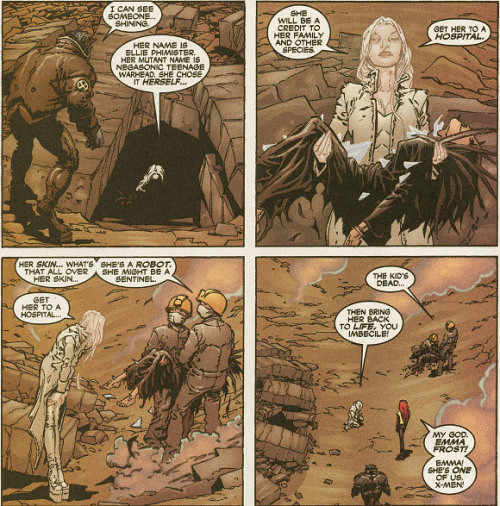
The first time I read this story, the attack by Emma's psychic avatars was confusing (as it's meant to be) but I shrugged it off and went along for the ride. Read immediately after the Morrison stories and I realized how poignant they were, manifestations of Emma's own guilt and fear. Cassandra Nova personifies Emma's pain at surviving the Genosha genocide; Sebastian Shaw represents Emma's self-loathing in her longest-lasting relationship. I didn't recognize Negasonic Teenage Warhead ("Boy, we really have run out names," Kitty says) until this second or third reading:
She's one of Emma's murdered students, seen for only a few panels in Morrison. The last manifestation, "Perfection" is an early version of Emma herself as the White Queen, dominatrix from Hell. Kitty's reaction matches the readers, as we all thought she'd already left Emma trapped in a cave.
Ordinarily, I dislike comics fans' worship of continuity. It's the inside baseball that drives readers away from serial story telling because some Asberger's/fashion victim just broke into your adult conversation with the news that Squirrel Green Lantern only wore the Star Sapphire costume for three issues in 1967, and he, the fanboy, really likes the second version of Empire Strikes Back but the third one makes no sense. Yes, great artists build up layers upon layers of meaning, allusion and reference in their work, but continuity is not the same as depth.
So what did we (I) learn here today? When writers use continuity in the way that Jack Benny did, the reader's prior knowledge adds layers of pleasure. Used as barbed wire to keep the gentiles away, continuity is a disease. One more reason to promise me you'll never pay money for a comic with Cable on the cover or the word "Crisis" in its title.
It seemed to me the character of Barbara Gordon was more interesting (and important to the fictional universe) as Oracle than as Batgirl. The editorial reasoning seems to be if comic book science can heal Batman's spinal cord, it's silly to keep Barbara in a wheelchair.
Why not have both? If they'da asked ME, I would have given her a cybernetic body, like a drone plane, that she could inhabit as Batgirl, while still living day-to-day as chair-bound Oracle. And Barbara as a wounded vet, so to speak, of the "war" that started in Crime Alley has more resonance, more skin in the game for the reader.
“The plague of publishing these days is to mistake ubiquity for significance.”
-- Arts and Letters Daily and Alexander Nazaryan on Knotted: How the Necktie Changed the World. and other such titles
***
“I was turning 40 and thinking, Oh dear, I'm probably going to have one of those midlife crisis things which always just bore the hell out of everybody. So it would probably be better if, rather than just having a midlife crisis, I just went completely screaming mad and declared myself to be a magician. That would, at least, be more colorful. So, I announced, on the night of my 40th birthday party — probably after more beers than I should have had — that, ''from this point on, I'm going to become a magician.'' And then the next morning you have to think, Oh, what have I said now? Are we going to have to go through with this? So I had to go about finding out what a magician was and what they did.
.... The mystics all seem to want to go straight to the Godhead; the magicians tend to be more curious. They want to explore all of the other aspects of the universe. For me, there is very little difference between magic and art. To me, the ultimate act of magic is to create something from nothing: It's like when the stage magician pulls the rabbit from the hat. And then you can turn that idea into a film, a book, a painting, a piece of music, something that other people can experience. That in itself is stunning. And I suppose this is one of the reasons I got into magic, because I was tired of ducking that question that people always ask writers, which is, '’Where do you get your ideas from?’''
***
“my family use to go see him [“Macho Man” Randy Savage] in his early career at hazard ky. my aunt loved leaping lenny. they wrested one time and the loser had to painted yellow.of couse macho man won.my aunt jumped up and ran to the ring.she was half way under the bottom ring where lenny was laying so she grabbed hold of him.she was calling macho names.he said come on old woman.she ended up with yellow paint all over her and two police officers had her by the legs trying to pull her out of the ring. everybody there was dying laughing at her. she almost went to jail, but macho man talked to the police to keep her from going to jail, so he was a good man.”
-- comment by msireta on news of Randy (Poffo) Savage’s death by natural causes
***
“Just by virtue of walking into a theater to see a movie called Transformers, I'm fully agreeing with just dispensing with a the laws of physics and accepting that nobody can tell which $200,000 car is a Transformer, for the same reason that James Bond is a secret agent who tells everyone his full name and drives around in the flashiest car he can. The problem is that it doesn't stop there. The movie brings things up as major plot points that are immediately contradicted, and even the internal logic of a movie about giant robots from space isn't consistent. ... You can make every allowance for it, you can talk about how it's about giant robots so it doesn't have to have logic or how it's for kids and they're dumb anyway, and you're still left with the core problem. Nothing makes sense, even from one scene to the next, and everyone's an asshole, so there's no reason to be interested or to care who lives or who dies.”
Guillermo del Toro: In the next 10 years, we're going to see all the forms of entertainment—film, television, video, games, and print—melding into a single-platform "story engine." The Model T of this new platform is the PS3. The moment you connect creative output with a public story engine, a narrative can continue over a period of months or years. It's going to rewrite the rules of fiction.
Wired: It sounds like you're talking about an entirely new form of storytelling. Guillermo del Toro:Think about the way oral tradition became written word—how what we know about Achilles was written many, many years after it made its way around the world with different names and different types of heroes. That can happen when you allow content to keep propagating itself through different kinds of platforms and engines—when you permit it to be retold with a promiscuous form of mythology. You see it when people create their own avatars in games and transfigure their game worlds.
Wired: How is that interactivity going to change Hollywood—and the way directors like you make movies? Guillermo del Toro: [Legendary B-movie producer] Samuel Arkoff once told me there are only 10 great stories. That's where the engine and promiscuity come in. Hollywood thinks art is like Latin in the Middle Ages—only a few should know it, only a few should speak it. I don't think so.
“Many parts of sub-Saharan Africa are a libertarian's paradise. The region as a whole is a low-tax utopia....Rather than unleashing entrepreneurship, this low rate of taxation means that basic public services like health, education, and pothole filling are starved of funding. The physical infrastructure on which a modern economy rests like roads, courts and the police are missing....people are free to protect their own families, and indeed they are forced to.”
-- Francis Fukuyama, The Origins of Political Order
The author of the website Hey Oscar Wilde! It's Clobberin' Time! asks comic artists for sketches of their own favorite authors or literary characters. The collection has grown enough since 1998 to be written up in the Los Angeles Times. There are some small treasures that may someday be regarded as the definitive portrait of their subject.
There's an ongoing tradition in fandom of collecting sketches by favorite artists. Some of the more interesting collectors bring their own sketchpad and collect different artists' interpretation of a particular character. (And some unscrupulous "collectors" auction them off on ebay, getting hundreds of dollars of a sketch that cost them ten to fifty dollars.) This is the collection I've seen that has interest beyond the world of fanboy/art class freaks like me.
Here is Colleen Coover's (Small Favors, Banana Sunday) take on Elizabeth Bennet from Pride and Prejudice:
... And Jill Thompson's sketch of Carson McCullers (Ballad of the Sad Cafe, The Heart is a Lonely Hunter):
Eric Canete's Truman Capote...
... And Gene Colan's sketch of the great Bill Mauldin:
David Hahn's Yossarian...
And Jeeves and Wooster by Roger Lanridge.
More literary-artsy goodness here; the artists and subjects are listed along the right-hand column.
Over at Comics Alliance, an essay by Chris Sims on why the archetypes running loose in Jack Kirby New Gods can trouble our thoughts thirty years after they first appeared. "[Darkseid's] actions are geared towards conditioning people to embrace and exploit their own base hatred and fear. That's how he wins and remakes the world in his own image... devoted not to death but to Anti-Life... a slavery that masquerades as freedom by allowing its victims to give in to the dark side of humanity. [Darkseid] is a villain who exploits the small selfishness that we all see, experience, and even commit on a daily basis and shows how it all adds up to towering evil, and that makes him one of the most genuinely terrifying villains in comics." Pursuant to an earlier conversation with friends, there's also a short list of prominent women working in comics-- my own favorites, like Amanda Conner, Gail Simone, Colleen Coover, a mention of Karen Berger's importance as an editor on Sandman-- and some I'd never heard of, like Emma Rios and Ramona Fradon. In the appendix of David Hajdu's The Ten Cent Plague, roughly half the artists who lost their jobs in the Wertham purge were women. The only one I knew as a child was Marie Severin on Dr. Strange; at least two generations have no idea the big studios used to cater to all readers, and they've never quite recovered. Kirby and the splash page for the first episode of New Gods; Amanda Conner, one of my imaginary girlfriends, and her take on Supergirl and Power Girl; Colleen Coover on an unintended side-effect of four color printing.
Celebrating the return of the online index When Fangirls Attack,"a compilation of articles on gender in comics and comics fandom". More often than not, this source has led me to some of the most interesting thinking on comics as a cultural signifier, from the "Women in Refrigerators" trope (an ongoing complaint of mine in any continuing series, from Star Trek to Travis McGee) to Alison Bechdel's "test" for female characters: 1. [The story] has to have at least two women in it (later amended to include women with actual names other than secretary or nurse) 2. Who talk to each other, 3. About something besides a man. The editors also have enough genuine love for the medium to wrestle with comic book quirks from Green Lantern butts to Power Girl's "boob window".
I held out longer than most of my friends, trying to give Barack Obama the benefit of the doubt. I was trying to be "sensible".
Excuse #1: Realpolitik means that progressives would have to swallow some things we don't like, in order to inch a little closer to a better world. I told my angry friends they underestimate the death grip of the intransigent right.
Excuse for Barack #2: Inheriting a dog's dinner of deficit, depression, and two trillion-dollar wars, I defy anyone to make Bush's mess into a chef d'œuvre.
Excuse #3: Obama is intentionally bending to the right so that when he finally implements the needed change, no one can accuse him of not trying to work with his opponents.
The Sharrod fiasco, followed fast by the administration's reaction to the Wikileaks affair finally tipped me over. No more excuses; "sensible" no longer.
Tom Tomorrow has introduced a new character, Chuckles the "Sensible" Woodchuck, who nails it better than anyone in the drawing above. Such is the power of the cartoon-- although Josh Shrei and Matt Hamlin come close: "If you’re changing your views or apologizing for a politician who has not met your expectations, something is wrong."
Hug, nay, kiss and buy drinks and dinner for the comic book geek of your choice (ahem.) And pass this along to the PFLAG community, community organizers, and other people of good will.
Apparently a few members of the the Westboro Baptist Church of Kansas, notorious and reviled for their "God Hates Fags" protests outside military funerals and other events, thought they would get their picture taken by protesting outside the Comicon in San Diego, biggest event in the comic book year. The Eisner Awards, comics' equivalent of the Oscar or the Pulitzer, happen there, and the big movie studios stalk the halls for "buzz", which I suppose attracted Fred Phelps.
Somehow, the fans at the convention not only got advance of the demonstration, they put together a counter-demonstration with materials at hand (costumes, signs) that was ten times larger and MUCH funnier. More in-jokes than ... than.. well I can't think of anyplace with more in-jokes than a comics convention, unless it's a couple of "Monty Python" fans, and those groups overlap.
Where else would you find a loving Jesus side by side with an invocation of the Hypno-Toad? Gail Simone was one of the pros there; she spoke clearly and simply about the protesters' intentions as you'd hope from the writer of Birds of Prey, Welcome to Tranquility, and the best run on Wonder Woman since Greg Rucka. I hope word spreads, because this seems much more effective at dissipating Phelps' power than the righteous anger and well-intentioned complaints he encounters elsewhere.
My friend Wayne hopes the Baptists try again in Chicago, giving him an excuse to break out the crotchless Riddler costume and a "KNEEL BEFORE ZOD" sign. As if he needs an excuse.
Cartoonist and muse Betty Lawyer Kimball passed away last week at the age of 97. Cartoon Brew posted a heartfelt obituary with charming photo album here.
“He had seen society in its three great phases—Obedience, Struggle and Revolt... and he hesitated in his choice. Obedience was dull, Revolt impossible, Struggle hazardous.” (Balzac, Pere Goriot)
“He who will not reason is a bigot; he who cannot is a fool; and he who dares not is a slave.” (William Drummond, some old Scotsman)
“Something nice this way comes. It begins with the awful—whether it’s as enormous as the Holocaust or the World Trade Center or as intimate as family dysfunction or the death of a loved one—and then finds comfort. None of this Anna on the tracks, Emma in the dumps, or depressing Father Zosima’s corpse smells stuff; that’s sooo 19th century. ... Instead, let’s just book passage on a gentle, healing voyage. Sound trite? It is, but it’s apparently the literature of our time as exemplified by Jonathan Safran Foer, Myla Goldberg, Nicole Krauss, and Dave Eggers, along with everything McSweeney’s, the magazine founded by Eggers.” (Melvin Jules Bukiet , ”Wonder Bread” in The American Scholar)
“In American popular culture, the private detective is a unique heroic figure: champion of last resort for the vulnerable client, a knight-errant for hire, bringing rough or poetic justice to cases unserved by more official powers that be. [Robert Parker] wrote dialogue that at once informed, amused and gave a sense of character; and he conjured characters a reader wanted to spend more time with—especially Spenser, a fixed point in a footloose world, take him or leave him. A pragmatist whose ethics were situational. A tough and decent type who did what needed to be done in the service of a moral cause, affirming the worth of the individual regardless of race, sexual orientation, social status, age or occupation. He made timeless points that need to be remade every generation, in a society ever able to find ways to betray the public and private trust.” (Obituary by Tom Nolan in the Wall Street Journal)
“As Juke [on a 1974 Lily Tomlin special], Richard Pryor gave one of his relatively few great performances in a project that he had not written or directed. He made use of the poignancy that marks all of his great comedic and dramatic performances, and of the vulnerability—the pathos cradling his sharp wit—that had seduced people into loving him in the first place.... The concert films are excellent examples of what the Village Voice critic Carrie Rickey once described as Pryor’s ability to “scare us into laughing at his demons—our demons—exorcising them through mass hyperventilation.”... Taken together, the concert films show the full panorama of Pryor’s moods: brilliant, boring, insecure, demanding, misogynist, racist, playful, and utterly empathetic.... Pryor embodied the voice of injured humanity. A satirist of his own experience, he revealed what could be considered family secrets—secrets about his past, and about blacks in general, and about his relationship to the black and white worlds he did and did not belong to.” (Hilton Als profile of Richard Pryor in The New Yorker
“So Wonder Woman counts among one of the very few superhero genre characters that are legitimately a gift to young women. She is not a character to be marketed to young men. Marston assured the company the boys would read as well, but she's custom designed for young women. For god's sake, she's a princess who talks to animals. Her entire supporting cast, with the exception of one blockheaded love interest, was women. She is a character made with little girls in mind. The bondage urban legend always struck me as a mean-spirited attempt to rob us of that. To strip her of all innocent and generous beginnings in favor of something uber-sexualized. To say that we weren't worth our own superhero princess, she had to be secretly aimed at young men. That she was really meant for boys. It's a way to steal Wonder Woman, and claim she wasn't ever stolen. To be honest, that's why I've always felt they had trouble with her. She is a female-oriented character that they keep marketing to a widely male audience.” (Ragnell on her blog Written World”
“I think that's a big part of it — she COULD tear someone's head off, she COULD destroy a country if she chose. But she would consider that a failure as a warrior for peace. The death of an enemy is not victory to her. I love that stuff. I think it's a far better blueprint for the future than most of the action hero stuff out there right now. But there are a million reasons. I love that she's the DC universe's premiere badass. I love that she was giving messages of the power of womanhood in the 40's, you know, decades before Buffy or Xena or Lara Croft. And there's a part of me that loves the pegasi and the princess-ness of it all, and all the trappings of Paradise Island. She's just brilliantly conceived. And I like her with a dry sense of humor, while we're at it. The sisterhood aspect of the Amazons is tremendously compelling to me. Who wouldn't love to have that many sisters who loved you AND carried bladed weapons?” (Gail Simone, current writer on Wonder Wonan, in an interview at After Ellen)
“If you have men who will exclude any of God's creatures from the shelter of compassion and pity, you will have men who deal likewise with their fellow men.” (Saint Francis)
“The largest single survey to date of serial killers found: 36 percent admitted to committing animal cruelty as children; 46 percent admitted to committing animal cruelty as adolescents; 36 percent admitted to committing animal cruelty as adults.” (Human Society of the United States)
“When John Paul II appointed Cardinal Ratzinger head of the department that watches over theological orthodoxy (the Congregation for the Doctrine of the Faith, or CDF), it was in full confidence that he would curb the proliferating dissidents, not least the liberation theologians of South America who argued that sin could often mean not wrongdoing by individual moral agents, but the injustice of social and political structures leading to poverty and oppression. He soon earned himself the sobriquet "the Pope's Rottweiler". Theologians guilty of unorthodoxy were summoned to his inquisitorial office: some were deprived of their teaching licences, and others were excommunicated. ... Benedict... continues to think of the abuse as a spiritual lapse, rather than a psychological, social and criminal problem. Priestly pedophile abuse, in his view, is a failure of priesthood, a failure of holiness, asceticism and piety. ... The cause of the crisis, he said, had been secularism, and the temptations secularism has posed to the holiness of priests. The innocent majority of priests in Ireland... are infuriated by Benedict's implied exculpation of the Vatican and the papacy.” (John Cornwell in The New Statesman)
“Scientists suspect that small inherited predispositions are either enhanced or suppressed by experience, and computer models show that tiny discrepancies at the start can become enormous over time, through feedback loopings of positive reinforcement. Evidence is also emerging that certain physical setpoints affect temperament globally. Notable among such setpoints is the relative rate at which one’s nervous system processes sensory information. “There are low information processors who don’t attend much to their environment and bulldoze through life,” said David Sloan Wilson of the State University of New York at Binghamton. “Then there are the sensitive ones who are always taking things in, which can be good because information is valuable, but it can also be overwhelming.” Studies of highly sensitive people show their delicacy is “domain general,” Dr. Wilson said. Not only are they “exceptionally moved by symphonies” and find graphic depictions of violence “too hard to bear,” but they are also sensitive to drugs like caffeine, and their skin is easily irritated by the wrong soap, sunscreen and fabric. Highly sensitive pigs squeal a lot; highly sensitive people feel a lot. Sure, it’s painful at times. But just switch on some Bach and I’ll squeal my thanks for thin skin.” (Natalie Angierin The New York Times)
“Most TV comics trade in brand-name jokes or jokes that play off physical stereotypes. They don’t question their culture so much as pander to its insatiable hunger for distraction. But [Bill] Hicks’ mischievous flights of fantasy bring the audience back to reality with a thump. Hicks is a kind of ventriloquist of his contradictory nature, letting voices and sound effects act out both his angst and his appetites.... He started writing and performing his jokes as an alienated thirteen-year-old in Houston in 1975, and, by his own count, for the last five years he has been performing about two hundred and sixty-five days a year, sometimes doing as many as three two-hour gigs a night. Few contemporary comics or actors have such an opportunity to get their education in public.” (Profile of the late Bill Hicks by John Lahr in The New Yorker)
"It seems strange that my life should end in such a terrible place, but for three years I had roses and apologized to no one."
The character of Valerie answers the question "Why we fight" in Alan Moore and David Lloyd's V for Vendetta, dramatized here:
If Valerie is the heart of the thing, my other favorite scene never appeared in the film -- a film Alan Moore sniffed at as "a thwarted and frustrated and largely impotent American liberal fantasy of someone with American liberal values standing up against a state run by neoconservatives— which is not what the comic V for Vendetta was about."
My other favorite is a sequence showing V speaking over a pirate broadcast to the audience of a fascist "news" program. As he speaks, the screen shows scenes of human misbehavior, some straight to the point, some ironic. It's more Jonathon Swift than Orwell-- it's Alan Moore, actually, and it might be the kind of literature you can only pull off in a comic, giving you time to consider the justapostion of word and image. It's the kind of dark laughter Twain used to pull off in The War Prayer and Letters from the Earth, and the kind of thing I don't ask anyone but myself to laugh at, but you might:
Good evening, London. I thought it time we had a little talk. Are you sitting comfortably? Then I'll begin... I suppose you're wondering why I've called you here this evening. Well, you see, I'm not entirely satisfied with your performance lately... I'm afraid your work's been slipping and... and well, I'm afraid we've been thinking about letting you go. Oh, I know, I know. You've been with the company a long time now. Almost... let me see. Almost ten thousand years! My word, doesn't time fly? It seems like only yesterday... I remember the day you commenced your employment, swinging down from the trees, fresh-faced and nervous, a bone clasped in your bristling fist... "Where do I start, sir?", you asked, plaintively. I recalled my exact words: "There's a pile of dinosaur eggs over there, youngster", I said, smiling paternally all the while. "Get sucking". Well, we've certainly come a long way since then, haven't we? And yes, yes, you're right, in all that time you haven't missed a day. Well done, thou good and faithful servant. Also, please don't think I've forgotten about your outstanding service record, or about all of the invaluable contributions that you've made to the company... Fire, the wheel, agriculture... It's an impressive list, old-timer. A jolly impressive list. Don't get me wrong. But... well, to be frank, we've had our problems too. There's no getting away from it. Do you know what I think a lot of it stems from? I'll tell you... It's your basic unwillingness to get on in the company. You don't seem to want to face up to any real responibility. To be your own boss. Lord knows you've been given plenty of opportunities... We've offered you promotion time and time again, and each time you've turned us down. "I couldn't handle the work, Guv'Nor", you wheedled. "I know my place". To be frank, you're not trying, are you? You see, you've been standing still for far too long, and its starting to show in your work... And, I might add, in your general standard of behavior. The constant bickering on the factory floor has not escaped my attention... nor the recent bouts of rowdiness in the staff canteen. Then of course there's... Hmm. Well, I didn't really want to have to bring this up, but... Well, you see, I've been hearing some disturbing rumors about your personal life. No, never you mind who told me. No names, no pack drill... I understand you are unable to get on with your spouse. I hear that you argue. I am told that you shout. Violence has been mentioned. I am reliably informed that you always hurt the one your love... the one you shouldn't hurt at all. And what about the children, its always the children who suffer, as you're well aware. Poor little mites. What are they to make of it? What are they to make of all your bullying, your despair, your cowardice and all your fondly nurtured bigotries? Really, its not good enough, is it? And its no good blaming the drop in work standards on and management either... though to be sure, the management is very bad. In fact, let us not mince words... The Management is terrible! We've had a string of embezzelers, frauds, liars and lunatics making a string of catastrophic decisions. This is plain fact. But who elected them? It was you! You who elected these people! You who gave them the power to make your decisions for you! While I'll admit that anyone can make a mistake once, to go on making the same lethal errors century after century seems to me nothing short of deliberate. You have encouraged these malicious incompetents, who have made your working life a shambles. You have accepted without question their senseless orders. You have allowed them to fill your workspace with dangerous and unproven machines. You could have stopped them. All you had to say was "No". You have no spine. You have no pride. You are no longer an asset to the company. I will, however, be generous. You will be granted two years to show me some improvement in your work. If at the end of that time you are still unwilling to make a go of it... you're fired. That will be all. You may return to your labors. (Alan Moore, V for Vendetta)
"It was believed afterward that the man was a lunatic, because there was no sense in what he said." (Twain)
I still think there's something creepy about Holden Caulfield. What's this business of catching children before they "fall" into adulthood-- when the world needs more adults, not fewer? Or Seymour Glass, waking his wife Muriel from her shallow slumber in a particularly ugly way?
I can imagine Holden (if he stays out of jail) ending as a basement-dwelling iconoclast, proud to be smarter, more "authentic" than the rest of us suffering monkeys, part of the cast of High Fidelity or the local comics shop. Given his social class, Holden might end as Jerry Rubin did, praising Charles Manson and then graduating to embrace Reagan and Wall Street, albeit with a Saturday Night Live ironic twist to his mouth. Is it unkind of me to wonder if Rubin was sneering when he was hit by a car? Am I the only one annoyed by Salinger's twee characters being made of, well, Glass? I know Seymour had a tough war (Salinger himself was part of D-Day), but does that excuse spattering even the silliest of women with a mess of brains? Better to volunteer for pharmaceutical experiments if you want to throw yourself away. Why not rush into a fire, or find a leper colony like Graham Greene's Burnt-Out Case?
The Canadian Phillip Marchand has some thoughts on the American man-child. Salinger himself managed the equivalent of a James Dean or Marilyn Monroe, never sullying his reputation with lesser work (as someone said of Elvis' death, "good career move")-- but not dying, enjoying his royalties in private, apparently a pleasant enough life with friends and family.
I would have liked Holden better if, having rejected the phoniness of straight society, he picked up a shovel and scooped shit at an animal shelter, or sorted clothes for the homeless, or even (cough) tried to teach in the public schools. Holden creeped me out when I first read Catcher in middle school-- I preferred Irving Stone's Michelangelo and VanGogh, or T.H. White's King Arthur: sensitive, maybe doomed, but not likely to surrender.
I still prefer genre writing to the finger-sniffing stories of "New Yorker" fiction. The wounded detectives, from Spenser to Travis McGee to T. Jefferson Parker, expose the truth like Holden but then try to do something about it. Even the silliest super hero, as Michael Chabon makes explicit in The Amazing Adventures of Kavalier and Clay and implies in Wonder Boys, is at least pretending to be a grown up, picking up their imaginary cosmic shovel or rescuing a kitten from a tree to make the world a better place. Salinger reminds me of those people who don't like kittens because they turn into cats.
A sweet and simple fund-raiser idea: Douglas E. Sherwood of Oni Press asked a couple of dozen artists to draw his favorite X-Men character, Kitty Pryde, with the results to be auctioned on E-Bay as a fundraiser for the Oregon Hemophilia Treatment Center. I like the specificity of the idea, and that it offers something tangible-- an hour's diversion, a framed print, maybe a t-shirt-- to a relatively small pool of contributors. Myself an O.G. X-Men reader, I'd outgrown the comic a decade before Kitty joined the team in 1980, though I came back for Grant Morrison's seven-volume run (still my favorite) and enjoyed Joss Whedon's take on the character. For me, it's all about Kitty and Lockheed, the most interesting pet/person relationship in comics. As a writer, it seems to me that Marvel is missing a bet by letting Kitty age with her readers, and not producing a series of adventures for the under twelves to be marketed to new readers, something like DC's Tiny Titans or Jeff Smith's Shazam. Call it "A Girl and Her Dragon", with the covers a parody of the "Boy and His Dog" motif. A million-dollar idea from a middle-aged man who wants to reboot Kamandi, Last Boy on Earth.
I enjoyed the Watchmen film more than I thought i would, seeing it with friends who'd never read the book but were able to respond to the larger themes. But ye gods, keep the general audience away from this thing that we love. Our local theater felt compelled to print out a sign warning customers that this is not a "superhero" film like they're used to, and I've already had students complain after the fact that they didn't understand the story or were disturbed by the content. I'll show you "school improvement" as soon as you outlaw parents-- who are these people that take an underage child to see the R-rated Watchmen? Probably the same parents that complain (never to my face) about my PG-13 World History class. Harlan Ellison used to talk about "the fan sneer", that peculiar expression on a connoisseur's face when everyone on the subway starts reading The Lord of the Rings, or drinking an obscure wine that you discovered, or quoting from a cult film. On the one hand you're pleased that something of value has found a wide audience; on the other hand, when the mob jumps into the pool, they inevitably start pissing in it. Now everyone can plop down a few bucks to see the film version of Alan Moore's The Watchmen, including those who can't read or don't read, which sadly includes the director. I thought the performances were perfect, and visually it's a panel-for-panel recreation of Dave Gibbons art-- Hollywood's problem is that set designers and special effects artists have outpaced its writers and directors by twenty years, giving us gorgeous films without souls. Jackie Earle Haley is a wonderful Rorschach, despite the cuts made in his part and Patrick Wilson as Dan Dreiberg is a revelation in an emotionally complex but less showy, and therefore more complicated role to play. This could have been Adam West as Batman, and instead Wilson's humanity, contrasted with John Osterman's perfection, has us rooting for Dan all the way. Malin Ackerman has been unjustly criticized as eye-candy-- Sally and Laurie Jupiter represent the pin-up girl archetype, just as Rorsharch is the paranoid (Batman or the Shadow without funds), Adrian the genius, Eddie the murderous "patriot", John the Superman and Dan the high tech millionaire adventurer. It's not Ackerman's fault that Laurie Jupiter's emotional development was cut down to the one big scene when she puts together the circumstances of her birth. In the novel, Laurie figures it out for herself; in the movie, she can't do it without magical help from Osterman. Visually gorgeous, and the actors put their hearts into it. But the director, Zach Snyder, is tone-deaf. The publicity mill keeps calling him a "visionary genius", but even Snyder knows the visions were piggybacked on someone else's hard work. The problem is that whenever the director deviates from Moore and Gibbon's text, his additions are immature and gross. Snyder represents that part of Hollywood that panders to 15 year old misanthropes. He has no aesthetic common sense. Snyder's Nixon wears a caricature nose. He rewrites jokes and blows the punchline. Violence in the film is drawn out from a panel or two to splatterporn in loving slow motion. Instead of Sally Jupiter scrabbling on the floor in ugly desperation to escape her rapist, Carla Gugino is bent aesthetically over a pool table, attempted rape as a Helmut Newton fashion spread. Snyder's film of 300, for all its fascist silliness, homoeroticism made palatable to an American audience, had a few genuinely beautiful images, but all of them based on Frank Miller and Lynn Varley's drawings-- and Snyder added a rape scene to that. When it comes to Rorschach's murder of the pedophile, the text has Rorschach handcuffing the villain and then setting the place on fire; we've already had our dose of horror by contemplating the off panel death of the victim. In the film, we're treated to Rorschach whacking at a prop head of the criminal with a meat cleaver. I've come to expect this from Hollywood, something to make the Roman mobs squeal "ew, gross!", but it's as obtrusive, gross and laughable as the cock-blocking voice singing Leonard Cohen's "Hallelujah" during Dan and Laurie's sex scene. "Was offered Swedish love and French love-- but not American love. American love; like Coke in green glass bottles. They dont make it anymore." Snyder's lip-licking violence, including two, count 'em, two slo-mo kung fu scenes for Laurie and Dan, leave no room for things like Rorschach's soliloquy as he watches the pedophile's factory burn: "Stood in firelight, sweltering. Bloodstain on chest like map of violent new continent. Felt cleansed. Felt dark planet turn under my feet and knew what cats know that makes them scream like babies in night. Looked at sky through smoke heavy with human fat and God was not there. The cold, suffocating dark goes on forever and we are alone. Live our lives, lacking anything better to do. Devise reason later. Born from oblivion; bear children, hell-bound as ourselves, go into oblivion. There is nothing else. Existence is random. Has no pattern save what we imagine after staring at it for too long. No meaning save what we choose to impose. This rudderless world is not shaped by vague metaphysical forces. It is not God who kills the children. Not fate that butchers them or destiny that feeds them to the dogs. It’s us. Only us. Streets stank of fire. The void breathed hard on my heart, turning it's illusions to ice, shattering them. Was reborn then, free to scrawl own design on this morally blank world. Was Rorschach. Does that answer your questions, Doctor?" Only part of that speech survives. Snyder makes the climax of the story unrecognizable, and judging from my friends reaction, incomprehensible. After washing our face in gore, he wimps out and cuts Laurie's horrified reaction to New York streets filled with corpses, mass murder for the greater good. Instead we're looking at a big computer generated hole. I've no problem with filmmakers editing a work, but shouldn't they follow an artistic Hippocratic oath, and first do no harm? This isn't a fanboy's plaint-- hell, I'd cut Hamlet or Macbeth for length-- but why are so many people who rise to this level in Hollywood-- the task of presenting a cultural touchstone to a mass audience-- have to be so tone-deaf?
"Life isn’t divided into genres. It’s a horrifying, romantic, tragic, comical, science-fiction cowboy detective novel. You know, with a bit of pornography if you're lucky." - Alan Moore
“I always offend someone by asserting that the reason the death of a pet is worse than the death of a human is that you have mixed feelings about all people.” -- Dick Cavett
"I think that by retaining one’s childhood love of such things as trees, fishes, butterflies, and -- to return to my first instance -- toads, one makes a peaceful and decent future a little more probable… At any rate, Spring is here, even in London N.1, and they can’t stop you enjoying it. This is a satisfying reflection. How many a time I have stood watching the toads mating, or a pair of hares having a boxing match in the young corn, and thought of all the important persons who would stop me enjoying this if they could. But luckily they can’t. So long as you are not actually ill, hungry, frightened or immured in a prison or holiday camp, Spring is still Spring. The atom bombs are piling up in the factories, the police are prowling through the cities, the lies are streaming from the loudspeakers, but the earth is still going round the sun, and neither the dictators nor the bureaucrats, deeply as they disapprove of the process, are able to prevent it." -- Orwell
“This town [Washington,DC] talks to itself and whips itself into a frenzy with its own theories that are completely at odds with what the rest of America is thinking.” – David Axelrod
“Faith is at best morally neutral, and at worst a vile mental distortion. Our habits are to respect people of faith, but I think we’ve been forced to question those habits. The powers of sweet reason look a lot more attractive post-9/11 than the beckonings of faith, and I no longer put them on equal scales.” -- Ian McEwan, profile in The New Yorker
“The search for an impartial and neutral tool to mitigate the disruptive effect of factionalism was an important feature of political life in Italian city republics. As Waley (1991) maintains, the political scene in medieval Italy was characterized by factionalism fueled by intense competition for political office. The citizens were driven by an ardent desire to obtain the "honors and benefits" of office (Manin 1995). To overcome factional strife, most Italian communes adopted the institution of podesta, a foreigner endowed with judicial and administrative powers. The podesta was usually hired for a year and played the role of military leader, judge, and administrator. An important attribute of the podesta was that he had to be a foreigner so that he could be neutral to the internal "discords and conspiracies" -- via Steve Clemons, The Washington Note
“The aim of literature is the creation of a small object covered with fur which breaks your heart.” -- Donald Barthelme
"In Final Crisis 7, Superman finally kills Darkseid [by singing a song into the newly constructed Miracle Machine. Morrison doesn't let the reader know exactly what song Superman sings, but instead leaves it up to the reader to fill in this particular gap." -- Meme explained in Dr. K's 100-Page Super Spectacular Blog, with links to other examples. (For the record, it is the opinion of this writer that this song would only lengthen Darkseid's reign.)
In the midst of winter, I finally learned that there was in me an invincible summer. – Albert Camus
*** Jimmy Olsen=me. And we all have signal watches -- unidentified comic fan, watching the inauguration
*** Friendships, like marriages, are dependent on avoiding the unforgivable. — John D. MacDonald
*** It may dash your hopes for that nice warm feeling called Schadenfreude, but the Masters of the Universe are smarter than the people they left behind at the investment banks. Their hedge funds have blown up here and there, but unlike the investment banks, they are still very much in business. They have hurriedly pulled themselves into defensive positions inside their shells, like turtles. Their Armageddon, if any, will not come for two more days, which is to say, Tuesday, Sept. 30. Most hedge funds open up a crack on Sept. 30, Dec. 31, March 31 and June 30 to give investors the chance to “redeem” their investments, meaning take their money out. -- Tom Wolfe
*** Bill Clinton is brooding in his hotel suite at Brown Palace Hotel, like the outcast Grendel lurking on the outskirts of the town where young Beowulf lived. -- Maureem Dowd
*** “In this issue, Hellboy bashes in a Hillbilly Devil’s face with a consecrated shovel. Goddamn I love comic books.” -- Chris Sims
*** "The artist is nothing without the gift, but the gift is nothing without work." - Emile Zola
*** “One could argue that the key Al Qaeda training for 9/11 occurred not in the Taliban’s Afghanistan but in Jeb Bush’s Florida. And in terms of terrorist planning, 9/11 would have been better avoided with an occupation of Hamburg, where most of the essential plotting for the attack occurred.” -- Bartle Breese Bull, NY Times
***
“There go the people. I must follow them. I am their leader.” -- Alexandre Ledru-Rollin, 1848
*** Depression and schizophrenia are diseases that distort reality, and cause great suffering in the process. Depression is a great liar. You are not a failure. You are not worthless. You are not unloved. You have been happy in the past, though you can’t remember it, and you will be happy in the future, though you cannot remember it.
-- Dick Cavett
*** “I think we’ve remained fixed on 1968 because it feels like where we missed our turn and went down the wrong road… And on some level, I think we blamed everything that went bad after that on those two deaths. Just before he was assassinated, Bobby Kennedy was asked when he thought the country would be ready to elect a black president. He said, “Forty years. 2008.” RFK was right on the nose. Barack Obama is not Martin Luther King, and he’s not Bobby Kennedy, but you’d have to be emotionally tone-deaf to miss the fact that he reminds boomers of both of those fallen leaders. That had to be part of the reason that this election created such elation in the population. It felt as if we were going back to that missed turn, and starting down the right road at last.
I didn't realize just how happy I was until I arrived at my friends' house and opened that first Guinness, with Rachel Maddow and the BBC interviewing survivors of the Little Rock Nine, and the joint realization that this is the first time in my lifetime that the guy I wanted to be president actually won. Sure, I voted for Clinton (Damn Near Republican) and went door-to-door for whoever was running against the Shrub, but this time...
Working with schoolchildren all day, with the inauguration on in the background, one tries to be a voice of moderation, explaining the process, asking leading questions, supplying the humorous anecdote: Andrew Johnson showing up drunk for his inauguration, William Henry Harrison (the Indian killer) literally talking himself to death by droning on for two hours in an icy rain. But children, for all their enthusiasm, don't get it. Being but strangers to this world, they recognize that it's "important", but they can't be expected to understand that there's anything unusual about today's events. If this day was going to be truly savored, it needed to be shared with adult friends.
The gore-crow of the Bush administration has finally taken its beak from out my heart. Complete sentences were spoken. Thomas Paine was quoted. The King James Bible was invoked. The wicked were politely admonished. My favorite was the benediction by the Reverend Joseph Lowery (co-founder of the SCLC with M.L. King) who with a twinkle in his eye, went beyond the lyrics of "Lift Every Voice and Sing" to end with a paraphrase of the bluesman Big Bill Broonzy:
But it wasn't just about seeing John Lewis and wondering what was going on in his scarred head, or seeing the cover painting of The Nation and tearing up when I realized that was Emmett Till and the four little girls killed in Birmingham standing on the podium with Obama. When Pat said there was a weight off her shoulders, I recognized there was a childlike element to my happiness; it felt like... when I was 10 or 11 years old... like that moment in Amazing Spider-Man #33...



 (And some days it takes more Stones than others...) Where Mythical Bestiary meets Contemporary Culture and Chews On Its Leg Until Covered with Slobber.


 (Lady Macbeth, by Steven Pugh)






 Oh, I know, I know. You've been with the company a long time now. Almost... let me see. Almost ten thousand years! My word, doesn't time fly? It seems like only yesterday... I remember the day you commenced your employment, swinging down from the trees, fresh-faced and nervous, a bone clasped in your bristling fist... "Where do I start, sir?", you asked, plaintively. I recalled my exact words: "There's a pile of dinosaur eggs over there, youngster", I said, smiling paternally all the while. "Get sucking".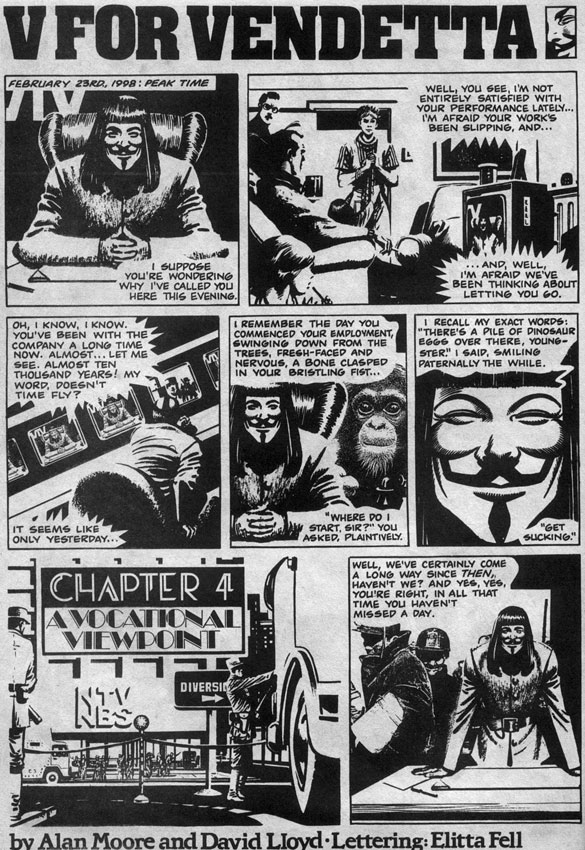


 Armageddon, if any, will not come for two more days, which is to say, Tuesday, Sept. 30. Most hedge funds open up a crack on Sept. 30, Dec. 31, March 31 and June 30 to give investors the chance to “redeem” their investments, meaning take their money out.
 “One could argue that the key Al Qaeda training for 9/11 occurred not in the Taliban’s Afghanistan but in Jeb Bush’s Florida. And in terms of terrorist planning, 9/11 would have been better avoided with an occupation of Hamburg, where most of the essential plotting for the attack occurred.”


