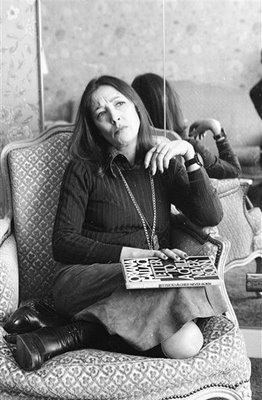
I just learned of the death in Florence of
Oriana Fallaci, killed by the cancer that's been gnawing at her the last few years.
She was a handsome, intelligent woman, with the kind of expectant glare that made you want to be more than you are, to live up to her standards . She was the only person I ever heard of that was angrier than me and not in jail.
She died as she lived, in
a pissing match with Islam, which ironically made her a darling of the right, though conservatives would drop her like a hot turd if they ever read any of her other works.
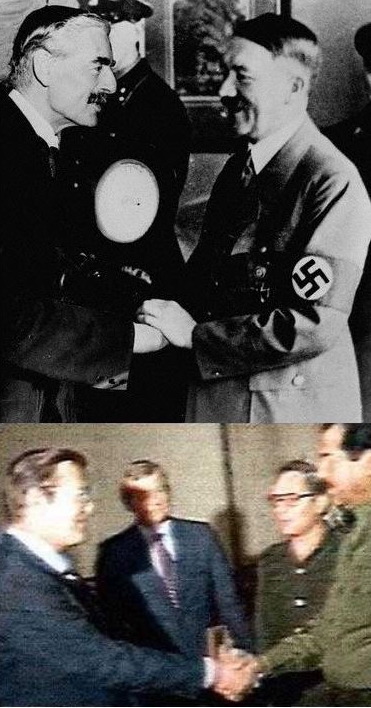
She saw no difference between murders committed in the name of Yassar Arafat and murders committed under the fat self-satisfied hand of Henry Kissinger. She outed
Arafat before "outing" was even a verb; she exposed
Kissinger's fantasies: "... I've always acted alone. Americans like that immensely. Americans like the cowboy who leads the wagon train by riding ahead alone on his horse, the cowboy who rides all alone into the town...”
Fair enough, though saying it to Fallaci opened that first crack for cartoonists to drive a truck through. "Henry Kissinger may have wished I had presented him as a combination of Charles DeGaulle and Disraeli, but I didn't. . .out of respect for DeGaulle and Disraeli. I described him as a cowboy because thats how he described himself. If I were a cowboy I would be offended."
Fallaci: "Don’t you find, Dr. Kissinger, that it’s [Vietnam] been a useless war?"
Kissinger: “On this, I can agree.”
Only in a world drunk with advertising could this man be presented as a successful diplomat after leaving a million corpses in his wake.
The Greek poet
Alexandros Pangoulis was her lover, until murdered by the generals who had tortured him in prison and murdered his brothers.
She was almost killed herself while covering a 1968 protest in Mexico City.
Mexican police killed several hundred protestors. Fallaci took three bullets, was dragged down stairs by her hair and left for dead.
Oriana Fallaci was the one who agreed to cover herself as precondition to interviewing the Ayatollah Khomeni, then asked him "how do you swim in a chador?", stripped off the garment and threw it to the floor. Khomeni pouted for two days, then came back for his medicine. She'd gotten in Riza Pahlavi's face, too, calling him a "a highly dangerous megalamaniac, because he combines the worst of the old and the worst of the new", and damning the Shah with his own words.
She is the better artist, and I leave her own words from the preface of
Interview with History as an obituary. It sums up a great deal of the anger that drove her, and a large part of why I loved her:
"Perhaps it is because I do not understand power, the mechanim by which men or women feel themselves invested or become invested with the right to rule over others and punish them if they do not obey. Whether it comes from a despotic sovereign or an elected president, from a murderous general or beloved leader, I see power as an inhuman and hateful phenomenon... Of course, to live in a group requires a governing authority; otherwise there is chaos. But the tragic side of the human condition seems to me precisely that of needing an authority to govern, a chief...
"....To the same degree that I do not understand power, I do understand those who oppose power, who criticize power, who contest power, especially those rebel against power imposed by brutality. I have always looked on disobedience toward the oppressive as the only way to use the miracle of having been born. I have always looked on the silence of those who do not react or who indeed applaud as the real death of a woman or man. And listen: for me the most beautiful monument to human dignity is still the one I saw on a hill in the Peloponnesus. It not a statue, it was not a flag, but three letters that in Greek signify "No": oxi. Men thirsting for freedom had written them among the trees during the Nazi-Fascist occupation, and for thirty years that No had remained there, unfaded by the sun or rain. Then the colonels had obliterated it with a stroke of whitewash. But immediately, almost magically, the sun and rain had dissolved the whitewash. So that day by day the three letters reappeared on the surface, stubborn, desperate, indelible."
Una mattina mi son' svegliato,
o bella, ciao! bella, ciao! bella, ciao, ciao, ciao!
Una mattina mi son' svegliato
ed ho trovato l'invasor.
O partigiano, portami via,
o bella, ciao! bella, ciao! bella, ciao, ciao, ciao!
O partigiano, portami via,
ché mi sento di morir.
E se io muoio da partigiano,
o bella, ciao! bella, ciao! bella, ciao, ciao, ciao!
E se io muoio da partigiano,
tu mi devi seppellir'.
Mi seppellirai lassù in montagna,
o bella, ciao! bella, ciao! bella, ciao, ciao, ciao!
Mi seppellirai lassù in montagna
sotto l'ombra di un bel fior'.
Tutte le genti che passeranno
o bella, ciao! bella, ciao! bella, ciao, ciao, ciao!
Tutte le genti che passeranno
mi diranno «Che bel fior'!»
«E questo è il fiore del partigiano»,
o bella, ciao! bella, ciao! bella, ciao, ciao, ciao!
«E questo è il fiore del partigiano
morto per la libertà!»

This morning I awakened
Oh Goodbye, Goodbye, Goodbye! bye! bye!
This morning I awakened
And I found the invader
Oh partisan carry me away
Oh Goodbye, Goodbye, Goodbye! bye! bye!
Oh partisan carry me away
Because I feel death approaching
And if I die as a partisan
Oh Goodbye, Goodbye, Goodbye! bye! bye!
And if I die as a partisan
Then you must bury me
Bury me up in the mountain
Oh Goodbye, Goodbye, Goodbye! bye! bye!
Bury me up in the mountain
Under the shade of a beautiful flower
And those who shall pass
Oh Goodbye, Goodbye, Goodbye! bye! bye!
And those who shall pass
Will tell me what a beautiful flower it is
This is the flower of the partisan
Oh Goodbye, Goodbye, Goodbye! bye! bye!
This is the flower of the partisan
Who died for freedom
 (And some days it takes more Stones than others...) Where Mythical Bestiary meets Contemporary Culture and Chews On Its Leg Until Covered with Slobber.