"All the Stones the Builders Rejected"  (And some days it takes more Stones than others...) Where Mythical Bestiary meets Contemporary Culture and Chews On Its Leg Until Covered with Slobber.
Showing posts with label writers. Show all posts
Showing posts with label writers. Show all posts

Commonplace Book, April: Sensitive Redheads, Richard Pryor, What Wonder Woman Represents and Too Much Twee in Literature
“He had seen society in its three great phases—Obedience, Struggle and Revolt... and he hesitated in his choice. Obedience was dull, Revolt impossible, Struggle hazardous.”
(Balzac, Pere Goriot)
“He who will not reason is a bigot; he who cannot is a fool; and he who dares not is a slave.”
(William Drummond, some old Scotsman)
“Something nice this way comes. It begins with the awful—whether it’s as enormous as the Holocaust or the World Trade Center or as intimate as family dysfunction or the death of a loved one—and then finds comfort. None of this Anna on the tracks, Emma in the dumps, or depressing Father Zosima’s corpse smells stuff; that’s sooo 19th century. ...
Instead, let’s just book passage on a gentle, healing voyage. Sound trite? It is, but it’s apparently the literature of our time as exemplified by Jonathan Safran Foer, Myla Goldberg, Nicole Krauss, and Dave Eggers, along with everything McSweeney’s, the magazine founded by Eggers.”
(Melvin Jules Bukiet , ”Wonder Bread” in The American Scholar)

“In American popular culture, the private detective is a unique heroic figure: champion of last resort for the vulnerable client, a knight-errant for hire, bringing rough or poetic justice to cases unserved by more official powers that be. [Robert Parker] wrote dialogue that at once informed, amused and gave a sense of character; and he conjured characters a reader wanted to spend more time with—especially Spenser, a fixed point in a footloose world, take him or leave him. A pragmatist whose ethics were situational. A tough and decent type who did what needed to be done in the service of a moral cause, affirming the worth of the individual regardless of race, sexual orientation, social status, age or occupation. He made timeless points that need to be remade every generation, in a society ever able to find ways to betray the public and private trust.”
(Obituary by Tom Nolan in the Wall Street Journal)
“As Juke [on a 1974 Lily Tomlin special], Richard Pryor gave one of his relatively few great performances in a project that he had not written or directed. He made use of the poignancy that marks all of his great comedic and dramatic performances, and of the vulnerability—the pathos cradling his sharp wit—that had seduced people into loving him in the first place.... The concert films are excellent examples of what the Village Voice critic Carrie Rickey once described as Pryor’s ability to “scare us into laughing at his demons—our demons—exorcising them through mass hyperventilation.”... Taken together, the concert films show the full panorama of Pryor’s moods: brilliant, boring, insecure, demanding, misogynist, racist, playful, and utterly empathetic.... Pryor embodied the voice of injured humanity. A satirist of his own experience, he revealed what could be considered family secrets—secrets about his past, and about blacks in general, and about his relationship to the black and white worlds he did and did not belong to.”
(Hilton Als profile of Richard Pryor in The New Yorker
“So Wonder Woman counts among one of the very few superhero genre characters that are legitimately a gift to young women. She is not a character to be marketed to young men. Marston assured the company the boys would read as well, but she's custom designed for young women. For god's sake, she's a princess who talks to animals. Her entire supporting cast, with the exception of one blockheaded love interest, was women. She is a character made with little girls in mind.
The bondage urban legend always struck me as a mean-spirited attempt to rob us of that. To strip her of all innocent and generous beginnings in favor of something uber-sexualized. To say that we weren't worth our own superhero princess, she had to be secretly aimed at young men. That she was really meant for boys. It's a way to steal Wonder Woman, and claim she wasn't ever stolen.
To be honest, that's why I've always felt they had trouble with her. She is a female-oriented character that they keep marketing to a widely male audience.” (Ragnell on her blog Written World”

“I think that's a big part of it — she COULD tear someone's head off, she COULD destroy a country if she chose. But she would consider that a failure as a warrior for peace. The death of an enemy is not victory to her. I love that stuff. I think it's a far better blueprint for the future than most of the action hero stuff out there right now.
But there are a million reasons. I love that she's the DC universe's premiere badass. I love that she was giving messages of the power of womanhood in the 40's, you know, decades before Buffy or Xena or Lara Croft. And there's a part of me that loves the pegasi and the princess-ness of it all, and all the trappings of Paradise Island. She's just brilliantly conceived. And I like her with a dry sense of humor, while we're at it. The sisterhood aspect of the Amazons is tremendously compelling to me. Who wouldn't love to have that many sisters who loved you AND carried bladed weapons?”
(Gail Simone, current writer on Wonder Wonan, in an interview at After Ellen)
“If you have men who will exclude any of God's creatures from the shelter of compassion and pity, you will have men who deal likewise with their fellow men.”
(Saint Francis)
“The largest single survey to date of serial killers found: 36 percent admitted to committing animal cruelty as children; 46 percent admitted to committing animal cruelty as adolescents; 36 percent admitted to committing animal cruelty as adults.”
(Human Society of the United States)
“When John Paul II appointed Cardinal Ratzinger head of the department that watches over theological orthodoxy (the Congregation for the Doctrine of the Faith, or CDF), it was in full confidence that he would curb the proliferating dissidents, not least the liberation theologians of South America who argued that sin could often mean not wrongdoing by individual moral agents, but the injustice of social and political structures leading to poverty and oppression. He soon earned himself the sobriquet "the Pope's Rottweiler". Theologians guilty of unorthodoxy were summoned to his inquisitorial office: some were deprived of their teaching licences, and others were excommunicated.
... Benedict... continues to think of the abuse as a spiritual lapse, rather than a psychological, social and criminal problem. Priestly pedophile abuse, in his view, is a failure of priesthood, a failure of holiness, asceticism and piety. ... The cause of the crisis, he said, had been secularism, and the temptations secularism has posed to the holiness of priests. The innocent majority of priests in Ireland... are infuriated by Benedict's implied exculpation of the Vatican and the papacy.”
(John Cornwell in The New Statesman)
“Scientists suspect that small inherited predispositions are either enhanced or suppressed by experience, and computer models show that tiny discrepancies at the start can become enormous over time, through feedback loopings of positive reinforcement. Evidence is also emerging that certain physical setpoints affect temperament globally. Notable among such setpoints is the relative rate at which one’s nervous system processes sensory information.
“There are low information processors who don’t attend much to their environment and bulldoze through life,” said David Sloan Wilson of the State University of New York at Binghamton. “Then there are the sensitive ones who are always taking things in, which can be good because information is valuable, but it can also be overwhelming.”
Studies of highly sensitive people show their delicacy is “domain general,” Dr. Wilson said. Not only are they “exceptionally moved by symphonies” and find graphic depictions of violence “too hard to bear,” but they are also sensitive to drugs like caffeine, and their skin is easily irritated by the wrong soap, sunscreen and fabric. Highly sensitive pigs squeal a lot; highly sensitive people feel a lot. Sure, it’s painful at times. But just switch on some Bach and I’ll squeal my thanks for thin skin.”
(Natalie Angierin The New York Times)
“Most TV comics trade in brand-name jokes or jokes that play off physical stereotypes. They don’t question their culture so much as pander to its insatiable hunger for distraction. But [Bill] Hicks’ mischievous flights of fantasy bring the audience back to reality with a thump. Hicks is a kind of ventriloquist of his contradictory nature, letting voices and sound effects act out both his angst and his appetites.... He started writing and performing his jokes as an alienated thirteen-year-old in Houston in 1975, and, by his own count, for the last five years he has been performing about two hundred and sixty-five days a year, sometimes doing as many as three two-hour gigs a night. Few contemporary comics or actors have such an opportunity to get their education in public.”
(Profile of the late Bill Hicks by John Lahr in The New Yorker)
(Balzac, Pere Goriot)
“He who will not reason is a bigot; he who cannot is a fool; and he who dares not is a slave.”
(William Drummond, some old Scotsman)
“Something nice this way comes. It begins with the awful—whether it’s as enormous as the Holocaust or the World Trade Center or as intimate as family dysfunction or the death of a loved one—and then finds comfort. None of this Anna on the tracks, Emma in the dumps, or depressing Father Zosima’s corpse smells stuff; that’s sooo 19th century. ...
Instead, let’s just book passage on a gentle, healing voyage. Sound trite? It is, but it’s apparently the literature of our time as exemplified by Jonathan Safran Foer, Myla Goldberg, Nicole Krauss, and Dave Eggers, along with everything McSweeney’s, the magazine founded by Eggers.”
(Melvin Jules Bukiet , ”Wonder Bread” in The American Scholar)

“In American popular culture, the private detective is a unique heroic figure: champion of last resort for the vulnerable client, a knight-errant for hire, bringing rough or poetic justice to cases unserved by more official powers that be. [Robert Parker] wrote dialogue that at once informed, amused and gave a sense of character; and he conjured characters a reader wanted to spend more time with—especially Spenser, a fixed point in a footloose world, take him or leave him. A pragmatist whose ethics were situational. A tough and decent type who did what needed to be done in the service of a moral cause, affirming the worth of the individual regardless of race, sexual orientation, social status, age or occupation. He made timeless points that need to be remade every generation, in a society ever able to find ways to betray the public and private trust.”
(Obituary by Tom Nolan in the Wall Street Journal)
“As Juke [on a 1974 Lily Tomlin special], Richard Pryor gave one of his relatively few great performances in a project that he had not written or directed. He made use of the poignancy that marks all of his great comedic and dramatic performances, and of the vulnerability—the pathos cradling his sharp wit—that had seduced people into loving him in the first place.... The concert films are excellent examples of what the Village Voice critic Carrie Rickey once described as Pryor’s ability to “scare us into laughing at his demons—our demons—exorcising them through mass hyperventilation.”... Taken together, the concert films show the full panorama of Pryor’s moods: brilliant, boring, insecure, demanding, misogynist, racist, playful, and utterly empathetic.... Pryor embodied the voice of injured humanity. A satirist of his own experience, he revealed what could be considered family secrets—secrets about his past, and about blacks in general, and about his relationship to the black and white worlds he did and did not belong to.”
(Hilton Als profile of Richard Pryor in The New Yorker
“So Wonder Woman counts among one of the very few superhero genre characters that are legitimately a gift to young women. She is not a character to be marketed to young men. Marston assured the company the boys would read as well, but she's custom designed for young women. For god's sake, she's a princess who talks to animals. Her entire supporting cast, with the exception of one blockheaded love interest, was women. She is a character made with little girls in mind.
The bondage urban legend always struck me as a mean-spirited attempt to rob us of that. To strip her of all innocent and generous beginnings in favor of something uber-sexualized. To say that we weren't worth our own superhero princess, she had to be secretly aimed at young men. That she was really meant for boys. It's a way to steal Wonder Woman, and claim she wasn't ever stolen.
To be honest, that's why I've always felt they had trouble with her. She is a female-oriented character that they keep marketing to a widely male audience.” (Ragnell on her blog Written World”

“I think that's a big part of it — she COULD tear someone's head off, she COULD destroy a country if she chose. But she would consider that a failure as a warrior for peace. The death of an enemy is not victory to her. I love that stuff. I think it's a far better blueprint for the future than most of the action hero stuff out there right now.
But there are a million reasons. I love that she's the DC universe's premiere badass. I love that she was giving messages of the power of womanhood in the 40's, you know, decades before Buffy or Xena or Lara Croft. And there's a part of me that loves the pegasi and the princess-ness of it all, and all the trappings of Paradise Island. She's just brilliantly conceived. And I like her with a dry sense of humor, while we're at it. The sisterhood aspect of the Amazons is tremendously compelling to me. Who wouldn't love to have that many sisters who loved you AND carried bladed weapons?”
(Gail Simone, current writer on Wonder Wonan, in an interview at After Ellen)
“If you have men who will exclude any of God's creatures from the shelter of compassion and pity, you will have men who deal likewise with their fellow men.”
(Saint Francis)
“The largest single survey to date of serial killers found: 36 percent admitted to committing animal cruelty as children; 46 percent admitted to committing animal cruelty as adolescents; 36 percent admitted to committing animal cruelty as adults.”
(Human Society of the United States)
“When John Paul II appointed Cardinal Ratzinger head of the department that watches over theological orthodoxy (the Congregation for the Doctrine of the Faith, or CDF), it was in full confidence that he would curb the proliferating dissidents, not least the liberation theologians of South America who argued that sin could often mean not wrongdoing by individual moral agents, but the injustice of social and political structures leading to poverty and oppression. He soon earned himself the sobriquet "the Pope's Rottweiler". Theologians guilty of unorthodoxy were summoned to his inquisitorial office: some were deprived of their teaching licences, and others were excommunicated.
... Benedict... continues to think of the abuse as a spiritual lapse, rather than a psychological, social and criminal problem. Priestly pedophile abuse, in his view, is a failure of priesthood, a failure of holiness, asceticism and piety. ... The cause of the crisis, he said, had been secularism, and the temptations secularism has posed to the holiness of priests. The innocent majority of priests in Ireland... are infuriated by Benedict's implied exculpation of the Vatican and the papacy.”
(John Cornwell in The New Statesman)
“Scientists suspect that small inherited predispositions are either enhanced or suppressed by experience, and computer models show that tiny discrepancies at the start can become enormous over time, through feedback loopings of positive reinforcement. Evidence is also emerging that certain physical setpoints affect temperament globally. Notable among such setpoints is the relative rate at which one’s nervous system processes sensory information.
“There are low information processors who don’t attend much to their environment and bulldoze through life,” said David Sloan Wilson of the State University of New York at Binghamton. “Then there are the sensitive ones who are always taking things in, which can be good because information is valuable, but it can also be overwhelming.”
Studies of highly sensitive people show their delicacy is “domain general,” Dr. Wilson said. Not only are they “exceptionally moved by symphonies” and find graphic depictions of violence “too hard to bear,” but they are also sensitive to drugs like caffeine, and their skin is easily irritated by the wrong soap, sunscreen and fabric. Highly sensitive pigs squeal a lot; highly sensitive people feel a lot. Sure, it’s painful at times. But just switch on some Bach and I’ll squeal my thanks for thin skin.”
(Natalie Angierin The New York Times)
“Most TV comics trade in brand-name jokes or jokes that play off physical stereotypes. They don’t question their culture so much as pander to its insatiable hunger for distraction. But [Bill] Hicks’ mischievous flights of fantasy bring the audience back to reality with a thump. Hicks is a kind of ventriloquist of his contradictory nature, letting voices and sound effects act out both his angst and his appetites.... He started writing and performing his jokes as an alienated thirteen-year-old in Houston in 1975, and, by his own count, for the last five years he has been performing about two hundred and sixty-five days a year, sometimes doing as many as three two-hour gigs a night. Few contemporary comics or actors have such an opportunity to get their education in public.”
(Profile of the late Bill Hicks by John Lahr in The New Yorker)
V for Valerie, V for Vendetta
"It seems strange that my life should end in such a terrible place, but for three years I had roses and apologized to no one."

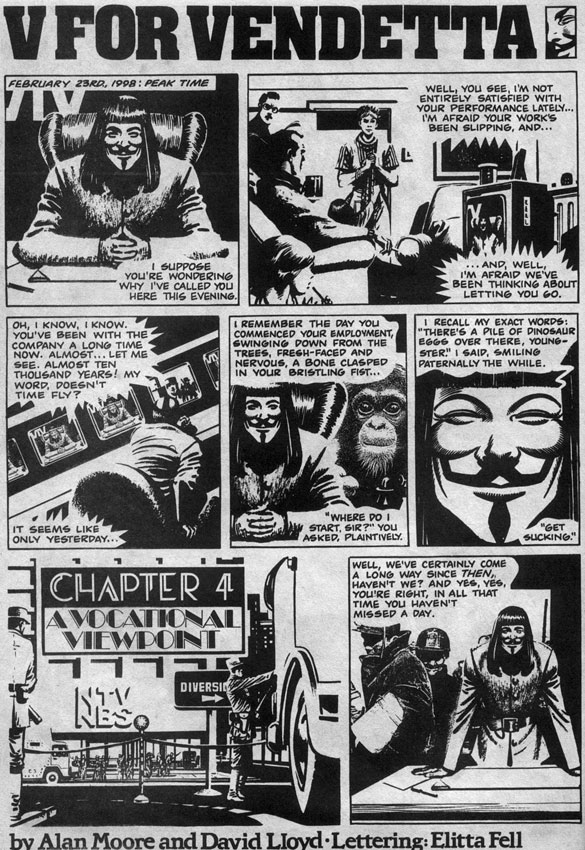
The character of Valerie answers the question "Why we fight" in Alan Moore and David Lloyd's V for Vendetta, dramatized here:
If Valerie is the heart of the thing, my other favorite scene never appeared in the film -- a film Alan Moore sniffed at as "a thwarted and frustrated and largely impotent American liberal fantasy of someone with American liberal values standing up against a state run by neoconservatives— which is not what the comic V for Vendetta was about."
My other favorite is a sequence showing V speaking over a pirate broadcast to the audience of a fascist "news" program. As he speaks, the screen shows scenes of human misbehavior, some straight to the point, some ironic. It's more Jonathon Swift than Orwell-- it's Alan Moore, actually, and it might be the kind of literature you can only pull off in a comic, giving you time to consider the justapostion of word and image. It's the kind of dark laughter Twain used to pull off in The War Prayer and Letters from the Earth, and the kind of thing I don't ask anyone but myself to laugh at, but you might:
Good evening, London. I thought it time we had a little talk. Are you sitting comfortably? Then I'll begin... I suppose you're wondering why I've called you here this evening. Well, you see, I'm not entirely satisfied with your performance lately... I'm afraid your work's been slipping and... and well, I'm afraid we've been thinking about letting you go.
 Oh, I know, I know. You've been with the company a long time now. Almost... let me see. Almost ten thousand years! My word, doesn't time fly? It seems like only yesterday... I remember the day you commenced your employment, swinging down from the trees, fresh-faced and nervous, a bone clasped in your bristling fist... "Where do I start, sir?", you asked, plaintively. I recalled my exact words: "There's a pile of dinosaur eggs over there, youngster", I said, smiling paternally all the while. "Get sucking".
Well, we've certainly come a long way since then, haven't we? And yes, yes, you're right, in all that time you haven't missed a day. Well done, thou good and faithful servant.
Also, please don't think I've forgotten about your outstanding service record, or about all of the invaluable contributions that you've made to the company... Fire, the wheel, agriculture... It's an impressive list, old-timer. A jolly impressive list. Don't get me wrong. But... well, to be frank, we've had our problems too.
There's no getting away from it. Do you know what I think a lot of it stems from? I'll tell you... It's your basic unwillingness to get on in the company. You don't seem to want to face up to any real responibility. To be your own boss.
Lord knows you've been given plenty of opportunities... We've offered you promotion time and time again, and each time you've turned us down. "I couldn't handle the work, Guv'Nor", you wheedled. "I know my place".
To be frank, you're not trying, are you? You see, you've been standing still for far too long, and its starting to show in your work... And, I might add, in your general standard of behavior. The constant bickering on the factory floor has not escaped my attention... nor the recent bouts of rowdiness in the staff canteen.
Then of course there's... Hmm. Well, I didn't really want to have to bring this up, but... Well, you see, I've been hearing some disturbing rumors about your personal life. No, never you mind who told me. No names, no pack drill... I understand you are unable to get on with your spouse. I hear that you argue. I am told that you shout. Violence has been mentioned. I am reliably informed that you always hurt the one your love... the one you shouldn't hurt at all.
And what about the children, its always the children who suffer, as you're well aware. Poor little mites. What are they to make of it? What are they to make of all your bullying, your despair, your cowardice and all your fondly nurtured bigotries? Really, its not good enough, is it?
And its no good blaming the drop in work standards on and management either... though to be sure, the management is very bad. In fact, let us not mince words... The Management is terrible!
We've had a string of embezzelers, frauds, liars and lunatics making a string of catastrophic decisions. This is plain fact. But who elected them?
It was you! You who elected these people! You who gave them the power to make your decisions for you! While I'll admit that anyone can make a mistake once, to go on making the same lethal errors century after century seems to me nothing short of deliberate.
You have encouraged these malicious incompetents, who have made your working life a shambles. You have accepted without question their senseless orders. You have allowed them to fill your workspace with dangerous and unproven machines.
You could have stopped them. All you had to say was "No". You have no spine. You have no pride. You are no longer an asset to the company.
I will, however, be generous. You will be granted two years to show me some improvement in your work. If at the end of that time you are still unwilling to make a go of it... you're fired.
That will be all. You may return to your labors.
(Alan Moore, V for Vendetta)

"It was believed afterward that the man was a lunatic, because there was no sense in what he said." (Twain)

The character of Valerie answers the question "Why we fight" in Alan Moore and David Lloyd's V for Vendetta, dramatized here:
If Valerie is the heart of the thing, my other favorite scene never appeared in the film -- a film Alan Moore sniffed at as "a thwarted and frustrated and largely impotent American liberal fantasy of someone with American liberal values standing up against a state run by neoconservatives— which is not what the comic V for Vendetta was about."
My other favorite is a sequence showing V speaking over a pirate broadcast to the audience of a fascist "news" program. As he speaks, the screen shows scenes of human misbehavior, some straight to the point, some ironic. It's more Jonathon Swift than Orwell-- it's Alan Moore, actually, and it might be the kind of literature you can only pull off in a comic, giving you time to consider the justapostion of word and image. It's the kind of dark laughter Twain used to pull off in The War Prayer and Letters from the Earth, and the kind of thing I don't ask anyone but myself to laugh at, but you might:
Good evening, London. I thought it time we had a little talk. Are you sitting comfortably? Then I'll begin... I suppose you're wondering why I've called you here this evening. Well, you see, I'm not entirely satisfied with your performance lately... I'm afraid your work's been slipping and... and well, I'm afraid we've been thinking about letting you go.
Oh, I know, I know. You've been with the company a long time now. Almost... let me see. Almost ten thousand years! My word, doesn't time fly? It seems like only yesterday... I remember the day you commenced your employment, swinging down from the trees, fresh-faced and nervous, a bone clasped in your bristling fist... "Where do I start, sir?", you asked, plaintively. I recalled my exact words: "There's a pile of dinosaur eggs over there, youngster", I said, smiling paternally all the while. "Get sucking". Well, we've certainly come a long way since then, haven't we? And yes, yes, you're right, in all that time you haven't missed a day. Well done, thou good and faithful servant.
Also, please don't think I've forgotten about your outstanding service record, or about all of the invaluable contributions that you've made to the company... Fire, the wheel, agriculture... It's an impressive list, old-timer. A jolly impressive list. Don't get me wrong. But... well, to be frank, we've had our problems too.
There's no getting away from it. Do you know what I think a lot of it stems from? I'll tell you... It's your basic unwillingness to get on in the company. You don't seem to want to face up to any real responibility. To be your own boss.
Lord knows you've been given plenty of opportunities... We've offered you promotion time and time again, and each time you've turned us down. "I couldn't handle the work, Guv'Nor", you wheedled. "I know my place".
To be frank, you're not trying, are you? You see, you've been standing still for far too long, and its starting to show in your work... And, I might add, in your general standard of behavior. The constant bickering on the factory floor has not escaped my attention... nor the recent bouts of rowdiness in the staff canteen.
Then of course there's... Hmm. Well, I didn't really want to have to bring this up, but... Well, you see, I've been hearing some disturbing rumors about your personal life. No, never you mind who told me. No names, no pack drill... I understand you are unable to get on with your spouse. I hear that you argue. I am told that you shout. Violence has been mentioned. I am reliably informed that you always hurt the one your love... the one you shouldn't hurt at all.
And what about the children, its always the children who suffer, as you're well aware. Poor little mites. What are they to make of it? What are they to make of all your bullying, your despair, your cowardice and all your fondly nurtured bigotries? Really, its not good enough, is it?
And its no good blaming the drop in work standards on and management either... though to be sure, the management is very bad. In fact, let us not mince words... The Management is terrible!
We've had a string of embezzelers, frauds, liars and lunatics making a string of catastrophic decisions. This is plain fact. But who elected them?
It was you! You who elected these people! You who gave them the power to make your decisions for you! While I'll admit that anyone can make a mistake once, to go on making the same lethal errors century after century seems to me nothing short of deliberate.
You have encouraged these malicious incompetents, who have made your working life a shambles. You have accepted without question their senseless orders. You have allowed them to fill your workspace with dangerous and unproven machines.
You could have stopped them. All you had to say was "No". You have no spine. You have no pride. You are no longer an asset to the company.
I will, however, be generous. You will be granted two years to show me some improvement in your work. If at the end of that time you are still unwilling to make a go of it... you're fired.
That will be all. You may return to your labors.
(Alan Moore, V for Vendetta)
"It was believed afterward that the man was a lunatic, because there was no sense in what he said." (Twain)
Commonplace Book of Readings, July 2009
“There are some people with a vested interest in the world as it is, because that’s the world they have power over.” -- Alan Moore
***
“People who read Empire of the Sun have often said to me, ‘What a strange life, how unusual,’ and I say to them, actually, the life I led in Shanghai before and during the Second World War was not strange; it wasn’t unusual. The majority of the people on this planet today and for most of this century and previous centuries have always lived lives much closer to the way I lived than to, say, the comfortable suburbs of Western Europe and North America. It is here where I live today that is very strange by the world’s standards. Civil war, famine, flood, drought, poverty, disease are the norms of human experience.” -- J.G. Ballard in a BBC interview.
***
“Conservatives are only funny when they don’t mean to be. How many fucking times do we have to say this?”
-- Comment by “Aquannissiwamissoo” on Wonkette
***
“This reflection on another girl’s morality is interesting, because however much our heroine revels in her naughtiness—and she does revel—she is at pains to tell us that she is not promiscuous like the other girls. Even in this genre, which is almost explicitly about how we shouldn’t judge the naked girl on the stage, we find the same judgment, the same innate, catty, female dividing of the world into sluts and non-sluts, that takes place in the rest of the world.” – Katie Roiphe on stripper’s memoirs in Double-X
***
“Popular artists, then faced with the corporate control of the popular media, have a choice: like Harvey Pekar, they can say exactly what they think about the times in which we live and thus remain at the margins of culture, at best only a cult figure, or, like Letterman, they can swallow their reservations and move to the spot-lit center of the culture, while remaining at the margins of the discourse about what is really going on.”
-- James Hynes, In These Times
***
“I had, by then, abandoned all pretence of work… I could not write or even, by that time, read. Words made no sense to me. I made no sense to me so how could I make sense to anyone else? If journalism is about anything, it is about making sense of the world in which we live. Words, sense, the very reason that kept me moored and anchored to the world had abandoned me. I was lost and that loss was catastrophic. Who are you when you are no longer who you are? What do you do with a self that is no longer your self? If you don’t know who you are, how do you go on living? If you cannot live as yourself, who and what is it that you are living for?” -- Sally Brampton, Shoot the Damn Dog
***
“You bid me rouse myself. Go, bid a man paralytic in both arms rub them briskly together, and that will cure him. Alas! That I cannot move my arms is my complaint.” – Coleridge, in a letter on writer’s block, 1804.
***
“Just how bad will August be, because of the Republicans and various anti-reform special interest groups? Imagine the Brooks Brothers Riot, but happening every day, across the country, for the entire month. Just health insurance employees being dispatched in plainclothes to town halls, so as to shout nonsense at congressmen and senators trying to inform their constituents about health care reform. CALLING IT NOW: Most obnoxious month in American history! Maybe.” – Wonkette, week of August 1st, 2009
***
“The experience of the poor… comes to resemble that of a rat in a cage scrambling to avoid erratically administered electric shocks.” – Barbara Ehrenreich
***
“It’s the sinking sensation that the American game is rigged — that, as the president typically put it a month after his inauguration, the system is in hock to “the interests of powerful lobbyists or the wealthiest few” who have “run Washington far too long.” …. What disturbs Americans of all ideological persuasions is the fear that almost everything, not just government, is fixed or manipulated by some powerful hidden hand, from commercial transactions as trivial as the sales of prime concert tickets to cultural forces as pervasive as the news media. It’s a cynicism confirmed almost daily by events.” -- Frank Rich, The New York Times
***
“A growing body of research shows that people with red hair need larger doses of anesthesia and often are resistant to local pain blockers like Novocaine…. Researchers believe redheads are more sensitive to pain because of a mutation in a gene that affects hair color. In people with brown, black and blond hair, the gene, for the melanocortin-1 receptor, produces melanin. But a mutation in the MC1R gene results in the production of a substance called pheomelanin that results in red hair and fair skin. The MC1R gene belongs to a family of receptors that include pain receptors in the brain, and as a result, a mutation in the gene appears to influence the body’s sensitivity to pain. A 2004 study showed that redheads require, on average, about 20 percent more general anesthesia than people with dark hair or blond coloring. And in 2005, researchers found that redheads are more resistant to the effects of local anesthesia, such as the numbing drugs used by dentists. In the latest study, the researchers tested for the MC1R gene variant, finding it in 65 of 67 redheads and in 20 of 77 people with brown or black hair.” – Tara Parker Pope, The New York Times
***
In the political jargon of those days, the word ‘intellectual’ was an insult. It indicated someone who did not understand life and was cut off from the people…. The invasion of Bohemia by the Russian army, whose occupation of the country had affected everything, had been for her a signal of a new life, out of the ordinary. She saw that people who ranked above her (and everyone ranked above her) were being deprived, on the slightest allegation, of their powers, their positions, their jobs, and their bread, and that excited her; she started to denounce people herself.
"So why is she still a gatekeeper? Why wasn't she promoted?"
The mechanic smiled. "She can't count to ten. They can't find another job for her. All they can do is let her go on denouncing people. For her, that's a promotion!" ….
The mechanic leaned over the engine again and said: "In Wenceslaus Square, in Prague, a guy is throwing up. Another guy comes up to him, pulls a long face, shakes his head, and says: 'I know just what you mean.'”
-- Milan Kundera, The Book of Laughter and Forgetting
***
“People who read Empire of the Sun have often said to me, ‘What a strange life, how unusual,’ and I say to them, actually, the life I led in Shanghai before and during the Second World War was not strange; it wasn’t unusual. The majority of the people on this planet today and for most of this century and previous centuries have always lived lives much closer to the way I lived than to, say, the comfortable suburbs of Western Europe and North America. It is here where I live today that is very strange by the world’s standards. Civil war, famine, flood, drought, poverty, disease are the norms of human experience.” -- J.G. Ballard in a BBC interview.
***
“Conservatives are only funny when they don’t mean to be. How many fucking times do we have to say this?”
-- Comment by “Aquannissiwamissoo” on Wonkette
***
“This reflection on another girl’s morality is interesting, because however much our heroine revels in her naughtiness—and she does revel—she is at pains to tell us that she is not promiscuous like the other girls. Even in this genre, which is almost explicitly about how we shouldn’t judge the naked girl on the stage, we find the same judgment, the same innate, catty, female dividing of the world into sluts and non-sluts, that takes place in the rest of the world.” – Katie Roiphe on stripper’s memoirs in Double-X
***
“Popular artists, then faced with the corporate control of the popular media, have a choice: like Harvey Pekar, they can say exactly what they think about the times in which we live and thus remain at the margins of culture, at best only a cult figure, or, like Letterman, they can swallow their reservations and move to the spot-lit center of the culture, while remaining at the margins of the discourse about what is really going on.”
-- James Hynes, In These Times
***
“I had, by then, abandoned all pretence of work… I could not write or even, by that time, read. Words made no sense to me. I made no sense to me so how could I make sense to anyone else? If journalism is about anything, it is about making sense of the world in which we live. Words, sense, the very reason that kept me moored and anchored to the world had abandoned me. I was lost and that loss was catastrophic. Who are you when you are no longer who you are? What do you do with a self that is no longer your self? If you don’t know who you are, how do you go on living? If you cannot live as yourself, who and what is it that you are living for?” -- Sally Brampton, Shoot the Damn Dog
***
“You bid me rouse myself. Go, bid a man paralytic in both arms rub them briskly together, and that will cure him. Alas! That I cannot move my arms is my complaint.” – Coleridge, in a letter on writer’s block, 1804.
***
“Just how bad will August be, because of the Republicans and various anti-reform special interest groups? Imagine the Brooks Brothers Riot, but happening every day, across the country, for the entire month. Just health insurance employees being dispatched in plainclothes to town halls, so as to shout nonsense at congressmen and senators trying to inform their constituents about health care reform. CALLING IT NOW: Most obnoxious month in American history! Maybe.” – Wonkette, week of August 1st, 2009
***
“The experience of the poor… comes to resemble that of a rat in a cage scrambling to avoid erratically administered electric shocks.” – Barbara Ehrenreich
***
“It’s the sinking sensation that the American game is rigged — that, as the president typically put it a month after his inauguration, the system is in hock to “the interests of powerful lobbyists or the wealthiest few” who have “run Washington far too long.” …. What disturbs Americans of all ideological persuasions is the fear that almost everything, not just government, is fixed or manipulated by some powerful hidden hand, from commercial transactions as trivial as the sales of prime concert tickets to cultural forces as pervasive as the news media. It’s a cynicism confirmed almost daily by events.” -- Frank Rich, The New York Times
***
“A growing body of research shows that people with red hair need larger doses of anesthesia and often are resistant to local pain blockers like Novocaine…. Researchers believe redheads are more sensitive to pain because of a mutation in a gene that affects hair color. In people with brown, black and blond hair, the gene, for the melanocortin-1 receptor, produces melanin. But a mutation in the MC1R gene results in the production of a substance called pheomelanin that results in red hair and fair skin. The MC1R gene belongs to a family of receptors that include pain receptors in the brain, and as a result, a mutation in the gene appears to influence the body’s sensitivity to pain. A 2004 study showed that redheads require, on average, about 20 percent more general anesthesia than people with dark hair or blond coloring. And in 2005, researchers found that redheads are more resistant to the effects of local anesthesia, such as the numbing drugs used by dentists. In the latest study, the researchers tested for the MC1R gene variant, finding it in 65 of 67 redheads and in 20 of 77 people with brown or black hair.” – Tara Parker Pope, The New York Times
***
In the political jargon of those days, the word ‘intellectual’ was an insult. It indicated someone who did not understand life and was cut off from the people…. The invasion of Bohemia by the Russian army, whose occupation of the country had affected everything, had been for her a signal of a new life, out of the ordinary. She saw that people who ranked above her (and everyone ranked above her) were being deprived, on the slightest allegation, of their powers, their positions, their jobs, and their bread, and that excited her; she started to denounce people herself.
"So why is she still a gatekeeper? Why wasn't she promoted?"
The mechanic smiled. "She can't count to ten. They can't find another job for her. All they can do is let her go on denouncing people. For her, that's a promotion!" ….
The mechanic leaned over the engine again and said: "In Wenceslaus Square, in Prague, a guy is throwing up. Another guy comes up to him, pulls a long face, shakes his head, and says: 'I know just what you mean.'”
-- Milan Kundera, The Book of Laughter and Forgetting
Oracle's Creator Runs Afoul of Our Glorious Health Care System

While corporate charity continues unabated, writer John Ostrander is going blind because the health insurance he bought isn't going to be there when he needs it. Ostrander, godfather of Barbara Gordon's re-invention as Oracle, still needs several surgeries with extended stays in Boston to save his eye sight.
Friends in the industry organized an auction to raise money for Ostrander at the Chicago Comic Con, with original art like that shown by Art Adams, Paul Chadwick and others along with autographed books and memorabilia. Their website at www.comix4sight.com has current information. Direct contributions (made out to John Ostrander) can also be sent to:
Mike Gold and Adriane Nash
ArrogantMGMS
304 Main Avenue, #194
Norwalk, CT 06851

Hemophilia, Comic Book Artists and Kitty Pryde
A sweet and simple fund-raiser idea: Douglas E. Sherwood of Oni Press asked a couple of dozen artists to draw his favorite X-Men character, Kitty Pryde, with the results to be auctioned on E-Bay as a fundraiser for the Oregon Hemophilia Treatment Center. I like the specificity of the idea, and that it offers something tangible-- an hour's diversion, a framed print, maybe a t-shirt-- to a relatively small pool of contributors.
Myself an O.G. X-Men reader, I'd outgrown the comic a decade before Kitty joined the team in 1980, though I came back for Grant Morrison's seven-volume run (still my favorite) and enjoyed Joss Whedon's take on the character. For me, it's all about Kitty and Lockheed, the most interesting pet/person relationship in comics. As a writer, it seems to me that Marvel is missing a bet by letting Kitty age with her readers, and not producing a series of adventures for the under twelves to be marketed to new readers, something like DC's Tiny Titans or Jeff Smith's Shazam. Call it "A Girl and Her Dragon", with the covers a parody of the "Boy and His Dog" motif. A million-dollar idea from a middle-aged man who wants to reboot Kamandi, Last Boy on Earth.
Myself an O.G. X-Men reader, I'd outgrown the comic a decade before Kitty joined the team in 1980, though I came back for Grant Morrison's seven-volume run (still my favorite) and enjoyed Joss Whedon's take on the character. For me, it's all about Kitty and Lockheed, the most interesting pet/person relationship in comics. As a writer, it seems to me that Marvel is missing a bet by letting Kitty age with her readers, and not producing a series of adventures for the under twelves to be marketed to new readers, something like DC's Tiny Titans or Jeff Smith's Shazam. Call it "A Girl and Her Dragon", with the covers a parody of the "Boy and His Dog" motif. A million-dollar idea from a middle-aged man who wants to reboot Kamandi, Last Boy on Earth.
Watching People Watch the Watchmen
I enjoyed the Watchmen film more than I thought i would, seeing it with friends who'd never read the book but were able to respond to the larger themes. But ye gods, keep the general audience away from this thing that we love. Our local theater felt compelled to print out a sign warning customers that this is not a "superhero" film like they're used to, and I've already had students complain after the fact that they didn't understand the story or were disturbed by the content. I'll show you "school improvement" as soon as you outlaw parents-- who are these people that take an underage child to see the R-rated Watchmen? Probably the same parents that complain (never to my face) about my PG-13 World History class.

Harlan Ellison used to talk about "the fan sneer", that peculiar expression on a connoisseur's face when everyone on the subway starts reading The Lord of the Rings, or drinking an obscure wine that you discovered, or quoting from a cult film. On the one hand you're pleased that something of value has found a wide audience; on the other hand, when the mob jumps into the pool, they inevitably start pissing in it. Now everyone can plop down a few bucks to see the film version of Alan Moore's The Watchmen, including those who can't read or don't read, which sadly includes the director.
I thought the performances were perfect, and visually it's a panel-for-panel recreation of Dave Gibbons art-- Hollywood's problem is that set designers and special effects artists have outpaced its writers and directors by twenty years, giving us gorgeous films without souls. Jackie Earle Haley is a wonderful Rorschach, despite the cuts made in his part and Patrick Wilson as Dan Dreiberg is a revelation in an emotionally complex but less showy, and therefore more complicated role to play. This could have been Adam West as Batman, and instead Wilson's humanity, contrasted with John Osterman's perfection, has us rooting for Dan all the way. Malin Ackerman has been unjustly criticized as eye-candy-- Sally and Laurie Jupiter represent the pin-up girl archetype, just as Rorsharch is the paranoid (Batman or the Shadow without funds), Adrian the genius, Eddie the murderous "patriot", John the Superman and Dan the high tech millionaire adventurer. It's not Ackerman's fault that Laurie Jupiter's emotional development was cut down to the one big scene when she puts together the circumstances of her birth. In the novel, Laurie figures it out for herself; in the movie, she can't do it without magical help from Osterman.
Visually gorgeous, and the actors put their hearts into it. But the director, Zach Snyder, is tone-deaf. The publicity mill keeps calling him a "visionary genius", but even Snyder knows the visions were piggybacked on someone else's hard work.

The problem is that whenever the director deviates from Moore and Gibbon's text, his additions are immature and gross. Snyder represents that part of Hollywood that panders to 15 year old misanthropes. He has no aesthetic common sense.
Snyder's Nixon wears a caricature nose. He rewrites jokes and blows the punchline. Violence in the film is drawn out from a panel or two to splatterporn in loving slow motion. Instead of Sally Jupiter scrabbling on the floor in ugly desperation to escape her rapist, Carla Gugino is bent aesthetically over a pool table, attempted rape as a Helmut Newton fashion spread. Snyder's film of 300, for all its fascist silliness, homoeroticism made palatable to an American audience, had a few genuinely beautiful images, but all of them based on Frank Miller and Lynn Varley's drawings-- and Snyder added a rape scene to that.
When it comes to Rorschach's murder of the pedophile, the text has Rorschach handcuffing the villain and then setting the place on fire; we've already had our dose of horror by contemplating the off panel death of the victim. In the film, we're treated to Rorschach whacking at a prop head of the criminal with a meat cleaver. I've come to expect this from Hollywood, something to make the Roman mobs squeal "ew, gross!", but it's as obtrusive, gross and laughable as the cock-blocking voice singing Leonard Cohen's "Hallelujah" during Dan and Laurie's sex scene. "Was offered Swedish love and French love-- but not American love. American love; like Coke in green glass bottles. They dont make it anymore."
Snyder's lip-licking violence, including two, count 'em, two slo-mo kung fu scenes for Laurie and Dan, leave no room for things like Rorschach's soliloquy as he watches the pedophile's factory burn: "Stood in firelight, sweltering. Bloodstain on chest like map of violent new continent. Felt cleansed. Felt dark planet turn under my feet and knew what cats know that makes them scream like babies in night. Looked at sky through smoke heavy with human fat and God was not there. The cold, suffocating dark goes on forever and we are alone. Live our lives, lacking anything better to do. Devise reason later. Born from oblivion; bear children, hell-bound as ourselves, go into oblivion. There is nothing else. Existence is random. Has no pattern save what we imagine after staring at it for too long. No meaning save what we choose to impose. This rudderless world is not shaped by vague metaphysical forces. It is not God who kills the children. Not fate that butchers them or destiny that feeds them to the dogs. It’s us. Only us. Streets stank of fire. The void breathed hard on my heart, turning it's illusions to ice, shattering them. Was reborn then, free to scrawl own design on this morally blank world. Was Rorschach. Does that answer your questions, Doctor?"

Only part of that speech survives. Snyder makes the climax of the story unrecognizable, and judging from my friends reaction, incomprehensible. After washing our face in gore, he wimps out and cuts Laurie's horrified reaction to New York streets filled with corpses, mass murder for the greater good. Instead we're looking at a big computer generated hole. I've no problem with filmmakers editing a work, but shouldn't they follow an artistic Hippocratic oath, and first do no harm?
This isn't a fanboy's plaint-- hell, I'd cut Hamlet or Macbeth for length-- but why are so many people who rise to this level in Hollywood-- the task of presenting a cultural touchstone to a mass audience-- have to be so tone-deaf?

Harlan Ellison used to talk about "the fan sneer", that peculiar expression on a connoisseur's face when everyone on the subway starts reading The Lord of the Rings, or drinking an obscure wine that you discovered, or quoting from a cult film. On the one hand you're pleased that something of value has found a wide audience; on the other hand, when the mob jumps into the pool, they inevitably start pissing in it. Now everyone can plop down a few bucks to see the film version of Alan Moore's The Watchmen, including those who can't read or don't read, which sadly includes the director.

I thought the performances were perfect, and visually it's a panel-for-panel recreation of Dave Gibbons art-- Hollywood's problem is that set designers and special effects artists have outpaced its writers and directors by twenty years, giving us gorgeous films without souls. Jackie Earle Haley is a wonderful Rorschach, despite the cuts made in his part and Patrick Wilson as Dan Dreiberg is a revelation in an emotionally complex but less showy, and therefore more complicated role to play. This could have been Adam West as Batman, and instead Wilson's humanity, contrasted with John Osterman's perfection, has us rooting for Dan all the way. Malin Ackerman has been unjustly criticized as eye-candy-- Sally and Laurie Jupiter represent the pin-up girl archetype, just as Rorsharch is the paranoid (Batman or the Shadow without funds), Adrian the genius, Eddie the murderous "patriot", John the Superman and Dan the high tech millionaire adventurer. It's not Ackerman's fault that Laurie Jupiter's emotional development was cut down to the one big scene when she puts together the circumstances of her birth. In the novel, Laurie figures it out for herself; in the movie, she can't do it without magical help from Osterman.
Visually gorgeous, and the actors put their hearts into it. But the director, Zach Snyder, is tone-deaf. The publicity mill keeps calling him a "visionary genius", but even Snyder knows the visions were piggybacked on someone else's hard work.

The problem is that whenever the director deviates from Moore and Gibbon's text, his additions are immature and gross. Snyder represents that part of Hollywood that panders to 15 year old misanthropes. He has no aesthetic common sense.
Snyder's Nixon wears a caricature nose. He rewrites jokes and blows the punchline. Violence in the film is drawn out from a panel or two to splatterporn in loving slow motion. Instead of Sally Jupiter scrabbling on the floor in ugly desperation to escape her rapist, Carla Gugino is bent aesthetically over a pool table, attempted rape as a Helmut Newton fashion spread. Snyder's film of 300, for all its fascist silliness, homoeroticism made palatable to an American audience, had a few genuinely beautiful images, but all of them based on Frank Miller and Lynn Varley's drawings-- and Snyder added a rape scene to that.
When it comes to Rorschach's murder of the pedophile, the text has Rorschach handcuffing the villain and then setting the place on fire; we've already had our dose of horror by contemplating the off panel death of the victim. In the film, we're treated to Rorschach whacking at a prop head of the criminal with a meat cleaver. I've come to expect this from Hollywood, something to make the Roman mobs squeal "ew, gross!", but it's as obtrusive, gross and laughable as the cock-blocking voice singing Leonard Cohen's "Hallelujah" during Dan and Laurie's sex scene. "Was offered Swedish love and French love-- but not American love. American love; like Coke in green glass bottles. They dont make it anymore."
Snyder's lip-licking violence, including two, count 'em, two slo-mo kung fu scenes for Laurie and Dan, leave no room for things like Rorschach's soliloquy as he watches the pedophile's factory burn: "Stood in firelight, sweltering. Bloodstain on chest like map of violent new continent. Felt cleansed. Felt dark planet turn under my feet and knew what cats know that makes them scream like babies in night. Looked at sky through smoke heavy with human fat and God was not there. The cold, suffocating dark goes on forever and we are alone. Live our lives, lacking anything better to do. Devise reason later. Born from oblivion; bear children, hell-bound as ourselves, go into oblivion. There is nothing else. Existence is random. Has no pattern save what we imagine after staring at it for too long. No meaning save what we choose to impose. This rudderless world is not shaped by vague metaphysical forces. It is not God who kills the children. Not fate that butchers them or destiny that feeds them to the dogs. It’s us. Only us. Streets stank of fire. The void breathed hard on my heart, turning it's illusions to ice, shattering them. Was reborn then, free to scrawl own design on this morally blank world. Was Rorschach. Does that answer your questions, Doctor?"

Only part of that speech survives. Snyder makes the climax of the story unrecognizable, and judging from my friends reaction, incomprehensible. After washing our face in gore, he wimps out and cuts Laurie's horrified reaction to New York streets filled with corpses, mass murder for the greater good. Instead we're looking at a big computer generated hole. I've no problem with filmmakers editing a work, but shouldn't they follow an artistic Hippocratic oath, and first do no harm?
This isn't a fanboy's plaint-- hell, I'd cut Hamlet or Macbeth for length-- but why are so many people who rise to this level in Hollywood-- the task of presenting a cultural touchstone to a mass audience-- have to be so tone-deaf?
He Watched Until His Eyes Bled

My friend Jef Burnham just finished his 100th review for Film Monthly, on a film of Goldsmith's She Stoops to Conquer. Were this a comic book, it would have a wraparound cover with the entire cast of characters and a hundred little Jefs watching them; if this was Vanity Fair, there would be a lot of manufactured drama over whose expensively powdered bare bottom should grace the cover; if it was Time magazine, there'd be a cover informing us how important Time is. Instead we have Jef emerging from his burrow and predicting six more weeks of night.

"Three Fancies from the Infernal Garden" by Claire Cooney

"Three Fancies from the Infernal Garden", a short story by my friend Claire Cooney, can be read online in the Winter 2009 issue of Subterranean magazine.
One of the things I love about Claire's poetry (and here, her stories) is that they look like smiling candied apples until you get up close enough to bite into one and you find them biting back. Here she plays around with figures from Russian fairy tales-- there's a firebird, and the witch Baba Yaga, and people called Ivan.

Claire is a fellow member of the Twilight Tales writers' group in Chicago, a survivor of Saratoga Springs and the Battle of the Black Gate, grande dame in training and one of the booksellers who brought the late lamented Kate the Great's Book Emporium to life. And if you live in Chicago, you should definitely track down Katie and Claire's other ventures such as Top Shelf Books in Palatine, with its open mic on Thursdays-- and attend Twilight Tales (at the Mystic Celt until the Red Lion finishes remodeling) the next time Claire is reading. I would adopt her if it wouldn't cause talk, Claire being too tall for me to explain as a Third World orphan.
.jpg)
Books: James Crumley, 1939-2008

Word comes that James Crumley has died of congestive heart failure. At least one of his novels, The Last Good Kiss earned him a seat at the table with Dashiell Hammett and Raymond Chandler, and another, Dancing Bear, is for me one of the best American novels of the last fifty years.
A lot of us have the first line of The Last Good Kiss memorized, like the opening of Moby Dick or Pride and Prejudice: “When I finally caught up with Abraham Trahearne, he was drinking beer with an alcoholic bulldog named Fireball Roberts in a ramshackle joint just outside of Sonora, California, drinking the heart right out of a fine spring afternoon.” – But it’s Dancing Bear that haunts me as a picture of lonely America in the closing years of the last century. It is also very funny and sometimes poetic and very violent and very sad.

The critics’ darling, Cormac McCarthy, covers some of the same violent ground, but doesn’t tell you anything you don’t already suspect about debased human nature; despite the poetry, there isn’t anything in No Country for Old Men or Blood Meridian you couldn’t learn elsewhere, and the Oprah bestseller The Road was a rehash of every genre post apocalypse novel from Jack London’s “The Scarlet Plague” to Brian K. Vaughn’s Y: The Last Man, and you’ll have a much better time reading Y. McCarthy and James Elroy have become splatterporn for the literati, assigned by professors as exemplary instruction for the naïve. "America was never innocent,” Ellroy scowls in American Tabloid We popped our cherry on the boat over and looked back with no regrets."

Violence is as American as apple pie, but you need a great soul for it to become tragedy, and that’s what Crumley’s books provide with narrators like C. W. in Kiss and Milo in Dancing Bear. Without a soulful witness, as in the heartless landscapes of McCarthy, Ellroy, and your average slasher film, suffering has no meaning, the dead are left unburied and unmourned as Antigone’s brothers. Crumley looks back more often than Lot's wife, and is all about the regret.
The “dancing bear” of the title might refer to the Indian myth invented for the opening chapter, telling how the bears taught native tribes to gather sweetness from the bee, or it might be a section of forest near the Dancing Bear River stolen from the natives by Milo’s grandfather, and endangered by corporate polluters (“pollution” being our era’s euphemism for poisoning someone else’s earth and water), or it might be the hide of a grizzly killed by poachers, or it might be Milo himself, kept hopping like a circus bear trained to “dance” by making him walk on a hot metal plate.
The later adventures of Milo and C.W., in Bordersnakes and The Mexican Tree Duck sometimes teeter on self-parody— the New York Times in a snide review, called the setting “a Montana demimonde undreamed of in the philosophies of Dale Evans”-- but then, The Thin Man and The Little Sister aren’t as good as Red Harvest or The Long Goodbye. For a while there, in The Last Good Kiss, The Wrong Case and the war novel One to Count Cadence, James Crumley crafted very good books, and in Dancing Bear he made a great one.

My neighbor the detective, who knew Crumley out West and told me about his death, has Crumley stories to tell, but my favorite is from the Chicago Sun-Times. Crumley showed up late for a reading once and apologized, explaining, "I lost my watch."
"Any idea where?" he was asked.
"Yeah," Crumley said. "I threw it out a car window in El Paso in 1978."
Books and Favorite Scenes: Dickens' Dog-and-Pony Show
An idle question from John Martin made me look up my favorite character in Dickens, the theatrical manager Crummles from Nicholas Nickleby. Crummles is a relative of the mountebank Fox and Cat in Pinocchio and the Mouse from Pogo, featured in my masthead, but I suspect they were all carved from life.
... Nicholas was prepared for something odd, but not for something quite so odd as the sight he encountered. At the upper end of the room, were a couple of boys, one of them very tall and the other very short, both
dressed as sailors--or at least as theatrical sailors, with belts, buckles, pigtails, and pistols complete--fighting what is called in play-bills a terrific combat, with two of those short broad-swords with basket hilts which are commonly used at our minor theatres. The short boy had gained a great advantage over the tall boy, who was reduced to mortal strait, and both were overlooked by a large heavy man, perched against the corner of a table, who emphatically adjured them to strike a
little more fire out of the swords, and they couldn't fail to bring the house down, on the very first night.
'Mr Vincent Crummles,' said the landlord with an air of great deference.
'This is the young gentleman.'
Mr Vincent Crummles received Nicholas with an inclination of the head,
something between the courtesy of a Roman emperor and the nod of a pot
companion; and bade the landlord shut the door and begone.
'There's a picture,' said Mr Crummles, motioning Nicholas not to advance
and spoil it. 'The little 'un has him; if the big 'un doesn't knock
under, in three seconds, he's a dead man. Do that again, boys.'
The two combatants went to work afresh, and chopped away until the
swords emitted a shower of sparks: to the great satisfaction of Mr
Crummles, who appeared to consider this a very great point indeed. The
engagement commenced with about two hundred chops administered by the
short sailor and the tall sailor alternately, without producing any
particular result, until the short sailor was chopped down on one knee;
but this was nothing to him, for he worked himself about on the one knee
with the assistance of his left hand, and fought most desperately until
the tall sailor chopped his sword out of his grasp. Now, the inference
was, that the short sailor, reduced to this extremity, would give in at
once and cry quarter, but, instead of that, he all of a sudden drew
a large pistol from his belt and presented it at the face of the tall
sailor, who was so overcome at this (not expecting it) that he let
the short sailor pick up his sword and begin again. Then, the chopping
recommenced, and a variety of fancy chops were administered on both
sides; such as chops dealt with the left hand, and under the leg, and
over the right shoulder, and over the left; and when the short sailor
made a vigorous cut at the tall sailor's legs, which would have shaved
them clean off if it had taken effect, the tall sailor jumped over the
short sailor's sword, wherefore to balance the matter, and make it all
fair, the tall sailor administered the same cut, and the short sailor
jumped over HIS sword. After this, there was a good deal of dodging
about, and hitching up of the inexpressibles in the absence of braces,
and then the short sailor (who was the moral character evidently, for he
always had the best of it) made a violent demonstration and closed with
the tall sailor, who, after a few unavailing struggles, went down,
and expired in great torture as the short sailor put his foot upon his
breast, and bored a hole in him through and through.
'That'll be a double ENCORE if you take care, boys,' said Mr Crummles.
'You had better get your wind now and change your clothes.'

Having addressed these words to the combatants, he saluted Nicholas, who
then observed that the face of Mr Crummles was quite proportionate in
size to his body; that he had a very full under-lip, a hoarse voice, as
though he were in the habit of shouting very much, and very short
black hair, shaved off nearly to the crown of his head--to admit (as
he afterwards learnt) of his more easily wearing character wigs of any
shape or pattern.
'What did you think of that, sir?' inquired Mr Crummles.
'Very good, indeed--capital,' answered Nicholas.
'You won't see such boys as those very often, I think,' said Mr
Crummles.
Nicholas assented--observing that if they were a little better match--
'Match!' cried Mr Crummles.
'I mean if they were a little more of a size,' said Nicholas, explaining
himself.
'Size!' repeated Mr Crummles; 'why, it's the essence of the combat that
there should be a foot or two between them. How are you to get up the
sympathies of the audience in a legitimate manner, if there isn't a
little man contending against a big one?--unless there's at least five
to one, and we haven't hands enough for that business in our company.'
'I see,' replied Nicholas. 'I beg your pardon. That didn't occur to me,
I confess.'
'It's the main point,' said Mr Crummles. 'I open at Portsmouth the day
after tomorrow. If you're going there, look into the theatre, and see
how that'll tell.'
Nicholas promised to do so, if he could, and drawing a chair near the
fire, fell into conversation with the manager at once. He was very
talkative and communicative, stimulated perhaps, not only by his natural
disposition, but by the spirits and water he sipped very plentifully, or
the snuff he took in large quantities from a piece of whitey-brown paper
in his waistcoat pocket. He laid open his affairs without the smallest
reserve, and descanted at some length upon the merits of his company,
and the acquirements of his family; of both of which, the two
broad-sword boys formed an honourable portion. There was to be
a gathering, it seemed, of the different ladies and gentlemen at
Portsmouth on the morrow, whither the father and sons were proceeding
(not for the regular season, but in the course of a wandering
speculation), after fulfilling an engagement at Guildford with the
greatest applause.
'You are going that way?' asked the manager.
'Ye-yes,' said Nicholas. 'Yes, I am.'
'Do you know the town at all?' inquired the manager, who seemed to
consider himself entitled to the same degree of confidence as he had
himself exhibited.
'No,' replied Nicholas.
'Never there?'
'Never.'
Mr Vincent Crummles gave a short dry cough, as much as to say, 'If you
won't be communicative, you won't;' and took so many pinches of snuff
from the piece of paper, one after another, that Nicholas quite wondered
where it all went to.
While he was thus engaged, Mr Crummles looked, from time to time, with
great interest at Smike, with whom he had appeared considerably struck
from the first. He had now fallen asleep, and was nodding in his chair.

'Excuse my saying so,' said the manager, leaning over to Nicholas, and
sinking his voice, 'but what a capital countenance your friend has got!'
'Poor fellow!' said Nicholas, with a half-smile, 'I wish it were a
little more plump, and less haggard.'
'Plump!' exclaimed the manager, quite horrified, 'you'd spoil it for
ever.'
'Do you think so?'
'Think so, sir! Why, as he is now,' said the manager, striking his knee
emphatically; 'without a pad upon his body, and hardly a touch of paint
upon his face, he'd make such an actor for the starved business as was
never seen in this country. Only let him be tolerably well up in the
Apothecary in Romeo and Juliet, with the slightest possible dab of red
on the tip of his nose, and he'd be certain of three rounds the moment
he put his head out of the practicable door in the front grooves O.P.'

'You view him with a professional eye,' said Nicholas, laughing.
'And well I may,' rejoined the manager. 'I never saw a young fellow so
regularly cut out for that line, since I've been in the profession. And
I played the heavy children when I was eighteen months old.'
The appearance of the beef-steak pudding, which came in simultaneously
with the junior Vincent Crummleses, turned the conversation to other
matters, and indeed, for a time, stopped it altogether. These two young
gentlemen wielded their knives and forks with scarcely less address than
their broad-swords, and as the whole party were quite as sharp set as
either class of weapons, there was no time for talking until the supper
had been disposed of.
The Master Crummleses had no sooner swallowed the last procurable
morsel of food, than they evinced, by various half-suppressed yawns and
stretchings of their limbs, an obvious inclination to retire for the
night, which Smike had betrayed still more strongly: he having, in the
course of the meal, fallen asleep several times while in the very act of
eating. Nicholas therefore proposed that they should break up at
once, but the manager would by no means hear of it; vowing that he had
promised himself the pleasure of inviting his new acquaintance to
share a bowl of punch, and that if he declined, he should deem it very
unhandsome behaviour.
'Let them go,' said Mr Vincent Crummles, 'and we'll have it snugly and
cosily together by the fire.'
Nicholas was not much disposed to sleep--being in truth too anxious--so,
after a little demur, he accepted the offer, and having exchanged a
shake of the hand with the young Crummleses, and the manager having
on his part bestowed a most affectionate benediction on Smike, he sat
himself down opposite to that gentleman by the fireside to assist in
emptying the bowl, which soon afterwards appeared, steaming in a
manner which was quite exhilarating to behold, and sending forth a most
grateful and inviting fragrance.
But, despite the punch and the manager, who told a variety of stories,
and smoked tobacco from a pipe, and inhaled it in the shape of snuff,
with a most astonishing power, Nicholas was absent and dispirited. His
thoughts were in his old home, and when they reverted to his present
condition, the uncertainty of the morrow cast a gloom upon him, which
his utmost efforts were unable to dispel. His attention wandered;
although he heard the manager's voice, he was deaf to what he said; and
when Mr Vincent Crummles concluded the history of some long adventure
with a loud laugh, and an inquiry what Nicholas would have done under
the same circumstances, he was obliged to make the best apology in his
power, and to confess his entire ignorance of all he had been talking
about.
'Why, so I saw,' observed Mr Crummles. 'You're uneasy in your mind.
What's the matter?'
Nicholas could not refrain from smiling at the abruptness of the
question; but, thinking it scarcely worth while to parry it, owned that
he was under some apprehensions lest he might not succeed in the object
which had brought him to that part of the country.
'And what's that?' asked the manager.
'Getting something to do which will keep me and my poor fellow-traveller
in the common necessaries of life,' said Nicholas. 'That's the truth.
You guessed it long ago, I dare say, so I may as well have the credit of
telling it you with a good grace.'
'What's to be got to do at Portsmouth more than anywhere else?' asked Mr
Vincent Crummles, melting the sealing-wax on the stem of his pipe in the
candle, and rolling it out afresh with his little finger.
'There are many vessels leaving the port, I suppose,' replied Nicholas.
'I shall try for a berth in some ship or other. There is meat and drink
there at all events.'
'Salt meat and new rum; pease-pudding and chaff-biscuits,' said the
manager, taking a whiff at his pipe to keep it alight, and returning to
his work of embellishment.
'One may do worse than that,' said Nicholas. 'I can rough it, I believe,
as well as most young men of my age and previous habits.'
'You need be able to,' said the manager, 'if you go on board ship; but
you won't.'
'Why not?'
'Because there's not a skipper or mate that would think you worth your
salt, when he could get a practised hand,' replied the manager; 'and
they as plentiful there, as the oysters in the streets.'
'What do you mean?' asked Nicholas, alarmed by this prediction, and
the confident tone in which it had been uttered. 'Men are not born able
seamen. They must be reared, I suppose?'
Mr Vincent Crummles nodded his head. 'They must; but not at your age, or
from young gentlemen like you.'
There was a pause. The countenance of Nicholas fell, and he gazed
ruefully at the fire.
'Does no other profession occur to you, which a young man of your figure
and address could take up easily, and see the world to advantage in?'
asked the manager.
'No,' said Nicholas, shaking his head.
'Why, then, I'll tell you one,' said Mr Crummles, throwing his pipe into
the fire, and raising his voice. 'The stage.'
'The stage!' cried Nicholas, in a voice almost as loud.
'The theatrical profession,' said Mr Vincent Crummles. 'I am in the
theatrical profession myself, my wife is in the theatrical profession,
my children are in the theatrical profession. I had a dog that lived
and died in it from a puppy; and my chaise-pony goes on, in Timour the
Tartar. I'll bring you out, and your friend too. Say the word. I want a
novelty.'
'I don't know anything about it,' rejoined Nicholas, whose breath had
been almost taken away by this sudden proposal. 'I never acted a part in
my life, except at school.'
'There's genteel comedy in your walk and manner, juvenile tragedy
in your eye, and touch-and-go farce in your laugh,' said Mr Vincent
Crummles. 'You'll do as well as if you had thought of nothing else but
the lamps, from your birth downwards.'
Nicholas thought of the small amount of small change that would remain
in his pocket after paying the tavern bill; and he hesitated.
'You can be useful to us in a hundred ways,' said Mr Crummles.
'Think what capital bills a man of your education could write for the
shop-windows.'
'Well, I think I could manage that department,' said Nicholas.
'To be sure you could,' replied Mr Crummles. '"For further particulars
see small hand-bills"--we might have half a volume in every one of
'em. Pieces too; why, you could write us a piece to bring out the whole
strength of the company, whenever we wanted one.'
'I am not quite so confident about that,' replied Nicholas. 'But I dare
say I could scribble something now and then, that would suit you.'
'We'll have a new show-piece out directly,' said the manager. 'Let
me see--peculiar resources of this establishment--new and splendid
scenery--you must manage to introduce a real pump and two washing-tubs.'
'Into the piece?' said Nicholas.
'Yes,' replied the manager. 'I bought 'em cheap, at a sale the other
day, and they'll come in admirably. That's the London plan. They look up
some dresses, and properties, and have a piece written to fit 'em. Most
of the theatres keep an author on purpose.'
'Indeed!' cried Nicholas.
'Oh, yes,' said the manager; 'a common thing. It'll look very well
in the bills in separate lines--Real pump!--Splendid tubs!--Great
attraction! You don't happen to be anything of an artist, do you?'
'That is not one of my accomplishments,' rejoined Nicholas.
'Ah! Then it can't be helped,' said the manager. 'If you had been,
we might have had a large woodcut of the last scene for the posters,
showing the whole depth of the stage, with the pump and tubs in the
middle; but, however, if you're not, it can't be helped.'
'What should I get for all this?' inquired Nicholas, after a few
moments' reflection. 'Could I live by it?'
'Live by it!' said the manager. 'Like a prince! With your own salary,
and your friend's, and your writings, you'd make--ah! you'd make a pound
a week!'
'You don't say so!'
'I do indeed, and if we had a run of good houses, nearly double the
money.'
Nicholas shrugged his shoulders; but sheer destitution was before him;
and if he could summon fortitude to undergo the extremes of want and
hardship, for what had he rescued his helpless charge if it were only to
bear as hard a fate as that from which he had wrested him? It was easy
to think of seventy miles as nothing, when he was in the same town with
the man who had treated him so ill and roused his bitterest thoughts;
but now, it seemed far enough. What if he went abroad, and his mother or
Kate were to die the while?
Without more deliberation, he hastily declared that it was a bargain,
and gave Mr Vincent Crummles his hand upon it.
As Mr Crummles had a strange four-legged animal in the inn stables,
which he called a pony, and a vehicle of unknown design, on which he
bestowed the appellation of a four-wheeled phaeton, Nicholas proceeded
on his journey next morning with greater ease than he had expected: the
manager and himself occupying the front seat: and the Master Crummleses
and Smike being packed together behind, in company with a wicker basket
defended from wet by a stout oilskin, in which were the broad-swords,
pistols, pigtails, nautical costumes, and other professional necessaries
of the aforesaid young gentlemen.
The pony took his time upon the road, and--possibly in consequence
of his theatrical education--evinced, every now and then, a strong
inclination to lie down. However, Mr Vincent Crummles kept him up pretty
well, by jerking the rein, and plying the whip; and when these means
failed, and the animal came to a stand, the elder Master Crummles got
out and kicked him. By dint of these encouragements, he was persuaded
to move from time to time, and they jogged on (as Mr Crummles truly
observed) very comfortably for all parties.
'He's a good pony at bottom,' said Mr Crummles, turning to Nicholas.
He might have been at bottom, but he certainly was not at top, seeing
that his coat was of the roughest and most ill-favoured kind. So,
Nicholas merely observed that he shouldn't wonder if he was.
'Many and many is the circuit this pony has gone,' said Mr Crummles,
flicking him skilfully on the eyelid for old acquaintance' sake. 'He is
quite one of us. His mother was on the stage.'
'Was she?' rejoined Nicholas.
'She ate apple-pie at a circus for upwards of fourteen years,' said the
manager; 'fired pistols, and went to bed in a nightcap; and, in short,
took the low comedy entirely. His father was a dancer.'
'Was he at all distinguished?'
'Not very,' said the manager. 'He was rather a low sort of pony. The
fact is, he had been originally jobbed out by the day, and he never
quite got over his old habits. He was clever in melodrama too, but too
broad--too broad. When the mother died, he took the port-wine business.'
'The port-wine business!' cried Nicholas.
'Drinking port-wine with the clown,' said the manager; 'but he was
greedy, and one night bit off the bowl of the glass, and choked himself,
so his vulgarity was the death of him at last.'
... Nicholas was prepared for something odd, but not for something quite so odd as the sight he encountered. At the upper end of the room, were a couple of boys, one of them very tall and the other very short, both
dressed as sailors--or at least as theatrical sailors, with belts, buckles, pigtails, and pistols complete--fighting what is called in play-bills a terrific combat, with two of those short broad-swords with basket hilts which are commonly used at our minor theatres. The short boy had gained a great advantage over the tall boy, who was reduced to mortal strait, and both were overlooked by a large heavy man, perched against the corner of a table, who emphatically adjured them to strike a
little more fire out of the swords, and they couldn't fail to bring the house down, on the very first night.
'Mr Vincent Crummles,' said the landlord with an air of great deference.
'This is the young gentleman.'
Mr Vincent Crummles received Nicholas with an inclination of the head,
something between the courtesy of a Roman emperor and the nod of a pot
companion; and bade the landlord shut the door and begone.
'There's a picture,' said Mr Crummles, motioning Nicholas not to advance
and spoil it. 'The little 'un has him; if the big 'un doesn't knock
under, in three seconds, he's a dead man. Do that again, boys.'
The two combatants went to work afresh, and chopped away until the
swords emitted a shower of sparks: to the great satisfaction of Mr
Crummles, who appeared to consider this a very great point indeed. The
engagement commenced with about two hundred chops administered by the
short sailor and the tall sailor alternately, without producing any
particular result, until the short sailor was chopped down on one knee;
but this was nothing to him, for he worked himself about on the one knee
with the assistance of his left hand, and fought most desperately until
the tall sailor chopped his sword out of his grasp. Now, the inference
was, that the short sailor, reduced to this extremity, would give in at
once and cry quarter, but, instead of that, he all of a sudden drew
a large pistol from his belt and presented it at the face of the tall
sailor, who was so overcome at this (not expecting it) that he let
the short sailor pick up his sword and begin again. Then, the chopping
recommenced, and a variety of fancy chops were administered on both
sides; such as chops dealt with the left hand, and under the leg, and
over the right shoulder, and over the left; and when the short sailor
made a vigorous cut at the tall sailor's legs, which would have shaved
them clean off if it had taken effect, the tall sailor jumped over the
short sailor's sword, wherefore to balance the matter, and make it all
fair, the tall sailor administered the same cut, and the short sailor
jumped over HIS sword. After this, there was a good deal of dodging
about, and hitching up of the inexpressibles in the absence of braces,
and then the short sailor (who was the moral character evidently, for he
always had the best of it) made a violent demonstration and closed with
the tall sailor, who, after a few unavailing struggles, went down,
and expired in great torture as the short sailor put his foot upon his
breast, and bored a hole in him through and through.
'That'll be a double ENCORE if you take care, boys,' said Mr Crummles.
'You had better get your wind now and change your clothes.'

Having addressed these words to the combatants, he saluted Nicholas, who
then observed that the face of Mr Crummles was quite proportionate in
size to his body; that he had a very full under-lip, a hoarse voice, as
though he were in the habit of shouting very much, and very short
black hair, shaved off nearly to the crown of his head--to admit (as
he afterwards learnt) of his more easily wearing character wigs of any
shape or pattern.
'What did you think of that, sir?' inquired Mr Crummles.
'Very good, indeed--capital,' answered Nicholas.
'You won't see such boys as those very often, I think,' said Mr
Crummles.
Nicholas assented--observing that if they were a little better match--
'Match!' cried Mr Crummles.
'I mean if they were a little more of a size,' said Nicholas, explaining
himself.
'Size!' repeated Mr Crummles; 'why, it's the essence of the combat that
there should be a foot or two between them. How are you to get up the
sympathies of the audience in a legitimate manner, if there isn't a
little man contending against a big one?--unless there's at least five
to one, and we haven't hands enough for that business in our company.'
'I see,' replied Nicholas. 'I beg your pardon. That didn't occur to me,
I confess.'
'It's the main point,' said Mr Crummles. 'I open at Portsmouth the day
after tomorrow. If you're going there, look into the theatre, and see
how that'll tell.'
Nicholas promised to do so, if he could, and drawing a chair near the
fire, fell into conversation with the manager at once. He was very
talkative and communicative, stimulated perhaps, not only by his natural
disposition, but by the spirits and water he sipped very plentifully, or
the snuff he took in large quantities from a piece of whitey-brown paper
in his waistcoat pocket. He laid open his affairs without the smallest
reserve, and descanted at some length upon the merits of his company,
and the acquirements of his family; of both of which, the two
broad-sword boys formed an honourable portion. There was to be
a gathering, it seemed, of the different ladies and gentlemen at
Portsmouth on the morrow, whither the father and sons were proceeding
(not for the regular season, but in the course of a wandering
speculation), after fulfilling an engagement at Guildford with the
greatest applause.
'You are going that way?' asked the manager.
'Ye-yes,' said Nicholas. 'Yes, I am.'
'Do you know the town at all?' inquired the manager, who seemed to
consider himself entitled to the same degree of confidence as he had
himself exhibited.
'No,' replied Nicholas.
'Never there?'
'Never.'
Mr Vincent Crummles gave a short dry cough, as much as to say, 'If you
won't be communicative, you won't;' and took so many pinches of snuff
from the piece of paper, one after another, that Nicholas quite wondered
where it all went to.
While he was thus engaged, Mr Crummles looked, from time to time, with
great interest at Smike, with whom he had appeared considerably struck
from the first. He had now fallen asleep, and was nodding in his chair.

'Excuse my saying so,' said the manager, leaning over to Nicholas, and
sinking his voice, 'but what a capital countenance your friend has got!'
'Poor fellow!' said Nicholas, with a half-smile, 'I wish it were a
little more plump, and less haggard.'
'Plump!' exclaimed the manager, quite horrified, 'you'd spoil it for
ever.'
'Do you think so?'
'Think so, sir! Why, as he is now,' said the manager, striking his knee
emphatically; 'without a pad upon his body, and hardly a touch of paint
upon his face, he'd make such an actor for the starved business as was
never seen in this country. Only let him be tolerably well up in the
Apothecary in Romeo and Juliet, with the slightest possible dab of red
on the tip of his nose, and he'd be certain of three rounds the moment
he put his head out of the practicable door in the front grooves O.P.'

'You view him with a professional eye,' said Nicholas, laughing.
'And well I may,' rejoined the manager. 'I never saw a young fellow so
regularly cut out for that line, since I've been in the profession. And
I played the heavy children when I was eighteen months old.'
The appearance of the beef-steak pudding, which came in simultaneously
with the junior Vincent Crummleses, turned the conversation to other
matters, and indeed, for a time, stopped it altogether. These two young
gentlemen wielded their knives and forks with scarcely less address than
their broad-swords, and as the whole party were quite as sharp set as
either class of weapons, there was no time for talking until the supper
had been disposed of.
The Master Crummleses had no sooner swallowed the last procurable
morsel of food, than they evinced, by various half-suppressed yawns and
stretchings of their limbs, an obvious inclination to retire for the
night, which Smike had betrayed still more strongly: he having, in the
course of the meal, fallen asleep several times while in the very act of
eating. Nicholas therefore proposed that they should break up at
once, but the manager would by no means hear of it; vowing that he had
promised himself the pleasure of inviting his new acquaintance to
share a bowl of punch, and that if he declined, he should deem it very
unhandsome behaviour.
'Let them go,' said Mr Vincent Crummles, 'and we'll have it snugly and
cosily together by the fire.'
Nicholas was not much disposed to sleep--being in truth too anxious--so,
after a little demur, he accepted the offer, and having exchanged a
shake of the hand with the young Crummleses, and the manager having
on his part bestowed a most affectionate benediction on Smike, he sat
himself down opposite to that gentleman by the fireside to assist in
emptying the bowl, which soon afterwards appeared, steaming in a
manner which was quite exhilarating to behold, and sending forth a most
grateful and inviting fragrance.
But, despite the punch and the manager, who told a variety of stories,
and smoked tobacco from a pipe, and inhaled it in the shape of snuff,
with a most astonishing power, Nicholas was absent and dispirited. His
thoughts were in his old home, and when they reverted to his present
condition, the uncertainty of the morrow cast a gloom upon him, which
his utmost efforts were unable to dispel. His attention wandered;
although he heard the manager's voice, he was deaf to what he said; and
when Mr Vincent Crummles concluded the history of some long adventure
with a loud laugh, and an inquiry what Nicholas would have done under
the same circumstances, he was obliged to make the best apology in his
power, and to confess his entire ignorance of all he had been talking
about.
'Why, so I saw,' observed Mr Crummles. 'You're uneasy in your mind.
What's the matter?'
Nicholas could not refrain from smiling at the abruptness of the
question; but, thinking it scarcely worth while to parry it, owned that
he was under some apprehensions lest he might not succeed in the object
which had brought him to that part of the country.
'And what's that?' asked the manager.
'Getting something to do which will keep me and my poor fellow-traveller
in the common necessaries of life,' said Nicholas. 'That's the truth.
You guessed it long ago, I dare say, so I may as well have the credit of
telling it you with a good grace.'
'What's to be got to do at Portsmouth more than anywhere else?' asked Mr
Vincent Crummles, melting the sealing-wax on the stem of his pipe in the
candle, and rolling it out afresh with his little finger.
'There are many vessels leaving the port, I suppose,' replied Nicholas.
'I shall try for a berth in some ship or other. There is meat and drink
there at all events.'
'Salt meat and new rum; pease-pudding and chaff-biscuits,' said the
manager, taking a whiff at his pipe to keep it alight, and returning to
his work of embellishment.
'One may do worse than that,' said Nicholas. 'I can rough it, I believe,
as well as most young men of my age and previous habits.'
'You need be able to,' said the manager, 'if you go on board ship; but
you won't.'
'Why not?'
'Because there's not a skipper or mate that would think you worth your
salt, when he could get a practised hand,' replied the manager; 'and
they as plentiful there, as the oysters in the streets.'
'What do you mean?' asked Nicholas, alarmed by this prediction, and
the confident tone in which it had been uttered. 'Men are not born able
seamen. They must be reared, I suppose?'
Mr Vincent Crummles nodded his head. 'They must; but not at your age, or
from young gentlemen like you.'
There was a pause. The countenance of Nicholas fell, and he gazed
ruefully at the fire.
'Does no other profession occur to you, which a young man of your figure
and address could take up easily, and see the world to advantage in?'
asked the manager.
'No,' said Nicholas, shaking his head.
'Why, then, I'll tell you one,' said Mr Crummles, throwing his pipe into
the fire, and raising his voice. 'The stage.'
'The stage!' cried Nicholas, in a voice almost as loud.
'The theatrical profession,' said Mr Vincent Crummles. 'I am in the
theatrical profession myself, my wife is in the theatrical profession,
my children are in the theatrical profession. I had a dog that lived
and died in it from a puppy; and my chaise-pony goes on, in Timour the
Tartar. I'll bring you out, and your friend too. Say the word. I want a
novelty.'
'I don't know anything about it,' rejoined Nicholas, whose breath had
been almost taken away by this sudden proposal. 'I never acted a part in
my life, except at school.'
'There's genteel comedy in your walk and manner, juvenile tragedy
in your eye, and touch-and-go farce in your laugh,' said Mr Vincent
Crummles. 'You'll do as well as if you had thought of nothing else but
the lamps, from your birth downwards.'
Nicholas thought of the small amount of small change that would remain
in his pocket after paying the tavern bill; and he hesitated.
'You can be useful to us in a hundred ways,' said Mr Crummles.
'Think what capital bills a man of your education could write for the
shop-windows.'
'Well, I think I could manage that department,' said Nicholas.
'To be sure you could,' replied Mr Crummles. '"For further particulars
see small hand-bills"--we might have half a volume in every one of
'em. Pieces too; why, you could write us a piece to bring out the whole
strength of the company, whenever we wanted one.'
'I am not quite so confident about that,' replied Nicholas. 'But I dare
say I could scribble something now and then, that would suit you.'
'We'll have a new show-piece out directly,' said the manager. 'Let
me see--peculiar resources of this establishment--new and splendid
scenery--you must manage to introduce a real pump and two washing-tubs.'
'Into the piece?' said Nicholas.
'Yes,' replied the manager. 'I bought 'em cheap, at a sale the other
day, and they'll come in admirably. That's the London plan. They look up
some dresses, and properties, and have a piece written to fit 'em. Most
of the theatres keep an author on purpose.'
'Indeed!' cried Nicholas.
'Oh, yes,' said the manager; 'a common thing. It'll look very well
in the bills in separate lines--Real pump!--Splendid tubs!--Great
attraction! You don't happen to be anything of an artist, do you?'
'That is not one of my accomplishments,' rejoined Nicholas.
'Ah! Then it can't be helped,' said the manager. 'If you had been,
we might have had a large woodcut of the last scene for the posters,
showing the whole depth of the stage, with the pump and tubs in the
middle; but, however, if you're not, it can't be helped.'
'What should I get for all this?' inquired Nicholas, after a few
moments' reflection. 'Could I live by it?'
'Live by it!' said the manager. 'Like a prince! With your own salary,
and your friend's, and your writings, you'd make--ah! you'd make a pound
a week!'
'You don't say so!'
'I do indeed, and if we had a run of good houses, nearly double the
money.'
Nicholas shrugged his shoulders; but sheer destitution was before him;
and if he could summon fortitude to undergo the extremes of want and
hardship, for what had he rescued his helpless charge if it were only to
bear as hard a fate as that from which he had wrested him? It was easy
to think of seventy miles as nothing, when he was in the same town with
the man who had treated him so ill and roused his bitterest thoughts;
but now, it seemed far enough. What if he went abroad, and his mother or
Kate were to die the while?
Without more deliberation, he hastily declared that it was a bargain,
and gave Mr Vincent Crummles his hand upon it.
As Mr Crummles had a strange four-legged animal in the inn stables,
which he called a pony, and a vehicle of unknown design, on which he
bestowed the appellation of a four-wheeled phaeton, Nicholas proceeded
on his journey next morning with greater ease than he had expected: the
manager and himself occupying the front seat: and the Master Crummleses
and Smike being packed together behind, in company with a wicker basket
defended from wet by a stout oilskin, in which were the broad-swords,
pistols, pigtails, nautical costumes, and other professional necessaries
of the aforesaid young gentlemen.
The pony took his time upon the road, and--possibly in consequence
of his theatrical education--evinced, every now and then, a strong
inclination to lie down. However, Mr Vincent Crummles kept him up pretty
well, by jerking the rein, and plying the whip; and when these means
failed, and the animal came to a stand, the elder Master Crummles got
out and kicked him. By dint of these encouragements, he was persuaded
to move from time to time, and they jogged on (as Mr Crummles truly
observed) very comfortably for all parties.
'He's a good pony at bottom,' said Mr Crummles, turning to Nicholas.
He might have been at bottom, but he certainly was not at top, seeing
that his coat was of the roughest and most ill-favoured kind. So,
Nicholas merely observed that he shouldn't wonder if he was.
'Many and many is the circuit this pony has gone,' said Mr Crummles,
flicking him skilfully on the eyelid for old acquaintance' sake. 'He is
quite one of us. His mother was on the stage.'
'Was she?' rejoined Nicholas.
'She ate apple-pie at a circus for upwards of fourteen years,' said the
manager; 'fired pistols, and went to bed in a nightcap; and, in short,
took the low comedy entirely. His father was a dancer.'
'Was he at all distinguished?'
'Not very,' said the manager. 'He was rather a low sort of pony. The
fact is, he had been originally jobbed out by the day, and he never
quite got over his old habits. He was clever in melodrama too, but too
broad--too broad. When the mother died, he took the port-wine business.'
'The port-wine business!' cried Nicholas.
'Drinking port-wine with the clown,' said the manager; 'but he was
greedy, and one night bit off the bowl of the glass, and choked himself,
so his vulgarity was the death of him at last.'
Wayne Sallee Haunts the City
Drumming up some readers for my buddy Wayne's blog here, Frankenstein 1959, which lately has been full of oddly charming (that's our clan's cri de guerre, "odd but charming") posts about what it's like getting around a major city with cerebral palsy, only enough money for a bookstore or to buy a friend a drink, and a humanist's eye for the people he shares the bus stop with, the ones on their way home to a cardboard box. Wayne's primarily a horror writer by trade (Fiends by Torchlight, Horror in the Heartland and others)but this stuff is a purer gold. It reminds me of Nelson Algren's Chicago, City on the Make crossed with John Callahan's Don't Worry, He Won't Get Far on Foot with the weather eye of the son of a Chicago cop (I mean, cahp) if they'd gone to school with the crew of Mystery Science Theater. I'm hoping his journal entries-- taking a wrong turn on foot in the cul de sac of a gated community designed to keep poor people out and being unable to hop the fence through which he can see the relative freedom of the streets-- will turn into a book someday.

"Going back to my post about the Wow! Signal and Elvis going home, HEF commented that the static from space was really a dinner bell. One night, he, I, Jeff, and Andrew smoked pot in his basement and I exclaimed "I am Emily Dickinson!" to which the other men choked down the goodness and of course I meant to say that I was Spartacus. And to this day I am reminded of this event....
"Tonight was the Printers Ball, a yearly thing. This time around it was at the MCA, the Museum of Contemporary Art. The photo above is from last year's event in Bridgeport in which the police were called because Bridgeport is full of @$$holes. I can type those words about Mayor Daley's old neighborhood and get away with it because NOBODY in Bridgeport is smart enough to use Google and type in Bridgeport Is Full Of @$$holes. So there, you Irish hillbillies. It was a neat little event and I soon realized that most everybody there was half my age....
"I was wearing a kind of tealish Hawaiian shirt, but I'd look pretty silly wearing my jeans and just the jacket and my three chest hairs. Silly there, but fashionable in Wrigleyville. I also got a whatever kind of look girls give guys twice their age from this Claire Danesish gal as I refilled my water bottle. She was by herself but I had nothing to say because I AM AN IDIOT. I could be with her right now, holding hands over deep dish pizza at Lou Malnati's before sneaking out the back way because I only have $22.37 and a giant Pope coin to my name. ...
"The Man in this case being the SS/Disability Board. I am STILL filling out the online form, mostly because I keep getting pages where I am repeating the same thing. Where I am repeating the same thing. I'm better today, as the evening has worn on. I'm in fighting mode again. But, I tell you, this damn form--now I'm up to my employment history, Christ knows if they want info from 1977 as they did with my medical info, I think I was a night dishwasher at a Golden Bear off State Road--this form, this THING, its as if Charles has ordered me at gunpoint to transcribe the history of the Green Lantern Corps. ...
"NFM Mike and I discussed porn while waiting for the Red Line and a young waif flipping through a magazine moved ever further away as I discussed such grand titles as THE NEIGHBORS SUCK AND SO DO WE, and the book I swear I will one day find again and one day own, I can see the cover as if it was 1979 all over again, MY DACHSHUND, MY LOVER. (I know if I keep mentioning the book, it will come to be in my possession.) And that was my last, oh, 18 hours or so. One more week of summer. I felt sooo old at that party tonight."

Waynes blog here and website with books for sale here

"Going back to my post about the Wow! Signal and Elvis going home, HEF commented that the static from space was really a dinner bell. One night, he, I, Jeff, and Andrew smoked pot in his basement and I exclaimed "I am Emily Dickinson!" to which the other men choked down the goodness and of course I meant to say that I was Spartacus. And to this day I am reminded of this event....
"Tonight was the Printers Ball, a yearly thing. This time around it was at the MCA, the Museum of Contemporary Art. The photo above is from last year's event in Bridgeport in which the police were called because Bridgeport is full of @$$holes. I can type those words about Mayor Daley's old neighborhood and get away with it because NOBODY in Bridgeport is smart enough to use Google and type in Bridgeport Is Full Of @$$holes. So there, you Irish hillbillies. It was a neat little event and I soon realized that most everybody there was half my age....
"I was wearing a kind of tealish Hawaiian shirt, but I'd look pretty silly wearing my jeans and just the jacket and my three chest hairs. Silly there, but fashionable in Wrigleyville. I also got a whatever kind of look girls give guys twice their age from this Claire Danesish gal as I refilled my water bottle. She was by herself but I had nothing to say because I AM AN IDIOT. I could be with her right now, holding hands over deep dish pizza at Lou Malnati's before sneaking out the back way because I only have $22.37 and a giant Pope coin to my name. ...
"The Man in this case being the SS/Disability Board. I am STILL filling out the online form, mostly because I keep getting pages where I am repeating the same thing. Where I am repeating the same thing. I'm better today, as the evening has worn on. I'm in fighting mode again. But, I tell you, this damn form--now I'm up to my employment history, Christ knows if they want info from 1977 as they did with my medical info, I think I was a night dishwasher at a Golden Bear off State Road--this form, this THING, its as if Charles has ordered me at gunpoint to transcribe the history of the Green Lantern Corps. ...
"NFM Mike and I discussed porn while waiting for the Red Line and a young waif flipping through a magazine moved ever further away as I discussed such grand titles as THE NEIGHBORS SUCK AND SO DO WE, and the book I swear I will one day find again and one day own, I can see the cover as if it was 1979 all over again, MY DACHSHUND, MY LOVER. (I know if I keep mentioning the book, it will come to be in my possession.) And that was my last, oh, 18 hours or so. One more week of summer. I felt sooo old at that party tonight."

Waynes blog here and website with books for sale here
Spiritual Comfort from a Dog and Merrill Markoe: PICK UP THE BIG FLAT WET THING

Tank and June, shown here, live with my friends Pat and Bill, all of whom have done the most to insist on my survival through the end of my marriage. The only good that I can see is that any bad karma I might have accumulated through causing pain to others has now been visited on my head threefold, balancing out any karmic debt outstanding.
This American Life broadcast an episode on "breakups" today, and although I meant not to listen, the radio was still on while I was weeping in the next room, and so I heard Merrill Markoe read the following story, which made me think of Tank and June (the cats at home being just as puzzled and confused as I) and contains the best of all the well-meaning advice I've heard from strangers and friends alike:
"Today our friend Paul came to the house in a near dissociative state of panic. Suddenly and without warning it appeared his marriage was unraveling.
He sat down on the big red couch in my living room , I offered him some vodka and he cautiously began to detail his anguish.
“Up until yesterday if you had asked me if my marriage was a happy one, I would have said yes, “ he said, choking back tears, his voice quivering with emotion,” and then last night, out of the blue, my wife comes in and tells me she wants a divorce.”
As Paul spoke , his voice full of shock and misery, our dog Puppyboy, a skinny brown and black Tijuana Shepherd, approached him. It appeared to be one of those moments of poignant intuitive empathy that people and animals sometimes share…right up until the moment I noticed that Puppyboy’s mouth was full of a large black completely deflated soccer ball. To Puppyboy, a ball is still a ball whether or not it is currently filled with air. And any occasion, even one that involves tears, is as good as any other to begin a game of “Fetch.” So he placed the flat wet piece of rubber gently on Paul’s knee, where it balanced like a rock at Stonehenge, then sat down right in front of Paul to wait for the games to begin. Paul, however, was too upset to notice....
"Hello, new seated person. I am Puppyboy and I can see that you are very upset for some reason. But I have something on my mind.
It is an idea so big that I can hardly hold my head up from the enormous weight of it. It is more than an idea. It is an urgent message. I am going out on a limb here and tell you that It is the most important thing I have ever had to say. And it is this: I have placed a thing on you that you must throw....
The only other possible explanation for your puzzling lack of interest is that you are purposefully ignoring me. And why would you do that? That doesn’t make any sense.
Especially since you are really hurting yourself more than you are hurting me. Because let’s face it…you’re the one who is passing up a great opportunity.
And by a great opportunity I am referring to the chance to have the kind of fun that everyone dreams of having. I speak of the chance to throw a big flat stretchy wet thing....
I don’t want to be preachy, but In life there are certain moments that may never come again. This, I believe, is one of those moments for you. Throw it now or live a life of regret.
I mean I can’t stop you if you’d rather just listen to yourself talk. Wife wife wife, she did this, she did that, really fascinating.
FOR CHRISSAKES LISTEN TO ME YOU WHINY HEN PECKED MOTHERFUCKER… JUST Look in to my eyes, and play along!
Pick up the big flat wet thing.
Pick up the big flat wet thing.
Pick up the big flat wet thing. PICK IT UP.PICK IT UP. PICK UP THE BIG FLAT WET THING?
CAN YOU HEAR ME OKAY? PICK UP THE BIG FLAT WET THING.
Are you even listening? You know, Maybe if you had LISTENED A LITTLE BETTER DURING YOUR MARRIAGE your wife wouldn’t want a divorce. DID you ever think of that? IT WOULDN’T SURPRISE ME IF YOU NEVER THREW THE THINGS THAT SHE BROUGHT YOU EITHER!"
Full text, by Merrill Markoe, at her website here
The Professor of Desire by Phillip Roth: For Every Suicide, His Own Noose
The first quarter of this novel required some patience, as the narrator, David Kepesh, seems determined to live up to Roth's reputation for being overly fascinated with the workings of his dick. Sex bores, like golfers and new-minted religious converts, insist on sharing 12-step stories of repression, inhibition and liberation, how they discovered orgasm and its variations (like the golf bore. forever working on their stroke), and how the wicked world (parents, churches, discarded lovers) doesn't understand their need-- no, their right!-- to find things to rub their genitals against.
But all this might be set-up, establishing the character as a rake, someone who considers himself a sophisticate when it comes to sex, but naive as a goat in a tiger trap when it comes to love. The novel takes on depth and becomes quite moving when Kepesh meets his nemesis, Helen, a woman he seems matched with erotically and in the constant search for peak experiences, but utterly hopeless as a spouse. I use "nemesis" here most carefully, in the magical sense of a personal doom especially designed by fate or one's own character to cause the maximum destruction. The fidgety smoker sucks on cigarettes until he ends by taking the smoke in through a tracheotomy; the Professor of Desire finds a Helen.
At its most simple, Helen is a "drama queen", as addicted to extremes in romance-- Hong Kong, married millionaires, and opium-- as Kepesh was to gymnastics with hot Swedes. Once Kepesh becomes her husband, someone with dry cleaning and envelopes to mail, she converts him from her lover into her jailer.
The last half of the book, the part worth getting to, concerns Kepesh's recovery from the end of his marriage and Helen's burning of another Illium. This is achieved by the matter-of-fact advice of a therapist, and, no surprise, the discovery of a new love, the grounded and loving (and Kepesh being Kepesh, large breasted and blonde) Claire-- but the book ends with a cliffhanger, a worm of fear gnawing at Kepesh like Blake's worm in the rose.
Visiting with his widowed father and an elderly Holocaust survivor, two men who've lost the people they loved, the Professor of Desire is terrified that all happiness, even his contentment with Claire, is provisional and temporary. He seems convinced that he will one day fall out of love with Claire, as bored with her as Helen was with him, that instead of putting one foot in front of the other and building a substantial life as his therapist instructed him, he will go off again in search of peak experiences. The older men seem to understand by instinct how much of life requires tending your own garden and showing up for work, but David Kepesh is hypnotized by possibility and potential, chasing Maya: the illusion of desire.
But all this might be set-up, establishing the character as a rake, someone who considers himself a sophisticate when it comes to sex, but naive as a goat in a tiger trap when it comes to love. The novel takes on depth and becomes quite moving when Kepesh meets his nemesis, Helen, a woman he seems matched with erotically and in the constant search for peak experiences, but utterly hopeless as a spouse. I use "nemesis" here most carefully, in the magical sense of a personal doom especially designed by fate or one's own character to cause the maximum destruction. The fidgety smoker sucks on cigarettes until he ends by taking the smoke in through a tracheotomy; the Professor of Desire finds a Helen.
At its most simple, Helen is a "drama queen", as addicted to extremes in romance-- Hong Kong, married millionaires, and opium-- as Kepesh was to gymnastics with hot Swedes. Once Kepesh becomes her husband, someone with dry cleaning and envelopes to mail, she converts him from her lover into her jailer.
The last half of the book, the part worth getting to, concerns Kepesh's recovery from the end of his marriage and Helen's burning of another Illium. This is achieved by the matter-of-fact advice of a therapist, and, no surprise, the discovery of a new love, the grounded and loving (and Kepesh being Kepesh, large breasted and blonde) Claire-- but the book ends with a cliffhanger, a worm of fear gnawing at Kepesh like Blake's worm in the rose.
Visiting with his widowed father and an elderly Holocaust survivor, two men who've lost the people they loved, the Professor of Desire is terrified that all happiness, even his contentment with Claire, is provisional and temporary. He seems convinced that he will one day fall out of love with Claire, as bored with her as Helen was with him, that instead of putting one foot in front of the other and building a substantial life as his therapist instructed him, he will go off again in search of peak experiences. The older men seem to understand by instinct how much of life requires tending your own garden and showing up for work, but David Kepesh is hypnotized by possibility and potential, chasing Maya: the illusion of desire.
Commonplace Book: Current Reading

“If there is sin against life, it consists… in hoping for another life and in eluding the implacable grandeur of this life.”
-- Albert Camus
“The irony is that you have to be somebody before anybody listens to you,” he said. “I wasn’t an expert when I was an expert, and now that I’m not an expert, I’m an expert. It’s kind of curious.”
-- Ed Burns, on his years of teaching and police work before writing The Wire
"I’ve decided that the single worst thing about this illness is its terrible authority. I mean the way it thunders at you, 'This is the reality. This is how it is and how it’s going to be. Any memories of fun or wellness are flukes, delusions. And will never come again. Now you have 20/20 vision and see life for the dreadful mess it really is.'”
-- Dick Cavett on depression
"Mr. [Phil] Gramm said that the former chief executive of AT&T, Ed Whitacre, was 'probably the most exploited worker in American history' since he received only a $158 million pay package rather than the 'billions' he deserved for his success in growing Southwestern Bell."
-- New York Times article

"...Only 8 percent [of Guantánamo detainees] were alleged to have associated with Al Qaeda. Fifty-five percent were not alleged to have engaged in any hostile act against the United States at all, and the remainder were charged with dubious wrongdoing, including having tried to flee U.S. bombs. The overwhelming majority — all but 5 percent — had been captured by non-U.S. players, many of whom were bounty hunters.”
-- Jane Mayer in The Dark Side: The Inside Story of How the War on Terror Turned Into a War on American Ideals
"The approach to international affairs that has dominated the American foreign affairs community for some years is called realism. The realist view of the pressure for a new international economic order in the seventies was summarized to me this way: There has always been inequality among nations, and if we ignore this flapdoodle long enough... the subject will simply fade away. Even at the height of the interest in North-South... there was a feeling that he should stop wasting his time with such issues-- that the North-South dialogue was the sort of subject that interested 'ex-hippies and women who are worried about babies with diarrhea'".
-- Calvin Trillin in Remembering Denny
"I suppose that there are endeavors in which self-confidence is even more important than it is in writing-- tightrope walking comes to mind-- but it's a difficult for me to think of anybody producing much writing if his confidence is completely shot. In order to take a crack at the third or fourth draft, you have to hold onto an almost insane belief-- insane in that you can't think of any rational evidence to support it-- that what you're working on, by now stupefyingly boring to you, will be of interest or value to others."
-- Calvin Trillin in Remembering Denny
"puerco araña.....puerco araña......ya nooes puerco araña ahora es puerco potterr.."
Archetypes: Criminals Are a Superstitious, Cowardly Lot
Frank Miller, whatever his faults elsewhere, and artist David Mazzucchelli still managed the best version yet of this archetypal moment from Batman: Year One, the story of the friendship between Bruce Wayne and then-Detective Jim Gordon.


Mark Twain's Rules for Funeral Etiquette

Do not criticize the person in whose honor the entertainment is given.
Make no remarks about his equipment. If the handles are plated, it is best to seem to not observe it.
If the odor of the flowers is too oppressive for your comfort, remember that they were not brought there for you, and that the person for whom they were brought suffers no inconvenience from their presence.
Listen, with as intense an expression of attention as you can command, to the official statement of the character and history of the person in whose honor the entertainment is given; and if these statistics should seem to fail to tally with the facts, in places, do not nudge your neighbor, or press your foot upon his toes, or manifest, by any other sign, your awareness that taffy is being distributed.
If the official hopes expressed concerning the person in whose honor the entertainment is given are known by you to be oversized, let it pass -- do not interrupt.
At the moving passages, be moved -- but only according to the degree of your intimacy with the parties giving the entertainment, or with the party in whose honor the entertainment is given. Where a blood relation sobs, an intimate friend should choke up, a distant acquaintance should sigh, a stranger should merely fumble sympathetically with his handkerchief. Where the occasion is military, the emotions should be graded according to military rank, the highest officer present taking precedence in emotional violence, and the rest modifying their feelings according to their position in the service.
Do not bring your dog.
READING IN CHICAGO MONDAY NIGHT

 A reminder for Chicago friends and family that I'll be part of the mix at The Mix in Chicago tomorrow night, as part of the Twilight Tales writer's group early Mardi Gras celebration.
 I'll be reading a new story written for the occasion-- "If There's Anyone Here That Weeps Like Mary", a horror story about Buddy Bolden's years in the insane asylum, as well as a sketch of Bourbon Street at 3AM and "They Carry Knives", the mostly true story of why we call it "Jazz" instead of "Spasm".

There will be King Cake and the wearing of amusing hats.
Subscribe to:
Posts (Atom)