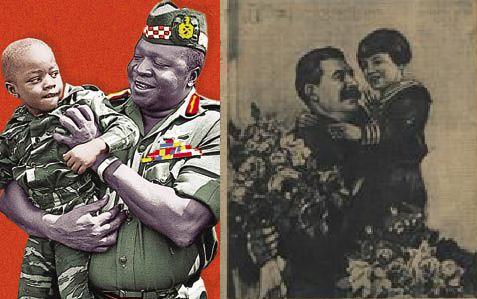
Complicity, or, the Willing (and Unwilling) Executioners in Uganda-- and Grand Rapids

But what's one more genocide? More than a thousand people are dying every week in Northern Uganda, in the concentration camps they've been herded to by their beneficent government-- "three times the death rate in Darfur."

It goes without saying that the proposed laws affecting gays in Uganda are monstrous, bugfuck crazy. Friendly heterosexuals and simple humanity are outlawed as well-- the law "also criminalizes failure to report relevant offenses." "Citizens, including health workers and civil society organizations" are compelled "...to report anyone they suspect of being homosexual." Right-wing American churchmen profess to be embarrassed by their Ugandan protegees, and that bunch swallows camels and strains at gnats without a blush.


This new murder in the heart of Uganda is just a reminder that Amin never acted alone. The thing is, we have a fantasy that the Bad Man went away and all the bad went with him. We tell our children a bedtime story that Hitler killed the children, Amin chopped up the women, some guy Stalin turned the poets into little mounds in the snow. But not us, not us! One of these days, some scholar will add up how many innocent people G.W. Bush killed to stop Saddam Hussein from killing innocent people. The historian Lucy Dawidowicz had a neat phrase, "Cain in corporate embodiment", a phrase Erik Prince might want to invoke when Blackwater (I mean, "Xe") has its day in court.


Without their admiring executioners, your average genocidal maniac is just some nut yelling on a street corner, a frustrated lurker in parking lots. Should we, as a critic asked of Daniel Goldhagen's Hitler's Willing Executioners, "separate the Germans from the Nazis"? Does cutting out a cancer guarantee that it hasn't spread?


"The more frightening question is why and how so many chose to follow Hitler. I do not necessarily mean the German people, per se, but the thousands of bureaucrats, managers, and soldiers who physically carried out The Final Solution, knowing exactly what this entailed and what it signified. Hitler seized the opportunity offered by the political and social situation to institutionalize his personal evil...without followers, millions of Jews (and Cambodians and Indians and so forth) could not have died. The evil that is so hard to face goes well beyond Hitler to a place that no one could truly wish to discover."
(Diane L. Schirf)

I've known a few Holocaust survivors, tattoos on their arms. The only Nazi I ever met, an engineer with the Luftwaffe, told me they heard about the genocide "but they were the kind of crazy stories you hear in the military, nobody took it seriously". How much do I pretend not to know about what we enabled in Cambodia and Chile, how many old folks and babies and dogs and cats were torn to shreds and reported as "collateral damage" in my lifetime, how much of that was done for my "security", a favor I neither asked nor wanted?

As Plain as the Balls in Your Face

"Ms. Stoeger, my plastic surgeon doesn't want me doing any activity where balls fly at my nose."
"Well, there goes your social life."


The Teabaggers' complaints about Obama's tax plan-- after years of taking it up the yinyang from both Bushes, giving tax cuts 'til it hurts to the richest people in America, then resenting the poor-- reminds me of Mark Twain's comment about the difference between a man and a dog.

The group hug for the bad craziness of Sarah Palin, and the ratfuck Republican co-opting of Teabagger rage, reminds us again that there are some things a rat just won't do.

I do think that the Obama administration will be complicit in its own undoing, if Obama persists in getting Wall Street's stank all over himself. It may be that the Bush-induced bailout couldn't be helped, but Obama has the college professor's knack for not knowing what goes on in the trenches between people's ears. As a public school teacher, who wrestles daily with ignorance, I've seen a lot of his manner at academic conferences, and too many times seen progressives wrest defeat from victory.

You can't scold people for ignorance if you let others educate them. The working class joins the far-right for the same reason orphaned children join gangs; no one else bothers to give a shit. Twice a week, my little country school hosts military recruiters, twice a year I get offers for a free classroom set of Ayn Rand, something Howard Zinn and his admirers never bothered to do.

There are amusing compensations. Was there ever a time when a nude model, impersonating a political figure, sounded more qualified than the political figure she was impersonating? Submitted for your approval, a reasonably safe-for-work interview (warning, some artifical cleavage involved) with "Lisa Ann":
"... This was more of a political piece, so people were asking me my political views and why I did this or that. It wasn’t as much about the sex and it wasn’t as ridiculed as I’ve seen on some mainstream television."

Did you ever have any hesitations about doing the movie?

"Honestly, I didn’t like Sara Palin. I got a chance to do something I felt strongly about. She was just so ridiculous. Such an easy target."

Compare Lisa Ann's syntax with any unscripted speech by Caribou Barbie, and tell me who gets a C and who gets a D-. I don't think we've seen such a topsy-turvy world since Nell Gwynn led the British aristocracy around by the... well, I guess we could call it a nose.

Hold 'Em in the Caul, Field

I still think there's something creepy about Holden Caulfield. What's this business of catching children before they "fall" into adulthood-- when the world needs more adults, not fewer? Or Seymour Glass, waking his wife Muriel from her shallow slumber in a particularly ugly way?

I can imagine Holden (if he stays out of jail) ending as a basement-dwelling iconoclast, proud to be smarter, more "authentic" than the rest of us suffering monkeys, part of the cast of High Fidelity or the local comics shop. Given his social class, Holden might end as Jerry Rubin did, praising Charles Manson and then graduating to embrace Reagan and Wall Street, albeit with a Saturday Night Live ironic twist to his mouth. Is it unkind of me to wonder if Rubin was sneering when he was hit by a car?

Am I the only one annoyed by Salinger's twee characters being made of, well, Glass? I know Seymour had a tough war (Salinger himself was part of D-Day), but does that excuse spattering even the silliest of women with a mess of brains? Better to volunteer for pharmaceutical experiments if you want to throw yourself away. Why not rush into a fire, or find a leper colony like Graham Greene's Burnt-Out Case?

The Canadian Phillip Marchand has some thoughts on the American man-child. Salinger himself managed the equivalent of a James Dean or Marilyn Monroe, never sullying his reputation with lesser work (as someone said of Elvis' death, "good career move")-- but not dying, enjoying his royalties in private, apparently a pleasant enough life with friends and family.

I would have liked Holden better if, having rejected the phoniness of straight society, he picked up a shovel and scooped shit at an animal shelter, or sorted clothes for the homeless, or even (cough) tried to teach in the public schools. Holden creeped me out when I first read Catcher in middle school-- I preferred Irving Stone's Michelangelo and VanGogh, or T.H. White's King Arthur: sensitive, maybe doomed, but not likely to surrender.

I still prefer genre writing to the finger-sniffing stories of "New Yorker" fiction. The wounded detectives, from Spenser to Travis McGee to T. Jefferson Parker, expose the truth like Holden but then try to do something about it. Even the silliest super hero, as Michael Chabon makes explicit in The Amazing Adventures of Kavalier and Clay and implies in Wonder Boys, is at least pretending to be a grown up, picking up their imaginary cosmic shovel or rescuing a kitten from a tree to make the world a better place. Salinger reminds me of those people who don't like kittens because they turn into cats.

Remembering Doctor Brydon

When you're wounded and left on Afghanistan's plains,
And the women come out to cut up what remains,
Jest roll to your rifle and blow out your brains
An' go to your Gawd like a soldier.


-- Rudyard Kipling, "The Young British Soldier"


Dr. William Brydon, shown here, was the sole survivor of a 16,500 man British invasion of Afghanistan in 1842. Dr. Brydon and two others were harassed by the Afghans to the gates of Jalalabad; the other two were killed, with Brydon deliberately left alive to tell the tale. A detailed account is available in Heaven’s Command: An Imperial Progress by Jan Morris. Morris interviewed an old man (this was before the Russian invasion) who still carried a British rifle taken from the dead. Morris asked what would happen if an invader came again. "The same," the old man said.

Commonplace Book of Readings, July 2009

“There are some people with a vested interest in the world as it is, because that’s the world they have power over.” -- Alan Moore
***
“People who read Empire of the Sun have often said to me, ‘What a strange life, how unusual,’ and I say to them, actually, the life I led in Shanghai before and during the Second World War was not strange; it wasn’t unusual. The majority of the people on this planet today and for most of this century and previous centuries have always lived lives much closer to the way I lived than to, say, the comfortable suburbs of Western Europe and North America. It is here where I live today that is very strange by the world’s standards. Civil war, famine, flood, drought, poverty, disease are the norms of human experience.” -- J.G. Ballard in a BBC interview.
***
“Conservatives are only funny when they don’t mean to be. How many fucking times do we have to say this?”
-- Comment by “Aquannissiwamissoo” on Wonkette
***

“This reflection on another girl’s morality is interesting, because however much our heroine revels in her naughtiness—and she does revel—she is at pains to tell us that she is not promiscuous like the other girls. Even in this genre, which is almost explicitly about how we shouldn’t judge the naked girl on the stage, we find the same judgment, the same innate, catty, female dividing of the world into sluts and non-sluts, that takes place in the rest of the world.” – Katie Roiphe on stripper’s memoirs in Double-X
***
“Popular artists, then faced with the corporate control of the popular media, have a choice: like Harvey Pekar, they can say exactly what they think about the times in which we live and thus remain at the margins of culture, at best only a cult figure, or, like Letterman, they can swallow their reservations and move to the spot-lit center of the culture, while remaining at the margins of the discourse about what is really going on.”
-- James Hynes, In These Times
***
“I had, by then, abandoned all pretence of work… I could not write or even, by that time, read. Words made no sense to me. I made no sense to me so how could I make sense to anyone else? If journalism is about anything, it is about making sense of the world in which we live. Words, sense, the very reason that kept me moored and anchored to the world had abandoned me. I was lost and that loss was catastrophic. Who are you when you are no longer who you are? What do you do with a self that is no longer your self? If you don’t know who you are, how do you go on living? If you cannot live as yourself, who and what is it that you are living for?” -- Sally Brampton, Shoot the Damn Dog
***
“You bid me rouse myself. Go, bid a man paralytic in both arms rub them briskly together, and that will cure him. Alas! That I cannot move my arms is my complaint.” – Coleridge, in a letter on writer’s block, 1804.
***
“Just how bad will August be, because of the Republicans and various anti-reform special interest groups? Imagine the Brooks Brothers Riot, but happening every day, across the country, for the entire month. Just health insurance employees being dispatched in plainclothes to town halls, so as to shout nonsense at congressmen and senators trying to inform their constituents about health care reform. CALLING IT NOW: Most obnoxious month in American history! Maybe.” – Wonkette, week of August 1st, 2009
***
“The experience of the poor… comes to resemble that of a rat in a cage scrambling to avoid erratically administered electric shocks.” – Barbara Ehrenreich
***
“It’s the sinking sensation that the American game is rigged — that, as the president typically put it a month after his inauguration, the system is in hock to “the interests of powerful lobbyists or the wealthiest few” who have “run Washington far too long.” …. What disturbs Americans of all ideological persuasions is the fear that almost everything, not just government, is fixed or manipulated by some powerful hidden hand, from commercial transactions as trivial as the sales of prime concert tickets to cultural forces as pervasive as the news media. It’s a cynicism confirmed almost daily by events.” -- Frank Rich, The New York Times
***
“A growing body of research shows that people with red hair need larger doses of anesthesia and often are resistant to local pain blockers like Novocaine…. Researchers believe redheads are more sensitive to pain because of a mutation in a gene that affects hair color. In people with brown, black and blond hair, the gene, for the melanocortin-1 receptor, produces melanin. But a mutation in the MC1R gene results in the production of a substance called pheomelanin that results in red hair and fair skin. The MC1R gene belongs to a family of receptors that include pain receptors in the brain, and as a result, a mutation in the gene appears to influence the body’s sensitivity to pain. A 2004 study showed that redheads require, on average, about 20 percent more general anesthesia than people with dark hair or blond coloring. And in 2005, researchers found that redheads are more resistant to the effects of local anesthesia, such as the numbing drugs used by dentists. In the latest study, the researchers tested for the MC1R gene variant, finding it in 65 of 67 redheads and in 20 of 77 people with brown or black hair.” – Tara Parker Pope, The New York Times
***
In the political jargon of those days, the word ‘intellectual’ was an insult. It indicated someone who did not understand life and was cut off from the people…. The invasion of Bohemia by the Russian army, whose occupation of the country had affected everything, had been for her a signal of a new life, out of the ordinary. She saw that people who ranked above her (and everyone ranked above her) were being deprived, on the slightest allegation, of their powers, their positions, their jobs, and their bread, and that excited her; she started to denounce people herself.
"So why is she still a gatekeeper? Why wasn't she promoted?"
The mechanic smiled. "She can't count to ten. They can't find another job for her. All they can do is let her go on denouncing people. For her, that's a promotion!" ….
The mechanic leaned over the engine again and said: "In Wenceslaus Square, in Prague, a guy is throwing up. Another guy comes up to him, pulls a long face, shakes his head, and says: 'I know just what you mean.'”
-- Milan Kundera, The Book of Laughter and Forgetting