"All the Stones the Builders Rejected"
(And some days it takes more Stones than others...) Where Mythical Bestiary meets Contemporary Culture and Chews On Its Leg Until Covered with Slobber.
Showing posts with label Joss Whedon. Show all posts
Jack Benny, the X-Men, and Continuity in Comics
Re-reading Grant Morrison's run on New X-Men led me again to its sequel, Joss Whedon's Astonishing--
and I now proclaim to the anxious masses that Torn (Astonishing X-Men Volume III) is best read in tandem with Morrison's Imperial (New X-Men Volume II).
Jack Benny is supposed to have gotten the biggest laugh in radio history when an armed robber snarls, "Your money or your life!" Benny doesn't say anything. The audience explodes. He waits (the power of the pause) and lets them subside before he answers, "I'm thinking about it." The joke works because the audience knew Benny's comedic persona, and knew that he would need time before such a "difficult" choice.
Just so with Whedon's "Torn", in which Cassandra Nova tries to escape by planting herself in Emma Frost's subconscious, then using Frost's manipulative ability to paralyze her captors. Scott is frozen by his deepest anxiety. Henry "devolves" into a feral carnivore. Logan reverts to his Little Lord Fauntleroy childhood.
Logan's "turn into Percy Dovetonsils" works because of the character's backstory; it wouldn't be so funny if the audience wasn't in on the joke.
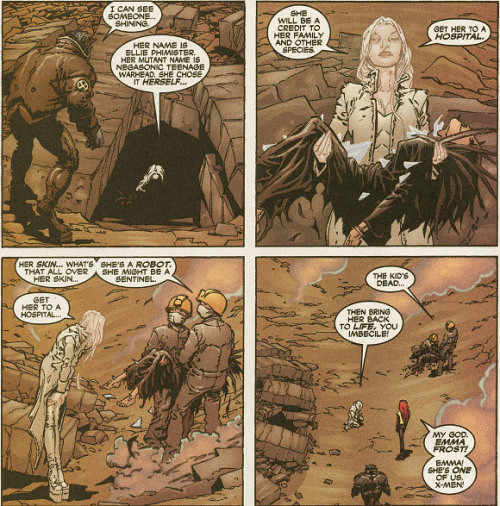
The first time I read this story, the attack by Emma's psychic avatars was confusing (as it's meant to be) but I shrugged it off and went along for the ride. Read immediately after the Morrison stories and I realized how poignant they were, manifestations of Emma's own guilt and fear. Cassandra Nova personifies Emma's pain at surviving the Genosha genocide; Sebastian Shaw represents Emma's self-loathing in her longest-lasting relationship. I didn't recognize Negasonic Teenage Warhead ("Boy, we really have run out names," Kitty says) until this second or third reading:
She's one of Emma's murdered students, seen for only a few panels in Morrison. The last manifestation, "Perfection" is an early version of Emma herself as the White Queen, dominatrix from Hell. Kitty's reaction matches the readers, as we all thought she'd already left Emma trapped in a cave.
Ordinarily, I dislike comics fans' worship of continuity. It's the inside baseball that drives readers away from serial story telling because some Asberger's/fashion victim just broke into your adult conversation with the news that Squirrel Green Lantern only wore the Star Sapphire costume for three issues in 1967, and he, the fanboy, really likes the second version of Empire Strikes Back but the third one makes no sense. Yes, great artists build up layers upon layers of meaning, allusion and reference in their work, but continuity is not the same as depth.
So what did we (I) learn here today? When writers use continuity in the way that Jack Benny did, the reader's prior knowledge adds layers of pleasure. Used as barbed wire to keep the gentiles away, continuity is a disease. One more reason to promise me you'll never pay money for a comic with Cable on the cover or the word "Crisis" in its title.
My Political Manifesto , or, "Lookit the Nut Wit' Da Sign!"
The BBC is talking about the death at age 91 of Helen Gavronsky Suzman, apparently the best known Caucasian anti-apartheid activist in South Africa. I've never heard of her before this, but something she said in a recording struck me as so simple and profound that I'd like to attach it to any description of my politics.
It's weird that Americans don't have "politics" the way Europeans do; there's even a bestseller making the rounds about how we vote with our gut and not with our heads. (The thought that our stomachs have a brain almost as powerful as our cerebrum is a scary thought I'll save for a science-fiction story). This is what happens in a culture when schools function as employment agencies for coaches, and you let them teach civics and history as a seat-warming exercise-- before you scoff, I knew at least one high-school librarian who spent his day drawing up football plays.

I was complimented by a French Swiss once and I had to tell him that I really wasn't that smart, but just had the habit (unusual for an American, apparently) of thinking about why I believe what I believe.

Before this, I've been content with Brendan Behan's summary, that I first read at a bar in Chicago: "I have a total irreverence for anything connected with society except that which makes the roads safer, the beer stronger, the food cheaper and the old men and old women warmer in the winter and happier in the summer." This sums up the goals of good government, and implies the need to build a lasting peace (which, despite the chest thumping of warriors, will always be harder to build than war. Emotionally and materially cheaper in the long run, though.)
But there was something missing, that kept this from being a complete political manifesto, at least for me. Behan's phrase tells us what to build, and leaves policy up to us, but doesn't deal with the Problem of Evil, the killer ape within, what Jungians call the Shadow (and for once, I'm not talking about Lamont Cranston). This is the oversight that collapses philosophical anarchism (what do we do with those who won't co-exist peacefully?).
James Madison addressed the problem in The Federalist Papers: "If men were angels, no government would be necessary." Our refusal to acknowledge the shadow killed the Sixties just as dead as CIA-sponsored drugs-- the Summer of Love was stabbed to death at Altamont, chopped into pieces by the Manson family, and shoved in a trunk by the Unicorn Killer. What, then, must we do?I look through my other rule books: Camus, Confucius, Orwell and Paolo Friere, and re-read the political attitudes etched in my bones, in The Once and Future King, Travis McGee and the superheroes, Pogo and Heinlein and Hannah Arendt, Angel and "Rumpole of the Bailey". All these things have shaped my thinking, help me define my moral compass (buy me a Guinness and I'll go on for hours), but there's no simple phase that can fit on a sign and still be understood out of context. Even Travis McGee admits that his own manifesto, a banner embroidered by countless maidens, keeps trailing on the ground and getting stepped on.

Suzman to the rescue this morning, one last note of a grace from a woman I never heard of. Here, then, is the Helen Suzman amendment to the Brendan Behan manifesto. It was a simple answer (with profound implications) to the question of what started her on her long road :
"I hate bullies and I like simple justice."
Oh, to be in New York, with a Hot but Sensitive Sugar Mama and Tickets to See Chiwetel Ejiofor in Othello
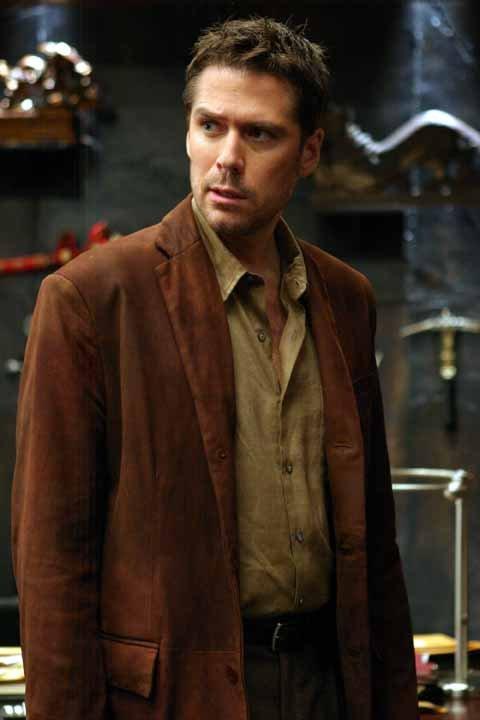
If jealousy is green-eyed, what color is envy? Chartreuse, maybe, or viridian. Access, that's what New Yorkers have. I envy East Coasters this week because Chiwetel Ejiofor is appearing as Othello , with Ewan McGregor as Iago. I first saw him as the nameless Alliance operative in Serenity, and my artsy friends as the desk clerk/physician/taxi driver in Dirty Pretty Things.

Never mind my prejudice against most actors and the theatrical profession as shallow, pretty things, the irresponsible babysitters of the modern American soul. Ejiofor's performances are layered, man. He played a nameless, remorseless, True Believer villain in Serenity, one of the biggest one-dimensional cliches in action films, but between Whedon's writing and Ejiofor's performance, the character is frightening and plausible, one of those clean-cut functionaries who were drawn to support dictators overseas because democracy is so messy. When these professionals find themselves being used for specious ends by a Nixon or a Bush, a Cheney or a Kennedy or a fictional Alliance, they rationalize murder-for-hire with a made-up samurai code, and if you understood the big picture like they do, you'd be all too happy to ensure that those little brown people die beautifully. You hate the character's guts and want to see him die for what he's doing to your friends, laugh when he's confounded-- nobody does Brer Rabbit against the monsters like Joss Whedon-- and almost feel sorry for the son-of-a-bitch when his nose is rubbed in the vileness he's defending.
What could an actor like that do with a text as layered as Shakespeare? Both London and New York are giving this Othello good reviews. Apparently Ejiofor catches the sweetness of the character, that part of Captain Othello's soul that forgets about soldiering and discovers joy and tenderness: "O my soul's joy!.... Perdition catch my soul, but I do love thee-- And when I love thee not, Chaos is come again." -- which makes it all the more heartbreaking when chaos comes, and he, base Indian, murders a pearl worth more than all his tribe. The New Yorker review noted that Ejiofor was young for the part-- Othello is, after all, an older man finally settling down with the first woman he's known that wasn't the colonel's lady or a camp follower-- but that Ejiofor's dignity carries it off. Imagine what he's going to do with it when he's of an age to fully empathize with Othello's tenderness-- and subsequent horror-- at being granted the grace note of Desdemona in a violent, lonely life.
Maybe next year they can trade parts, with Othello set in a Southern military town, and the insecurities of a po' white Othello risen to military success, but naive about women, who makes the mistake of thinking the whole world honest because he himself is honest. Has anyone ever tried an all-black Othello, with the dynamics of race taken out of the mix? A high-yellow Iago and a dark skinned Othello? I've no idea what Ejiofor would do with Iago, but I'd like to see him try.
Some days I regret not being in the cultural center of things, usually when wading through the slushpile with a manuscript clutched to my breast, trying to forge a connection with publishers and agents. It's both startling and energizing to go to a convention and find myself surrounded by people smarter and more talented than myself, being able to chat with people who have the same concerns and awareness of a larger world than the one between their legs or ears or bellies.
But I don't envy these artists the struggle with brute survival a creative life requires in Chicago, Washington, or New York. A one room apartment costs more than our entire house and modest garden, no parking, no pets, no room for a pet, and certainly not a menagerie. A trip for a gallon of milk is a polar expedition. My buddy Wayne has to endure freezing bus stops, trains, automobiles and shank's mare for a trip to the post office that take me five minutes, fifteen if I decide to walk. Living in a college town helps; between magazine subscriptions, decent coffee beans, an understanding library and newstand, cable and the internets, there's not much intellectual stimulation lacking in Kalamazoo if you've sense enough to seek it out. Our neighboring suburb of Portage, a Republican enclave that never saw a development scheme it didn't want to suck, seems determined to turn itself into Houston North, with asphalt as far as the eye can see, travel times twice that of Kalamazoo, and a corresponding diminishment of lifestyle.
And I wonder if being in the center of things brings a distortion to thought that we escape in the flyover provinces; you only have to turn on five minutes of what passes for network commentary to see that for all their vaunted connections, money and power, their blind spots are greater than ours, with more catastrophic results. The janitor knows more about the boss than the boss knows about the janitor.

Never mind my prejudice against most actors and the theatrical profession as shallow, pretty things, the irresponsible babysitters of the modern American soul. Ejiofor's performances are layered, man. He played a nameless, remorseless, True Believer villain in Serenity, one of the biggest one-dimensional cliches in action films, but between Whedon's writing and Ejiofor's performance, the character is frightening and plausible, one of those clean-cut functionaries who were drawn to support dictators overseas because democracy is so messy. When these professionals find themselves being used for specious ends by a Nixon or a Bush, a Cheney or a Kennedy or a fictional Alliance, they rationalize murder-for-hire with a made-up samurai code, and if you understood the big picture like they do, you'd be all too happy to ensure that those little brown people die beautifully. You hate the character's guts and want to see him die for what he's doing to your friends, laugh when he's confounded-- nobody does Brer Rabbit against the monsters like Joss Whedon-- and almost feel sorry for the son-of-a-bitch when his nose is rubbed in the vileness he's defending.
What could an actor like that do with a text as layered as Shakespeare? Both London and New York are giving this Othello good reviews. Apparently Ejiofor catches the sweetness of the character, that part of Captain Othello's soul that forgets about soldiering and discovers joy and tenderness: "O my soul's joy!.... Perdition catch my soul, but I do love thee-- And when I love thee not, Chaos is come again." -- which makes it all the more heartbreaking when chaos comes, and he, base Indian, murders a pearl worth more than all his tribe. The New Yorker review noted that Ejiofor was young for the part-- Othello is, after all, an older man finally settling down with the first woman he's known that wasn't the colonel's lady or a camp follower-- but that Ejiofor's dignity carries it off. Imagine what he's going to do with it when he's of an age to fully empathize with Othello's tenderness-- and subsequent horror-- at being granted the grace note of Desdemona in a violent, lonely life.
Maybe next year they can trade parts, with Othello set in a Southern military town, and the insecurities of a po' white Othello risen to military success, but naive about women, who makes the mistake of thinking the whole world honest because he himself is honest. Has anyone ever tried an all-black Othello, with the dynamics of race taken out of the mix? A high-yellow Iago and a dark skinned Othello? I've no idea what Ejiofor would do with Iago, but I'd like to see him try.
Some days I regret not being in the cultural center of things, usually when wading through the slushpile with a manuscript clutched to my breast, trying to forge a connection with publishers and agents. It's both startling and energizing to go to a convention and find myself surrounded by people smarter and more talented than myself, being able to chat with people who have the same concerns and awareness of a larger world than the one between their legs or ears or bellies.
But I don't envy these artists the struggle with brute survival a creative life requires in Chicago, Washington, or New York. A one room apartment costs more than our entire house and modest garden, no parking, no pets, no room for a pet, and certainly not a menagerie. A trip for a gallon of milk is a polar expedition. My buddy Wayne has to endure freezing bus stops, trains, automobiles and shank's mare for a trip to the post office that take me five minutes, fifteen if I decide to walk. Living in a college town helps; between magazine subscriptions, decent coffee beans, an understanding library and newstand, cable and the internets, there's not much intellectual stimulation lacking in Kalamazoo if you've sense enough to seek it out. Our neighboring suburb of Portage, a Republican enclave that never saw a development scheme it didn't want to suck, seems determined to turn itself into Houston North, with asphalt as far as the eye can see, travel times twice that of Kalamazoo, and a corresponding diminishment of lifestyle.
And I wonder if being in the center of things brings a distortion to thought that we escape in the flyover provinces; you only have to turn on five minutes of what passes for network commentary to see that for all their vaunted connections, money and power, their blind spots are greater than ours, with more catastrophic results. The janitor knows more about the boss than the boss knows about the janitor.
Serenity, Kicked Dogs, and Don Quixotes: the Human Versus the Corporate
Joss Whedon's Serenity has been my default movie of late-- whenever it's on cable, whenever I need something rousing to keep me pedaling or escapist heroes to root for, that's the film I've been watching over and over until I have the dialogue memorized. As Robert Parker's Spencer said about watching The Magnificent Seven , it's not about the plot anymore, it's about the ritual.
I still love Whedon's dialogue, and the tension dispelling laughs, and that "Fuck, Yeah!" moment when the Reavers come home to roost, a splash worthy of Jack Kirby. Reams of scholarly publications would suggest that there are themes loose in Whedon's work that lead from cult science fiction to some of the dark little secrets of contemporary America. What follows is not so much what I know, as what I think I know.
The crew of Serenity is composed of four combat veterans who fought for the losing side in a gallant but mismatched rebellion against a wealthy empire. Along the way they've adopted up a Graham Greene priest with a past, a tomboy engineer, a slumming courtesan, and finally an upper-class doctor and his half-mad, half-prodigy sister, who for reasons unknown are avoiding the authorities. They all live hand-to-mouth (and planet to planet) on the fringes of acceptable society and aren't too proud about what they'll do next to keep the wolves at bay. There's a deliberate Old West look to the space frontier, a trope borrowed from Frederick Turner and Robert Heinlein, who argued that mules, horses and 19th century technology still have a place in everyday life when you're millions of miles away from advanced infrastructure. Tractors, for example, can't reproduce themselves like horses and donkeys can.
All these survivors were injured in some way by a conflict with the dominant culture, with the possible exception of the mercenary Jayne, who's too comically obtuse to think there's anything unhealthy about living out of a locker. It occurs to me that this is a common trait in fictional characters and people I love: the damaged cast of Whedon's Angel, the Chilean survivors in the novels of Roberto Bolaño, the down-and-out moan of the great blues men's lyrics, even historical figures. For all that the dominant culture admires Richard F. Burton, Truman, or even Churchill, they were dismissed or despised by their contemporaries. When Churchill visited America in the 1930s, he had to be hurried onto a train and paid in cash by a minister in Grand Rapids to avoid the bill collectors. Vincent VanGogh, 'buked and scorned, is now a secular saint.
Japanese culture already has a well-established place for the "beautiful loser", as described in studies like Ivan Morris' The Nobility of Failure: Tragic Heroes in the History of Japan, and enacted by the animated crew of the good ship Cowboy Bebop. Japan is the place where "the nail that sticks up gets hammered down", homogenous in its culture (Koreans and burakumin need not apply). It is not necessary for a protagonist to "win" or "succeed" in order to be admired. There's nothing the Japanese Romantic loves more than a doomed hero waiting in the snow for one last scuffle with an unassailable foe. If there are drops of blood against the whiteness, if the snowflakes on his cheek mix with a single tear, so much the better. The beautiful loser has appeared in Western culture before-- in Hemingway's For Whom the Bell Tolls and The Old Man in the Sea, in popular culture through Raymond Chandler and John D. MacDonald, the films and novels where "a man must walk these mean streets who is not himself mean". When even the Mormons start talking about "the nobility of failure", you know we're on to something here.
Barack Obama (yeah) and Huckabee (eh) won the Iowa caucus last night against machine candidates Romney and Clinton. (Hilary Clinton may be infinitely preferable to any Republican short of Lincoln, but don't kid yourself, she's the machine candidate-- she and her husband are now and have been Wall Street Democrats, albeit efficent ones. And Romney is, well, a machine. Amazing what they can do with synthetics these days.) For one brief moment we can enjoy a triumph against the corporate interests and their lackies, and get out our rain coats before the shit storm starts. We don't even have a choice in Michigan-- all of the Democratic candidates have dutifully taken their name off the primary ballot with the exception of Hillary "Party Rules? I AM the Party!" Clinton. All we can do is make a futile gesture against Clinton's inevitability by voting "non-committed" and watch the Michigan Democratic Party piss away $10 million dollars.
Someting there is in human nature that decides early on whether to be a Joiner or a... well we don't really have an objective word for this, do we? "Individual" and "Lone Wolf" are loaded semantically as are "rebel", "maladjusted", and eventually, with the triumph of the dominant culture, "loser". There must have been a few Egyptians standing around who would rather notwork on the pyramids. Pyramids are fine evidence of corporate cooperation, cathedrals are beautiful testimony to group effort and aspiration-- but what if you don't want to add your little stone to the megalith?
The dangers lurking in the "beautiful loser's" world view are self-pity, despair, and immobility. at least two of which are releated to Deadly Sins. There is danger of the survivor's syndrome described in non-fiction like Friendly Fire and seen on the street in skepticism at official explanations-- having been so often lied to, the survivor no longer trusts or recognizes the truth even when it's finally revealed. There's the stubborn futility of activists not being able to take yes for an answer, an inability to compromise, like the John Cleese character so stupid that he doesn't know when he's beaten but doesn't know when he's winning, either. Principle becomes self-congratulatory martyrdom and narcissism; Ralph Nader runs for president and sneers at the sell-outs and compromisers.
The problem with the corporate culture favored by unregulated capitalism is that it has little tolerance for people and things that will not or can not submit to the corporate structure. A polar bear cannot wise up and adjust to the economy's demand for increased carbon emissions, and it may be that some people can't, either. The title of a study of the Chicago machine spoke volumes: Don't Make No Waves...Don't Back No Losers. Joiners tell themselves that the corporation, the organization, the church, the group will protect and nourish them all the days of their life, but the dirty little secret is that the moment an individual no longer fits the master plan, they are tossed aside like a used tissue. A chauvinist for the status quo is just a worker who hasn't been laid off yet.
In Whedon's Serenity, the dominant culture that knows what's best for us all is represented by a military-industrial government called "The Alliance". In his earlier series Angel, it was the corporate law firm Wolfram and Hart. Serenity is oddly the more optimistic of the two. Broadcasting the truth about the Alliance's activities does some small amount of good, whereas in Angel, the Powers that Be are very bad losers, humanity is indifferent to the struggle, and when Angel takes an elevator to confront "the Source of all Evil", he finds himself back on the street, like the "egress" in Barnum's museum:
ANGEL:Why fight?
HOLLAND:That's really the question you should be asking yourself, isn't it? See, for us, there is no fight. Which is why winning doesn't enter into it. We - go on - no matter what. Our firm has always been here. In one form or another. The Inquisition. The Khmer Rouge. We were there when the very first cave man clubbed his neighbor. See, we're in the hearts and minds of every single living being. And that - friend - is what's making things so difficult for you. See, the world doesn't work in spite of evil, Angel. It works with us. It works because of us.
(The elevator stops, the doors open to reveal the L.A. city streets)
HOLLAND:Welcome to the home office.
ANGEL: (horrified) This isn't...
HOLLAND: Well, you know it is. You know that better than anyone. Things you've seen. Things you've, well - done. You see, if there wasn't evil in every single one of them out there, why, they wouldn't be people. They'd all be angels.
(Angel drops the glove and wanders out of the elevator, petrified and expressionless)
HOLLAND: Have a nice day.
The difference here is that Angel's fight is supernatural, the province of monks and boddhisatvas, whereas the crew of Serenity are contending with a human construct of political alliances, military might and industrial capacity. Corporations are busy, busy, little enterprises, with a hundred soldier ants and a hundred workers for every contingency, and those resisting the corporate takeover of everything are understaffed and underfunded. That cultural complex can seem mighty mighty, as Nelson Algren said of Chicago; it even possesses a kind of immortality, granted when our courts decided that a corporation has rights similar to an individual's. To money and raw power, add the kind of religious awe that most Americans seem to have for the social construct around them, their insistence that this pyramid we're building is just "the way things are", and you've got a real one-sided fight on your hands.
I still love Whedon's dialogue, and the tension dispelling laughs, and that "Fuck, Yeah!" moment when the Reavers come home to roost, a splash worthy of Jack Kirby. Reams of scholarly publications would suggest that there are themes loose in Whedon's work that lead from cult science fiction to some of the dark little secrets of contemporary America. What follows is not so much what I know, as what I think I know.
The crew of Serenity is composed of four combat veterans who fought for the losing side in a gallant but mismatched rebellion against a wealthy empire. Along the way they've adopted up a Graham Greene priest with a past, a tomboy engineer, a slumming courtesan, and finally an upper-class doctor and his half-mad, half-prodigy sister, who for reasons unknown are avoiding the authorities. They all live hand-to-mouth (and planet to planet) on the fringes of acceptable society and aren't too proud about what they'll do next to keep the wolves at bay. There's a deliberate Old West look to the space frontier, a trope borrowed from Frederick Turner and Robert Heinlein, who argued that mules, horses and 19th century technology still have a place in everyday life when you're millions of miles away from advanced infrastructure. Tractors, for example, can't reproduce themselves like horses and donkeys can. All these survivors were injured in some way by a conflict with the dominant culture, with the possible exception of the mercenary Jayne, who's too comically obtuse to think there's anything unhealthy about living out of a locker. It occurs to me that this is a common trait in fictional characters and people I love: the damaged cast of Whedon's Angel, the Chilean survivors in the novels of Roberto Bolaño, the down-and-out moan of the great blues men's lyrics, even historical figures. For all that the dominant culture admires Richard F. Burton, Truman, or even Churchill, they were dismissed or despised by their contemporaries. When Churchill visited America in the 1930s, he had to be hurried onto a train and paid in cash by a minister in Grand Rapids to avoid the bill collectors. Vincent VanGogh, 'buked and scorned, is now a secular saint.

Japanese culture already has a well-established place for the "beautiful loser", as described in studies like Ivan Morris' The Nobility of Failure: Tragic Heroes in the History of Japan, and enacted by the animated crew of the good ship Cowboy Bebop. Japan is the place where "the nail that sticks up gets hammered down", homogenous in its culture (Koreans and burakumin need not apply). It is not necessary for a protagonist to "win" or "succeed" in order to be admired. There's nothing the Japanese Romantic loves more than a doomed hero waiting in the snow for one last scuffle with an unassailable foe. If there are drops of blood against the whiteness, if the snowflakes on his cheek mix with a single tear, so much the better. The beautiful loser has appeared in Western culture before-- in Hemingway's For Whom the Bell Tolls and The Old Man in the Sea, in popular culture through Raymond Chandler and John D. MacDonald, the films and novels where "a man must walk these mean streets who is not himself mean". When even the Mormons start talking about "the nobility of failure", you know we're on to something here.
Barack Obama (yeah) and Huckabee (eh) won the Iowa caucus last night against machine candidates Romney and Clinton. (Hilary Clinton may be infinitely preferable to any Republican short of Lincoln, but don't kid yourself, she's the machine candidate-- she and her husband are now and have been Wall Street Democrats, albeit efficent ones. And Romney is, well, a machine. Amazing what they can do with synthetics these days.) For one brief moment we can enjoy a triumph against the corporate interests and their lackies, and get out our rain coats before the shit storm starts. We don't even have a choice in Michigan-- all of the Democratic candidates have dutifully taken their name off the primary ballot with the exception of Hillary "Party Rules? I AM the Party!" Clinton. All we can do is make a futile gesture against Clinton's inevitability by voting "non-committed" and watch the Michigan Democratic Party piss away $10 million dollars. Someting there is in human nature that decides early on whether to be a Joiner or a... well we don't really have an objective word for this, do we? "Individual" and "Lone Wolf" are loaded semantically as are "rebel", "maladjusted", and eventually, with the triumph of the dominant culture, "loser". There must have been a few Egyptians standing around who would rather notwork on the pyramids. Pyramids are fine evidence of corporate cooperation, cathedrals are beautiful testimony to group effort and aspiration-- but what if you don't want to add your little stone to the megalith?

The dangers lurking in the "beautiful loser's" world view are self-pity, despair, and immobility. at least two of which are releated to Deadly Sins. There is danger of the survivor's syndrome described in non-fiction like Friendly Fire and seen on the street in skepticism at official explanations-- having been so often lied to, the survivor no longer trusts or recognizes the truth even when it's finally revealed. There's the stubborn futility of activists not being able to take yes for an answer, an inability to compromise, like the John Cleese character so stupid that he doesn't know when he's beaten but doesn't know when he's winning, either. Principle becomes self-congratulatory martyrdom and narcissism; Ralph Nader runs for president and sneers at the sell-outs and compromisers.
The problem with the corporate culture favored by unregulated capitalism is that it has little tolerance for people and things that will not or can not submit to the corporate structure. A polar bear cannot wise up and adjust to the economy's demand for increased carbon emissions, and it may be that some people can't, either. The title of a study of the Chicago machine spoke volumes: Don't Make No Waves...Don't Back No Losers. Joiners tell themselves that the corporation, the organization, the church, the group will protect and nourish them all the days of their life, but the dirty little secret is that the moment an individual no longer fits the master plan, they are tossed aside like a used tissue. A chauvinist for the status quo is just a worker who hasn't been laid off yet. In Whedon's Serenity, the dominant culture that knows what's best for us all is represented by a military-industrial government called "The Alliance". In his earlier series Angel, it was the corporate law firm Wolfram and Hart. Serenity is oddly the more optimistic of the two. Broadcasting the truth about the Alliance's activities does some small amount of good, whereas in Angel, the Powers that Be are very bad losers, humanity is indifferent to the struggle, and when Angel takes an elevator to confront "the Source of all Evil", he finds himself back on the street, like the "egress" in Barnum's museum:
ANGEL:Why fight?
HOLLAND:That's really the question you should be asking yourself, isn't it? See, for us, there is no fight. Which is why winning doesn't enter into it. We - go on - no matter what. Our firm has always been here. In one form or another. The Inquisition. The Khmer Rouge. We were there when the very first cave man clubbed his neighbor. See, we're in the hearts and minds of every single living being. And that - friend - is what's making things so difficult for you. See, the world doesn't work in spite of evil, Angel. It works with us. It works because of us.
(The elevator stops, the doors open to reveal the L.A. city streets)
HOLLAND:Welcome to the home office.
ANGEL: (horrified) This isn't...
HOLLAND: Well, you know it is. You know that better than anyone. Things you've seen. Things you've, well - done. You see, if there wasn't evil in every single one of them out there, why, they wouldn't be people. They'd all be angels.
(Angel drops the glove and wanders out of the elevator, petrified and expressionless)
HOLLAND: Have a nice day.
The difference here is that Angel's fight is supernatural, the province of monks and boddhisatvas, whereas the crew of Serenity are contending with a human construct of political alliances, military might and industrial capacity. Corporations are busy, busy, little enterprises, with a hundred soldier ants and a hundred workers for every contingency, and those resisting the corporate takeover of everything are understaffed and underfunded. That cultural complex can seem mighty mighty, as Nelson Algren said of Chicago; it even possesses a kind of immortality, granted when our courts decided that a corporation has rights similar to an individual's. To money and raw power, add the kind of religious awe that most Americans seem to have for the social construct around them, their insistence that this pyramid we're building is just "the way things are", and you've got a real one-sided fight on your hands.
Joss Whedon Interview, Lessons from Bad Writing, & Cultural Notes on Wonder Woman

Joss Whedon being one of the contemporary writers that I admire, an interview with Tasha Robinson at the AV Club is useful and informative not just for Whedon fans, but for all students of the culture. The standard take on writers in Hollywood is Henry Slesar's "success in Hollywood is like climbing a mountain of shit to pluck one perfect rose, and then discovering that you've lost your taste of smell". To my unschooled eye, Whedon has managed to pluck more roses from the pile than most, even compared with the admirable William Goldman and Hal Ashby. If this keeps up, Whedon could have a resume that makes him the Billy Wilder of adventure movies.
As much as I am wrapped up in Whedon's successes, I learn more, as a creative person, from his failures. As much as I admired (and early on, imitated) for example, John D. MacDonald and Robert Heinlein, all I could do was gape and wonder, how'd they do that?, whereas it was easier to decode what didn't work in bad novels, B-movies and crap comics, and so learn what not to do. It wasn't until I matured enough to see MacDonald and Heinlein's flaws that I was able to decipher how they got their affects.
The failures described at length in this interview-- the collapse of Whedon's script for Wonder Woman, for instance, has some interesting things to say about our culture's relationship with feminine archetypes. Try and name a female character in an action film that isn't somebody's girlfriend (the anonymous scream machine) or a soulless-but-hot killing machines (Aeon Flux, Underworld, Linda Hamilton in the Terminator sequels, ad infinitum. (Whedon himself, at a low point in his career, was reduced to tears when he saw what had been made of his script forAlien: Ressurection.) To this day, Greg Rucka's series of Wonder Woman reprints are the only ones I'd recommend with a clean conscience.
Whedon's Wonder Woman sounds like an opportunity to stir fish-out-water social satire together with comic book ass-kicking. His Diana of Themiscrya was a kind of Candide with super-powers, who just doesn't understand why humans are so small and nasty and cruel, clawing one another for top position on a mudball, when they could build a paradise on earth if they just... ? He wrote a scene that worked the magic bracelets into this vision. Whedon even managed to redeem the (I thought) unredeemable Steve Trevor (a character so disliked, I found it difficult to type his name)-- making him the wry voice of struggling humanity, trying to explain to a perfect creature made from clay why children are starving, or this group hates that group, or...

I can imagine all kinds of PG-13 Michael Valentine Smith moments, with an Amazon princess being gobsmacked by human taboos-- remember when Heinlein's character took his first dip on a public beach? Or economic inequities-- I can imagine Diana saving us from Max Lord (DC's young-and-handsome take on Rupert Murdoch) and then baffled as to why this man goes unpunished, why he should have more wealth than the people who do the work that creates his wealth. More difficult to pull off, but interesting, might be the feminist villains-- why does the Cheetah's sexual power turn to bitterness and villainy instead of joy, or Circe's revelling in manipulation and deceit instead of using her power to heal? (This is starting to sound too good to me; I'd better get back to my own work before the long day wanes.)
The Commonplace Book of Quotations, midway through January, 2007
“I recognize happiness by the sound it makes when it leaves.” (Jacques Prévert)
***
Dec. 29, 2006 (UPI) -- About 90 percent of Iraqis feel the situation in the country was better before the U.S.-led invasion than it is today, according to a new ICRSS [Iraq Centre for Research and Strategic Studies ] poll.
The findings emerged after house-to-house interviews conducted by the ICRSS during the third week of November. About 2,000 people from Baghdad (82 percent), Anbar and Najaf (9 percent each) were randomly asked to express their opinion. Twenty-four percent of the respondents were women.
Only five percent of those questioned said Iraq is better today than in 2003. While 89 percent of the people said the political situation had deteriorated, 79 percent saw a decline in the economic situation; 12 percent felt things had improved and 9 percent said there was no change.
***
"As long as Saddam obediently protected and facilitated the economic and
territorial interests of the American (and European) colonialists who backed him, his ruthlessness was their profit, and clearly tolerable."
(Marc Ash at Truthout.org)
***
“I don’t care if it IS an orgy of death, there’s still such a thing as a napkin.”
(Willow Rosenberg)
***
“What I want to hear from you is how we’re going to win, not how we’re going to leave.”
(G.W. Bush to Marine commandant Gen. James T. Conway)
***
“Saddam Hussein deserves no one’s pity. But as anyone who has seen the graphic cellphone video of his hanging can testify, his execution bore little resemblance to dispassionate, state-administered justice. The condemned dictator appeared to have been delivered from United States military custody into the hands of a Shiite lynch mob.
(New York Times editorial)
***
“Pity is treason.”
(Robespierre)
***
“Accept the truth from whoever speaks it, the Talmud advises. Eccentricity, for Saul, conferred an analytical advantage, because it promised a fresh standpoint, from which things previously not noted might be noted; and what he disliked about the intellectuals of his time was their lack of it. Sometimes the mockery of thinking people in his books irritated me, the way the anti-intellectualism of intellectuals always does; many of his plots concerned the humiliation of intellectuality by vitality, and he taught his readers, among many other things, that seriousness was a little ludicrous. But in fact Saul was the most ferocious of the believers in ideas, because he protested that they could be found everywhere, and that they could be a primary subject of literature. He did not deny the problem of being, but he preferred to set it in the subway. When Herzog wrote to Heidegger, it was because he desperately needed an answer. This was funny, but it was not grotesque. Saul liked his profundities vernacular. What is so exciting about the carnal and commercial tumult in which his tales rejoice is that it never lets go of the question of how to live. As a matter of philosophical principle and artistic method, he married life to thought.”
[Leon Wieseltier on Saul Bellow]
***
“For a Westerner to trash Western culture is like criticizing our nitrogen/oxygen atmosphere on the grounds that it sometimes gets windy, and besides, Jupiter’s is much prettier. You may not realize its advantages until you’re trying to breathe liquid methane.”
(Neal Stephenson)
***
“Modern psychology suggests that policymakers come to the debate predisposed to believe their hawkish advisors more than the doves. There are numerous reasons for the burden of persuasion that doves carry, and some of them have nothing to do with politics or strategy. In fact, a bias in favor of hawkish beliefs and preferences is built into the fabric of the human mind.” (Daniel Kahneman and Jonathan Renshon in Foreign Policy)
***
“In light of all this, it seems hard to believe that, just a few years ago, Rumsfeld was hailed as a visionary war leader. Among conservatives, in particular, he was treated to the sort of over-the-top hero worship that the right customarily bestows upon its standard bearers in flush political times. And so it seems as good a time as any to reexamine the wave of Rumsfeld hagiography that was in vogue for about two years following September 11, 2001. These documents offer a prime window into the pathologies of conservative thought in the Bush era. To be a loyal conservative during the last half-dozen years, you had to convince yourself to accept a series of propositions that ran the gamut from somewhat implausible to completely absurd. As those propositions collapse, one by one, conservatives are reacting much the same way as communists did following the fall of the Berlin Wall. There are the frantic efforts to rescue conservative orthodoxy by defining the party's leaders as apostates who deviated from the true faith. And there are the dazed true believers coming to grips with certain realities--Katherine Harris is a not a paragon of wisdom and fair-mindedness, after all; the administration's fiscal policies may not be completely sound; President Bush is not quite the visionary war leader we made him out to be; and so on. Only by revisiting the conservative propaganda in light of history's verdict can we see how delusional the movement had become. And on perhaps no topic were conservatives quite as delusional as on the leadership genius of Donald Rumsfeld.” ( Jonathon Chait in The New Republic)
***
“Only this president could extol the "thoughtful recommendations of the Iraq Study Group," and then take its most far-sighted recommendation - "engage Syria and Iran" - and transform it into "threaten Syria and Iran" - when al-Qaida would like nothing better than for us to threaten Syria, and when Iranian President Mahmoud Ahmadinejad would like nothing better than to be threatened by us. This is diplomacy by skimming; it is internationalism by drawing pictures of Superman in the margins of the text books; it is a presidency of Cliff Notes.... Oh, and one more to add, tonight: Oceania has always been at war with East Asia.”
(Keith Olbermann)
***
“So what if the candle flickers and goes out? We have a piece of flint, and a spark.”
(Rumi)
***
Dec. 29, 2006 (UPI) -- About 90 percent of Iraqis feel the situation in the country was better before the U.S.-led invasion than it is today, according to a new ICRSS [Iraq Centre for Research and Strategic Studies ] poll.
The findings emerged after house-to-house interviews conducted by the ICRSS during the third week of November. About 2,000 people from Baghdad (82 percent), Anbar and Najaf (9 percent each) were randomly asked to express their opinion. Twenty-four percent of the respondents were women.
Only five percent of those questioned said Iraq is better today than in 2003. While 89 percent of the people said the political situation had deteriorated, 79 percent saw a decline in the economic situation; 12 percent felt things had improved and 9 percent said there was no change.
***
"As long as Saddam obediently protected and facilitated the economic and
territorial interests of the American (and European) colonialists who backed him, his ruthlessness was their profit, and clearly tolerable."
(Marc Ash at Truthout.org)
***
“I don’t care if it IS an orgy of death, there’s still such a thing as a napkin.”
(Willow Rosenberg)
***
“What I want to hear from you is how we’re going to win, not how we’re going to leave.”
(G.W. Bush to Marine commandant Gen. James T. Conway)
***
“Saddam Hussein deserves no one’s pity. But as anyone who has seen the graphic cellphone video of his hanging can testify, his execution bore little resemblance to dispassionate, state-administered justice. The condemned dictator appeared to have been delivered from United States military custody into the hands of a Shiite lynch mob.
(New York Times editorial)
***
“Pity is treason.”
(Robespierre)
***
“Accept the truth from whoever speaks it, the Talmud advises. Eccentricity, for Saul, conferred an analytical advantage, because it promised a fresh standpoint, from which things previously not noted might be noted; and what he disliked about the intellectuals of his time was their lack of it. Sometimes the mockery of thinking people in his books irritated me, the way the anti-intellectualism of intellectuals always does; many of his plots concerned the humiliation of intellectuality by vitality, and he taught his readers, among many other things, that seriousness was a little ludicrous. But in fact Saul was the most ferocious of the believers in ideas, because he protested that they could be found everywhere, and that they could be a primary subject of literature. He did not deny the problem of being, but he preferred to set it in the subway. When Herzog wrote to Heidegger, it was because he desperately needed an answer. This was funny, but it was not grotesque. Saul liked his profundities vernacular. What is so exciting about the carnal and commercial tumult in which his tales rejoice is that it never lets go of the question of how to live. As a matter of philosophical principle and artistic method, he married life to thought.”
[Leon Wieseltier on Saul Bellow]
***
“For a Westerner to trash Western culture is like criticizing our nitrogen/oxygen atmosphere on the grounds that it sometimes gets windy, and besides, Jupiter’s is much prettier. You may not realize its advantages until you’re trying to breathe liquid methane.”
(Neal Stephenson)
***
“Modern psychology suggests that policymakers come to the debate predisposed to believe their hawkish advisors more than the doves. There are numerous reasons for the burden of persuasion that doves carry, and some of them have nothing to do with politics or strategy. In fact, a bias in favor of hawkish beliefs and preferences is built into the fabric of the human mind.” (Daniel Kahneman and Jonathan Renshon in Foreign Policy)
***
“In light of all this, it seems hard to believe that, just a few years ago, Rumsfeld was hailed as a visionary war leader. Among conservatives, in particular, he was treated to the sort of over-the-top hero worship that the right customarily bestows upon its standard bearers in flush political times. And so it seems as good a time as any to reexamine the wave of Rumsfeld hagiography that was in vogue for about two years following September 11, 2001. These documents offer a prime window into the pathologies of conservative thought in the Bush era. To be a loyal conservative during the last half-dozen years, you had to convince yourself to accept a series of propositions that ran the gamut from somewhat implausible to completely absurd. As those propositions collapse, one by one, conservatives are reacting much the same way as communists did following the fall of the Berlin Wall. There are the frantic efforts to rescue conservative orthodoxy by defining the party's leaders as apostates who deviated from the true faith. And there are the dazed true believers coming to grips with certain realities--Katherine Harris is a not a paragon of wisdom and fair-mindedness, after all; the administration's fiscal policies may not be completely sound; President Bush is not quite the visionary war leader we made him out to be; and so on. Only by revisiting the conservative propaganda in light of history's verdict can we see how delusional the movement had become. And on perhaps no topic were conservatives quite as delusional as on the leadership genius of Donald Rumsfeld.” ( Jonathon Chait in The New Republic)
***
“Only this president could extol the "thoughtful recommendations of the Iraq Study Group," and then take its most far-sighted recommendation - "engage Syria and Iran" - and transform it into "threaten Syria and Iran" - when al-Qaida would like nothing better than for us to threaten Syria, and when Iranian President Mahmoud Ahmadinejad would like nothing better than to be threatened by us. This is diplomacy by skimming; it is internationalism by drawing pictures of Superman in the margins of the text books; it is a presidency of Cliff Notes.... Oh, and one more to add, tonight: Oceania has always been at war with East Asia.”
(Keith Olbermann)
***
“So what if the candle flickers and goes out? We have a piece of flint, and a spark.”
(Rumi)
The Commonplace Book, November 2006
"I hope we shall crush in its birth the aristocracy of our moneyed corporations which dare already to challenge our government in a trial of strength, and bid defiance to the laws of our country." (Thomas Jefferson) 
***
"...the big trouble with dumb bastards is that they are too dumb to believe there is such a thing as being smart." ( Kurt Vonnegut, Jr.)
***
“... the very first example of congressional oversight in our history was an inquiry into President George Washington’s deployment of the military. In that case, a committee appointed by the House in 1792 was authorized to investigate the disastrous defeat the year before of Gen. Arthur St. Clair by Indians in the Ohio Territory, with the power to issue subpoenas for “persons, papers and records as may be necessary to assist their inquiries.” (Stanley Brand
***
“.... One day, Tomasello and Paabo were talking in the institute's cafeteria about a family in England with a remarkable genetic defect. Some members of the family have a mutation in a gene known as FOXP2, which helps direct the development of the brain during infancy and childhood. Every family member with the mutation had great difficulty speaking. Paabo had been thinking about how to identify genes that had changed during human evolution to make speech possible, and FOXP2 seemed like a prime candidate. He and his co-workers sequenced the gene—that is, they figured out the order of the DNA bases that make up FOXP2—in six different species. They found that it was one of the most stable genes they had ever studied; from mice to rhesus macaques to chimps, the protein produced by the gene is almost exactly identical, suggesting that the gene itself plays a fundamental role in animal function. But in humans the gene had undergone a slight modification. About 250,000 years ago, according to the scientists' calculations, two of the molecular units in the 715-unit DNA sequence of the gene abruptly changed. That's not long before modern humans first appeared in the fossil record. Could the changes in FOXP2 have enabled modern humans to speak? And could articulate speech have given modern humans an edge over the Neanderthals and other archaic humans?
“That's certainly what some newspaper stories implied, labeling FOXP2 a "language gene." But Paabo and other scientists are more cautious. FOXP2 "is one of who knows how many genes that affect language ability," says Ken Weiss, an expert on evolution and genetics at Pennsylvania State University. The change in FOXP2 might have been entirely coincidental. Or the gene may be related to language indirectly—for example, by influencing coordination. And some scientists argue that language evolved much earlier than our version of FOXP2, and that archaic humans also had speech....”
(Smithsonian magazine)
***
“As usual, Cheney's remarks reinforce mistaken notions about terrorism. He suggests to the bomber forces that only taking the fight to terrorists can turn the tide.
“Cheney doesn't talk about stealing the audience from terrorists or robbing from them the ability to exploit grievances that many in the Middle East feel.” (Steve Clemons)
***
"Many of the governments here in South America are now made up of people who were thrown in prison and tortured in the past, so they're taking a very different look at the role of their armed forces and their military relations with the United States."
(Lisa Sullivan, Caracas-based organizer for SOA [School of the Americas] Watch)
***
"Look at the JLA; They all map on the chakras. Batman is a human being of ultimate power [and intention.] Flash is communication. Superman is about giving selflessly. He represents the sun. He is that thing that loves us unconditionally. ,,, Batman is like Christ harrowing Hell, because only he can withstand it. He endures everything for us. Batman is a character who was almost brought to the brink of his destruction, but who persevered. Batman is our shadow and we have to look at the shadow and integrate the shadow. ... Mr. Miracle [an escape artist who survived a Dickensinian childhood on a Hell planet] is the transcendent character, the seventh Chakra.”
(Grant Morrison)
***
“In the 1970s form began to be considered uncool. It represented the rigid establishment. So everything started to become vague and mushy.”
(John Kricfalusi)
***
“I remember when the famous phrase "Live from Studio 60, it's Friday Night In Hollywood!" used to mean something. Back then, when the show first came out, I'd stay home every Monday night just to make sure I didn't miss an episode. There was such a buzz around the show in the weeks leading up to its premiere because it was something new, something no one had ever seen before. But ever since Judd Hirsch left, * the show's totally gone downhill.” (Review by “Artie Mayer” in The Onion)
[* NOTE: Judd Hirsch’s character only appeared in the first five minutes of the show.]
***
"I passionately hate the idea of being with it, I think an artist has always to be out of step with his time." (Orson Welles)
***
“There are two very separate worlds: the marketplace, and the bustling bazaar that is my brain. The brain place is crowded with goods, ideas, sequels, spinoffs, animated versions, miniseries, radio dramas -- this is just the used goods. All the new wares are in there as well and it's deafening. Once I create a verse I never let go of it. And figuring out how much of my energy should be devoted to reawakening the projects you all love with the actors and characters I all love, and how much should be forging ahead and creating entirely new works (which you are contractually obligated to love) is exhausting. More than you know. You know the horse caught bwtween two pools of water? Add seven pools, and make the horse wicked A.D.D. The other world, the marketplace, I don't even begin to understand or predict.” (Joss Whedon)
***
“By labeling concerns of American workers [regarding cheap labor from illegal immigrants] “nativism”, you dismiss those concerns as reactionary or invalid. Characterizing those concerns as racist or xenophobic allows you to ignore the economic impact on the working class... You are playing into the multinational corporations’ agenda. Way to go.”
(Les Reed, in a letter to The Nation 11/13/2006)
***
“If you’re talking about mugging little old ladies, you don’t say, ‘What’s our target for the rate of mugging little old ladies?’ You say, ‘Mugging little old ladies is bad, and we’re going to try to eliminate it.’ You recognize you might not be a hundred percent successful, but your goal is to eliminate the mugging of little old ladies. And I think we need to eventually come around to looking at carbon dioxide emissions the same way.” (Ken Caldeira, a scientist at Lawrence Livermore National Laboratory, whose work for the Department of Energy showed an increasing acidification of the oceans.)

***
"...the big trouble with dumb bastards is that they are too dumb to believe there is such a thing as being smart." ( Kurt Vonnegut, Jr.)
***
“... the very first example of congressional oversight in our history was an inquiry into President George Washington’s deployment of the military. In that case, a committee appointed by the House in 1792 was authorized to investigate the disastrous defeat the year before of Gen. Arthur St. Clair by Indians in the Ohio Territory, with the power to issue subpoenas for “persons, papers and records as may be necessary to assist their inquiries.” (Stanley Brand
***
“.... One day, Tomasello and Paabo were talking in the institute's cafeteria about a family in England with a remarkable genetic defect. Some members of the family have a mutation in a gene known as FOXP2, which helps direct the development of the brain during infancy and childhood. Every family member with the mutation had great difficulty speaking. Paabo had been thinking about how to identify genes that had changed during human evolution to make speech possible, and FOXP2 seemed like a prime candidate. He and his co-workers sequenced the gene—that is, they figured out the order of the DNA bases that make up FOXP2—in six different species. They found that it was one of the most stable genes they had ever studied; from mice to rhesus macaques to chimps, the protein produced by the gene is almost exactly identical, suggesting that the gene itself plays a fundamental role in animal function. But in humans the gene had undergone a slight modification. About 250,000 years ago, according to the scientists' calculations, two of the molecular units in the 715-unit DNA sequence of the gene abruptly changed. That's not long before modern humans first appeared in the fossil record. Could the changes in FOXP2 have enabled modern humans to speak? And could articulate speech have given modern humans an edge over the Neanderthals and other archaic humans?
“That's certainly what some newspaper stories implied, labeling FOXP2 a "language gene." But Paabo and other scientists are more cautious. FOXP2 "is one of who knows how many genes that affect language ability," says Ken Weiss, an expert on evolution and genetics at Pennsylvania State University. The change in FOXP2 might have been entirely coincidental. Or the gene may be related to language indirectly—for example, by influencing coordination. And some scientists argue that language evolved much earlier than our version of FOXP2, and that archaic humans also had speech....”
(Smithsonian magazine)
***
“As usual, Cheney's remarks reinforce mistaken notions about terrorism. He suggests to the bomber forces that only taking the fight to terrorists can turn the tide.
“Cheney doesn't talk about stealing the audience from terrorists or robbing from them the ability to exploit grievances that many in the Middle East feel.” (Steve Clemons)
***
"Many of the governments here in South America are now made up of people who were thrown in prison and tortured in the past, so they're taking a very different look at the role of their armed forces and their military relations with the United States."
(Lisa Sullivan, Caracas-based organizer for SOA [School of the Americas] Watch)
***
"Look at the JLA; They all map on the chakras. Batman is a human being of ultimate power [and intention.] Flash is communication. Superman is about giving selflessly. He represents the sun. He is that thing that loves us unconditionally. ,,, Batman is like Christ harrowing Hell, because only he can withstand it. He endures everything for us. Batman is a character who was almost brought to the brink of his destruction, but who persevered. Batman is our shadow and we have to look at the shadow and integrate the shadow. ... Mr. Miracle [an escape artist who survived a Dickensinian childhood on a Hell planet] is the transcendent character, the seventh Chakra.”(Grant Morrison)
***
“In the 1970s form began to be considered uncool. It represented the rigid establishment. So everything started to become vague and mushy.”
(John Kricfalusi)
***
“I remember when the famous phrase "Live from Studio 60, it's Friday Night In Hollywood!" used to mean something. Back then, when the show first came out, I'd stay home every Monday night just to make sure I didn't miss an episode. There was such a buzz around the show in the weeks leading up to its premiere because it was something new, something no one had ever seen before. But ever since Judd Hirsch left, * the show's totally gone downhill.” (Review by “Artie Mayer” in The Onion)
[* NOTE: Judd Hirsch’s character only appeared in the first five minutes of the show.]
***
"I passionately hate the idea of being with it, I think an artist has always to be out of step with his time." (Orson Welles)
***
“There are two very separate worlds: the marketplace, and the bustling bazaar that is my brain. The brain place is crowded with goods, ideas, sequels, spinoffs, animated versions, miniseries, radio dramas -- this is just the used goods. All the new wares are in there as well and it's deafening. Once I create a verse I never let go of it. And figuring out how much of my energy should be devoted to reawakening the projects you all love with the actors and characters I all love, and how much should be forging ahead and creating entirely new works (which you are contractually obligated to love) is exhausting. More than you know. You know the horse caught bwtween two pools of water? Add seven pools, and make the horse wicked A.D.D. The other world, the marketplace, I don't even begin to understand or predict.” (Joss Whedon)
***
“By labeling concerns of American workers [regarding cheap labor from illegal immigrants] “nativism”, you dismiss those concerns as reactionary or invalid. Characterizing those concerns as racist or xenophobic allows you to ignore the economic impact on the working class... You are playing into the multinational corporations’ agenda. Way to go.”
(Les Reed, in a letter to The Nation 11/13/2006)
***
“If you’re talking about mugging little old ladies, you don’t say, ‘What’s our target for the rate of mugging little old ladies?’ You say, ‘Mugging little old ladies is bad, and we’re going to try to eliminate it.’ You recognize you might not be a hundred percent successful, but your goal is to eliminate the mugging of little old ladies. And I think we need to eventually come around to looking at carbon dioxide emissions the same way.” (Ken Caldeira, a scientist at Lawrence Livermore National Laboratory, whose work for the Department of Energy showed an increasing acidification of the oceans.)
"CHOSEN" FAMILIES
Slayage 18 (a scholarly study of Joss Whedon's work) has an excerpt from a compelling title: Blood Relations: Chosen Families in Buffy the Vampire Slayer and Angel by Jes Battis. This is a theme I'd overlooked, but of course it's there: even the core biological family, Joyce and Buffy, is abandoned by the father, embraces Dawn, and adopts strays like Xander and Spike. (Often to comic effect: as with Xander's erotic fantasies about Joyce, or Joyce in the kitchen with Spike the creature of the night, discussing their favorite soap opera, "Passions".)
I often hear abuse victims express hatred of their blood families, and sometimes reassure them that if they survive to adulthood, their "real" family, their second father, mother, brothers and sisters will be chosen by them. It's often struck me how many historical figures I admire, Churchill and R.F. Burton, start as outsiders to their family or nation and then later are called back to redeem the conformist members of the tribe. Some, like Churchill, build "chosen" families around themselves. Interesting that Whedon is now writing X-Men, another series about an "chosen" or "assembled" family of outsiders.
(Churchill was so broke in the 1930's-- he wouldn't shut up about Hitler-- that after making a speech in Grand Rapids, he had to be smuggled out of town by the pastor of Fountain Street Church, and paid as he was getting on the train-- otherwise the creditors would have taken his fee before he could send it home to his family.)
Here are some excerpts from Battis' "Demonic Maternities, Complex Motherhoods: Cordelia, Fred, and the Puzzle of Illyria":
". ...What begins as a derision towards human cultural customs on Illyria's part develops, over time, into a knowledge gap that frustrates her, just as Fred's social awkwardness was a site of both frustration and desire in that it forced her to watch from the outside, to linger, a bit like Angel himself, looking in on the warm human dynamics of an extended family she didn't quite know how to penetrate.
Illyria's outsiderness, although it manifests itself as icy posturing and imperialism-writ-large, is no less predicated on loneliness than was Fred's...
". ...There is a moment, before Fred dies, when Spike, gazing at the Deeper Well which leads all the way to the center of the earth, observes that "there's a hole in the world. Feels like we ought to have known." In truth, both have known that hole, and known it intimately—both have felt Buffy's death, grieved for her, and then come to accept her return in unique ways. But this is a different sort of hole. This is the staggering possibility that someone, a loved someone, could disappear and not come back—or come back wrong...
". ... When Wesley first speaks to Illyria, she is astonished at his boldness. "I thought the humans would have long died out by now" ("Shells," 5016) she says, duplicating the demonic hubris—and critical underestimation of human resilience—that many creatures before her on Buffy and Angel have been guilty of. Wesley tries to use this arrogance against her, telling her that "humans rule the earth. . . crying and sweating and puking their feelings all over you. Go back. Sleep." But, as with future conversations that she will have with Wesley, Illyria sees through his attempts at deception. It does not take long for Illyria to become a version of Cordelia, giving everyone the cold and honest truth whether they want it or don't. Unlike Cordelia, however, who knows who she is and what she has to do, Illyria is directionless. She is actually in much the same position that Buffy was in when she first returned from the grave, not knowing what is expected of her, not understanding what she's supposed to say or do, and experiencing the world as a kind of assault. Buffy describes her waking life as "hard and bright and violent" ("Afterlife," 6003), and Illyria describes it as "too small. . . it's too small. I can't breathe" ("Underneath," 5017).
See also Deconstructing Wesley, The Stone the Builders Rejected: Col. Ted Westhusing, The Stone the Builders Rejected: Susie Scott, Musical Playlist for Giles and Wesley
I often hear abuse victims express hatred of their blood families, and sometimes reassure them that if they survive to adulthood, their "real" family, their second father, mother, brothers and sisters will be chosen by them. It's often struck me how many historical figures I admire, Churchill and R.F. Burton, start as outsiders to their family or nation and then later are called back to redeem the conformist members of the tribe. Some, like Churchill, build "chosen" families around themselves. Interesting that Whedon is now writing X-Men, another series about an "chosen" or "assembled" family of outsiders.
(Churchill was so broke in the 1930's-- he wouldn't shut up about Hitler-- that after making a speech in Grand Rapids, he had to be smuggled out of town by the pastor of Fountain Street Church, and paid as he was getting on the train-- otherwise the creditors would have taken his fee before he could send it home to his family.)
Here are some excerpts from Battis' "Demonic Maternities, Complex Motherhoods: Cordelia, Fred, and the Puzzle of Illyria":
". ...What begins as a derision towards human cultural customs on Illyria's part develops, over time, into a knowledge gap that frustrates her, just as Fred's social awkwardness was a site of both frustration and desire in that it forced her to watch from the outside, to linger, a bit like Angel himself, looking in on the warm human dynamics of an extended family she didn't quite know how to penetrate.
Illyria's outsiderness, although it manifests itself as icy posturing and imperialism-writ-large, is no less predicated on loneliness than was Fred's...". ...There is a moment, before Fred dies, when Spike, gazing at the Deeper Well which leads all the way to the center of the earth, observes that "there's a hole in the world. Feels like we ought to have known." In truth, both have known that hole, and known it intimately—both have felt Buffy's death, grieved for her, and then come to accept her return in unique ways. But this is a different sort of hole. This is the staggering possibility that someone, a loved someone, could disappear and not come back—or come back wrong...
". ... When Wesley first speaks to Illyria, she is astonished at his boldness. "I thought the humans would have long died out by now" ("Shells," 5016) she says, duplicating the demonic hubris—and critical underestimation of human resilience—that many creatures before her on Buffy and Angel have been guilty of. Wesley tries to use this arrogance against her, telling her that "humans rule the earth. . . crying and sweating and puking their feelings all over you. Go back. Sleep." But, as with future conversations that she will have with Wesley, Illyria sees through his attempts at deception. It does not take long for Illyria to become a version of Cordelia, giving everyone the cold and honest truth whether they want it or don't. Unlike Cordelia, however, who knows who she is and what she has to do, Illyria is directionless. She is actually in much the same position that Buffy was in when she first returned from the grave, not knowing what is expected of her, not understanding what she's supposed to say or do, and experiencing the world as a kind of assault. Buffy describes her waking life as "hard and bright and violent" ("Afterlife," 6003), and Illyria describes it as "too small. . . it's too small. I can't breathe" ("Underneath," 5017).
See also Deconstructing Wesley, The Stone the Builders Rejected: Col. Ted Westhusing, The Stone the Builders Rejected: Susie Scott, Musical Playlist for Giles and Wesley
Joss Whedon Parody/ Hand Puppet Theater: "Serenity"
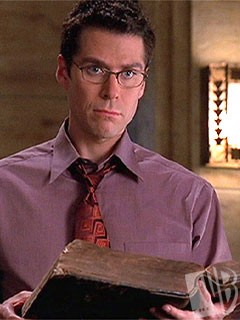
An affectionate retelling of the film "Serenity", done entirely with hand puppets. Very well done, too. Far more informative than your average review. Hand Puppet Theater Presents: "Serenity"
Alliance Student: Centuries into the future, and we're still making redneck jokes.

River: And there's still major problems with the education system, too.

****
Inara: Why is it always the concubine that gets used for emotional entrapment?

Mal: So does this mean we have to start dealing with our sexual tension again?
****
See Also: Deconstructing Wesley; Godzilla Parodies; Blues for Wesley
Alliance Student: Centuries into the future, and we're still making redneck jokes.
River: And there's still major problems with the education system, too.****
Inara: Why is it always the concubine that gets used for emotional entrapment?
Mal: So does this mean we have to start dealing with our sexual tension again?****
See Also: Deconstructing Wesley; Godzilla Parodies; Blues for Wesley
LITERATURE: DECONSTRUCTING WESLEY (and Illyria): What I'm Reading, a Vacation from Grief and Politics
From "A Sense of the Ending: Schrödinger's 'Angel'" a literary essay by Roz Kaveny, published online and in "Reading Angel : The TV Spin-off With a Soul" edited by Stacy Abbott:
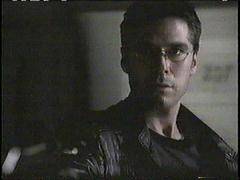
".... In Angel, the character who has most consistently acted as Angel’s shadow and surrogate is Wesley, whose story has throughout been that of ‘The Man who Learns Better’. Remembered by Angel and the audience as the largely useless fop of Buffy Season Three,
the ex-Watcher has re-invented himself as a leather-clad rogue demon-hunter without having changed his essence. The ways in which he changes are many and varied: to pick but one, he consistently chooses Angel over earlier loyalties to the Watchers’ Council, even when what appears to be his father arrives claiming to be its emissary (‘Lineage’, 5007). Wesley is a character whose essence is to lose and yet lose so honourably as to be admirable.
He is the ‘loyal servant’ who betrays Angel by kidnapping his son, but does it to save him from the prophesied guilt of killing him – and in the long run, Angel has to kill Connor so that he can be reborn as the sane heroic youth of Season Five.
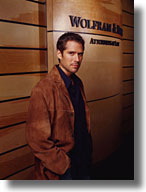
Wesley sells his own soul to Wolfram & Hart in a vain attempt to save that of Lilah, whom he no longer loves; he finally wins Fred, only to lose her to Illyria; and it is his death that finally redeems Illyria by teaching her the meaning of human grief. Wesley’s death is both the price of Angel’s victory and a demonstration that the mission is about self-sacrifice."
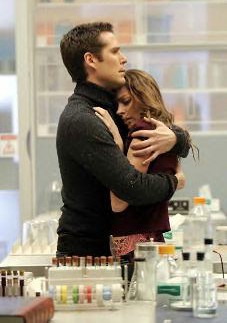
".... ‘You’re not looking at your friend; you’re looking at the thing that killed him’ (Giles in ‘The Harvest’, B1002) is even truer of Illyria than it was of, say, Harmony; Illyria is a long dead god/demon that inhabits the corpse of Fred
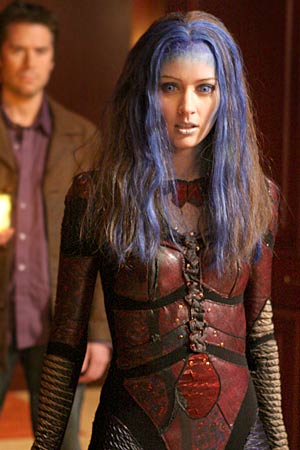
and devoured her soul in the fires of her re-creation. Yet, as with many vampires, it is not as simple as that; even before the restoration of Fred’s memories of her penultimate year and a half of life she is totally Illyria,
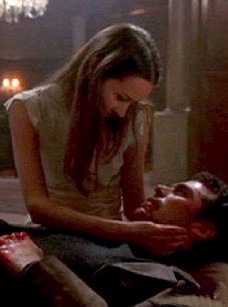
yet increasingly conjoined or contaminated with elements of Fred. If Illyria were wholly and solely the creature she claims, and believes herself, to be, she would not impersonate Fred for the dead woman’s parents, or offer to give Wesley a final perfect day. Both Buffy and Angel have always been shows about redemption; the reason why Wesley refuses Illyria’s offer and then accepts it when mortally wounded is not that he dies having finally chosen illusion over reality, but that her offer is an outward sign of genuine inward change. In an interview at the Hyperion convention, Amy Acker said that Joss Whedon redirected the scene having realized that it was not about Wesley’s love for Illyria or Fred, but about Illyria’s love for Wesley."
".... In Angel, the character who has most consistently acted as Angel’s shadow and surrogate is Wesley, whose story has throughout been that of ‘The Man who Learns Better’. Remembered by Angel and the audience as the largely useless fop of Buffy Season Three,
the ex-Watcher has re-invented himself as a leather-clad rogue demon-hunter without having changed his essence. The ways in which he changes are many and varied: to pick but one, he consistently chooses Angel over earlier loyalties to the Watchers’ Council, even when what appears to be his father arrives claiming to be its emissary (‘Lineage’, 5007). Wesley is a character whose essence is to lose and yet lose so honourably as to be admirable.
He is the ‘loyal servant’ who betrays Angel by kidnapping his son, but does it to save him from the prophesied guilt of killing him – and in the long run, Angel has to kill Connor so that he can be reborn as the sane heroic youth of Season Five.
Wesley sells his own soul to Wolfram & Hart in a vain attempt to save that of Lilah, whom he no longer loves; he finally wins Fred, only to lose her to Illyria; and it is his death that finally redeems Illyria by teaching her the meaning of human grief. Wesley’s death is both the price of Angel’s victory and a demonstration that the mission is about self-sacrifice."
".... ‘You’re not looking at your friend; you’re looking at the thing that killed him’ (Giles in ‘The Harvest’, B1002) is even truer of Illyria than it was of, say, Harmony; Illyria is a long dead god/demon that inhabits the corpse of Fred
and devoured her soul in the fires of her re-creation. Yet, as with many vampires, it is not as simple as that; even before the restoration of Fred’s memories of her penultimate year and a half of life she is totally Illyria,
yet increasingly conjoined or contaminated with elements of Fred. If Illyria were wholly and solely the creature she claims, and believes herself, to be, she would not impersonate Fred for the dead woman’s parents, or offer to give Wesley a final perfect day. Both Buffy and Angel have always been shows about redemption; the reason why Wesley refuses Illyria’s offer and then accepts it when mortally wounded is not that he dies having finally chosen illusion over reality, but that her offer is an outward sign of genuine inward change. In an interview at the Hyperion convention, Amy Acker said that Joss Whedon redirected the scene having realized that it was not about Wesley’s love for Illyria or Fred, but about Illyria’s love for Wesley."
Real Music for Imaginary People

Any excuse to mix and burn CDs for friends (Lewis owes me a few-- his taste is now so rarified he's afraid any mix he makes will cause a rift in the space time fabric.) A couple of Christmases ago, Marte gave me a book of recipes from the Napoleonic Wars, "Lobscouse and Spotted Dog: Which It's a Gastronomic Companion to the Aubrey/Maturin Novels of Patrick O'Brian". Chefs Anne Chotzinoff Grossman and Lisa Grossman Thomas researched the book not for profit but out of love for the novels,
The Iron Chef panel might make smacking noises over "sea urchin roe like mother used to make", but some of these recipes might give them pause. It's wonderful to read through, especially if you wanted to know how those underfed midshipmen actually prepared "millers" (rats) for dinner.
In the same spirit, Essay Recordings has several albums of music performed in the novels by Jack Aubrey on violin and Stephen Maturin on cello.

Hear Some
So why not create playlists for imaginary characters or historical persons we admire, to try and evoke their personalities for friends? (Nudge: ALWAYS WITH MUSIC THAT WE PAID FOR, ahem.) Pat Hanavan has never watched an episode of "Buffy" or "Angel", so Darling Violetta's theme from "Angel" and Bill Kennedy's Stiff Records collection (Costello and Pogues) turned into a mix called "Blues for Wesley Wyndham Price". (The less said about my mental state and Wesley's near the end, the better.)
BLUES FOR WESLEY WYNDHAM PRICE; playlist:1. "Allison", Elvis Costello
2. "Watching the Detectives", Elvis Costello
3. "I Just Don't Know What to Do with Myself", Elvis Costello (Oh, Fred...)
4. "The Sick Bed of Cuchulain", The Pogues (Wes finds his balls again)
5. "Dark Streets of London", The Pogues
6. "Sally MacLennane", The Pogues
7. "Words that We Couldn't Say", Yoko Kannon and the Seatbelts (Cowboy Bebop)
8. "Call Me", Yoko Kannon and the Seatbelts (Gunn: "What happened to you, man?" Wes:"My throat was cut and my friends abandoned me.")
9. "The Real Folk Blues" alternate version, Yoko Kannon and the Seatbelts
10. "Space Lion", Yoko Kannon and the Seatbelts
11. "Bela Lugosi's Dead", Bauhaus (goes without saying)
12. "Call Me", Blondie (Wes's relationship with Lilah)
13. "Dreaming", Blondie (Lilah's relationship with Wes)
14. "Tank!" Yoko Kannon and the Seatbelts (Wes going Chow Yun Fat on your ass)
15. "Good Morning Heartache", Billie Holliday (goes without saying)
16. "Bye Bye Blackbird" (any version with all the lyrics)
17. "Oh Sinner Man", Nina Simone
18. "Angel Opening Title Theme", Darling Violetta
RIPPER aka RUPERT; playlist for Giles
1. "Me and the Devil", Robert Johnson
2. "Everybody Wants to Rule the World", Tears for Fears
3. "Cemet'ry Gates", The Smiths
4. "Behind Blue Eyes", The Who (Anthony Head sings this himself in one episode)
5. "Standing" (Giles' lament from "Once More With Feeling")
6. "I've Got a Theory" ("It must be bunnies, bunnies, bunnies, BUN-NIIEEES..")
7. "Frankly, Mr, Shankly", The Smiths
8. "Me and My Big Ideas", Tears for Fears
9. "Walk Through the Fire" (Buffy cast again)
10. "Falling Down", Tears for Fears
11. "What You Feel" (Reprise) Hinton Battle, "Once More With Feeling"
12. "Where Do We Go From Here?", Buffy Cast, "Once More With Feeling"
13. "West End Girls", Pet Shop Boys
14. "Hounds of Love", Kate Bush
None of these are cast in stone, and Suggestions/additions/deletions from these are welcome. As time wasting and impulse allow, I'm thinking about mixes for Travis McGee (Buena Vista Social Club, La Pistola y el Corazon, Paul Desmond, etc.), Albert Camus (Django Reinhardt, Edith Piaf and Jacques Brel, but which songs? and what else?) Frida Kahlo, Harlan Ellison...
Writer Reginald Hudlin has been asking readers for playlists to go with the new "Black Panther" comic. HIGHLY recommended and issue 6 has some good tips on afro-pop titles. Let's see some lists and links.
Subscribe to:
Posts (Atom)