Showing posts with label mythology. Show all posts

New Gods for Old; Women Who Work in Comics

Over at Comics Alliance, an essay by Chris Sims on why the archetypes running loose in Jack Kirby New Gods can trouble our thoughts thirty years after they first appeared. "[Darkseid's] actions are geared towards conditioning people to embrace and exploit their own base hatred and fear. That's how he wins and remakes the world in his own image... devoted not to death but to Anti-Life... a slavery that masquerades as freedom by allowing its victims to give in to the dark side of humanity. [Darkseid] is a villain who exploits the small selfishness that we all see, experience, and even commit on a daily basis and shows how it all adds up to towering evil, and that makes him one of the most genuinely terrifying villains in comics."

Pursuant to an earlier conversation with friends, there's also a short list of prominent women working in comics-- my own favorites, like Amanda Conner, Gail Simone, Colleen Coover, a mention of Karen Berger's importance as an editor on Sandman-- and some I'd never heard of, like Emma Rios and Ramona Fradon. In the appendix of David Hajdu's The Ten Cent Plague, roughly half the artists who lost their jobs in the Wertham purge were women. The only one I knew as a child was Marie Severin on Dr. Strange; at least two generations have no idea the big studios used to cater to all readers, and they've never quite recovered.

Kirby and the splash page for the first episode of New Gods; Amanda Conner, one of my imaginary girlfriends, and her take on Supergirl and Power Girl; Colleen Coover on an unintended side-effect of four color printing.


Joseph Campbell's Story About the Tiger Who Thought He Was a Goat

I heard Joseph Campbell tell this story at Fountain Street Church in Grand Rapids back in the Eighties. Just found this transcription, and the story wants to be told again, for what it's worth.


A starving and pregnant tigress comes upon a flock of goats and pounces on them with such fervor that she brings about the birth of her little one, as well as her own death. The goats scatter, but soon come back to find the newborn tiger by the side of its dead mother.

Tho goats adopt the baby tiger and it grows up believing it is a goat. He learns to bleat and eat grass, but the trouble is that grass doesn’t nourish tigers well, and he grows into a weak and miserable member of his own species.

One day, a large male tiger pounces on the flock and the goats scatter. The young tiger, not being a goat, remains standing there. The big male is surpised to find a young tiger living with goats, and when he enquired into it, the young one simply says, “Maaaa.” Mortified, the old tiger swats him back and forth a couple of times, but the only response coming forth was more bleating and grass nibbling.

The old tiger brings the young one to a pond and makes him look at his own reflection for the first time. He leans over and points out to him, “See, you look like me. You’re not a goat. You are a tiger, like me. Be like me!” He then brings the young tiger to his den and shows him bloody chunks of gazelle meat from a recent hunt. Taking a big chunk, he says “Open up and eat this!” “Oh no, I’m a vegetarian,” says the little one. But the old tiger would not take no for an answer, and shoves a piece of red meat down the little one’s throat, causing him to gag a little. Now the real tiger food is in his gut, getting into his blood. Spontaneously, the young one gives a a tiger-like stretch, and then a small little tiger roar.

“Now you’ve got it! Now go into the forest and eat tiger food!” says the big one.

Is there something larger than our ego that wants to come through, to demand authenticity and genuineness in the way we live? Are we to cruise onwards toward that inevitable ending, that certain exit on terms that were assumed and purchased for the first half? The second half of life is not a chronological issue, but a psychological one, in which we question what values and paradigms we are living by.
This is a question for each of us, whatever stage of life we’re in - are we tigers living as goats? If the answer is in the affirmative, then a second question - what is good tiger food? In other words, if we are not living as we ought to be, activating our fullest potentials, then what must we do, what would nourish us towards that?

-- A Joseph Campbell Companion, edited by
Diane K. Osbon, The Joseph Campbell Foundation, 1991.

Monkey Puzzle


Monkey is the great trickster hero of Asia, kin to Coyote and Odysseus, Brer Rabbit, Mouse Deer and the rest. Monkey is always wandering, bragging, grabbing at everything and never shutting up, showing off, asking questions, and getting in and out of trouble. They call him "the animal with a hundred hands" because he's always grabbing at things, like the mind that won't stay still but gets itself into unnecessary trouble: the mind, the Zen masters tell us, IS a monkey.
I made this drawing some years ago as part of a long abandoned project. The monkey bodies spell out his name. There's a big painted version in color as well, with the word MONKEY arranged vertically, a blue-green background and the monkeys in red and yellow. An art lover paid me good money for that one (now will I believe that there are unicorns), so it either hangs on some wall or in a rummage sale somewhere.
Monkey: Journey to the West is a classic Buddhist novel of Monkey's adventures traveling with a Buddhist monk in search of enlightenment, faced with 80 impossible tasks 100 chapters and demons and temptations galore-- even pissing on Buddha's hand-- and despite all his character flaws, Monkey finally achieves enlightenment, hope for the silliest.


Now I'm pleased that Jamie Hewlett (Tank Girl and the Gorillaz) has combined Monkey's adventures with the Olympics as an intro for BBC Sports. It's a connection that was hanging there waiting for someone to grab it, so I'm glad it was them and not Disney or some other corporate thief of other people's dreams. Carlo Collodi invented Pinocchio and James Barrie created Peter Pan. Felix Salten wrote Bambi and Hans Christian Anderson dreamed the Little Mermaid (with an unhappy ending) and Rudyard Kipling's "The Jungle Books" is ten times more profound than that jazz-track abomination. Walt Disney may have been the Thomas Edison of idea factories, but that's scarcely a recommendation.

The Captive Princess


[Rapunzel] "begins with two intense cravings: that of a pregnant woman for a plant that grows in a garden next door, and that of a witch for a girl child..."
-- essay by Alison Lurie on the archetypes running around in the fairy tale at The New York Review of Books

The Dark NIght of the Soul


Upon the darkened night
the flame of love was burning in my breast
And by a lantern bright
I fled my house while all in quiet rest
Shrouded by the night
and by the secret stair I quickly fled
The veil concealed my eyes
while all within lay quiet as the dead

Oh Night, Thou was my guide
Oh Night more loving than the rising sun--
Oh Night that joined the lover
to the beloved one
transforming each of them into the other


Upon that misty night
in secrecy, beyond such mortal sight
Without a guide or light
than that which burned so deeply in my heart

That fire t'was led me on
and shone more bright than of the midday sun
To where he waited still
it was a place where no one else could come

Within my pounding heart
which kept itself entirely for Him
He fell into His sleep
beneath the cedars all my love I gave
And by the fortress walls
the wind would brush His hair against his brow
And with its smoothest hand
caressed my every sense it would allow

I lost myself to Him
and laid my face upon my lover's breast
And care and grief grew dim
as in the mornings mist became the light
There they dimmed amongst the lilies fair


The Dark Night of the Soul by St. John of the Cross
Adapted and set to music by Loreena McKennitt

“That which this anguished soul feels most deeply is the conviction that God has abandoned it, of which it has no doubt; that He has cast it away into darkness as an abominable thing . . . and this comes from the sense of being abandoned by God, being chastised and cast out by His wrath and heavy displeasure. All this and even more the soul feels now, for a terrible apprehension has come upon it that thus this despair will be with it for ever. It has also the same sense of abandonment with respect to all creatures, and that it is an object of contempt to all, especially to its friends.” The "Dark Night" got its name from John of the Cross, but something like it happens on almost every mystic path. Meister Eckhart talks about "leaving God for God", losing your personal, tribal concepts of the divine so they can be replaced by something closer to the Real, but sometimes that means God pushes you down the stairs with a helpful hand in the small of your back. Religious bigots like bin Laden or Dobson never feel abandoned at all, never question, and so stay stuck as spiritual infants convinced they have God's unlisted phone number and God (who strangely resembles them in a mirror) "sits up nights to admire them." Their concept of the Divine will always be small and mean and hunched by their own limitations.

Some dark comfort that the talons griping my soul in the dark once drew blood from the shoulder of Athene. If Jesus isn't abandoned in the garden when God ran from the po-pos to let him die screaming desolate on the cross, if some small part of his consciousness thinks he's going to get out of this, he's not really going to die, then it doesn't really count, does it? In shamanic experience, the Dark Night means your helper spirits leave you to have your body get torn apart, eaten and shat out by wild animals, and the task-- unless you decide to just lie there and stay dead-- is to reassemble the bloody chunks into something resembling a human being. One of the northern nations (Cree, I think) used to leave those exhibiting bizarre behavior alone in a lean-to for the winter-- if you reconstituted and were still alive in the Spring, then you were meant to be a shaman, but if you starved or froze to death, then it was just a schizophrenic episode and not a mystic experience at all. Odin lost an eye messing with this stuff, and probably counted himself lucky that it wasn't his left nut.

Happy Marmot Appreciation Day; I Mean Imbolc, I Mean Saint Brigid's Day


Ah, syncreticism, without which we might as well all be Protestants. Julius Caesar conflated the triple goddess of the Celts as related to Minerva, which was dandy for religious tolerance but a pain in the butt for for historians because, following the custom of interpretatio romana, he described the Celtic pantheon to the folks back home using their Roman names. The original names are lost to the vagaries of oral tradition. Roman Catholics followed his cue and turned the Irish goddess Bride into the "Mary of the Celts" Saint Bride or Brigit or Bridget, midwife to Mary the Mother of Jesus.
The ewes start lactating, almost ready for the lambs, not that I'm one to be so up close and personal with sheep. Bridget features a cow, "our second mother" in her iconography, and some traditions hold that Brigid herself was wet nurse to the infant god. There's a lot of milk and fecundity and swollen bellies running around this holiday-- the name Ibolc itself means "In the Belly". Psychologically I suppose this is the part of the winter when we're waiting for something to happen, pregnant with change maybe, and waiting for the weather to break.

This plump little figure is from one of Saint Bridget's wells in Ireland. And the plump little fellow peeking out of his burrow represents my favorite part of the holiday, because what other day do we honor my favorite Mammalian order, the Rodentia?


The Celts had a rhyme they recited about a serpent coming out of his hole this day as a predictor of the coming Spring. That custom must have been brought over to America on the same boat as the carved turnip Jack O'Lantern, and mixed in with the animal the Algonquins called weeauchok. There's a paradox involved in the Chuck's prediction that I've never understood-- if the sun shines, and he sees his shadow today, that means more winter, not less?-- but it is the nature of the mystic quest and the way of the groundhog shaman to learn to live with paradox.

The prize for guttsiest groundhogs I know goes to a band of chucks who moved into a Michigan peace officer's back yard. Being a bear of very little brain, he decided to get rid of the woodchucks by setting charges of dynamite in and around their holes, inserting blasting caps and standing back to blast the critters out like Yosemite Sam.

Sad to say, it was an amateur installation-- by the trooper's brother-in-law-- and the dynamite failed to go off when they turned the crank. Didn't go off when they shot at it with pistols, either. Now instead of one groundhog family, there's a colony of woodchucks living in an overgrown mound more than 10 feet across, lined with explosive. The cop is afraid to go anywhere near the dynamite, which only becomes more volatile as its components separate, and he carefully mows around it. The chucks now live in a bramble and grass covered fortress, protected by the threat of Mutual Assured Destruction.

CASSIOPEIA, DIRTY MUDFLAP GIRL IN THE SKY

I may have uncovered the archetype beneath badly drawn female anatomy, and no, I don't mean the Venus of Willendorf.

News from Perseus, which seems to be a busy part of the sky this time of year. The scientists who located the first of almost 250 planets known to be outside our solar system have announced a new planet that almost matches ours in its distance from its sun, with a year of 360 days. Bad news is, the star it circles is a Red Giant that's eaten up the equivalent orbits of Mercury and Venus and long since baked away any water or life that might have been there.

My friends and relatives who live away from city lights are used to me pestering them this time of year, because August 12 is when I start lurking in their back yards to watch for the Perseids, a thick meteor shower that seems to come out of that part of the sky. The light circled in red above, NGC1275 or Perseus A, is the source of a strong radio signal of unknown origin. At these distances there's no connection, but fun for a writer to play with-- shades of Arthur C. Clarke's "The Star".

The winking eye of the gorgon's head in Perseus' hand, Algol, was called Ras Al Ghul by the medieval Arabs, "head of the demon" (and gave its name to a Batman villain). It's the only binary star we can see with the naked eye, that darkens every couple of days when the smaller of the two stars passes behind its companion.

I can only reliably find about five constellations without a map and both hands. I usually find Perseus by first looking for the W or upside down M in the sky. The professionals call it Cassiopeia, the queen on her throne, but my wife and her sister have renamed her "Dirty Mud Flap Girl", as you can see from the incredibly expensive graphic I've provided here.


My friend Wayne Allen Sallee plans on renaming the cities of America when he's the last survivor of the next great plague. The novelist Jim Harrison wants to rename any birds of America that labor under inadequate or unpoetic names-- "The Beige Dolorosa", one of three novellas in Julip, describes the plan. Bridget and Colleen discovered the Dirty Mud Flap as girls, during long nights on Grandma Olga's dock, and in the weird archetypal nature of these metaphors, it's an appropriate nickname.

Cassiopeia was the beautiful queen of Ethiopia, so vain that she boasted she was as beautiful as the fifty daughters of the Old Man of the Sea. Hence the connection with our chrome avatar of badly drawn female pulchritude; did Michael Turner design that thing while he was still in high school?

Cassiopeia was punished by a sea monster that ravaged the coast of Ethiopia, appeased only by sacrificing maidens. What is it with these monsters and their treasure and their maidens? They don't know what to do with either, like an obtuse millionaire with a trophy wife. They ran through all the virgins 'til there weren't any left, except for the queen's daughter Andromeda, the girl chained to the two starry pillars to the lower right of Perseus. Perseus rescued Andromeda, and thereby hangs a tale and a plot point in Clash of the Titans, by which I mean the Harryhausen film and not the legend of Power Girl's breasts.

LET'S PUT THE CTHULU BACK IN CHRISTMAS

It’s not about the monster show, the man in the rubber suit that jumps out of the dark. A B-movie or a rollercoaster can accomplish as much. That is a momentary scare, not something that freezes your soul until you can never be warm again.

The most frightening thing in the fiction of H.P. Lovecraft isn’t the ichor dripping from the jaws of elder gods, or the thought of vulnerable flesh being pierced and stripped from our bones by the scuttling claws of unnamed things that the very sight of would drive men to insanity. We already have diseases enough that do that to our bodies in microcosm, and in our visible world men build machines to destroy other men, women and children in a hundred ways to teach us that our hopes and dreams and ideas of beauty and truth are easily turned to garbage for dogs and crows.

The horrible perception of reality in Lovecraft comes when his characters feel the weight of aeons before humanity ever existed and the endless stretch of darkness after our last spark is gone. It is the awareness of the indifference of the universe that is represented by the metaphor of Lovecraft’s Elder Gods. You matter no more than a speck of sand that dreamed it was a mountain once.

In contrast, in, I hope, unending opposition, we have the symbolism of Christmas Eve: that an indifferent universe heard Job’s complaint, and took on human form. I am well aware of the historical evidence that makes the baby Jesus just one of many gods and avatars of the same idea; I usually find myself better read on the subject than most of Christianity’s critics and defenders.

It seems to me that these half-informed debates over the historicity of Jesus are beside the point. The conservative Christians and Muslims, with their simpleton’s insistence on their faith as literal and exclusive “fact”, do more damage to religion than the most science-bound atheist.

I have faith in certain metaphors as the potential salvation for mankind. Shelley was right about that much, when he called poets the secret legislators of mankind, even if he was a dope about sailboats. I feel anger and pity for those religionists who claim, “If every word in my holy book [insert title here] is not literally true, then all my faith is in vain.” A pretty shoddy faith, if it’s so easily undone.

It’s the meaning we attach to a vulnerable child that spits in the eye of Lovecraft’s indifferent, cold stars, and the marketplace sensibility of the social Darwinist capitalists who dominate our culture, and the mechanistic reductionists who sneer at love and the nuturing impulse as mere chemical predestination.

The ox and ass of the nativity crèche were once recognized by Egyptians as Osiris and Set, giving their blessing to the new god bedded down in their hay. If the self-important, indifferent to human suffering god of the Old Testament would give up his place of prominence to an unwed mother from a gynophobic culture and an all-too-human child, then surely that’s a good thing for the rest of us? Let us be tender towards the universe tonight as if it were a small child, and if the Elder Gods are still cruel, then that's their problem, not ours. Punk-ass slime monsters.

JUNG'S TOWER and PERSONAL MYTHOLOGY, Part Three

[Continued from Part Two]...

.... Four years later, Jung's "testament in stone" reached its penultimate state: "I added a courtyard and a loggia by the lake, which formed a fourth element that was separated from the unitary threeness of the house." This fourth element opens the self up to nature and the sky, to the divine and the cosmos. The courtyard is a part of the house but it is also connected to something far beyond the Self. to look into the eye of God.

Twenty years later, after the death of his wife Emma, Jung made his last addition to the building, an upper story added to the central section. "I felt an inner obligation to become what I myself am," Jung explains to himself in Memories, Dreams, Reflections, "I could no longer hide myself behind the 'maternal' [Part I] and the 'spiritual' towers [Part II]. I added an upper story to this section, which represents myself, or my ego-personality."

Why this fifth stage of development in the structure? What more is there to build, after the womb, action taking action in the world, after withdrawal into the self, after the open courtyard perceiving the eternal? There is the final act that mystics speak of as bringing the divine down to this world and rising up to meet it so that the two are one, indistinguishable from one another. This is what the design of the Star of David represents with its two triangles meeting to form a single star: "As above, so below"; "I and the Father are One".

This concept is common to many mystic traditions. In Kundalini yoga, seven "chakras"-- levels of spiritual development-- are imagined at seven points in the human body. The penultimate chakra, on the forehead between the eyes, represents a level of development wherein "God", or the "Universe", has finally revealed itself to the seeker-- but the ultimate chakra is higher still, at the crown of the head, where the mystic becomes one with the divine, no longer separate, beyond polarity. The Christian mystic Meister Eckhardt speaks of "the leaving of God for God for God"-- that is to say, growing beyond one's preconceptions in order to discover the true mystery.

As a caveat, this might be the time to tell the story of the moth who spent all night banging against the glass of a lantern trying to reach the flame within. When he went home the next morning, he told his friends, "I've seen God!", and his friends replied, "You don't look any better for it."

Had Jung attempted this stage of spiritual development at any other time than in his old age, it would have been a gross act of inflation. Coming at this time of life, his acknowledgement of ego is a simple act of recognition, like crowning a piece in the game of checkers when it reaches the other side of the board. "I felt an inner obligation to become what I myself am... Earlier, I would have regarded it as presumptuous self-emphasis. Now it signified an extension of consciousness avhieved in old age."

How much of the tower's evolutionary design was intentional, and how much was unconscious? Jung hints that he knew perfectly well what he was doing with this pun made of stone, when he speaks of the marker stone outside the tower: "The stone stands outside the Tower, and is like an explanation of it. It is a manifestation of the occupant, but one which remains incomprehensible to others. Do you know what I wanted to chisel into the stone? 'Le cri de Merin!' For what the stone expressed reminded me of Merlin's life in the forest, after which he vanished from the world. Men still hear his cries, so the legend runs, but they cannot understand or interpret them."

The truly transcendent experience cannot be described; it cannot be adequately translated to others. As the Sufis say, "To taste is to know"-- words are not experience. As the Sufis (and young animals) say, "To taste is to know"-- words are not experience. It is as the naturalist Loren Eiseley explained, after his own transcendent moment involving a wild fox cub, a chicken bone, and a moment of play: "The universe was swinging in some fantastic fashion around to present its face, and the face was so small that the universe itself was laughing... It is the gravest, most meaningful act I shall ever accomplish, but, as Thoreau remarked of some peculiar errand of his own, there is no use reporting it to the Royal Society."

Jung's Bollingen is like a magician's tower from fable: the edifice is not just a representation of his temporal power, but synonymous with the magician itself. Unlike the tower made from faery dust, Bollingen did not collapse when its magician died, perhaps because of the integrity of the craftsmanship.

JUNG'S TOWER and PERSONAL MYTHOLOGY, Part Two


(Continued from Part One)
The first expansion of Jung's tower-- what is now the central structure-- came four years after the initial stage. Despite the feelings of "response and renewal" within the first structure, Jung felt that something more was needed, beyond the familial hearth.
In a practical sense, the tower would have to be expanded in order to become useful as a work space, family cottage, guest room, an actual dwelling. Its potential usefulnes expands. This stage of the building can be read as a symbol in stone of the need for the Self to move beyond the castle keep of the womb, beyond its source, into action in the world, to become, as humans must, a socialized animal.

After action in the world, the evolving Self will feel the need to withdraw into itself if only to recharge and rest, to assimilate exxperience and listen for its own voice. Four years later, Jung's tower is extended again-- and hear its personal meaning is fairly well spelled out for us by Jung himself:
"I wanted a room in this tower where I could exist for myself alone. I had in mind what I had seen in Indian houses, in which there is usually an area-- though it may be only a corner of a room separated off by a curtain-- in which the inhabitants can withdraw. There they may meditate for perhaps a quarter or half an hour, or do yoga exercises. such an area of retirement is essential in India, where people live crowded very close together."
Jung keeps the key to this private room well guarded. He meditates, he paints on the wall, he writes arcana in his magician's diary, the so-called "Red Book" containing paintings of his visions-- expressing "all those things which have carried me out of time into seclusion, out of the present into timelessness... a place of spiritual concentration." One of the pictures shown here-- "Shadow Cornered"-- was painted during the depression that followed Jung's break from Freud.
Following to Gaaskell's scholarly stricture, it should be noted that the Greek god informing this third stage of development-- the Spiritual-- is Hermes, the trickster benefactor of alchemists, tricksters, thieves and travelers.

To be Continued...

JUNG'S TOWER and PERSONAL MYTHOLOGY, Part One


C.G. Jung described the stone tower he built with his own hands at Bollingen on Lake Zurich as a "representation in stone of my innermost thoughts and of the knowledge I had acquired... a confession of faith in stone." The tower's design is something more than an intellectual exercise in spiritual symbolism, more than weekend physical exercise designed to call the intellect back to earth. The tower is also one of the more interesting self-portraits of European culture. The evolution of its design, as related in "Memories, Dreams, Reflections", parallels the evolution of a soul. "At Bollingen," he said, "I am in the midst of my true life, I am most deeply myself."

The home built after Jung's marriage was well and good for a proper Swiss physician and family man; the sorcerer-in-training required something more. The tower is, in a sense, a part of Jung himself left behind, like the shell of a chambered nautilus.

The Bollingen stone tower took shape in five stages, corresponding with five stages of consciousness described by mystics of various disciplines as follows:
-- The physical plane, that of our animal flesh;
-- The astral plane, containing the so-called "lower" emotions such as desire and possessiveness;
-- The mental plane, where the higher emotions and the individua personality begin to manifest themselves;
-- The spiritual plane, where the wisdom of nature and the "Holy Spirit" begin to inform the mystic pilgrim;
-- the celestial plane, where a manifest god, God-the-Son for the Christians, Apollo for the Greeks, the discovery of the "god within", the individuated "Self" appears.

Beyond these five stages of spiritual development awaits the unknown, the "Absolute": the God Unknown, the Tetragrammaton, the living archetypes of the Divine.

These five stages, borrowing from G.A. Gaskell's "Dictionary of All Scriptures and Myths", correspond with the gods and symbols of both ancient and modern pantheons. In ancient Egypt, for example, the god Nepthys represented the physical level of development, Set the astral level, Thoth the mental, Isis the spiritual, Osiris the celestial, with Ra as the unknowable archetype over all. It risks academic grasping to fit Jung's homely architecture into such a tight boot, but the pattern does offer intriguing parallels.

Jung tells us that the first section of the tower "represented for me the maternal heart." It is here that the family gathers 'round-- a birthplace, a primal source. Interestingly, Gaskell's study identifies the "physical" stage not just with Nepthys but with the Greek goddess Hestia (in Rome, "Vesta"): the goddess of the hearth.

Continued...

Provence, Three

Photos by Patricia Relf Hanavan with exception of the Alpine marmot; look for her books at Amazon.com.
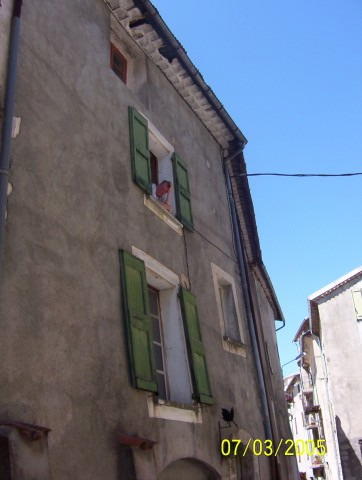
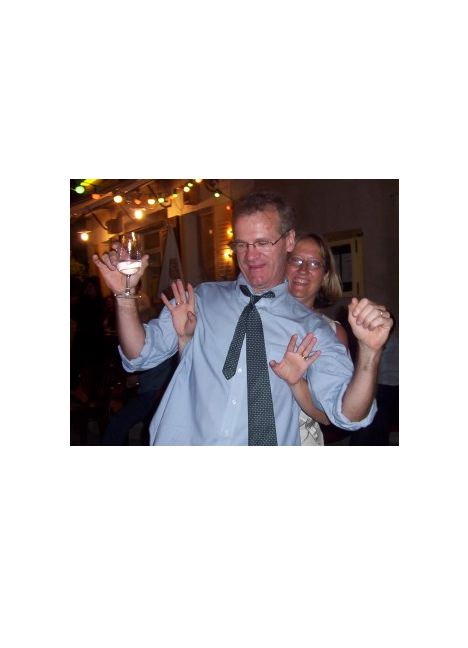
1) Yelling at beggars from the window of Michel and Maureen's house in Vergons. Built in the 1700s along a winding street.2) "Ils sont fou, ces Americans." 2) Former Congo bush pilot Gilbert supervises truly dangerous animals: Americans moving a sleeper couch. This room had been used as a smoke room for hams; Michel, Bridget and Maureen cleaned, painted, papered, and dug out the beams, floor installed by Michel et moi.
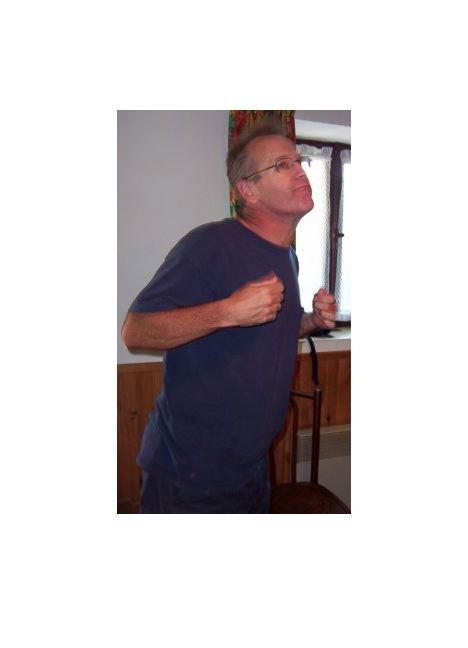
3) People all around the world, they'll be dancing in the gitte...
4) Wedding gifts: every home should have one.5) Maureen teaches Bill the forbidden Nipple Dance.
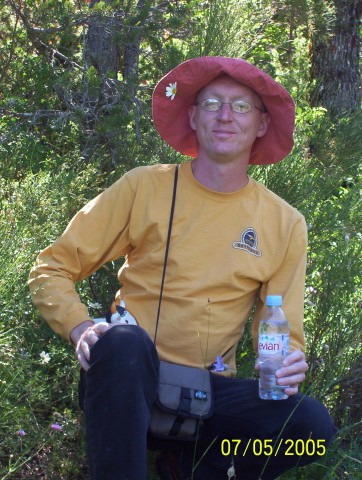
6) Mike Martin on the Fossil Hunt, wearing Ann Anson's hat against the sun; a touching Victorian moment, posed in a meadow as "The Flower Fairy".
7) A complaint was made about the profound lack of nymphs and dryads bathing in the ancient springs; Louise attempts to make up for this.
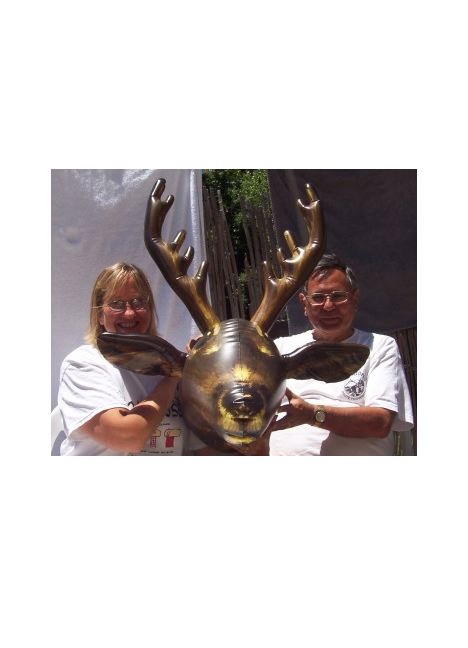
8) B., Pat and Bill, with a Provencal marmot in an Alpine hat that yodels when you squeeze it.

Houyhnhnms and the People of the Lie

The Houyhnhnms are a race of highly intelligent and civilized horses. They live in a remote land first revealed by the Englishman Lemuel Gulliver in the 18th century, and described by Jonathan Swift in Gulliver’s Travels.

The Houyhnhnms speak a language, and use the curve between the hoof and the pastern to grasp objects, in the same way that humans use their hands.

They have no wars, no poverty, and almost no disease. They are completely ruled by reason and the laws of nature. They live together with all our human virtues and none of our vices. The very idea of “evil” is unknown to them.

One reason for this is that Houyhnhnms do not know how to lie. They use language for communication and understanding, and not deception, so “to say a thing that is not” makes no sense to them.

Current research sponsored by Ormondroyd’s suggests that the Houyhnhnms’ inability to lie stems from equine nature, not nurture. Most human children have learned to lie, or at least dissemble, by the age of two. Indeed, learning to lie might be part of human psychological maturation.

Our first lies represent “the beginning of the end of idealizing parents”, according to David A. Gershaw, Ph.D.-- the dawning realization that parents are not omnipotent. He cites Psychiatrist Arnold Goldberg remark, "The first time you see a limit to your parents' powers is a developmental step forward, towards a more realistic view of others." The reader is also referred to Twain’s My First Lie, and How I got Out of It.

What then do we make of the adult lie, the hypocrisy and cognitive dissonance that devastate our world? It is our ability to lie to ourselves and to others that makes it possible to murder, steal, wage war, cheat widows and orphans, and pave over forests. Men like Joel Schumacher and Paul Verhoeven continue to be employed as film directors despite all evidence to the contrary.

As highly intelligent creatures, Houyhnhnms have the ability to imagine a crime against another. They are not kept from villainy because they are angels, but because they cannot rationalize such a crime. They cannot lie to themselves about motives or justification.
Both Orwell and Solzhenitsyn have written much more profoundly about how lies provide the fertile ground necessary for human misery to grow.

We can only add the casual observation that humans prefer lies to truth; we are drawn to them like a crack baby seeking its addiction in its mother’s milk. The forced laughter of the radio sidekick telling us these people are having a good time, the avuncular politician who flatters and panders, the body count fantasies of the action film, we are surrounded by lies and elevate the master liars to the highest ranks. Those who delude themselves as well as their followers run for president.

Truth tellers are only honored in retrospect, when Truth is the daughter of Time. The little boy who announced that the emperor had no clothes was not rewarded for his vision, and as Robert Heinlein put it, “in the Country of the Blind, the one-eyed man is in for a hell of a rough ride.”

How do we make the truth as attractive as the lie? How do we ask Americans to listen to complex issues when simple answers are so much sweeter? We discover democracy when we recognize that every serf in Wat Tyler’s army has some value equal to the king; we did not anticipate that the American mob would prefer bleached and sugared bread to whole wheat thought. This is a bitter realization for sons and daughters of Athena, a triumph for the children of Machiavelli.

We cannot imitate the Houyhnhnms, because they are virtuous by nature, not by choice. Animals are not often pulled in two directions, feeling two things at once as humans do. Jim Harrison has observed, “When a cat doesn’t know what to do, it sits down.”

A degenerate species of humanoids called “Yahoos” live in the land of the Houyhnhnms. They are very stupid and very nasty, and have to be controlled by the Houyhnhnms because they cannot control themselves. Yahoos have spread out over most of our planet and can interbreed with homo sapiens.

For this reason Lemuel Gulliver wished he could always live with the Houyhnhnms. It only takes a moment for a handful of Yahoos to destroy even out noblest achievements. Men and women like Jonathan Swift, with their heads and hearts broken by their fellow man, may well turn to the company of animals for comfort. Fanny Hackabout-Jones, in a biographical novel by Erica Jong, observed that Swift’s misanthropy was not that of a malicious conservative; rather it was the bitterness of a disappointed lover.
Wood Elves, Crackers, and Class Warfare

“Elf” is a generic term for faery-folk who appear human except for their pointed ears. “High Elves” are tall and
elegant and aristocratic. “Wood elves” are shorter, sometimes quaint fellows running through the woods wearing red
caps and pointed shoes.  
High elves have the same relationship to wood elves as modern humans have with the genus “Redneck”.  Jokes
about their haircuts, clothing and personal habits are similar in tone:

Q. What are a wood elf’s last words?
A. “Watch this!”

Q. How can you tell if a wood elf is a virgin?
A. She can run faster than her cousin.

Some helpful analogies:

Wood Elf
* pixie cut
* pointed cap and red shoes
* Aversion to cold iron
* Evolved from Nature Spirits

Redneck
*mullet
* billed cap and wife beater
* Sullen expression when speaking to teachers or policemen
* Didn’t pay attention during the Industrial Revolution

*Incest, self-destruction, attempts at meta-amphetamine production by persons who’ve never
studied chemistry = about the same.

These stereotypes are grossly unfair to Wood elves, and reflect the prejudices fostered by Tolkein and more recently, the special effects highjinks of Orlando Bloom. The High Elves of "LOTR" have penetrated the zeitgeist much more than Wendy and Richard Pini's portrait of Wood Elves in the "Elfquest" series.
The editors of Ormondroyd's do not subscribe to this calumny; if forced to choose up sides, it is the position of our editors that “High Elf culture” is itself a mockery of European aristocracy and its rigid class structure.
What must we do when the culture of our "social betters" is just as noxious as the habits of the "lower classes"? Both high and low wreak havoc, except that the aristocracy-- including that obnoxious dynasty from Ohio now inhabiting the White House-- is much better financed.
This is admittedly a bad tempered post.

A Ritual Ordeal for Young Brides

CALLICANTZARI (Greek; see also FAERY)

Callicantzari are Greek faery folk, sometimes small and mischievous, sometimes large and dangerous.  During the twelve days
of Christmas they are free to roam the earth and make trouble.
One of these callicantzari, the drakos, stops wedding parties on the road and tries to carry off the bridegroom. The
bride can scare him off, if she stands her ground and declares that she is the daughter of the thunder and she has
already eaten nine dragons for breakfast that morning.
This is noteworthy when so much of our folklore is worried about the fidelity of the bridegroom, and takes the
woman’s commitment to marriage as a given.  The drakos would seem to demand something more of Greek
brides.  By standing up to the bridegroom thief and pronouncing herself worthy as a warrior, the girl enters into
marriage as a conscious choice.  A surprising number of young women marry out of an unconscious desire to
purchase Brides’ magazines and organize a catered affair; out of a desire to please; or because they can’t think of
what else to do with themselves at a certain stage in their lives.
There are plenty of marriage customs hidden beneath the icing that involve an ordeal; the best man is a reminder of the days when a bridegroom had to "steal" his bride (literally or symbolically) from her family. The best man was there to watch his back in case the family, or a rival, came to steal the bride back.
Some other culture (Levantine perhaps? I think it was mentioned in Robert Johnson's book "She") has young boys hopping painfully on one foot during the ceremony.
Rough stuff, wedding customs. Wendell Berry refers to it as "The Country of Marriage" and you'd better prove yourself ready to shoulder your canoe with Lewis and Clark before you embark.
Quoting myself from one of my incomplete/inadequate poems, "Toy Wilderness" (dibs on the title): "We hunt one another through a toy wilderness where we ourselves are the animals."