Showing posts with label Science Fiction. Show all posts

Forrest Ackerman


Forrest Ackerman, ninety-something years old, is fading away in California, body failing but alert as a cricket and taking the greatest joy in messages of affection from unofficial "nieces and nephews" around the world. It isn't too much of an exaggeration to say Mr. Ackerman is one of the people who created and sustained genre fandom, with Famous Monsters of Filmdom one of the cornerstones. I was in the third or fourth grade when I first saw a copy at Steve Noel's house, with the ads for Mole Men masks in the back-- thirty years later, when I saw the cast of Mystery Science Theater wearing those masks, it was like a secret handshake.
Forrest Ackermman must look 'round at the San Diego Comicon with a wild surmise like Balboa on that peak in Darien. He's the Mr. Chips of science fiction, comics, horror and fantasy, and if anyone asks if he has any children, tell them "hundreds and hundreds".
Cards and letters are welcome at:
FORREST J ACKERMAN
4511 Russell Avenue
Los Angeles, CA
90027

The Last of Poor Yorick


One of my favorite comics of the last five years, Brian K. Vaughan's Y: The Last Man reached its conclusion this week. This is science fiction (throat clearing, pretend it's not a "graphic novel") to push on comic-averse friends, and oodles more fun as an adventure story than pretentious wallpaper like Jimmy Corrigan.
The premise is, literally, the second oldest trope in science fiction; Mary Shelley had a go at it in her second novel, The Last Man. A pandemic takes down our precarious civilization-- to paraphrase Roberto Vacca, the more complicated the plumbing, the easier it is to sabotage. Survivors are left to sort through the wreckage, as in memoirs of the bubonic plague. Almost simultaneously, a mysterious plague kills every mammal on earth carrying a Y chromosome, except for amiable slacker/stage magician Yorick Brown and his helper monkey, Ampersand. Try one, two, or all ten collected volumes.

1. Unmanned (collecting issues #1-5)
Wearing a gas mask against the pestilence, Yorick makes his way to Washington, D.C. to find his mother, Congresswoman Brown, and sister Hero (their father was a Shakespeare scholar). Republican wives stage a coup, as the surviving government, composed of females, is predominately Democratic (do the math). A new President, the former Secretary of Agriculture, is sworn in by Agent 355, a member of the Culper Ring, the remnant of George Washington's personal spy agency and the only viable intelligence operation left in the US.
(The Culper Ring was, in truth, organized by Washington and Benjamin Tallmadge, and the first agent to die anonymously in the service of this country was a woman known only as "355". We know that she was captured as a spy in New York, akept on a prison ship in the harbor, and was either hanged or died from complications of childbirth and imprisonment. In Vaughan's novel, the Ring has been hidden-in-plain-sight all these years from the rest of the military industrial complex. 355 is the 10th woman to carry that designation, a badge of high honor within the organization.)
The President sends 355 and Yorick to Boston, to contact geneticist Dr. Allison Mann in an attempt to learn what's happened. Dr. Mann's lab is destroyed by Israeli agents led by Alter Tse'elon, a ruthless Israeli Colonel (always the goddamn colonels-- maybe we should abolish that rank altogether) who has learned of Yorick's survival and wants him for Israel. Yorick, 355 and Dr. Mann head towards a government lab in the Midwest and Mann's backup lab in San Francisco.

Girls That Kick Ass
Kung-fu women, once limited to Mrs. Peel and Wonder Woman, are everywhere you turn around in pop culture since the success of Buffy, and Vaughan and the series artist, Pia Guerra, avoid several of the pitfalls. 355 is tough, watchful and calculating in desperate situations, but not omniscent or invulnerable, and Guerra made a deliberate effort to keep the fight scenes grounded by gravity and realistic forms of combat.
"Magic Negroes"
Vaughan also avoids the trap of "the Magic Negro", a hideous trope in fiction and film in which the leading black character has all the soul and weary world wisdom, while the white characters are repressed and plastic. Having grown up and worked for some years in predominately African American communities, I am here to testify that "the Magic Negro" is a Hollywood fiction, possibly from the same ranch in Arizonia where they find all those blonde girlfriends and villains with British accents. In my experience, African-American friends and co-workers were as shallow and uninsightful as their white suburban Republican counterparts, just as quick to worship the plastic over the real. Black schoolmates, drawn to the arts, were rejected by supposedly "soulful" brothers and sisters and had to hang out with the white hipsters. One friend never knew he was "black" until he went away to an all white college, and could earn authenticity points in the English Department for that accident of birth. I dread the coming film adaptation of Y and suspect that Hollywood will turn 355 into another Magic Negro, if only because the audience and the studios are comforted by seeing Foxy Brown in the preview. If anything, it's Yorick Brown who brings humor and soul to the upright Agent 355, and in spite of the thousand shocks that flesh is heir to, neither of them have a background as traumatic as the third lead, the biologist Allison Mann.

Boys to Men
Yorick Brown himself is no booted survivalist, but funny, affable, well read, unambitious except for his own dreamy pursuits, and more than a little hapless-- the kind of man women call "a sweet boy" among themselves, someone to cuddle but not a man to take seriously. Before the plague, Yorick would have been the eternal "boyfriend" rather than the "husband". But needs must when the devil drives, and Y is also the story of Yorick's growing maturity, and a gallant effort to acquire steel in his character without losing his gentleness (he is more soft-hearted than either Mann or 355). If "Man does, woman is", it is interesting that Yorick's attention to a craft-- locks and lockpicking-- more than once saves the day and earns grudging respect from his companions. (Vaughan is quite aware of the layers of implication in his stories, and I wonder if he knew that the hapless Louis XVI was a locksmith, one who tried to escape just a little too late to save his family.) One irony in Yorick's "slackerdom" is that he is the opposite of the kind of man who got the species into this mess-- not a follower, not a bully, not an amoral engineer who creates a doomsday weapon out of curiosity. Yorick, for better or worse, is the voice of the Humanities ("I'd have an easier time finding a fellow Stooges fan") and the head-shaking dynamic between Yorick, 355 as praetorian guard and the voice of the soldierly virtues, and Dr. Mann as the voice of technology without prudence (imagine a family of Victor Frankentsteins), is one of the pleasures of the series.
Doomsday Cults
The travellers find refuge in rural Ohio, in a community governed, ironically, by surviving female convicts from the local prison. The village is attacked by a doomsday cult, the Daughters of the Amazon-- including Yorick's sister Hero-- intent on killing the last male. This cult of violent women who've mainlined Andrea Dworkin was, for me, the weakest idea in Y, and I was glad to see the back of them-- but even Mary Shelley's Last Man has a doomsday cult in it, perhaps with the medieval flaggellants in mind (or the vampire zombies in Omega Man did'jya see it? It was Beauty, eh).
For me the Daughters of the Amazon are the only undeveloped idea in the series, the least worked out and dependent on science fiction cliches, though living in a world where women blow themselves up to secure the privilege of wearing a burkha, and send young people to die in foreign lands so they can stand tall in an election, I suppose I could be complacent about the vicious power of hysteria and the mob. The Daughters fade out after a couple of volumes and a few hundred miles of road, to my relief, and become irrelevant to the overriding quest.

3. One Small Step (issues #11-17)
A Russian astronaut, Natalya Zamyatin tries to rescue the astronauts (two male and one female) who were trapped in orbit by the plague. Yorick, 355 and Dr. Mann reach a sealed government lab and geneticists Heather and Heidi. Oh, great, the fricking Israeli Army invades Kansas looking for the last man, soldier girls following the psychopatic Colonel Alter. And one of the astronauts is pregnant. The survivors of this mess fall in with a theatrical troupe performing something called The Last Man its characters taken from Mary Shelly's other novel.
4. Safeword (issues #18-23)
Ampersand is sick, and his survival of the plague makes him more than just another shit-thrower. 355 and Mann leave Yorick in the hands of Culper Agent 711, who has the damnedest cure for depression and survivor guilt you've ever seen. Survivalists in Arizona block the road to California, and they're no better than their male counterparts.
5. Ring of Truth (issues #24-31)
On to San Francisco. Yorick discovers another survivor named Beth, my favorite of the female characters in the series. How Yorick and Ampersand survived the Plague. Yorick and his sister Hero are reunited, but a fucking ninja ruins everyone's plans.
6. Girl on Girl (issues #32-36)
Pirates, a sea voyage, female navvies on an Australian sub, the return of international espionage. And the return of that fucking psychotic Alter Tse'elon of the Israeli Defense Force, one of the most despicable literary villains of recent memory.
7. Paper Dolls (issues #37-42)
Yorick is revealed to an unbelieving world; his sister Hero finds Beth II (from Volume 6); we learn the biography of Culper Agent 355, and the origin of Ampersand, Yorick's caupuchin.
8. Kimono Dragons (issues #43-48)
The secrets of Dr. Allison Mann, her father and mother are revealed along with a tentative explanation of the plague. The unhealthy lengths some Japanese survivors will go to in their worship of pop divas.
9.Motherland (issues #49-54)
Yorick and 355 and Toyota confront the murderous origins of the plague. One last ninja fight, ranking right up there with the finale of Rob Roy. Yorick and 355 make their way across Russia towards Paris.
10. (Finale, tentatively collected as Whys and Wherefores (issues #55-60).
The cast of characters, including Natalya the Russian, Beth II, and their offspring, reaches Paris, and a reunion with Yorick's old girlfriend Beth. Some truths are told and some hearts are broken. I hate Alder more than ever. Coda.

Of all the post-apocalyptic science fiction I can think of, from low-minded drive-in to NYT approved literature-- Jack London's The Scarlet Plague through I Am Legend, Cormac McCarthy's The Road or Lessing's Memoirs of a Survivor-- I'd say King's The Stand and Brian K. Vaughan's Y: the Last Man are the afterworlds most populated with human and humane characters.

How the Boss Made a Monkey Out of Me

The recent headlines about chimps who outperform college students at mental math are somewhat misleading. It's not that these were super chimps, or moronic freshmen. Boxer and Feinstein, two female chimps named for California's senators, played a memory game that asked them to compare numbers and choose the larger number of two sets of objects. Their human opponents-- here's what made the difference-- "were not allowed to count or verbalize as they worked, and they were told to answer as quickly as possible. Both chimps and humans typically answered within 1 second. And both groups fared about the same."

Comparing sets of numbers resembles a task primates might have to perform in nature: grabbing as much as you can before the hyenas chase you away, or the po-pos arrive, whichever comes first. Taking language away from the humans put us on a level playing field with the other primates. "I think of this more as using non-human primates as a tool for discovering where the sophisticated human mind comes from," explains Jessica Cantlon of Duke. "I don't think language is the only thing that differentiates humans from non-human primates, but in terms of math tasks, it is probably the big one," she said.

The snatch-and-grab-it instinct tells us a lot about why so many right wing cranks reject taxation, and vote against their own self interest to support the Republican party while the infrastructure turns to shit around them. Kim Stanley Robinson does the math in his novel Forty Signs of Rain:
“The average surplus value created by American workers is thirty-three dollars an hour.... Sixty four thousand three hundred and fifty dollars a year, generated by the average worker in surplus value.”

".... What's the average income?" Edgardo asked. "Thirty thousand?.... Call it thirty, and what's the average taxes paid?.... Call it ten. So let's see. You work every day of the year, except for three lousy weeks. You make around a hundred thousand dollars. Your boss takes two thirds, and gives you one third, and you give a third of that to the government. Your government uses what it takes to build all the roads and schools and police and pensions, and your boss takes his share and buys a mansion on an island somewhere. So naturally you complain about your bloated inefficient Big Brother of a government, and you always vote for the pro-owner party."

“.... It's a matter of what you can see," [Frank] suggested. "You see your boss, you see your paycheck, it's given to you. You have it. Then you're forced to give some of it to the government. You never know about the surplus value you've created, because it was disappeared in the first place. Cooked in the books.... The only things people understand are sensory. We’re hard-wired to understand life on the savannah. Someone gives you meat, they’re your friend. Someone takes your meat, they’re your enemy. Abstract concepts or statistics just aren’t as real as what you see and touch. People are only good at what they can think out in terms of their senses. That’s just the way we evolved.”

JAMES MADISON SAY SIGNIFYING MONKEY IS GONNA GET YOUR MOMMA

The science that inspired my Twilight Tales story "Signifying Monkey" [warning: graphic violence and sexual language*] is in the news again with a story about robots controlled by human thoughts and another hopeful story about applications for amputees. And again, I call for a memorial to be built to the experimental subjects, animal and human (remember the yellow fever volunteers, and Dr. Erlich's assistant?) that have given up their agony in the service of humanity. Kalamazoo is a pharmecutical town and I'd like to see a gentle tribute here in Bronson Park, along with our memory of the GAR, Lincoln's visit and the Boxer Rebellion.


I wish humans were benevolent enough to Use This Power Only For Good, but then I know that the military began this line of thought in order to create robotic soldiers. We 're not the only ones; Israel is working on a nanotech "hornet" like the hunter-seeker in DUNE, and Lord knows what the Chinese will get up to.

Reginald Hudlin, in his fine revival of the Black Panther, posits a US fighting force that uses dead soldiers as cybernetically controlled fighting zombies, and I suppose that would be next. Horribly, the thing that makes this a "comic book" idea isn't the outre science: in the real world, most militaries still find it cheaper to use up live meat than to spend all that money on hardware to reanimate the dead.

"If men were angels," James Madison says, "no government would be necessary." My students hear that phrase constantly as an explanation for the Constitution and my sad-but-true refutation of the anarchist dream. Now it seems we need to leash engineers and physicians who use their dark art to hurt rather than heal.


* Five bucks says that warning inspires someone to read the story for the sole purpose of being offended.

TRUST ME: Three VERY Disturbing Films for Halloween: "HAXAN", "THE DESIGNATED MOURNER", and "FIVE MILLION YEARS FROM EARTH"


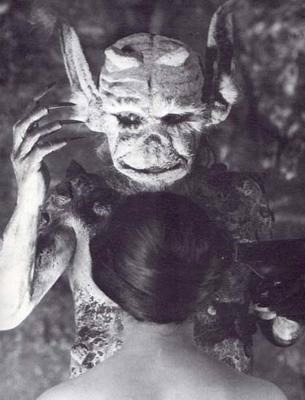
HAXAN, a Danish silent film made in 1922 by Benjamin Christensen, contains images you won't be able to get out of your mind. Intended as a documentary about the witch hysteria of the Middle Ages, with tableaus modeled after old woodcuts more disturbing and archetypal than most modern horror films. It's easy for horror movies to repulse or sicken, but after the bloody roller coaster ride, how many get under your skin and start to worry you...?

FIVE MILLION YEARS FROM EARTH, also found in Britain under the title QUARTERMASS AND THE PIT, is a Hammer film made in 1967 with Andrew Keir, James Donald and Barbara Shelley. Under a London alley called Hobb's Lane, workers unearth an unexploded shell that turns out to be a lost ship from an ancient, dying Mars-- with hominid fossils on board. Human aggression, the "killer ape" impulse that took over the Earth, is a genetic inheritance from the red planet. Our primordial fear of the Devil's horns is an imprinted memory of the Martian "locusts"' antennae, our genocidal wars a reenactment of their annual Martian culling of the weaker members of their herd. And the ship isn't dead, it's only sleeping...

THE DESIGNATED MOURNER, a play by Wallace Shawn, was filmed by David Hare with Mike Nichols, Miranda Richardson, and David de Keyser in 1997. The survivor of a government purge tries to justify himself to an unseen audience after he realizes that ''everyone on earth who could read John Donne was now dead." Imagine Winston Smith as an Edgar Allen Poe character confessing the murder of his own soul, telling us how he learned to stop worrying and love Big Brother, and yes, he really is glad that Julia's dead, because after all she just expected too much of us, didn't she, and I just want to be left alone to watch my TV and not have to think all the time...

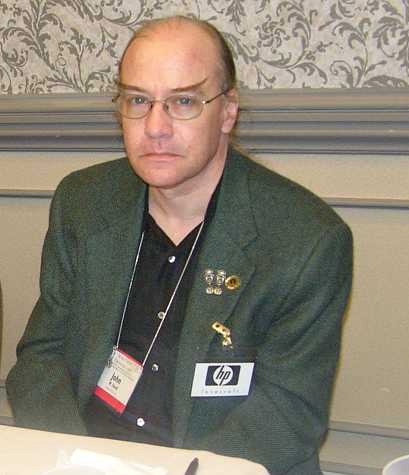
John M. ("Mike") Ford, 1957-2006


Terrible news, which wasn't news anymore, except to me: the writer John M. Ford died unexpectedly September 24 in Minneapolis.
I met him briefly at WFC in Wisconsin, long enough to shake his hand and ask him to sign THE LAST HOT TIME. I knew I'd be lugging home boxes of books from the convention, and that was the only book I'd brought from home to be autographed. We chatted about inconsequential things and I didn't get to tell him how good I thought he was, or how I always recommended him when people asked me about books.
I heard him read the next day, and it was my favorite of all those I attended. He read something called "The Fellowship of the Woosters", Tolkein's trilogy if it had been written by P.G. Wodehouse, and Bertie Wooster had been assigned to destroy the Ring instead of Frodo, with the Great War of the Ring another muddle for Jeeves to sort out. Evidently he never published it, just saved it for conventions. I laughed out loud and thought that was unusual for a writer to not try and sell every scrap he produced, but then I read some of his posts at Making Light and incidental pieces elsewhere-- poems with technically proficent meter and scansion, a "Talk Like a Pirate" entry written in the voice of Stephen Maturin-- and I realized his throwaways were as good as most of the things the rest of us sweat over. The voice of the Wooster and Jeeves piece was so letter perfect it should have been given the case of Bollinger and prize pig the Wodehouse estate gives out every year... now I wonder who will ever read it again, will it be saved.

If writers have "chops" like jazz musicians, John M. Ford was the most technically skilled of any contemporary writer I know. Lots of writers are good or great at their own niche; John Michael Ford seemed to be good at whatever genre he turned his hand to, better than Gaiman or Moore or whoever you care to name. He won a couple of World Fantasy Awards and the Philip K. Dick Award, but like R.A. MacAvoy or Thomas Burnett Swann, he deserved more attention than he was given. I hope the regard of a discerning few was enough for him.

One of those things I was going-to-get-around-to was an appreciation on this blog of his short story and poetry collection, HEAT OF FUSION. I was looking forward to meeting him again. This is written and posted in a hurry, without his skill or polish-- if I have any strengths as a writer, they lie elsewhere. It is heartfelt.

Track down THE LAST HOT TIME, the only urban fantasy I know where Chester Himes characters meet Chicago gangland elves, an EMT hero and girls in Louise Brooks haircuts with the best written explication of bondage and discipline sex I've ever read (come to think, it's the ONLY book like that I ever read), or GROWING UP WEIGHTLESS, or HEAT of FUSION, (with a version of Oedipus and Antigone if a Seymour Hersch or Frank Rich were trying to write a profile for the New Yorker); I still plan to write that appreciation of the stories there. I've never read THE DRAGON WAITING or DRAGONS of LIGHT, but I know some people swear by them. He even wrote a couple of Star Trek novels, and one of them, HOW MUCH FOR JUST THE PLANET? is considered the best of them all by people who know better than I.

You know that great feeling when you think you've read everything written by all your favorite writers, and then you discover someone new to you and you realize that your finding their work makes you young again like finding an unexplored world...?

Cormac McCarthy Writes a Science Fiction Novel


You ask what makes me reject the dominant culture of the United States in the Year of Our Lord 2006. I answer that there is some shit I will not eat for profit. There are some things I will not do in order to achieve a nervous financial supremacy. I do not begrudge a beggar the crumbs while I serve the master of the castle prime cuts of meat, just so I can scramble after the scraps and scheme to become a master myself. I do not see the world as an inevitable war of all against all, of let's do it to them before they do it to us. It makes me a much better neighbor to have when the chips are down.

***
The boy asks: "We wouldn't ever eat anybody, would we?"
"No. Of course not..."
"No matter what."
"No. No matter what."
"Because we're the good guys."
"Yes."
"And we're carrying the fire."
"And we're carrying the fire. Yes."

***
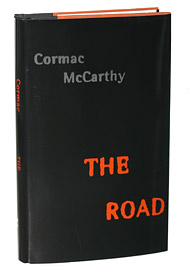
I wonder if Harold Bloom is going to swallow his pride and read a science fiction novel...? Cormac McCarthy, one of Bloom's favorite writers, has written a post-apocalyptic novel, THE ROAD, cut from the same cloth as A CANTICLE FOR LEIBOWITZ and MEMOIRS OF A SURVIVOR, a slap upside the head to the self-congratulatory LEFT BEHIND series.

McCarthy has discovered that you can do things with the literature of the fantastic that cannot be done with any other genre. He probably already knew this; a writer's taste is rarely as limited as the critics', just as musicians listen to stuff their fans would never touch (Louis Armstrong loved Guy Lombardo). Critic's darlings Doris Lessing, Neil Gaiman, and Alan Moore would have told him the same thing. Margaret Atwood is still living in denial, insisting that novels like THE HANDMAID'S TALE and ORYX AND CRAKE are not science fiction.

The tropes of fantasy and science fiction are the same metaphors our ancestors used to populate the archetypes of myth. If the quality-- and the seriousness-- varies wildly-- that's the fault of the publishers and the writers, not the genre.

Joss Whedon Parody/ Hand Puppet Theater: "Serenity"

An affectionate retelling of the film "Serenity", done entirely with hand puppets. Very well done, too. Far more informative than your average review. Hand Puppet Theater Presents: "Serenity"


Alliance Student: Centuries into the future, and we're still making redneck jokes.

River: And there's still major problems with the education system, too.

****

Inara: Why is it always the concubine that gets used for emotional entrapment?

Mal: So does this mean we have to start dealing with our sexual tension again?

****
See Also: Deconstructing Wesley; Godzilla Parodies; Blues for Wesley