Showing posts with label literature. Show all posts

Hold 'Em in the Caul, Field

I still think there's something creepy about Holden Caulfield. What's this business of catching children before they "fall" into adulthood-- when the world needs more adults, not fewer? Or Seymour Glass, waking his wife Muriel from her shallow slumber in a particularly ugly way?

I can imagine Holden (if he stays out of jail) ending as a basement-dwelling iconoclast, proud to be smarter, more "authentic" than the rest of us suffering monkeys, part of the cast of High Fidelity or the local comics shop. Given his social class, Holden might end as Jerry Rubin did, praising Charles Manson and then graduating to embrace Reagan and Wall Street, albeit with a Saturday Night Live ironic twist to his mouth. Is it unkind of me to wonder if Rubin was sneering when he was hit by a car?

Am I the only one annoyed by Salinger's twee characters being made of, well, Glass? I know Seymour had a tough war (Salinger himself was part of D-Day), but does that excuse spattering even the silliest of women with a mess of brains? Better to volunteer for pharmaceutical experiments if you want to throw yourself away. Why not rush into a fire, or find a leper colony like Graham Greene's Burnt-Out Case?

The Canadian Phillip Marchand has some thoughts on the American man-child. Salinger himself managed the equivalent of a James Dean or Marilyn Monroe, never sullying his reputation with lesser work (as someone said of Elvis' death, "good career move")-- but not dying, enjoying his royalties in private, apparently a pleasant enough life with friends and family.

I would have liked Holden better if, having rejected the phoniness of straight society, he picked up a shovel and scooped shit at an animal shelter, or sorted clothes for the homeless, or even (cough) tried to teach in the public schools. Holden creeped me out when I first read Catcher in middle school-- I preferred Irving Stone's Michelangelo and VanGogh, or T.H. White's King Arthur: sensitive, maybe doomed, but not likely to surrender.

I still prefer genre writing to the finger-sniffing stories of "New Yorker" fiction. The wounded detectives, from Spenser to Travis McGee to T. Jefferson Parker, expose the truth like Holden but then try to do something about it. Even the silliest super hero, as Michael Chabon makes explicit in The Amazing Adventures of Kavalier and Clay and implies in Wonder Boys, is at least pretending to be a grown up, picking up their imaginary cosmic shovel or rescuing a kitten from a tree to make the world a better place. Salinger reminds me of those people who don't like kittens because they turn into cats.

Wayne Sallee Haunts the City

Drumming up some readers for my buddy Wayne's blog here, Frankenstein 1959, which lately has been full of oddly charming (that's our clan's cri de guerre, "odd but charming") posts about what it's like getting around a major city with cerebral palsy, only enough money for a bookstore or to buy a friend a drink, and a humanist's eye for the people he shares the bus stop with, the ones on their way home to a cardboard box. Wayne's primarily a horror writer by trade (Fiends by Torchlight, Horror in the Heartland and others)but this stuff is a purer gold. It reminds me of Nelson Algren's Chicago, City on the Make crossed with John Callahan's Don't Worry, He Won't Get Far on Foot with the weather eye of the son of a Chicago cop (I mean, cahp) if they'd gone to school with the crew of Mystery Science Theater. I'm hoping his journal entries-- taking a wrong turn on foot in the cul de sac of a gated community designed to keep poor people out and being unable to hop the fence through which he can see the relative freedom of the streets-- will turn into a book someday.

"Going back to my post about the Wow! Signal and Elvis going home, HEF commented that the static from space was really a dinner bell. One night, he, I, Jeff, and Andrew smoked pot in his basement and I exclaimed "I am Emily Dickinson!" to which the other men choked down the goodness and of course I meant to say that I was Spartacus. And to this day I am reminded of this event....
"Tonight was the Printers Ball, a yearly thing. This time around it was at the MCA, the Museum of Contemporary Art. The photo above is from last year's event in Bridgeport in which the police were called because Bridgeport is full of @$$holes. I can type those words about Mayor Daley's old neighborhood and get away with it because NOBODY in Bridgeport is smart enough to use Google and type in Bridgeport Is Full Of @$$holes. So there, you Irish hillbillies. It was a neat little event and I soon realized that most everybody there was half my age....
"I was wearing a kind of tealish Hawaiian shirt, but I'd look pretty silly wearing my jeans and just the jacket and my three chest hairs. Silly there, but fashionable in Wrigleyville. I also got a whatever kind of look girls give guys twice their age from this Claire Danesish gal as I refilled my water bottle. She was by herself but I had nothing to say because I AM AN IDIOT. I could be with her right now, holding hands over deep dish pizza at Lou Malnati's before sneaking out the back way because I only have $22.37 and a giant Pope coin to my name. ...
"The Man in this case being the SS/Disability Board. I am STILL filling out the online form, mostly because I keep getting pages where I am repeating the same thing. Where I am repeating the same thing. I'm better today, as the evening has worn on. I'm in fighting mode again. But, I tell you, this damn form--now I'm up to my employment history, Christ knows if they want info from 1977 as they did with my medical info, I think I was a night dishwasher at a Golden Bear off State Road--this form, this THING, its as if Charles has ordered me at gunpoint to transcribe the history of the Green Lantern Corps. ...
"NFM Mike and I discussed porn while waiting for the Red Line and a young waif flipping through a magazine moved ever further away as I discussed such grand titles as THE NEIGHBORS SUCK AND SO DO WE, and the book I swear I will one day find again and one day own, I can see the cover as if it was 1979 all over again, MY DACHSHUND, MY LOVER. (I know if I keep mentioning the book, it will come to be in my possession.) And that was my last, oh, 18 hours or so. One more week of summer. I felt sooo old at that party tonight."

Waynes blog here and website with books for sale here

Anne Sexton


A long time ago a professor who used to write poetry on the side told me he had met Anne Sexton after a reading, and asked her how she wrote a particular poem, and "All she did was hold up her wrists for me to see with the scars on them from her suicide attempts". He seemed to think it was an example of her extreme nature, and I used to think it was a lesson in the difference between an academic and a poet, and now I think she could have lived longer and loved her daughters more with the improved medications for depression, and there really isn't much connection between madness and art, except as predispositions that live next door to each other like alcoholism and diabetes-- and I don't know what I think any more about what else her answer might mean to the creative life. Truman Capote says when God gives you a talent, he also gives you a whip (if you want to get any work done), and call it romanticizing if you will, but I've noticed a lot us walk with a limp like Jacob after he wrestled with the angel, and God gave him such a smack, he never would forget it, and maybe that's what the marks on her wrists were.
This is the poem by Anne Sexton that knows my secret heart, the way Jeremiah talks about being know before he was formed in the womb, the way Isak Dinesen's ravaged smile and her story "The Cabin-Boy's Tale" kept me alive one night, the way Job and Isaiah reassure me that God belongs to the small dark forgotten things as well, that "the beasts of the field shall honor me, the dragons and the owls-- because I give waters in the wilderness, and rivers in the desert."

A story, a story!
(Let it go. Let it come.)
I was stamped out like a Plymouth fender
into this world.
First came the crib
with its glacial bars.
Then dolls
and the devotion to their plactic mouths.
Then there was school,
the little straight rows of chairs,
blotting my name over and over,
but undersea all the time,
a stranger whose elbows wouldn't work.
Then there was life
with its cruel houses
and people who seldom touched-
though touch is all-
but I grew,
like a pig in a trenchcoat I grew,
and then there were many strange apparitions,
the nagging rain, the sun turning into poison
and all of that, saws working through my heart,
but I grew, I grew,
and God was there like an island I had not rowed to,
still ignorant of Him, my arms, and my legs worked,
and I grew, I grew,
I wore rubies and bought tomatoes
and now, in my middle age,
about nineteen in the head I'd say,
I am rowing, I am rowing
though the oarlocks stick and are rusty
and the sea blinks and rolls
like a worried eyebal,
but I am rowing, I am rowing,
though the wind pushes me back
and I know that that island will not be perfect,
it will have the flaws of life,
the absurdities of the dinner table,
but there will be a door
and I will open it
and I will get rid of the rat inside me,
the gnawing pestilential rat.
God will take it with his two hands
and embrace it.

As the African says:
This is my tale which I have told,
if it be sweet, if it be not sweet,
take somewhere else and let some return to me.
This story ends with me still rowing.

-- Anne Sexton

Peter Gabriel worked some of this into his song about Anne, Mercy Street. The reason I like Anne Sexton better than Plath (or Lowell, for that matter) is that she reminds me of that poorly drawn but heartfelf cartoon where the bird of prey is bearing down upon the little mouse, and the mouse is giving it the finger.

Theresa Duncan and Jeremy Blake and Descents into Darkness


I found Theresa Duncan's blog of cultural criticism, The Wit of the Staircase while doing a search for the spelling of the phrase esprit d'escalier, "the wisdom of the staircase", meaning the things you wish you'd said after an argument, after slamming the door, on your way down the stairs or a couple of blocks down the street. Being cursed with fierce memory means that I have to make a conscious decision to pack away and dismiss other's (minor) faults and my own (major) sins, or else carry them around with me all day and night. This makes a phrase that describes regret more sympathetically than "coulda shoulda woulda" a useful thing to have.

Now I find out from New York magazine that Theresa Duncan killed herself, that her lover Jeremy Blake followed a week after. At first I was just going to move her link next to Molly Ivins', in memorium, still worth reading, with regrets for another intelligent stranger that shouldn't be dead, but is. People that make the world a better place in small or large ways keep dropping like flies, while shitheels go on crawling like roaches, leaking juices and polluting the world for days, even after being squashed. It must be a part of that plan for the world that says at any given time there are only thirty six tzadikkum, just and righteous people, who hold the world together with masking tape and mud and never know the value of their labor. Poisonous assholes, great and small, never get tired, while nature apparently puts a load limit on virtue.

According to the article, Duncan had been frustrated in her efforts to become an independent filmaker, which if you'd asked me, I coulda told you, Henry Slesar's description of "success in Hollywood" being enough for me. Add to that what Jim Harrison said: that a successful career in the arts faces about the same odds as an unlucky combat platoon, or a retirement community in Florida, with a few survivors breaking through and then attributing their success to inherent virtue and hard work instead of the vagaries of fate. Garrison Keillor wisely sneered at religious pundits who talk about Faith without ever really having to dig for it: "there's no one knows more about faith than an undiscovered artist." There's no one waiting for your next outburst, you have to feel energized enough to do the work, but not so energized you don't want to stay in your seat, you have to and believe that a project's worth finishing even if no one ever sees it, its value to the world roughly less than that fallen sumac tree that no one heard.

As connected as Theresa Duncan was in New York, even after her big break when her animated film The History of Glamour got national attention, it just wasn't enough to get a film made. I knew a guy who had the "option" picked up for a comedy script he wrote, thousands of dollars-- but six years later he was still waiting tables. Filmmaking, if you'da ast me (which you didn't), is art-by-committee: you need a lot of hands and a lot of money, and all kinds of trouble I don't need-- whereas when the power was out in Kalamazoo for more than three days, we managed somehow with a pencil and a flashlight. Theresa Duncan had at least one editor telling her to give up on film for now, and move into prose full time... but it tasked her. Zero Mostel, after he was blacklisted, just said Screw It and went on painting until the wheel turned around again. Worried about that day the Right finally transforms the United States into Chile, and we're all locked up with three hots and a cot in Guantanamo...? I'm the guy muttering, "Finally, I can get some work done."

Apparently for Duncan and Blake, their frustrations started turning into conspiracy theories about Scientologists who didn't want them to succeed. The natural process of finding out Who Your True Friends Are degenerated into making lists of Who Was Loyal and Who Was Part of the Conspiracy. No one can follow from the outside all the dark and lonely convolutions that lead a person to suicide, and according to New York, no one knows exactly when this beautiful couple drove off the main road until they were lost from sight.

Yeah, yeah, I was young and beautiful and doomed once, too. And yet, and yet, as I read on, I was surprised to find out that Theresa Duncan was a sister under the skin, another smart and literate kid from a small town (Lapeer, in her case) in Michigan, another talented writer unable to break into the world dominated by million dollar contracts for celebrity authors, which, in case you haven't figured out, means more than a thousand talented writers who will never be published at all because the corporation blew the budget on Sonnee Tufts' tell-all. She didn't want to be a fly-over, when silly people with much less to say are lionized in the cultural centers of New York and Los Angeles. We are mute, emasculated, unheard, drowned out by the shouting from Madison Avenue until we find some way to break a crack in the rock so the living water can flow through to bring water to the owls and the dragons. Add in chemical, genetic and situational depression, suicidal impulses, the frustration of having one eye in a kingdom of the blind (for example, I see from the papers that Norman Finkelstein was denied tenure by Depaul for getting into a pissing match with the Israeli lobby, his apparent sin being speaking truth to someone who buys ink by the barrellful). Add in the chronic anguish that can drive someone to a hasty decision simply to escape, baby, my credentials are on file. These are the things that Hamlet puts on his list of daily insults to the brain, next to the law's delay and the proud man's contumely.

There's a conversation in Long Day's Journey into Night between the compromised father and the ambitious son:
James: Yes, there's the makings of a poet in you all right
Edmund: The makings of a poet. I'm like a bum who asks for a cigarette: he doesn’t have the makings, he's only got the habit. I could never touch what I tried to tell you just now. I just stammered.

I've been luckier than poor Theresa Duncan (would she have chased those pills with whiskey if she'd known Jeremy Blake would follow her in? Was it an poorly thought-out impulse?) I was lucky enough to have a friend nearby who could warn me when I started to sound like a danger to myself. Non-depressives sometimes forget the nature of the disease: when you're down in a hole (hence, "depression") the only reality you can see is the side of the hole, with the patch of sunlight up above being something reserved for "winners" instead of "losers" like yourself. Reality is filtered through a delusion that even the most despicable human beings-- telemarketers, torturers, dog fight promoters-- are winners in the eyes of the world, while the most noble depressive is unworthy of life. The depressive appears lucid, even cheerful-- how many of us are full of jokes!-- but when those chemicals are acting up, there's a distortion of subjective reality that would make a schizophrenic call us crazy.

So include a little prayer for Thersa Duncan and Jeremy Blake and sad people everywhere, even, reportedly, the actor Owen Wilson, and for all the wayfarers looking for the soul of the world, the hobos Kerouac described as wearing two watches, the sun on one wrist and the moon on the other. Some of the very best people are exiles from the culture at large; you'll eat canned beans with the likes of Diogenes and Chu Yuan. But it's like all those times when you were maybe too drunk to drive but you made it home anyway, or went home with the wrong person but you managed not to drive your life into a ditch. If making a success as an artist requires the happiest of chances, so does being rescued from suicide, encountering this person instead of that, turning left instead of right on some dark corner on one dark night. I can remember a night when a photograph of Isak Dinesen's ancient face saved my life: I said, "she looks like I feel", and with nothing left but curiosity, I went home and read the only story by Dinesen I had in the house, and by chance it was a tale that had a particular blessing for me, and so I was saved. I've been rescued too many times by the luck of floating branches in the rushing current to ever sneer at someone else's nemesis.

I CAN HAS CHEESEBURGER! AN EXEGESIS


The Seraphic web page I CAN HAS CHEESEBURGER offers lots of cute animals with misspelled captions added by semi-anonymous contributors. I laughed until I choked.

There are many variations of the "I'm in your base killin ur doodz" meme, which is defined here as an internet "catchphrase that can be roughly translated to 'LOL [laughing out loud] you got pwned [owned] and don't even know it yet.'" It caught on (is there a folklorist in the house?) and now there must be hundreds of chat room name tags reading "I'M IN UR [noun] [verb]ING UR [noun]", for example:

"I'm in your fridge eating your f00dz

"I'm in your house impeachin ur doodz"

and expressing-the-expressible: I'm in ur macaronis warming my feets.

It supposedly originated with on-line multiplayer games such as Command and Conquer, a taunt used when one player surprises another-- though I suspect it has deeper roots in street taunts from pick-up basketball games and such.

The creative spelling is part of the charm. Even the mistyped "pwned" is retained ironically. Deliberate misspellings were first legitimized by Prince in the printed lyrics on his album covers. Misspelled words began as a sign of ignorance, then as an indicator of street authenticity or "keeping it real", then were winked at by weak teachers, then mocked ironically by hipster youth, and finally achieved affectionate status as a form of creative wordplay among the young.

Our Every Choice Is Hateful. What, Then, Must We Do?

I am wholly sympathetic with those who want the troops out of Iraq yesterday-- but I want some third alternative to "get out now" and "escalate".

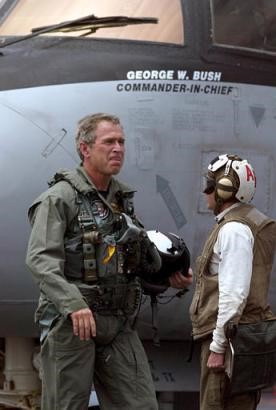
Here is my reason: our country (in spite of my feeble protest) invaded a foreign country, caused the murder of thousands of innocent people and destroyed billions of dollars worth of other people's infrastructure. Having committed these crimes, do we now leave the mess for other people to clean up-- like a certain frat boy has done all his life?

Isn't that why we hated Tom and Daisy Buchanan? "They were careless people, Tom and Daisy- they smashed up things and creatures... and let other people clean up the mess they had made." There's a reason why that book contains one of the most powerful metaphors ever written to explain America.

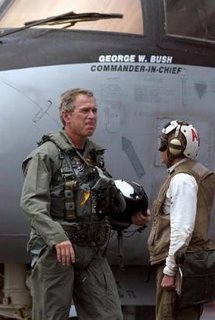
Is this George Bush's ultimate triumph as the Antichrist, to make good people in his likeness? Even the people who despise him? "Gee, sorry we killed your cat and your baby and trashed your house, Iraq, guess we better leave now, this party's no fun anymore, still friends?"

This, to me, would be as monstrous as the invasion. Now those of us against the war will do the job that Bush can't bring himself to do, but he will happily spend the rest of his life blaming those antiwar killjoys for ruining his master plan. There's a psychological reason Bush supporters accuse us of hating America, of "wanting the terrorists to win." Psychically, they cannot afoord to admit to themselves that George W. Bush has been the best recruiting tool al-Qaeda ever had. And that they were his enablers.

The men (and women) who ordered this war, and their enablers, should be removed from office and put far away from power, where they can never hurt anyone again-- but the evil that men do lives after them. What, Then, Must WE Do?

Merry Christmas from Comrade Bailey and Those Commies at the Savings and Loan

"...With regard to the picture 'It's a Wonderful Life', [redacted] stated in substance that the film represented rather obvious attempts to discredit bankers by casting Lionel Barrymore as a "scrooge-type" so that he would be the most hated man in the picture. This, according to these sources, is a common trick used by Communists.
"In addition, [redacted] stated that, in his opinion, this picture deliberately maligned the upper class, attempting to show the people who had money were mean and despicable characters. [redacted] related that if he made this picture portraying the banker, he would have shown this individual to have been following the rules as laid down by the State Bank Examiner in connection with making loans. Further, [redacted] stated that the scene wouldn't have 'suffered at all' in portraying the banker as a man who was protecting funds put in his care by private individuals and adhering to the rules governing the loan of that money rather than portraying the part as it was shown. In summary, [redacted] stated that it was not necessary to make the banker such a mean character and 'I would never have done it that way.'"
(Memo to J. Edgar Hoover from D.M. Ladd, May 27, 1947)
Uncovered by Wise Bread

This would be one of those absurdities-of-the-past, had I not heard an interview on NPR Christmas Day in which the academic Michael Levin defended Ebenezer Scrooge and his descendents as misunderstood and much maligned free-market capitalists. Scrooge, he said, had done more good than harm to society; that if Cratchit were a worthwhile human being he would have been able to find better employment. "There can be no arguing with Dickens's wish to show the spiritual advantages of love. But there was no need to make the object of his lesson an entrepreneur whose ideas and practices benefit his employees, society at large, and himself."

Levin defends Scrooge's evocation of prisons and workhouses for the poor: "As Scrooge observes, he supports those institutions with his taxes. Already forced to help those who can't or won't help themselves, it is not unreasonable for him to balk at volunteering additional funds for their extra comfort.... The more pleasant the alternatives to gainful employment, the greater will be the number of people who seek these alternatives, and the fewer there will be who engage in productive labor. If society expects anyone to work, work had better be a lot more attractive than idleness." This last shows a want of historicity on Levin's part, and a willful ignorance of Victorian conditions. If it doesn't bother Scrooge, then why should it bother the poor?

The weird thing is, I can't tell if Levin is being ironic or not.

I would not so disdain believers in free-market capitalism, if only they could show me that the Invisible Hand truly existed. Only a naif or a collaborator still believes that the marketplace as it exists is truly free. The deck is stacked before the game has even started. Milton Freidman's is another God that Failed, but as it was in Soviet Russia, why should the house slaves in the brokerage houses admit that injustice exists, so long as they themselves feed well off the carcass?

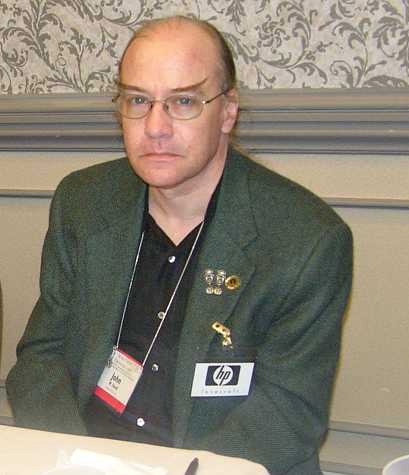
John M. ("Mike") Ford, 1957-2006


Terrible news, which wasn't news anymore, except to me: the writer John M. Ford died unexpectedly September 24 in Minneapolis.
I met him briefly at WFC in Wisconsin, long enough to shake his hand and ask him to sign THE LAST HOT TIME. I knew I'd be lugging home boxes of books from the convention, and that was the only book I'd brought from home to be autographed. We chatted about inconsequential things and I didn't get to tell him how good I thought he was, or how I always recommended him when people asked me about books.
I heard him read the next day, and it was my favorite of all those I attended. He read something called "The Fellowship of the Woosters", Tolkein's trilogy if it had been written by P.G. Wodehouse, and Bertie Wooster had been assigned to destroy the Ring instead of Frodo, with the Great War of the Ring another muddle for Jeeves to sort out. Evidently he never published it, just saved it for conventions. I laughed out loud and thought that was unusual for a writer to not try and sell every scrap he produced, but then I read some of his posts at Making Light and incidental pieces elsewhere-- poems with technically proficent meter and scansion, a "Talk Like a Pirate" entry written in the voice of Stephen Maturin-- and I realized his throwaways were as good as most of the things the rest of us sweat over. The voice of the Wooster and Jeeves piece was so letter perfect it should have been given the case of Bollinger and prize pig the Wodehouse estate gives out every year... now I wonder who will ever read it again, will it be saved.

If writers have "chops" like jazz musicians, John M. Ford was the most technically skilled of any contemporary writer I know. Lots of writers are good or great at their own niche; John Michael Ford seemed to be good at whatever genre he turned his hand to, better than Gaiman or Moore or whoever you care to name. He won a couple of World Fantasy Awards and the Philip K. Dick Award, but like R.A. MacAvoy or Thomas Burnett Swann, he deserved more attention than he was given. I hope the regard of a discerning few was enough for him.

One of those things I was going-to-get-around-to was an appreciation on this blog of his short story and poetry collection, HEAT OF FUSION. I was looking forward to meeting him again. This is written and posted in a hurry, without his skill or polish-- if I have any strengths as a writer, they lie elsewhere. It is heartfelt.

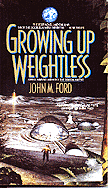
Track down THE LAST HOT TIME, the only urban fantasy I know where Chester Himes characters meet Chicago gangland elves, an EMT hero and girls in Louise Brooks haircuts with the best written explication of bondage and discipline sex I've ever read (come to think, it's the ONLY book like that I ever read), or GROWING UP WEIGHTLESS, or HEAT of FUSION, (with a version of Oedipus and Antigone if a Seymour Hersch or Frank Rich were trying to write a profile for the New Yorker); I still plan to write that appreciation of the stories there. I've never read THE DRAGON WAITING or DRAGONS of LIGHT, but I know some people swear by them. He even wrote a couple of Star Trek novels, and one of them, HOW MUCH FOR JUST THE PLANET? is considered the best of them all by people who know better than I.

You know that great feeling when you think you've read everything written by all your favorite writers, and then you discover someone new to you and you realize that your finding their work makes you young again like finding an unexplored world...?

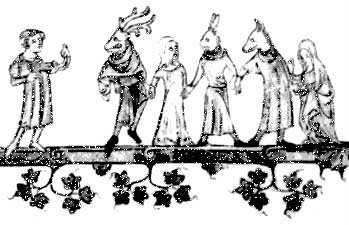
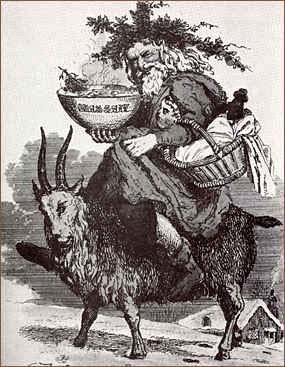
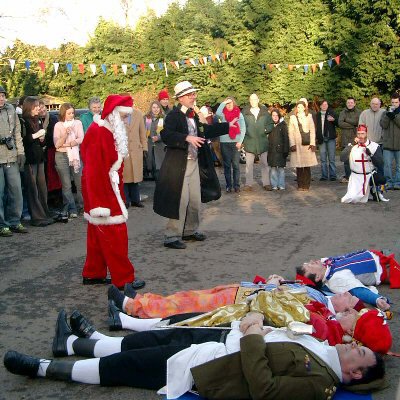
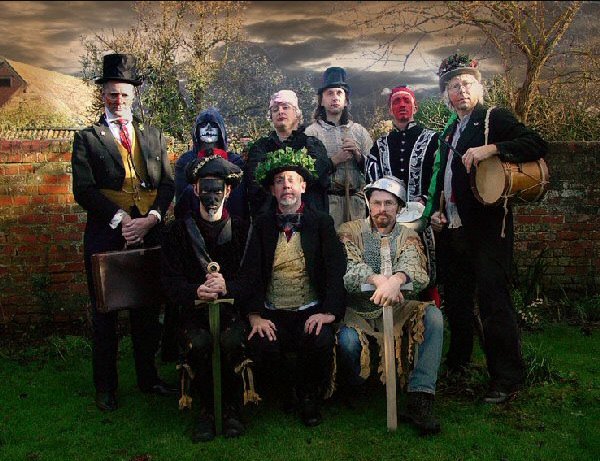
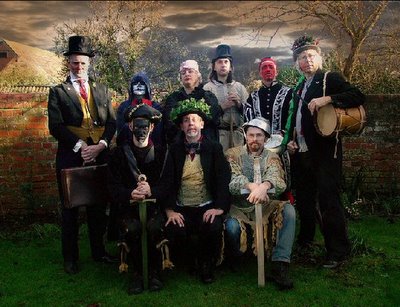
BOXING DAY MUMMERS' PLAY


TEXT: Taken verbatim from traditional secular British Boxing Day plays, in which the "Doctor" resurrects the dying sun.

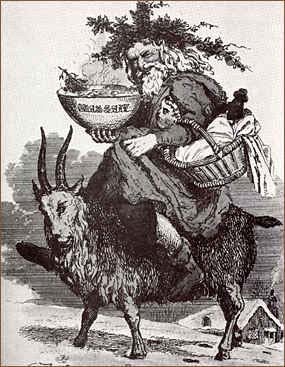
FATHER CHRISTMAS:
Here comes Father Christmas ; who does not know my name?
Sword and buckler by my side, I hope to win the game.
Rise up, good wives, shake your feathers ;
Don't you think that we are beggars !
We are gentles, come to play,
And seek your English good money.
Move off stocks, then move off stools,
Here comes in "The Feast of Fools !"
Muckle head, with little wit
May stand behind the door ;
But such a set as we are
Was never here before !
And in this Room there shall be shown
The finest Battle that ever was known
Between Saint George and ye Turkish Knight

{Enter Saint George who says}

SAINT GEORGE:
In come I Saint George Saint George
That valiant Man of courage bold
all with my Sword and Spear I won 10 Crowns of Gold
I fought the fierce Dragon and brought him to slaughter
and by this means I won the King of Bohemia's Daughter

DRAGON:
Who is it seek the dragon' blood
And speak so angry and so loud?
That English dog who look so proud?
Or if I could catch him with my claws,
Long teet' and harried jaws,
I'll break off his core
And increase my appetite for more.
Marrow from your bone I will squeeze,
And suck your blood up by degrees.

{They fight and St George kills Dragon.}

{Enter Turkish Knight}

TURKISH KNIGHT:
In come I the Turkish Knight
old England for the fight
I will fight Saint George that valiant Man of courage bold
and if his Blood is hot I'll quickly make it cold.

{They fight and Saint George vanquishes Turkish Knight.}

{Saint George then Says}

SAINT GEORGE:
I am a little Man that talks very bold
much like a Lad that I have been told
Therefore draw out thy Sword and fight,
pull out thy Purse and pay -
Satisfaction I will have before I go away

TURKISH KNIGHT
Spare Me Saint George: and do not cut Me down

SAINT GEORGE

Oh, I'll cut thee down and thou shalt rise no more
Then forfeit thy life to make a Store.
Gentlemen and Ladies walk out and see what Miracles I've done.
I've cut and slain my Father down all by ye Evening Sun.
Oh Doctor Doctor is there an Italian Doctor lately come from Spain.
To heal ye Sick and raise ye dead again.

DOCTOR:
Oh yes, there is an Italian Doctor lately come from Spain
To heal ye Sick and raise ye dead again.

{Doctor appears}

SAINT GEORGE:
Oh Doctor what canst Thou cure

DOCTOR:
I can cure ye Itch, ye Palsy and Gout
and raging Pains that run both in and out
Broken Legs and arms, if any Man shall break his Neck
I will set it again, and have nothing for my Pains

SAINT GEORGE:
Oh Doctor what is thy Pay

DOCTOR:
Ten Guineas is my Fee, but ten pounds I will take of thee

SAINT GEORGE:
Take it -

DOCTOR:
Ive got a little Bottle in y Band of my Breeches called Elecampane
{applies it saying} Rise, Beau Champion, and fight again

{Enter Cut and Scar}

CUT AND SCAR
In come I cut and scarred - just come from ye bloody War
I and seven more will beat eleven Score.
Marching Men of War, many Battles I have Seen
Many Battles I have been in for Saint George our King.

{Enter Poor and Mean - He Says}

POOR AND MEAN
In come I poor and Mean,
hardly worthy to be seen
Christmas comes but once a Year
When it comes it brings good Cheer
Roast Beef, Plum Pudding and mince Pye
no body loves them better than I
a Mug of your Christmas Ale will make us dance and sing
and money in our Pockets is a very fine Thing.

{Enter Bold Slasher}

BOLD SLASHER
In come I Bold Slasher, Bold Slasher is my Name
with my Sword and Buckler by my side I hope to win this Game
what Man, what Man comes under my bloody Hand
I cut him and slay Him as small as dust
and send him to ye Cook's Shop to make Pye Crust

{Enter Twing Twang}

TWING TWANG
In comes Twing Twang,
Lieutenant of ye Press Gang
I press all these bold Mummers and send them aboard a Man of War -
To fight the French and Dutch and Spaniards also

SAINT GEORGE:
I am St George, that bravely champion bold,
By my sword and spear I own three crowns of gold.

And with behaviour I own the powers of the King of Egypt's daughter.
Stand forth the royal princess and boldly act thy part.

PRINCESS OF SHEBA:

I am the Princess of Sheva, it is my only delight,
To give sweetest pleasure of this bright and gallant knight.

SAINT GEORGE
Why there is a sight!
Won't it fill any man' heart to see this dragon slain?
Then subdue. Thou wouldest take thy hand unto thy pocket;
Thou wouldest put thy hand upon thy shoulder.
For I love a woman and a woman love me,
So when I want a fool, I'll surely send for thee.
So dear, If any man' heart who contain in this company
Let him stand forth and boldly tell his name.
GIANT:
I don't want just my courageous knight,
For in this war I and you had seen some sight'
In Palestine, in days of yore,
I boldly scrush and et t'ree hogsheads meal twice per day.
But now I became a giant snail,
I'm just waiting, waiting for a meal.
SAINT GEORGE:
Ah, Saladim, Saladim, wilt thou comest to St George with sword and spear?
As Christian so damned
Rush to be stand?

GIANT:
Yes, yes, St George, I mean to fight.
For with one blow, I will let you know,
I am not the Turkish Knight.

{They fight; the Giant wins.}
{Enter St. Patrick}

PATRICK:
Here come I, St. Patrick, in shining armour bright,
A famous champion & a worthy Knight.
What was St. George? But St. Patrick's boy!

He fed his horses seven long years on oats & hay,
And after that, - he ran away.

PRINCESS OF EGYPT:
I say, by George you lie Sir,
Pull out your sword & try Sir,
Pull out your Purse and Pay Sir,
I'll run my sword through your body
And make you run away Sir.
And if you don't believe what I say
Come in Old Noll and clear the way.

OLIVER CROMWELL:
Here come I Oliver Cromwell as you may suppose,
I have conquered many nations, with my Copper Nose;
I made my foes to tremble and my enemies to quake,
And beat all my opposers, till I made their hearts to ache,

And if you don't believe the words I have to say
Enter in Old Beelzebub and clear for me the way.

{B. enters singing to the tune of "Nancy Dawson"}

BEELZEBUB:
"Here I come Old Beelzebub;
Here I come Old Beelzebub;
And over my shoulder I carry my club;
And in my hand a dripping pan
In my hand a dripping pan,
And I think myself a jolly young man."
And if you don't believe what I say
Come in Mr. Devil Doubt & clear the way.

DEVIL DOUBT:
Here come I little Devil Doubt
If you don't give me money, I'll sweep you all out
Money I want, and money I crave
If you don't give me Money, I'll sweep you all to the grave."

{Exeunt omnes, saying}

[All]

I wish You a merry Christmas,
and a happy new Year
a pocket full of Money and a Cellar full of Beer.
See Also: Don't Question Me!; Third Combat Tour in Iraq; Jekyll & Hyde President; Hating the French; The Worms Turn; Pinter's Nobel Speech; et alia

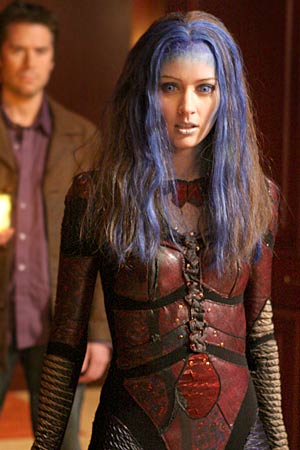
LITERATURE: DECONSTRUCTING WESLEY (and Illyria): What I'm Reading, a Vacation from Grief and Politics

From "A Sense of the Ending: Schrödinger's 'Angel'" a literary essay by Roz Kaveny, published online and in "Reading Angel : The TV Spin-off With a Soul" edited by Stacy Abbott:

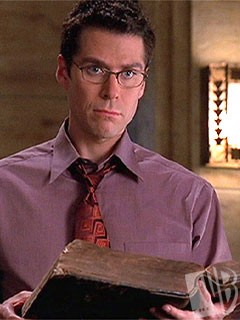
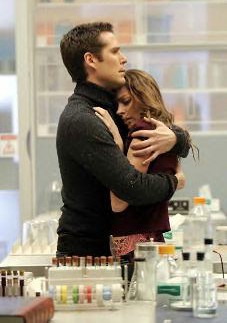
".... In Angel, the character who has most consistently acted as Angel’s shadow and surrogate is Wesley, whose story has throughout been that of ‘The Man who Learns Better’. Remembered by Angel and the audience as the largely useless fop of Buffy Season Three, the ex-Watcher has re-invented himself as a leather-clad rogue demon-hunter without having changed his essence. The ways in which he changes are many and varied: to pick but one, he consistently chooses Angel over earlier loyalties to the Watchers’ Council, even when what appears to be his father arrives claiming to be its emissary (‘Lineage’, 5007). Wesley is a character whose essence is to lose and yet lose so honourably as to be admirable. He is the ‘loyal servant’ who betrays Angel by kidnapping his son, but does it to save him from the prophesied guilt of killing him – and in the long run, Angel has to kill Connor so that he can be reborn as the sane heroic youth of Season Five. Wesley sells his own soul to Wolfram & Hart in a vain attempt to save that of Lilah, whom he no longer loves; he finally wins Fred, only to lose her to Illyria; and it is his death that finally redeems Illyria by teaching her the meaning of human grief. Wesley’s death is both the price of Angel’s victory and a demonstration that the mission is about self-sacrifice."

".... ‘You’re not looking at your friend; you’re looking at the thing that killed him’ (Giles in ‘The Harvest’, B1002) is even truer of Illyria than it was of, say, Harmony; Illyria is a long dead god/demon that inhabits the corpse of Fred and devoured her soul in the fires of her re-creation. Yet, as with many vampires, it is not as simple as that; even before the restoration of Fred’s memories of her penultimate year and a half of life she is totally Illyria, yet increasingly conjoined or contaminated with elements of Fred. If Illyria were wholly and solely the creature she claims, and believes herself, to be, she would not impersonate Fred for the dead woman’s parents, or offer to give Wesley a final perfect day. Both Buffy and Angel have always been shows about redemption; the reason why Wesley refuses Illyria’s offer and then accepts it when mortally wounded is not that he dies having finally chosen illusion over reality, but that her offer is an outward sign of genuine inward change. In an interview at the Hyperion convention, Amy Acker said that Joss Whedon redirected the scene having realized that it was not about Wesley’s love for Illyria or Fred, but about Illyria’s love for Wesley."

"Mostly he cries for his parents and his home, and wonders what has happened, what will happen, to him."

From Colleen Mondor's review of "Kipling's Choice" by Geert Spillebeen:
"As he suffers great pain and loneliness in the time before his death, John does not reflect philosophically upon his life or his loss of it. Mostly he cries for his parents and his home, and wonders what has happened, what will happen, to him. It is one of the more realistic and emotional portrayals of a death that I have read and shows far better than any movie just what dying in a war is all about. It is worth noting that in the Battle of Loos the British army sent their men out to be little more than cannon fodder. They marched them into German guns, hoping they would overwhelm their defenses; they were wrong. The same thing happened in Gettysburg and Fredericksburg in the U.S. Civil War; the same thing happened in Gallipoli also in 1915. There are a hundred similar battles I could list here, give me time and it could be a thousand. And all of the soldiers are dead just like John Kipling, and all of them died just like he did. And it is never pretty, and it is never glorious. Death never is any of those things and if you think it will be different in battle then you are a dreamer; we are all dreamers."