"The tradition of the oppressed teaches us that the ‘state of emergency’ in which we live is not the exception but the rule."
-- Walter Benjamin
"When fascism comes to America, it will be wrapped in a flag and carrying a cross." -- Sinclair Lewis
“Now that blind ambition no longer carries the slightest taint and the term "sell-out" holds no meaning, now that earnest young men sing not of love but of ‘want(ing) to be a billionaire so frickin' bad,’ now that narcissistic outbursts and trips to rehab are tantamount to self-promotion, now that, on blogs and Facebook and Twitter, millions of self-branding voices cry out and are never silenced, now that reaching for the stars is encountered less, by young people, as euphemism than high-priority action item, it may be time to question, at long last, the reigning ethos of super-sized individualism.... Warrior-speak is so much the common lexicon of reality TV that each on-camera confession could stand in for any other: She wants to win at all costs. He's not going to give up, no matter what. She doesn't care who has to eat dirt along the way. The parlance of high school football coaches and insurance salesman has become the native tongue of cable TV.”
-- Heather Havrilesky, in a review of Limitless, a film of Alan Glynn's novel The Dark Fields
Now I will tell Meader’s story; I have a moral in view.
He was pestered by a grizzly so bold and malicious
That he used to snatch caribou meat from the eaves of the cabin.
Not only that. He ignored men and was unafraid of fire.
One night he started battering the door
And broke the window with his paw, so they curled up
With their shotguns beside them, and waited for the dawn.
He came back in the evening, and Meader shot him at close range,
Under the left shoulder blade. Then it was jump and run,
A real storm of a run: a grizzly, Meader says,
Even when he’s been hit in the heart, will keep running
Until he falls down. Later, Meader found him
By following the trail – and then he understood
What lay behind the bear’s odd behavior:
Half of the beast’s jaw was eaten away by an abscess, and caries.
Toothache, for years. An ache without comprehensible reason,
Which often drives us to senseless action
And gives us blind courage. We have nothing to lose,
We come out of the forest, and not always with the hope
That we will be cured
-- Czeslaw Milosz
“Economists long ago tried to justify the vast inequalities that seemed so troubling in the mid-19th century—inequalities that are but a pale shadow of what we are seeing in America today. The justification they came up with was called “marginal-productivity theory.” In a nutshell, this theory associated higher incomes with higher productivity and a greater contribution to society. It is a theory that has always been cherished by the rich. Evidence for its validity, however, remains thin. The corporate executives who helped bring on the recession of the past three years—whose contribution to our society, and to their own companies, has been massively negative—went on to receive large bonuses. In some cases, companies were so embarrassed about calling such rewards “performance bonuses” that they felt compelled to change the name to “retention bonuses” (even if the only thing being retained was bad performance). Those who have contributed great positive innovations to our society, from the pioneers of genetic understanding to the pioneers of the Information Age, have received a pittance compared with those responsible for the financial innovations that brought our global economy to the brink of ruin.”
-- Joseph E. Stiglitz, ”Of the 1%, By the 1%, For the 1%”
“You go to war with the liquor cabinet you have, not the liquor cabinet you wish you had.”
-- Memzilla, commenter on Wonkette
"All the Stones the Builders Rejected"  (And some days it takes more Stones than others...) Where Mythical Bestiary meets Contemporary Culture and Chews On Its Leg Until Covered with Slobber.
Showing posts with label capitalism. Show all posts
Showing posts with label capitalism. Show all posts

When Bear Stearns Dove, and Lehman Spasmed, Who Then Was the Gentleman?

Writing about high finance is way beyond my pay grade, and my indifference to Wall Street drama is surpassed only by capitalism's indulgent contempt and incomprehension for what I do--
But now investment banks are failing, and the Merrill Lynch bull has been eaten by Bank of America, and they come crawling to the taxpayers for a bailout, so damnit, I'm going to say something.
Capitalism, or more specifically, the pursuit of profit, has inspired a great deal of harm [insert obligatory but-communism-was-much-much-worse boilerplate here]. One of the most pernicious is its insistence that all-- all!-- must get on the capitalist train and serve the Invisible Hand or be run over. Minimum wage lackeys, folks losing their homes, artists, teachers, soldiers reduced to food stamps, sweatshop workers, firemen, cops-- except when they're needed-- poor dopes, they should have wised up to the way the world works, accepted that money talks and bullshit walks. The working class that maintains the great cities like San Francisco or New York can't afford to live there.
Their great-grandfathers had the same pious contempt for the Indians, and African slaves before that: serves 'em right for being hunter-gatherers, and if the Africans didn't want to build our infrastructure, they shouldn't have let themselves be kidnapped in the first place.
Now the shoe is on the other foot. The Servants of the Invisible Hand have had a thirty-year spree, with Ronald Reagan and the rest (I include Clinton in this) looking the other way while they Built Wealth, with no serious regulation and devil take the hindmost. The problem is fundamental: this "wealth" is mostly a game of three-card monte, money moved from here to there; "real" wealth would include a sound infrastructure, roads and bridges, concrete and steel, manufacturing here instead of overseas, and schools that produce human capital for the future instead of fighting an intellectual holding battle.

Apparently they've gotten themselves in a whole mess of trouble, and even people whose job it is to know this stuff, like the Treasury Secretary or Christopher Dodd on the Banking Committee, are flummoxed. I was going to say "standing around with their dicks in their hand", but "flummoxed" was classier.
If Fannie Mae and Freddie Mac were an elderly couple about to lose their home, the response from capitalism's gatekeepers would be a loud "Fuck you. Your fault. Now hurry up and die." Instead we are expected to reach in our pockets and bail out the investment bankers. The bohemians, teachers, soldiers, firemen, cops and minimum wage lackeys will chip in and bail them out with whatever tax money is left over from Bush's wars. The thing the losers understand, that capitalism's servants don't seem to get, is that if you want to live in a civil society, then when someone's in trouble, even an arrogant rich asshole, it's in everyone's interest to grit our teeth and bail their sorry asses out. They can go back to spitting in our eye the next time the market goes up.
Memorial Day, Part Two: a Million Victims of Unfettered Capitalism
This anonymous clipping below came in on Memorial Day, regarding an earlier post I made about the suspicious death of Colonel Ted Westhusing in Iraq:
Memorial Day is ours to honor our fallen.............
Ted's Ghost
The Death of Ted Westhusing Leaves a Widening Circle of Sorrow
by Tom Palaima
When the Greek hero Odysseus visits the Underworld in Book 11 of Homer's The Odyssey, he learns that his mother, Antikleia, who was alive when he set sail for Troy, has died and now dwells in the gloomy regions the Greeks called Hades. Odysseus sees her there and, overcome by sorrow, tries to embrace her. She slips away from his grasp but responds to his tearful pleas by explaining, "We no longer have sinews keeping the bones and flesh together, but once the life-force has departed from our bones ... the soul slips away like a dream." Cold comfort for the still-living and long-suffering Odysseus.
My friend, my former student, my scholarly collaborator Ted Westhusing is a ghost to me now. He is a ghost to his mother, his father, his brothers and sister, his wife and three children, his fellow soldiers, his former students at West Point Military Academy, and to the many people who wrote messages in his memorial guestbook (www.legacy.com/GB/GuestbookView.aspx?PersonId=14190695). We all want Ted, flesh and blood, self-effacing wit, plainspoken and honest, dedicated, moral, caring. We want to hear his laughter and feel the warmth of his hello, only matched in how good it made you feel, in my experience, by my late friend Clifford Antone's "Hey there, brother."
I want Ted, not his ghost. And I only knew Ted for three years. I feel the profound grief of his mother and family. Their loss seems to me unbearable, all the more because of the circumstances described so well in Robert Bryce's article (p.28).
In the online guestbook, Steve, an old friend of Ted's from Jenks High School in Oklahoma, writes, a year and a half after Ted's death, that "Ted always made us feel like we were someone special. ... Just the other day, I talked to my children about how important it is to look out for others. When my son was being bullied by a group at school, I talked about Ted and how he cared and looked out for others. It really made an impact on my son. Thanks Ted and God bless you and your family." Ted is somehow still alive in Steve's son.

Imagine the man Steve describes shouldering the overwhelming responsibility of training Iraqi security forces and doing so with no brothers-in-arms around him and, as his "suicide note" makes clear, without the support of his two commanders. One of them, with an irony right out of Joseph Heller's Catch-22, is Gen. David Petraeus, "Iraq's repairman," as Newsweek calls him.
Fierce Dedication
I teach ancient Greek and war and violence studies through the filter of ancient history. I knew Ted Westhusing in both these areas. Ted was 41 years old and a stellar Army officer of almost two decades when he came to UT-Austin in the summer of 2002 to study intensive Greek, five hours a day, five days a week. He needed Greek for his Ph.D. thesis, and he was taking it with graduate students and gifted undergraduates. He reminded me then of Col. Kurtz in Apocalypse Now, who went through Army Airborne School at age 38. Capt. Willard describes Kurtz's Westhusing-like experience in this way: "The next youngest guy in his class was half his age. They must have thought he was some far-out old man humping it over that course. I did it when I was 19, and it damn near wasted me. A tough motherfucker. He finished." As a description of how his fellow students viewed him, Ted would disagree only with the use of the word "motherfucker." I never heard him swear.
Ted was not a natural linguist. But he mastered Greek by long hours and hard work. He later described his experience in the UT alumni magazine, The Alcalde, as being harder than Army Airborne training.
Even in intensive Greek with so many hours of contact, memorable students are rare. The focus is on getting 20-25 students through historical linguistics and then assorted classical Greek literary genres. But Ted's achievement stayed with me. We stayed in touch despite our widely differing views on whether the American military should be in Iraq and Afghanistan.
Ted invited me up to West Point for five days to lecture to his cadet students on the nature of ancient Greek warfare and ancient Greek attitudes about the morality of warfare. He trusted that I would stay on message and not interject my strong views about Iraq and Afghanistan. I saw there the fierce dedication he had to his cadets and the respect bordering on awe they had for him. I also noticed how he had organized every detail of my five-day visit with scrupulous care.
Ted and I worked together on three other major projects. We were advisers to a Discovery Channel program on war in the Homeric epics. We wrote an article together for London's Times Higher Education Supplement on the value of studying Homer at West Point. And we both gave papers at a conference in St. Louis on the experience of war and the trauma it causes, from ancient Greece to the Iraq war. On all these projects, Ted's sense of values and his fierce belief in moral principles were conspicuous.
When Ted e-mailed me on Dec. 20, 2004, with what he called "twice good news" – that he had been selected for eventual promotion to colonel and had agreed to deploy to Iraq to serve under "a former boss of mine Lt. Gen. Petraeus" – I first responded in keeping with his own excitement about assisting in "the continuing effort to get the Iraqi security forces capable of killing the bad guys themselves and of securing their own country."
I expressed my pride in what he had achieved and my heartfelt good wishes. But later, I wrote that soldiers who had been writing me and sending me images of the effects of suicide-bomb blasts were not "optimistic" about the effectiveness of "Dumsfeld's" strategies. Ted's reply was strong. He felt there was no place for such attitudes and even requested the names and units of my informants. I declined in a way that let the matter drop, but that break stayed with us so that I did not communicate with Ted while he was in Iraq.
The Diameter of Death
I feel now that I let my friend down. Ted's death haunts me. His ghost sometimes flits close enough for me to feel. I have the cards from his memorial service that his mother sent me propped up in my study at home and at my computer in my office in Waggener Hall. It is much too easy to turn any dead soldier into whatever you want him or her to be. I want to remember who Ted really was.
In my opinion, it is good that Ted has become a symbol of the waste of this particular war. Those who want to defend the war can easily say that Ted's moral sensibilities were too inflexible and that war's moral ambiguities produce many shades of gray, while Ted saw things only in black and white. Those who want to condemn the war, as I do, can easily use Ted as a symbol for all that is wrong with our leadership and how this war is being waged. Those choices make dead soldiers into icons, and they also let us blame easy targets, Bush, Rumsfeld, Ted himself, and move on.
We should instead remember what Yehuda Amichai writes in his poem "The Diameter of the Bomb" about the death of a single young woman from a terrorist bomb. The grief from her death radiates outward to affect people on other continents and eventually involve the whole world in a circle of sorrow "with no end and no God."
The conditions of the Iraqi war enclosed Ted in a circle within which he could not feel the tender mercies of his God, nor the saving love of his family and friends. His death is a terrible waste. We should have more than the ghost of this good and honorable man for comfort.”
Colonel Westhusing found himself in a fight with the logic of capitalism and war profiteers. We always hear about the victims of Communism, millions in China and Russia who died for someone else’s utopia, but maybe we need a memorial for those Americans whose ideals got between a profiteer and his money. Theodore Westhusing is one of many, from the Cherokee farmers and merchants harried along the Trail of Tears to the Maryknoll nuns murdered by the crack-dealing, gun-toting friends of Saint Ronald Reagan.
Memorial Day is ours to honor our fallen.............
Ted's Ghost
The Death of Ted Westhusing Leaves a Widening Circle of Sorrow
by Tom Palaima
When the Greek hero Odysseus visits the Underworld in Book 11 of Homer's The Odyssey, he learns that his mother, Antikleia, who was alive when he set sail for Troy, has died and now dwells in the gloomy regions the Greeks called Hades. Odysseus sees her there and, overcome by sorrow, tries to embrace her. She slips away from his grasp but responds to his tearful pleas by explaining, "We no longer have sinews keeping the bones and flesh together, but once the life-force has departed from our bones ... the soul slips away like a dream." Cold comfort for the still-living and long-suffering Odysseus.
My friend, my former student, my scholarly collaborator Ted Westhusing is a ghost to me now. He is a ghost to his mother, his father, his brothers and sister, his wife and three children, his fellow soldiers, his former students at West Point Military Academy, and to the many people who wrote messages in his memorial guestbook (www.legacy.com/GB/GuestbookView.aspx?PersonId=14190695). We all want Ted, flesh and blood, self-effacing wit, plainspoken and honest, dedicated, moral, caring. We want to hear his laughter and feel the warmth of his hello, only matched in how good it made you feel, in my experience, by my late friend Clifford Antone's "Hey there, brother."
I want Ted, not his ghost. And I only knew Ted for three years. I feel the profound grief of his mother and family. Their loss seems to me unbearable, all the more because of the circumstances described so well in Robert Bryce's article (p.28).
In the online guestbook, Steve, an old friend of Ted's from Jenks High School in Oklahoma, writes, a year and a half after Ted's death, that "Ted always made us feel like we were someone special. ... Just the other day, I talked to my children about how important it is to look out for others. When my son was being bullied by a group at school, I talked about Ted and how he cared and looked out for others. It really made an impact on my son. Thanks Ted and God bless you and your family." Ted is somehow still alive in Steve's son.

Imagine the man Steve describes shouldering the overwhelming responsibility of training Iraqi security forces and doing so with no brothers-in-arms around him and, as his "suicide note" makes clear, without the support of his two commanders. One of them, with an irony right out of Joseph Heller's Catch-22, is Gen. David Petraeus, "Iraq's repairman," as Newsweek calls him.
Fierce Dedication
I teach ancient Greek and war and violence studies through the filter of ancient history. I knew Ted Westhusing in both these areas. Ted was 41 years old and a stellar Army officer of almost two decades when he came to UT-Austin in the summer of 2002 to study intensive Greek, five hours a day, five days a week. He needed Greek for his Ph.D. thesis, and he was taking it with graduate students and gifted undergraduates. He reminded me then of Col. Kurtz in Apocalypse Now, who went through Army Airborne School at age 38. Capt. Willard describes Kurtz's Westhusing-like experience in this way: "The next youngest guy in his class was half his age. They must have thought he was some far-out old man humping it over that course. I did it when I was 19, and it damn near wasted me. A tough motherfucker. He finished." As a description of how his fellow students viewed him, Ted would disagree only with the use of the word "motherfucker." I never heard him swear.
Ted was not a natural linguist. But he mastered Greek by long hours and hard work. He later described his experience in the UT alumni magazine, The Alcalde, as being harder than Army Airborne training.
Even in intensive Greek with so many hours of contact, memorable students are rare. The focus is on getting 20-25 students through historical linguistics and then assorted classical Greek literary genres. But Ted's achievement stayed with me. We stayed in touch despite our widely differing views on whether the American military should be in Iraq and Afghanistan.
Ted invited me up to West Point for five days to lecture to his cadet students on the nature of ancient Greek warfare and ancient Greek attitudes about the morality of warfare. He trusted that I would stay on message and not interject my strong views about Iraq and Afghanistan. I saw there the fierce dedication he had to his cadets and the respect bordering on awe they had for him. I also noticed how he had organized every detail of my five-day visit with scrupulous care.
Ted and I worked together on three other major projects. We were advisers to a Discovery Channel program on war in the Homeric epics. We wrote an article together for London's Times Higher Education Supplement on the value of studying Homer at West Point. And we both gave papers at a conference in St. Louis on the experience of war and the trauma it causes, from ancient Greece to the Iraq war. On all these projects, Ted's sense of values and his fierce belief in moral principles were conspicuous.
When Ted e-mailed me on Dec. 20, 2004, with what he called "twice good news" – that he had been selected for eventual promotion to colonel and had agreed to deploy to Iraq to serve under "a former boss of mine Lt. Gen. Petraeus" – I first responded in keeping with his own excitement about assisting in "the continuing effort to get the Iraqi security forces capable of killing the bad guys themselves and of securing their own country."
I expressed my pride in what he had achieved and my heartfelt good wishes. But later, I wrote that soldiers who had been writing me and sending me images of the effects of suicide-bomb blasts were not "optimistic" about the effectiveness of "Dumsfeld's" strategies. Ted's reply was strong. He felt there was no place for such attitudes and even requested the names and units of my informants. I declined in a way that let the matter drop, but that break stayed with us so that I did not communicate with Ted while he was in Iraq.
The Diameter of Death
I feel now that I let my friend down. Ted's death haunts me. His ghost sometimes flits close enough for me to feel. I have the cards from his memorial service that his mother sent me propped up in my study at home and at my computer in my office in Waggener Hall. It is much too easy to turn any dead soldier into whatever you want him or her to be. I want to remember who Ted really was.
In my opinion, it is good that Ted has become a symbol of the waste of this particular war. Those who want to defend the war can easily say that Ted's moral sensibilities were too inflexible and that war's moral ambiguities produce many shades of gray, while Ted saw things only in black and white. Those who want to condemn the war, as I do, can easily use Ted as a symbol for all that is wrong with our leadership and how this war is being waged. Those choices make dead soldiers into icons, and they also let us blame easy targets, Bush, Rumsfeld, Ted himself, and move on.
We should instead remember what Yehuda Amichai writes in his poem "The Diameter of the Bomb" about the death of a single young woman from a terrorist bomb. The grief from her death radiates outward to affect people on other continents and eventually involve the whole world in a circle of sorrow "with no end and no God."
The conditions of the Iraqi war enclosed Ted in a circle within which he could not feel the tender mercies of his God, nor the saving love of his family and friends. His death is a terrible waste. We should have more than the ghost of this good and honorable man for comfort.”
Colonel Westhusing found himself in a fight with the logic of capitalism and war profiteers. We always hear about the victims of Communism, millions in China and Russia who died for someone else’s utopia, but maybe we need a memorial for those Americans whose ideals got between a profiteer and his money. Theodore Westhusing is one of many, from the Cherokee farmers and merchants harried along the Trail of Tears to the Maryknoll nuns murdered by the crack-dealing, gun-toting friends of Saint Ronald Reagan.
The Rabbit's Prayer: But First They Have to Catch You

It used to be respectable to learn from Nature, although that has fallen out of vogue-- deer stupidly refuse to adapt to motor vehicles, and fur, fish and fowl alike have shown themselves pathetically unable to fit in with a system dominated by asphalt, Dick Cheney and Monsanto. Adopt the wisdom of the animals? The Native Americans' embrace of casinos filled with clouds of blue tobacco smoke only shows that they've finally wised up and joined the party. If the polar bear didn't want to become extinct, he would would have planned for the future like the rest of us. And if military planners succeed in their quest for the robot soldier (127 billion being spent on something called the Future Combat Project), it'll be our turn to learn what it's like to be a raccoon in the headlight.
And yet, and yet... the book of Nature, when it's not paved over but read with care, contains undiscovered cures for cancer (oops, that plant just went extinct, sorry) and biological marvels of technology beyond human ken. If humans could make an elevator cable with the strength of a spider web, we would ride elevators into space instead of explosive rockets. The unassuming kangaroo can put a fertlized embryo into stasis for years at a time before it is born, effectively suspended animation. Jim Harrison learned a principle of Zen from watching his cat: "When a cat doesn't know what to do, it sits down."
The motto beneath this picture is the rabbit's prayer from Richard Adams Watership Down. Like most gifts granted to mythic heroes, it contains both a boon and a curse. The rabbit hero El-ahrairah was the last to receive a blessing from God in Adams' lapine mythology, and with a sauce familiar to owners of house rabbits, the trickster told God he could just bless his rear end, and so in a dangerous world where everyone else has the weapons and the money and the lawyers and the bulldozers, the rabbit-- "prince with a thousand enemies"-- was given the means of escape.
This is a world of killer apes, unspeakably cruel to the small things of this world. The voice of a woman named Zawadi Mongane is on the BBC testifying about unspeakable atrocities. Her children were killed; she was forced to hang her own baby. She lives in absolute poverty now because of the stigma attached to rape victims in the Congo. She stays alive because one daughter had been overlooked and still needed her. This is a world that makes good people live like weeds in the cracks of a sidewalk.
I think of Franklin Roosevelt's "Four Freedoms", a clear definition the difference between the Western democracies and fascism. "Freedom from Fear" was one of the planks. Norman Rockwell made a picture: two small children lie asleep while their parents hold a newspaper filled with war news. No one is going to be raped or murdered or left behind. It was our credo, once, for about five minutes back in the Forties. It was a Tuesday. It ought to be our credo now, recited like the Pledge of Allegiance, but now we are an empire, and we only "rescue" people and "give the gift of democracy" if they're sitting on an oil reserve. The worst thing about a world of monsters and lawyers is that they force the rest of humanity to become lawyers and monsters just like them. The Cherokee, as I recall, tried adopting suits and ties and farms and churches and newpapers, they even tried the Supreme Court, and it didn't do them a damn bit of good against a man like Andrew Jackson.
Never mind the Hollywood Indian talking about Brother Bear and Sister Mountain Lion and busy Brother Beaver. There's not much they can do against a court order or an AK-47. What should I learn from watching my little rabbit brothers and sisters? When Sophie our house rabbit went into the dark, she went kicking, angry and grunting at her illness when it wouldn't let her stand up straight, but still kissing and nuzzling my hands to the last. She never was sad a moment in her life. All the races in her cosseted life had been for fun, mock assaults on our startled cats, ear shaking laughter when she outwitted an imaginary foe. Now she was running from death, and she saw no reason to drop her insousciance because she was going to lose this one. Pluck.
The robot soldiers are coming, papered with writs drafted by lawyers like Douglas Feith, and no one you know is going to own one. If the storm clouds break over your house, God grant you strong legs and daring.
(Rabbit print by Zanfandel, available at DeviantArt, which if you've never been there before, is the widest ranging online gallery for amateurs and professionals alike.)
Petroleum Pity Party
Exxon Mobil, Shell, Chevron, and ConocoPhillips are going to receive $18 billion dollars' worth of tax breaks over the next ten years, in spite of $123 billion dollars in profit and poor people spending 10 percent of their income on gas because American corporations have sabotaged every attempt to create European style mass transit in this country.
In 1886 the Supreme Court unwittingly created a pantheon of living gods on Earth by granting corporations the same rights given to individuals. In a dispute between Santa Clara County and the Southern Pacific Railroad, the Court defined corporations as "persons", that according to the 14th Amendment (intended to protect freed slaves), "no state shall deprive any person of life, liberty or property, without due process of law", and that California could not tax corporations differently than individuals.
A corporation can effectively become an immortal being of immense power by replacing worn out personnel and acolytes, and if need be, by moving across the street and changing its name, as gods themselves are wont to do. Modern life has thus become a competition between unconnected individuals and the thousands who have allied themselves with some corporate master. This puts a free man in the unenviable position of a journeyman carpenter trying to compete with the team building a pyramid.
 To join a corporation, to consider its mission statement your holy writ, requires the corporate believer to hold fast to certain professions of faith. The Senior Vice President of Exxon Mobil, Stephen Simon, tells us that the oil companies deserve the tax break because "imposing punitive taxes on American companies will discourage the investments needed to safeguard our energy security." Shell's Hofmeister has the gall to blame the Interior Department. "The U.S. government restricts supply to American consumers," and Peter Robertson, vice chairman of Chevron, chimes in that the Congress should "open up the 95 percent of the outer continental shelf that's off limits" to drilling. Poor babies; Exxon only made $40 billion dollars last year, and only 9 percent of that was profit margin.
Remember when we used to smile at Grandfather Heinlein's science fiction prophecy that nation states would be replaced by corporations?
In 1886 the Supreme Court unwittingly created a pantheon of living gods on Earth by granting corporations the same rights given to individuals. In a dispute between Santa Clara County and the Southern Pacific Railroad, the Court defined corporations as "persons", that according to the 14th Amendment (intended to protect freed slaves), "no state shall deprive any person of life, liberty or property, without due process of law", and that California could not tax corporations differently than individuals.
A corporation can effectively become an immortal being of immense power by replacing worn out personnel and acolytes, and if need be, by moving across the street and changing its name, as gods themselves are wont to do. Modern life has thus become a competition between unconnected individuals and the thousands who have allied themselves with some corporate master. This puts a free man in the unenviable position of a journeyman carpenter trying to compete with the team building a pyramid.
 To join a corporation, to consider its mission statement your holy writ, requires the corporate believer to hold fast to certain professions of faith. The Senior Vice President of Exxon Mobil, Stephen Simon, tells us that the oil companies deserve the tax break because "imposing punitive taxes on American companies will discourage the investments needed to safeguard our energy security." Shell's Hofmeister has the gall to blame the Interior Department. "The U.S. government restricts supply to American consumers," and Peter Robertson, vice chairman of Chevron, chimes in that the Congress should "open up the 95 percent of the outer continental shelf that's off limits" to drilling. Poor babies; Exxon only made $40 billion dollars last year, and only 9 percent of that was profit margin.
Remember when we used to smile at Grandfather Heinlein's science fiction prophecy that nation states would be replaced by corporations?
"When your ethicists start killing themselves, you know your military has some serious problems."

Robert Lindsay, a free-lance journalist who's written about the suspicious death of Colonel Theodore Westhusing in Iraq, has an entry on his blog that that considers and finally rejects the rumors that Colonel Westhusing was not a suicide, but murdered by military contractors. There are more than enough unusual circumstances as described by The Texas Observer and Los Angeles Times to cause suspicion, but Lindsay believes these are unhappy coincidence and not proof of murder. Hardly the first suicide connected with the Iraq invasion, certainly not the last. What's missing is public outrage at the situation, some "hook" like Teapot Dome or Nixon's Saturday NIght Massacre that will focus the lazy mind. No one seems surprised that we've spent twice as much "rebuilding" Iraq as we spent on Japan, and that was after two atomic bombs. Baghdad still doesn't have reliable electricity or running water.
Westhusing's commander, General Petreus, wears four stars now, and $14 billion dollars have been spent on training programs in Iraq. The GAO can't find 110,000 AK-47 assault rifles, 80,000 pistols, 135,000 items of body armor, and 115,000 helmets that were bought for Iraq; maybe, like the Sixth Avenue El, someone's saving it for a surprise. Six billion dollars' worth of expenditures are being investigated for the fraud Colonel Westhusing complained about, and the $9 billion that Paul Bremer lost has been shrugged away.
Serenity, Kicked Dogs, and Don Quixotes: the Human Versus the Corporate
Joss Whedon's Serenity has been my default movie of late-- whenever it's on cable, whenever I need something rousing to keep me pedaling or escapist heroes to root for, that's the film I've been watching over and over until I have the dialogue memorized. As Robert Parker's Spencer said about watching The Magnificent Seven , it's not about the plot anymore, it's about the ritual.
 I still love Whedon's dialogue, and the tension dispelling laughs, and that "Fuck, Yeah!" moment when the Reavers come home to roost, a splash worthy of Jack Kirby. Reams of scholarly publications would suggest that there are themes loose in Whedon's work that lead from cult science fiction to some of the dark little secrets of contemporary America. What follows is not so much what I know, as what I think I know.
 The crew of Serenity is composed of four combat veterans who fought for the losing side in a gallant but mismatched rebellion against a wealthy empire. Along the way they've adopted up a Graham Greene priest with a past, a tomboy engineer, a slumming courtesan, and finally an upper-class doctor and his half-mad, half-prodigy sister, who for reasons unknown are avoiding the authorities. They all live hand-to-mouth (and planet to planet) on the fringes of acceptable society and aren't too proud about what they'll do next to keep the wolves at bay. There's a deliberate Old West look to the space frontier, a trope borrowed from Frederick Turner and Robert Heinlein, who argued that mules, horses and 19th century technology still have a place in everyday life when you're millions of miles away from advanced infrastructure. Tractors, for example, can't reproduce themselves like horses and donkeys can.
All these survivors were injured in some way by a conflict with the dominant culture, with the possible exception of the mercenary Jayne, who's too comically obtuse to think there's anything unhealthy about living out of a locker. It occurs to me that this is a common trait in fictional characters and people I love: the damaged cast of Whedon's Angel, the Chilean survivors in the novels of Roberto Bolaño, the down-and-out moan of the great blues men's lyrics, even historical figures. For all that the dominant culture admires Richard F. Burton, Truman, or even Churchill, they were dismissed or despised by their contemporaries. When Churchill visited America in the 1930s, he had to be hurried onto a train and paid in cash by a minister in Grand Rapids to avoid the bill collectors. Vincent VanGogh, 'buked and scorned, is now a secular saint.
Japanese culture already has a well-established place for the "beautiful loser", as described in studies like Ivan Morris' The Nobility of Failure: Tragic Heroes in the History of Japan, and enacted by the animated crew of the good ship Cowboy Bebop. Japan is the place where "the nail that sticks up gets hammered down", homogenous in its culture (Koreans and burakumin need not apply). It is not necessary for a protagonist to "win" or "succeed" in order to be admired. There's nothing the Japanese Romantic loves more than a doomed hero waiting in the snow for one last scuffle with an unassailable foe. If there are drops of blood against the whiteness, if the snowflakes on his cheek mix with a single tear, so much the better. The beautiful loser has appeared in Western culture before-- in Hemingway's For Whom the Bell Tolls and The Old Man in the Sea, in popular culture through Raymond Chandler and John D. MacDonald, the films and novels where "a man must walk these mean streets who is not himself mean". When even the Mormons start talking about "the nobility of failure", you know we're on to something here.
 Barack Obama (yeah) and Huckabee (eh) won the Iowa caucus last night against machine candidates Romney and Clinton. (Hilary Clinton may be infinitely preferable to any Republican short of Lincoln, but don't kid yourself, she's the machine candidate-- she and her husband are now and have been Wall Street Democrats, albeit efficent ones. And Romney is, well, a machine. Amazing what they can do with synthetics these days.) For one brief moment we can enjoy a triumph against the corporate interests and their lackies, and get out our rain coats before the shit storm starts. We don't even have a choice in Michigan-- all of the Democratic candidates have dutifully taken their name off the primary ballot with the exception of Hillary "Party Rules? I AM the Party!" Clinton. All we can do is make a futile gesture against Clinton's inevitability by voting "non-committed" and watch the Michigan Democratic Party piss away $10 million dollars.
Someting there is in human nature that decides early on whether to be a Joiner or a... well we don't really have an objective word for this, do we? "Individual" and "Lone Wolf" are loaded semantically as are "rebel", "maladjusted", and eventually, with the triumph of the dominant culture, "loser". There must have been a few Egyptians standing around who would rather notwork on the pyramids. Pyramids are fine evidence of corporate cooperation, cathedrals are beautiful testimony to group effort and aspiration-- but what if you don't want to add your little stone to the megalith?
The dangers lurking in the "beautiful loser's" world view are self-pity, despair, and immobility. at least two of which are releated to Deadly Sins. There is danger of the survivor's syndrome described in non-fiction like Friendly Fire and seen on the street in skepticism at official explanations-- having been so often lied to, the survivor no longer trusts or recognizes the truth even when it's finally revealed. There's the stubborn futility of activists not being able to take yes for an answer, an inability to compromise, like the John Cleese character so stupid that he doesn't know when he's beaten but doesn't know when he's winning, either. Principle becomes self-congratulatory martyrdom and narcissism; Ralph Nader runs for president and sneers at the sell-outs and compromisers.
 The problem with the corporate culture favored by unregulated capitalism is that it has little tolerance for people and things that will not or can not submit to the corporate structure. A polar bear cannot wise up and adjust to the economy's demand for increased carbon emissions, and it may be that some people can't, either. The title of a study of the Chicago machine spoke volumes: Don't Make No Waves...Don't Back No Losers. Joiners tell themselves that the corporation, the organization, the church, the group will protect and nourish them all the days of their life, but the dirty little secret is that the moment an individual no longer fits the master plan, they are tossed aside like a used tissue. A chauvinist for the status quo is just a worker who hasn't been laid off yet.
In Whedon's Serenity, the dominant culture that knows what's best for us all is represented by a military-industrial government called "The Alliance". In his earlier series Angel, it was the corporate law firm Wolfram and Hart. Serenity is oddly the more optimistic of the two. Broadcasting the truth about the Alliance's activities does some small amount of good, whereas in Angel, the Powers that Be are very bad losers, humanity is indifferent to the struggle, and when Angel takes an elevator to confront "the Source of all Evil", he finds himself back on the street, like the "egress" in Barnum's museum:
ANGEL:Why fight?
HOLLAND:That's really the question you should be asking yourself, isn't it? See, for us, there is no fight. Which is why winning doesn't enter into it. We - go on - no matter what. Our firm has always been here. In one form or another. The Inquisition. The Khmer Rouge. We were there when the very first cave man clubbed his neighbor. See, we're in the hearts and minds of every single living being. And that - friend - is what's making things so difficult for you. See, the world doesn't work in spite of evil, Angel. It works with us. It works because of us.
(The elevator stops, the doors open to reveal the L.A. city streets)
HOLLAND:Welcome to the home office.
ANGEL: (horrified) This isn't...
HOLLAND: Well, you know it is. You know that better than anyone. Things you've seen. Things you've, well - done. You see, if there wasn't evil in every single one of them out there, why, they wouldn't be people. They'd all be angels.
(Angel drops the glove and wanders out of the elevator, petrified and expressionless)
HOLLAND: Have a nice day.
The difference here is that Angel's fight is supernatural, the province of monks and boddhisatvas, whereas the crew of Serenity are contending with a human construct of political alliances, military might and industrial capacity. Corporations are busy, busy, little enterprises, with a hundred soldier ants and a hundred workers for every contingency, and those resisting the corporate takeover of everything are understaffed and underfunded. That cultural complex can seem mighty mighty, as Nelson Algren said of Chicago; it even possesses a kind of immortality, granted when our courts decided that a corporation has rights similar to an individual's. To money and raw power, add the kind of religious awe that most Americans seem to have for the social construct around them, their insistence that this pyramid we're building is just "the way things are", and you've got a real one-sided fight on your hands.
 I still love Whedon's dialogue, and the tension dispelling laughs, and that "Fuck, Yeah!" moment when the Reavers come home to roost, a splash worthy of Jack Kirby. Reams of scholarly publications would suggest that there are themes loose in Whedon's work that lead from cult science fiction to some of the dark little secrets of contemporary America. What follows is not so much what I know, as what I think I know.
 The crew of Serenity is composed of four combat veterans who fought for the losing side in a gallant but mismatched rebellion against a wealthy empire. Along the way they've adopted up a Graham Greene priest with a past, a tomboy engineer, a slumming courtesan, and finally an upper-class doctor and his half-mad, half-prodigy sister, who for reasons unknown are avoiding the authorities. They all live hand-to-mouth (and planet to planet) on the fringes of acceptable society and aren't too proud about what they'll do next to keep the wolves at bay. There's a deliberate Old West look to the space frontier, a trope borrowed from Frederick Turner and Robert Heinlein, who argued that mules, horses and 19th century technology still have a place in everyday life when you're millions of miles away from advanced infrastructure. Tractors, for example, can't reproduce themselves like horses and donkeys can.
 All these survivors were injured in some way by a conflict with the dominant culture, with the possible exception of the mercenary Jayne, who's too comically obtuse to think there's anything unhealthy about living out of a locker. It occurs to me that this is a common trait in fictional characters and people I love: the damaged cast of Whedon's Angel, the Chilean survivors in the novels of Roberto Bolaño, the down-and-out moan of the great blues men's lyrics, even historical figures. For all that the dominant culture admires Richard F. Burton, Truman, or even Churchill, they were dismissed or despised by their contemporaries. When Churchill visited America in the 1930s, he had to be hurried onto a train and paid in cash by a minister in Grand Rapids to avoid the bill collectors. Vincent VanGogh, 'buked and scorned, is now a secular saint.

Japanese culture already has a well-established place for the "beautiful loser", as described in studies like Ivan Morris' The Nobility of Failure: Tragic Heroes in the History of Japan, and enacted by the animated crew of the good ship Cowboy Bebop. Japan is the place where "the nail that sticks up gets hammered down", homogenous in its culture (Koreans and burakumin need not apply). It is not necessary for a protagonist to "win" or "succeed" in order to be admired. There's nothing the Japanese Romantic loves more than a doomed hero waiting in the snow for one last scuffle with an unassailable foe. If there are drops of blood against the whiteness, if the snowflakes on his cheek mix with a single tear, so much the better. The beautiful loser has appeared in Western culture before-- in Hemingway's For Whom the Bell Tolls and The Old Man in the Sea, in popular culture through Raymond Chandler and John D. MacDonald, the films and novels where "a man must walk these mean streets who is not himself mean". When even the Mormons start talking about "the nobility of failure", you know we're on to something here.
 Barack Obama (yeah) and Huckabee (eh) won the Iowa caucus last night against machine candidates Romney and Clinton. (Hilary Clinton may be infinitely preferable to any Republican short of Lincoln, but don't kid yourself, she's the machine candidate-- she and her husband are now and have been Wall Street Democrats, albeit efficent ones. And Romney is, well, a machine. Amazing what they can do with synthetics these days.) For one brief moment we can enjoy a triumph against the corporate interests and their lackies, and get out our rain coats before the shit storm starts. We don't even have a choice in Michigan-- all of the Democratic candidates have dutifully taken their name off the primary ballot with the exception of Hillary "Party Rules? I AM the Party!" Clinton. All we can do is make a futile gesture against Clinton's inevitability by voting "non-committed" and watch the Michigan Democratic Party piss away $10 million dollars.
 Someting there is in human nature that decides early on whether to be a Joiner or a... well we don't really have an objective word for this, do we? "Individual" and "Lone Wolf" are loaded semantically as are "rebel", "maladjusted", and eventually, with the triumph of the dominant culture, "loser". There must have been a few Egyptians standing around who would rather notwork on the pyramids. Pyramids are fine evidence of corporate cooperation, cathedrals are beautiful testimony to group effort and aspiration-- but what if you don't want to add your little stone to the megalith?

The dangers lurking in the "beautiful loser's" world view are self-pity, despair, and immobility. at least two of which are releated to Deadly Sins. There is danger of the survivor's syndrome described in non-fiction like Friendly Fire and seen on the street in skepticism at official explanations-- having been so often lied to, the survivor no longer trusts or recognizes the truth even when it's finally revealed. There's the stubborn futility of activists not being able to take yes for an answer, an inability to compromise, like the John Cleese character so stupid that he doesn't know when he's beaten but doesn't know when he's winning, either. Principle becomes self-congratulatory martyrdom and narcissism; Ralph Nader runs for president and sneers at the sell-outs and compromisers.
 The problem with the corporate culture favored by unregulated capitalism is that it has little tolerance for people and things that will not or can not submit to the corporate structure. A polar bear cannot wise up and adjust to the economy's demand for increased carbon emissions, and it may be that some people can't, either. The title of a study of the Chicago machine spoke volumes: Don't Make No Waves...Don't Back No Losers. Joiners tell themselves that the corporation, the organization, the church, the group will protect and nourish them all the days of their life, but the dirty little secret is that the moment an individual no longer fits the master plan, they are tossed aside like a used tissue. A chauvinist for the status quo is just a worker who hasn't been laid off yet.
 In Whedon's Serenity, the dominant culture that knows what's best for us all is represented by a military-industrial government called "The Alliance". In his earlier series Angel, it was the corporate law firm Wolfram and Hart. Serenity is oddly the more optimistic of the two. Broadcasting the truth about the Alliance's activities does some small amount of good, whereas in Angel, the Powers that Be are very bad losers, humanity is indifferent to the struggle, and when Angel takes an elevator to confront "the Source of all Evil", he finds himself back on the street, like the "egress" in Barnum's museum:
ANGEL:Why fight?
HOLLAND:That's really the question you should be asking yourself, isn't it? See, for us, there is no fight. Which is why winning doesn't enter into it. We - go on - no matter what. Our firm has always been here. In one form or another. The Inquisition. The Khmer Rouge. We were there when the very first cave man clubbed his neighbor. See, we're in the hearts and minds of every single living being. And that - friend - is what's making things so difficult for you. See, the world doesn't work in spite of evil, Angel. It works with us. It works because of us.
(The elevator stops, the doors open to reveal the L.A. city streets)
HOLLAND:Welcome to the home office.
ANGEL: (horrified) This isn't...
HOLLAND: Well, you know it is. You know that better than anyone. Things you've seen. Things you've, well - done. You see, if there wasn't evil in every single one of them out there, why, they wouldn't be people. They'd all be angels.
(Angel drops the glove and wanders out of the elevator, petrified and expressionless)
HOLLAND: Have a nice day.
The difference here is that Angel's fight is supernatural, the province of monks and boddhisatvas, whereas the crew of Serenity are contending with a human construct of political alliances, military might and industrial capacity. Corporations are busy, busy, little enterprises, with a hundred soldier ants and a hundred workers for every contingency, and those resisting the corporate takeover of everything are understaffed and underfunded. That cultural complex can seem mighty mighty, as Nelson Algren said of Chicago; it even possesses a kind of immortality, granted when our courts decided that a corporation has rights similar to an individual's. To money and raw power, add the kind of religious awe that most Americans seem to have for the social construct around them, their insistence that this pyramid we're building is just "the way things are", and you've got a real one-sided fight on your hands.
Heartbreaker, Nervewrecker, Meansucker—Which of You Stole Wesley Willis’ Money?
My kid-sister-in-law Colleen used to greet Wesley Willis on her way to and from class in Chicago. Wesley was a homeless, 300-pound schizophrenic who then made a few bucks selling ballpoint pen drawings and a CD he’d cut of homemade songs sung (badly— tone-deaf Wesley was a living refutation of the myth that black people are naturally musical) in front of a Casio keyboard that always played the same tune. Colleen usually shared her change, bought a CDs and received her blessing: knocking foreheads together and Wesley’s assurance that “you are my friend in Jesus’ name”. Starting in the 1970s, and then with a vengence in the 1980's, there was a devil's bargain between liberal pity for the institutionalized and conservative disdain for the poor : schizophrenics and severe manic depressives were turned out of the State Hospitals by the thousands and given pittances for rent and medications-- of course, they didn't take their medicine without supervision and wound up living on the street or being exploited in the new, private sector "group homes". Wesley was just one more broken loser, a failed capitalist in self congratulatory America. Great job, Brownie.
Then the beautiful people discovered Wesley. Chicago punks started using him as an opening act, then nationally known “alternative” artists, who shall remain nameless because I don’t feel like getting into a pissing match with Jello Biafra fans, started hailing Wesley Willis as a primitive genius, a celebrity of outsider art, started getting him gigs, recording contracts, having him over until they got tired of him. And I have no problem with that, if it got him out of the cold once in a while, if he had friends who checked on him once in a while.
But as entertainment, I never quite thought the joke was funny. I thought Will Robinson Sheff hit the nail on the head when he said "periodic appearances for crowds of jeering white "fratboys" evoke an uncomfortable combination of minstrel act and traveling freakshow. “It’s funny” my less fastidious friends tell me, “it’s not exploitive, it’s funny the way he screams ‘Suck a Swiss hound’s diiiiick...’ “. It’s still a freak show, I answer, and I have mixed feelings about the morality of freak shows. But then it’s all about the freak show these days, isn’t it? And nothing is immoral in America if it can be marketed somehow.
But Wesley died of leukemia at the age of 40, and no one seems to know where Wesley’s money went from the sold-out shows and the novelty act CD sales and his appearance fees for being laughed at on the Howard Stern show. If stealing a dead crazy man's money is a prerequisite for hipness, then turn my heart to stone. In a more honest age, we called them “geeks” and they bit the heads off live chickens and we paid them in drugs or bottles of hootch, and paraded them for the marks as “The Wild Man of Borneo” or some such-- but we knew it was grotesque and we didn’t kid ourselves that we were being chic. Yeah, rock on, Chicago.
Then the beautiful people discovered Wesley. Chicago punks started using him as an opening act, then nationally known “alternative” artists, who shall remain nameless because I don’t feel like getting into a pissing match with Jello Biafra fans, started hailing Wesley Willis as a primitive genius, a celebrity of outsider art, started getting him gigs, recording contracts, having him over until they got tired of him. And I have no problem with that, if it got him out of the cold once in a while, if he had friends who checked on him once in a while.

But as entertainment, I never quite thought the joke was funny. I thought Will Robinson Sheff hit the nail on the head when he said "periodic appearances for crowds of jeering white "fratboys" evoke an uncomfortable combination of minstrel act and traveling freakshow. “It’s funny” my less fastidious friends tell me, “it’s not exploitive, it’s funny the way he screams ‘Suck a Swiss hound’s diiiiick...’ “. It’s still a freak show, I answer, and I have mixed feelings about the morality of freak shows. But then it’s all about the freak show these days, isn’t it? And nothing is immoral in America if it can be marketed somehow.
But Wesley died of leukemia at the age of 40, and no one seems to know where Wesley’s money went from the sold-out shows and the novelty act CD sales and his appearance fees for being laughed at on the Howard Stern show. If stealing a dead crazy man's money is a prerequisite for hipness, then turn my heart to stone. In a more honest age, we called them “geeks” and they bit the heads off live chickens and we paid them in drugs or bottles of hootch, and paraded them for the marks as “The Wild Man of Borneo” or some such-- but we knew it was grotesque and we didn’t kid ourselves that we were being chic. Yeah, rock on, Chicago.
FOLLOW-UP to the Death of Colonel Theodore Westhusing

"Despite his intelligence, his ability to grasp the idea that profit is an important goal for people in the private sector was surprisingly limited."
Lt. Col. Lisa Breitenbach, in her report on the suspicious death of Colonel Ted Westhusing
Merry Christmas from Comrade Bailey and Those Commies at the Savings and Loan
 "...With regard to the picture 'It's a Wonderful Life', [redacted] stated in substance that the film represented rather obvious attempts to discredit bankers by casting Lionel Barrymore as a "scrooge-type" so that he would be the most hated man in the picture. This, according to these sources, is a common trick used by Communists.
"In addition, [redacted] stated that, in his opinion, this picture deliberately maligned the upper class, attempting to show the people who had money were mean and despicable characters. [redacted] related that if he made this picture portraying the banker, he would have shown this individual to have been following the rules as laid down by the State Bank Examiner in connection with making loans.
 Further, [redacted] stated that the scene wouldn't have 'suffered at all' in portraying the banker as a man who was protecting funds put in his care by private individuals and adhering to the rules governing the loan of that money rather than portraying the part as it was shown. In summary, [redacted] stated that it was not necessary to make the banker such a mean character and 'I would never have done it that way.'"
(Memo to J. Edgar Hoover from D.M. Ladd, May 27, 1947)
Uncovered by Wise Bread
This would be one of those absurdities-of-the-past, had I not heard an interview on NPR Christmas Day in which the academic Michael Levin defended Ebenezer Scrooge and his descendents as misunderstood and much maligned free-market capitalists. Scrooge, he said, had done more good than harm to society; that if Cratchit were a worthwhile human being he would have been able to find better employment. "There can be no arguing with Dickens's wish to show the spiritual advantages of love. But there was no need to make the object of his lesson an entrepreneur whose ideas and practices benefit his employees, society at large, and himself."
Levin defends Scrooge's evocation of prisons and workhouses for the poor: "As Scrooge observes, he supports those institutions with his taxes. Already forced to help those who can't or won't help themselves, it is not unreasonable for him to balk at volunteering additional funds for their extra comfort.... The more pleasant the alternatives to gainful employment, the greater will be the number of people who seek these alternatives, and the fewer there will be who engage in productive labor. If society expects anyone to work, work had better be a lot more attractive than idleness." This last shows a want of historicity on Levin's part, and a willful ignorance of Victorian conditions. If it doesn't bother Scrooge, then why should it bother the poor?
The weird thing is, I can't tell if Levin is being ironic or not.
I would not so disdain believers in free-market capitalism, if only they could show me that the Invisible Hand truly existed. Only a naif or a collaborator still believes that the marketplace as it exists is truly free. The deck is stacked before the game has even started.
 Milton Freidman's is another God that Failed, but as it was in Soviet Russia, why should the house slaves in the brokerage houses admit that injustice exists, so long as they themselves feed well off the carcass?
Apparently, There ARE Some Things That Even a Maggot Will Gag At
Before we congratulate Rupert Murdoch for stepping in and cancelling the O.J. Simpson bookdeal, let us remember that this was not done in a fit of good taste but as an economic decision, disaster control after the universal outrage started to outpoll any potential profit.
And again, it underscores my argument that the factions in the "Culture Wars" are aiming at the wrong target. It is not liberalism or atheism that has vugarzed popular culture, it is capitalism and the profit incentive. And neither side, not the religious right or the limousine liberals is simply not ready to reject teh assumptions of capitalism. Much easier to blame an amorphous "they" for the murder as entertainment on television, tabloid news instead of detailed stories, and smarmy sitcoms as afterschool babysitters.
UPDATE: Judith Regan, who brokered the deal, was fired from Harper Collins December 15th, no doubt with a severance package that will let her go on to better things.
And again, it underscores my argument that the factions in the "Culture Wars" are aiming at the wrong target. It is not liberalism or atheism that has vugarzed popular culture, it is capitalism and the profit incentive. And neither side, not the religious right or the limousine liberals is simply not ready to reject teh assumptions of capitalism. Much easier to blame an amorphous "they" for the murder as entertainment on television, tabloid news instead of detailed stories, and smarmy sitcoms as afterschool babysitters.
UPDATE: Judith Regan, who brokered the deal, was fired from Harper Collins December 15th, no doubt with a severance package that will let her go on to better things.
Cormac McCarthy Writes a Science Fiction Novel
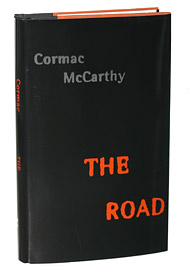
You ask what makes me reject the dominant culture of the United States in the Year of Our Lord 2006. I answer that there is some shit I will not eat for profit. There are some things I will not do in order to achieve a nervous financial supremacy. I do not begrudge a beggar the crumbs while I serve the master of the castle prime cuts of meat, just so I can scramble after the scraps and scheme to become a master myself. I do not see the world as an inevitable war of all against all, of let's do it to them before they do it to us. It makes me a much better neighbor to have when the chips are down.
***
The boy asks: "We wouldn't ever eat anybody, would we?"
"No. Of course not..."
"No matter what."
"No. No matter what."
"Because we're the good guys."
"Yes."
"And we're carrying the fire."
"And we're carrying the fire. Yes."
***
I wonder if Harold Bloom is going to swallow his pride and read a science fiction novel...? Cormac McCarthy, one of Bloom's favorite writers, has written a post-apocalyptic novel, THE ROAD, cut from the same cloth as A CANTICLE FOR LEIBOWITZ and MEMOIRS OF A SURVIVOR, a slap upside the head to the self-congratulatory LEFT BEHIND series.
McCarthy has discovered that you can do things with the literature of the fantastic that cannot be done with any other genre. He probably already knew this; a writer's taste is rarely as limited as the critics', just as musicians listen to stuff their fans would never touch (Louis Armstrong loved Guy Lombardo). Critic's darlings Doris Lessing, Neil Gaiman, and Alan Moore would have told him the same thing. Margaret Atwood is still living in denial, insisting that novels like THE HANDMAID'S TALE and ORYX AND CRAKE are not science fiction.
The tropes of fantasy and science fiction are the same metaphors our ancestors used to populate the archetypes of myth. If the quality-- and the seriousness-- varies wildly-- that's the fault of the publishers and the writers, not the genre.
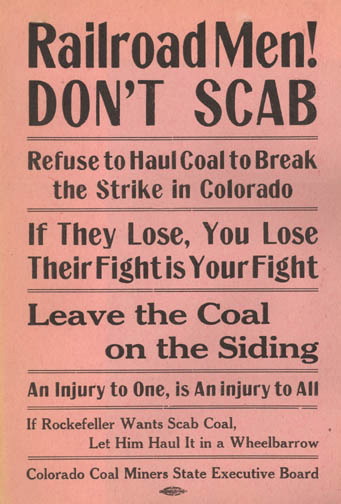
LABOR DAY: The Self-Hatred of the Working Class
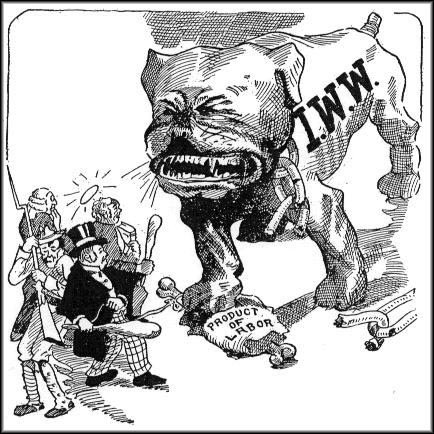
I am still puzzled (though no longer surprised) by how often workers identify with their bosses' interests instead of their own. Union meetings are spent on back-biting, complaints against other union members and fighting over crumbs, while the CEO still takes the biggest piece of cheese.
Administrative executives are given car allowances, golden parachutes, retirement packages, arbitrary power-- and they fight tooth and nail against every pittance that might be spent on the business instead of themselves. This is supposed to be evidence of the Invisible Hand: the marketplace wouldn't be paying CEOs these high salaries if they weren't worth it. Forbes reports in April of 2005 that "the heads of America's 500 biggest companies received an aggregate 54% pay raise last year. As a group, their total compensation amounted to $5.1 billion, versus $3.3 billion in fiscal 2003."
Never mind workers' wages-- I'd settle for investment in infrastructure, in an improved work environment. It was a mistake when workers took cash instead of a seat on the board. We traded a boat in the driveway for our birthright.

Why don't working people laugh out loud at the annual call to abolish the estate tax? Only about 2% of all estates will ever be subject to the tax. "Death tax", the Republicans are intructed to call it, as though the IRS were taxing the right to die.
Years ago, I asked Doc Clark why so many people were eager to turn against each other to do favors for the powerful. "I guess people like to hang out with rich people; they think some of it might rub off on them," he said. Maybe that's part of it: a desire to curry favor, like the knights who murdered Beckett because they thought it would please the king. In the feudal south, my father remembers poor whites defending the landowner's interests against black sharecroppers, though the crackers would never see a dime themselves.
I've seen a head waiter tyrannize the wait staff because he thinks he owns the restaurant. Imagine his disappointment when the owners pass him over in favor of a relative.
 There's some kind of class-warfare version of the Stockholm syndrome going on, where the captive over-identfies with the kidnapper instead of his rescuers.
In 2001 the top 1% of households owned 33.4% of all privately held wealth. The next top 19% held 51%. That leaves (let me take off my socks, so I can count on my toes) 15.6% for the rest of us to fight over.
You probably know the stories of outrageous compensation for administrators and executives, the examples of waste better than I, and yet it's union members who are attacked in ads sponsored by something called The Center for Union Facts out of Washington, D.C. -- as if the employees had a voice in spending priorities or work conditions! Thus the Chamber of Commerce shows its true colors.
American workers fantasize that they have more in common with their employers than with other working stiffs. They haven't learned that even though you love your job, the job does not necessarily love you.
The collapse of Ford and GM under the weight of the health care system might knock some sense into us. The New Yorker has a remarkably clear piece on something called the"dependency ratio" that explains what's really going on when a company can't keep its promises to its workers, why China, India and even Ireland are outpacing us.
Instead of letting workers invest in a centralized health care and pension fund, the big corporations insisted on private funding for their employees. Now, after decades of improvements in manufacturing and a growing pool of retirees, there are fewer workers than there are dependents. Simply put, our old fear of socialism is catching up to us.
As Malcom Gladwell puts it: "This crisis is sometimes portrayed as the result of corporate America’s excessive generosity in making promises to its workers. But when it comes to retirement, health, disability, and unemployment benefits there is nothing exceptional about the United States: it is average among industrialized countries—more generous than Australia, Canada, Ireland, and Italy, just behind Finland and the United Kingdom, and on a par with the Netherlands and Denmark. The difference is that in most countries the government, or large groups of companies, provides pensions and health insurance. The United States, by contrast, has over the past fifty years followed the lead of Charlie Wilson and the bosses of Toledo and made individual companies responsible for the care of their retirees. It is this fact, as much as any other, that explains the current crisis. In 1950, Charlie Wilson [the CEO] was wrong, and Walter Reuther [the union guy] was right."

It was the bosses that shot themselves in the ass. And Joe Hill, God bless him, has the last grim laugh.
REAL ESTATE AND MEMORY
In London I could show you a lumberyard built over a plague pit. They threw bodies in all through the summer of ’65 until they lost count of the dead.
The ghosts of America are limited to the lifespan of whatever local can remember that this apartment complex was once an orchard full of pheasants, or that this bank was once a funeral home was once a hamburger restaurant, was once an Indian burial mound. No one remembers and no one listens anyway if it interferes with a real estate deal and making a buck.
There’s a section of wall that Charles Dickens’ father stared at when the alley was part of Southwark debtor’s prison, and there’s a corner in the Old Cheddar Cheese pub off Fleet Street where Dickens the son sat staring at the fire, just around the corner from the house where Dr. Johnson wrote the famous dictionary, and a stuffed parrot in that pub once held renown as the greatest master of profanity in all the British Empire, including Poona and Rangoon.
John D. MacDonald said once that a Florida conservationist is someone who bought their waterfront property LAST week. A few years ago, Disney had to be talked out of building a theme park next to the Fredericksburg battleground where Joshua Lawrence Chamberlain covered himself with the dead to guard against snipers and had to listen all night to the hogs tearing at the dead and the wounded. That was before Gettysburg and the Battle of Little Round Top, when he and the 20th Maine saved the whole sorry country for the makers of theme parks and the real estate mavens.
A volunteer for ACORN (they lobby for housing for the poor) told me that their greatest enemies lurked in the United Way, which is often controlled by local real estate interests. I wonder what part memory will play in the rebuilding, I mean systematic looting, of drowned New Orleans? It's not just the poor that are being dispossessed. A good many people in the middle class are learning the hard way about the Invisible Hand of the marketplace: who it favors and who it bitch slaps, despite the pretty words of the civic boosters.
See Also: Eminent Domain and the Supreme Court, et al
The ghosts of America are limited to the lifespan of whatever local can remember that this apartment complex was once an orchard full of pheasants, or that this bank was once a funeral home was once a hamburger restaurant, was once an Indian burial mound. No one remembers and no one listens anyway if it interferes with a real estate deal and making a buck.
There’s a section of wall that Charles Dickens’ father stared at when the alley was part of Southwark debtor’s prison, and there’s a corner in the Old Cheddar Cheese pub off Fleet Street where Dickens the son sat staring at the fire, just around the corner from the house where Dr. Johnson wrote the famous dictionary, and a stuffed parrot in that pub once held renown as the greatest master of profanity in all the British Empire, including Poona and Rangoon.
John D. MacDonald said once that a Florida conservationist is someone who bought their waterfront property LAST week. A few years ago, Disney had to be talked out of building a theme park next to the Fredericksburg battleground where Joshua Lawrence Chamberlain covered himself with the dead to guard against snipers and had to listen all night to the hogs tearing at the dead and the wounded. That was before Gettysburg and the Battle of Little Round Top, when he and the 20th Maine saved the whole sorry country for the makers of theme parks and the real estate mavens.
A volunteer for ACORN (they lobby for housing for the poor) told me that their greatest enemies lurked in the United Way, which is often controlled by local real estate interests. I wonder what part memory will play in the rebuilding, I mean systematic looting, of drowned New Orleans? It's not just the poor that are being dispossessed. A good many people in the middle class are learning the hard way about the Invisible Hand of the marketplace: who it favors and who it bitch slaps, despite the pretty words of the civic boosters.
See Also: Eminent Domain and the Supreme Court, et al
The Commonplace Book-- Excerpts from my reading in June
capitalism
“... We're recasting the Bizarros as a frightening, unstoppable zombie-plague style menace. The Bizarros are a lot more predatory in All-Star and their touch is infectious. It's a 'zombie apocalypse' approach to the Bizarro concept and the idea of an unstoppable plague of backwards-talking idiocy sweeping across the globe seems ironically amusing right now.”
-- Grant Morrison on writing All-Star Superman
***
It's like, "Hey, ever heard of a little thing called 'resolving issues through unconscious acting-out of a maladaptive fantasy-life manifesting itself through inappropriately weak personal boundaries'?" Hello? -- “Becky OFlanahan” interview for The Onion
***
“This book augments the portrait of Mr. Bush as an incurious and curiously uninformed executive that Mr. Suskind earlier set out in "The Price of Loyalty" and in a series of magazine articles on the president and key aides. In "The One Percent Doctrine," he writes that Mr. Cheney's nickname inside the C.I.A. was Edgar (as in Edgar Bergen), casting Mr. Bush in the puppet role of Charlie McCarthy, and cites one instance after another in which the president was not fully briefed (or had failed to read the basic paperwork) about a crucial situation.”
---book review for THE ONE PERCENT DOCTRINE by Ron Suskind in The NYT 6/20/06
“During a November 2001 session with the president, Mr. Suskind recounts, a C.I.A. briefer realized that the Pentagon had not told Mr. Bush of the C.I.A.'s urgent concern that Osama bin Laden might escape from the Tora Bora area of Afghanistan (as he indeed later did) if United States reinforcements were not promptly sent in. And several months later, he says, attendees at a meeting between Mr. Bush and the Saudis discovered after the fact that an important packet laying out the Saudis' views about the Israeli-Palestinian situation had been diverted to the vice president's office and never reached the president.
Keeping information away from the president, Mr. Suskind argues, was a calculated White House strategy that gave Mr. Bush "plausible deniability" from Mr. Cheney's point of view, and that perfectly meshed with the commander in chief's own impatience with policy details. Suggesting that Mr. Bush deliberately did not read the full National Intelligence Estimate on Iraq, which was delivered to the White House in the fall of 2002, Mr. Suskind writes: "Keeping certain knowledge from Bush — much of it shrouded, as well, by classification — meant that the president, whose each word circles the globe, could advance various strategies by saying whatever was needed. He could essentially be 'deniable' about his own statements."
"Whether Cheney's innovations were tailored to match Bush's inclinations, or vice versa, is almost immaterial," Mr. Suskind continues. "It was a firm fit. Under this strategic model, reading the entire N.I.E. would be problematic for Bush: it could hem in the president's rhetoric, a key weapon in the march to war. He would know too much."
***
“After all, there’s a reason they call it the mass market. It’s massive. It’s fat, it’s big, and it’s dumb as a post.”
“The Direct Market is about as hale and hearty as a beached whale, and Marvel Comics has spent the last few years muttering to itself and pushing around a shopping cart. So failing to look for new readers and new venues would be eight kinds of stupid. We gotta shop around.”
-- Frank Miller, speaking at the Harvey Kurtzman awards
***
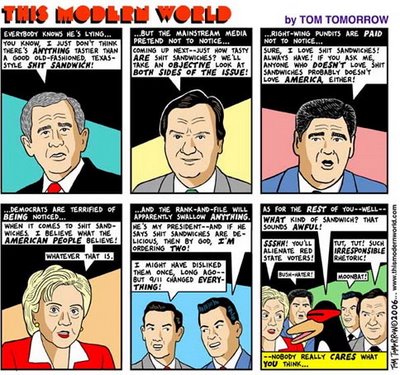
***
• "These self-obsessed women seem genuinely unaware that 9-11 was an attack on our nation and acted like as if the terrorist attack only happened to them. They believe the entire country was required to marinate in their exquisite personal agony. Apparently, denouncing bush was part of the closure process. These broads are millionaires, lionized on TV and in articles about them, reveling in their status as celebrities and stalked by griefparrazies. I have never seen people enjoying their husband’s death so much." --Ann Coulter
• "We have been slandered. Contrary to Ms. Coulter’s statements, there was no joy in watching men that we loved burn alive. There was no happiness in telling our children that their fathers were never coming home again. We adored these men and miss them every day," -- Kristen Breitweiser, Lorie Van Auken, Mindy Kleinberg and Patty Casazza of New Jersey
***
“I got in a lot of trouble a few weeks ago for being disrespectful toward Ana Marie Cox. I have no intention of being disrespectful now. I think it's just terrific that she's become a full fledged member of the mainstream media and is covering bloggers as if they are pod people from mars. It's the smart career move. Still, it's quite a transition since for several years she represented the liberal blogosphere on countless blogging panels and media appearances. It's a testament to her faking skills that she could convincingly be a blogging pioneer one minute and a befuddled mainstream journalist the next. It's trailblazing, actually.”
-- digby on the shark-jumping Wonkette
***
“Favorite complain about contemporary world: the facetiousness of ‘respectable’ people... who, because not taking anyting seriously, are destroying old human feelings older than TIME magazine... Dave Garroways laughing at white doves.”
-- Jack Kerouac, in the introduction to “Lonesome Traveler’
***
“For there is something new in the Reign of Terror, and that is its absolutism. You couldn’t escape it. In the old regime, if you were determined to stay out of politics, politics could stay out of you. In revolutionary France, the modern development was that you could not withdraw, or go into self-exile—you could not even repent or adopt the other religion. You could only wait and hope not to die. When the Abbé Sieyès, asked what he had done during the Terror, answered, “I lived,” he was making more than a mordant joke; he was identifying the new thing that had come into the world, which was a will to killing that made merely living achievement enough.
“The bloodlust of the time makes the attempt to trace the Terror to any single intellectual source, or peculiar circumstance—to Enlightenment rationalism gone mad, or to the paranoia of the encircled Republicans—feel inadequate to the Terror’s essential nature, which was that it didn’t matter what the ideology was. The argument that a taste for the ideal and the tabula rasa leads to terror, after all, would be more convincing if its opposite—a desire for an organic, authentic, traditional society—didn’t lead to terror, too. The Red Terror led to a White Terror; Robespierre’s head had hardly fallen before the Gilded Youth were attacking the now helpless Jacobins. It sometimes seems as if history had deliberately placed Hitler and Stalin side by side at the climax of the horror of modern history simply to demonstrate that the road to Hell is paved with any intention you like; a planned, pseudo-rationalist utopianism and an organic, racial, backward-looking Romanticism ended up with the same camps and the same carnage. The historical lesson of the first Terror is not that reason devours its own but that reason cannot stop us from devouring each other.”
-- Adam Gopnik, HEADLESS HORSEMAN
The Reign of Terror Revisited The New Yorker, 6/5/06
***
"How can one wonder at any number of strange assertions from men whose whole lives were devoted to mockery, and who were ready at any time to sacrifice the reputation of their superiors to vulgar envy and spite, as to some evil genius."
-- Pericles
(quotation included in a birthday letter written to Eleanor Roosevelt by Harry Truman)
***
“You’ve got some kind of adolescent infatuation with the idea of gallantry and fair play,” she said. “He was doing what he thought was right. Damn you, why have you got me defending him? Would you leave? Please?”
-- from THE EMPTY COPPER SEA by John D. MacDonald
***
Students will contrast and compare the following excerpts from THE ONE PERCENT DOCTRINEby Ron Suskind with THE EMPTY COPPER SEA by John D. MacDonald:
I. (From Suskind): “As for Mr. Tenet, this book provides a nuanced portrait of a man with "colliding loyalties — to the president, who could have fired him after 9/11 but didn't; and to his analysts, whom he was institutionally and emotionally committed to defend." It would become an increasingly untenable position, as the White House grew more and more impatient with the C.I.A.'s reluctance to supply readily the sort of intelligence it wanted. ...While many C.I.A. analysts were deeply skeptical of the imminent danger posed by Mr. Hussein and simultaneously worried about the fallout of a possible invasion, the C.I.A., paradoxically enough, would become a favorite scapegoat for the administration's decision to go to war against Iraq, thanks in no small measure to Mr. Tenet's remark (quoted in Bob Woodward's 2004 book "Plan of Attack") that the existence of Iraqi weapons of mass destruction was a "slam dunk." ...He depicts the former C.I.A. director as frequently being made by the White House "to take the fall" for his superiors, on matters including the administration's handling of prewar intelligence to the 16 disputed words in the president's State of the Union address, regarding Iraq's supposed efforts to obtain uranium from Africa. Because it was Mr. Tenet "who brought analysis up the chain from the C.I.A.," Mr. Suskind writes, he "was best positioned to assume blame. And Rice was adept at laying it on Tenet."
At the same time, Mr. Suskind suggests that Mr. Tenet acted as a kind of White House enabler: he writes that in the wake of 9/11, Mr. Tenet felt a "mix of insecurity and gratitude" vis-à-vis George W. Bush, and that eager to please his boss, he repeatedly pushed C.I.A. staff members to come up with evidence that might support the president's public statements.
In the days after 9/11 Mr. Bush defended the embattled C.I.A. chief to angry congressmen, and at that point, Mr. Suskind writes: "George Tenet would do anything his President asked. Anything. And George W. Bush knew it."
II. (From MacDonald): “It’s hard to find very much about Van from Van. As a young man he was a notorious drunk. He broke places up and was thrown in jail dozens of times. You knew him in Lauderdale after he’d sobered up and became a respectable citizen. A reputation hangs on. For example, when he lost his shrimp boat, there was talk around Timber Bay that he’d been at the helm, drunk, when it happened. When Hub hired him at Hula Marine, people said Hub would live to regret it. Hub Lawless enjoyed hiring... misfits. I think he enjoyed gratitude.”
“Then it was pretty damn cruel to feed Van a mickey.”
“It was wicked the way the word is used in the Bible.”
***
“Whatever academic scholarship may insist, surely a sense of proportion is the last thing we want from history—perspective, certainly, but not proportion. Anything, after all, can be seen in proportion, shown to be no worse a crime than some other thing. Time and distance can’t help but give us a sense of proportion: it was long ago and far away and so what? What the great historians give us, instead, is a renewed sense of sorrow and anger and pity for history’s victims—for some luckless middle-aged Frenchman standing in the cold gray, shivering as he watches the members of his family being tied up and having their heads cut off. Read Gibbon on the destruction of the Alexandria library by the Christians, or E. P. Thompson on the Luddites—not to mention Robert Conquest on the Gulag—and suddenly old murders matter again; the glory of the work of these historians is that the right of the dead to have their pain and suffering taken seriously is being honored. It is not for history to supply us with a sense of history. Life always supplies us with a sense of history. It is for history to supply us with a sense of life.”
-- Adam Gopnik, HEADLESS HORSEMAN
The Reign of Terror Revisited The New Yorker, 6/5/06
***
"Damn, girl, this goes way past kink; you're in love."
-- Bob Vickery
“... We're recasting the Bizarros as a frightening, unstoppable zombie-plague style menace. The Bizarros are a lot more predatory in All-Star and their touch is infectious. It's a 'zombie apocalypse' approach to the Bizarro concept and the idea of an unstoppable plague of backwards-talking idiocy sweeping across the globe seems ironically amusing right now.”
-- Grant Morrison on writing All-Star Superman
***
It's like, "Hey, ever heard of a little thing called 'resolving issues through unconscious acting-out of a maladaptive fantasy-life manifesting itself through inappropriately weak personal boundaries'?" Hello? -- “Becky OFlanahan” interview for The Onion
***
“This book augments the portrait of Mr. Bush as an incurious and curiously uninformed executive that Mr. Suskind earlier set out in "The Price of Loyalty" and in a series of magazine articles on the president and key aides. In "The One Percent Doctrine," he writes that Mr. Cheney's nickname inside the C.I.A. was Edgar (as in Edgar Bergen), casting Mr. Bush in the puppet role of Charlie McCarthy, and cites one instance after another in which the president was not fully briefed (or had failed to read the basic paperwork) about a crucial situation.”
---book review for THE ONE PERCENT DOCTRINE by Ron Suskind in The NYT 6/20/06
“During a November 2001 session with the president, Mr. Suskind recounts, a C.I.A. briefer realized that the Pentagon had not told Mr. Bush of the C.I.A.'s urgent concern that Osama bin Laden might escape from the Tora Bora area of Afghanistan (as he indeed later did) if United States reinforcements were not promptly sent in. And several months later, he says, attendees at a meeting between Mr. Bush and the Saudis discovered after the fact that an important packet laying out the Saudis' views about the Israeli-Palestinian situation had been diverted to the vice president's office and never reached the president.
Keeping information away from the president, Mr. Suskind argues, was a calculated White House strategy that gave Mr. Bush "plausible deniability" from Mr. Cheney's point of view, and that perfectly meshed with the commander in chief's own
 impatience with policy details. Suggesting that Mr. Bush deliberately did not read the full National Intelligence Estimate on Iraq, which was delivered to the White House in the fall of 2002, Mr. Suskind writes: "Keeping certain knowledge from Bush — much of it shrouded, as well, by classification — meant that the president, whose each word circles the globe, could advance various strategies by saying whatever was needed. He could essentially be 'deniable' about his own statements."
"Whether Cheney's innovations were tailored to match Bush's inclinations, or vice versa, is almost immaterial," Mr. Suskind continues. "It was a firm fit. Under this strategic model, reading the entire N.I.E. would be problematic for Bush: it could hem in the president's rhetoric, a key weapon in the march to war. He would know too much."
***
“After all, there’s a reason they call it the mass market. It’s massive. It’s fat, it’s big, and it’s dumb as a post.”
“The Direct Market is about as hale and hearty as a beached whale, and Marvel Comics has spent the last few years muttering to itself and pushing around a shopping cart. So failing to look for new readers and new venues would be eight kinds of stupid. We gotta shop around.”
-- Frank Miller, speaking at the Harvey Kurtzman awards
***

***
• "These self-obsessed women seem genuinely unaware that 9-11 was an attack on our nation and acted like as if the terrorist attack only happened to them. They believe the entire country was required to marinate in their exquisite personal agony. Apparently, denouncing bush was part of the closure process. These broads are millionaires, lionized on TV and in articles about them, reveling in their status as celebrities and stalked by griefparrazies. I have never seen people enjoying their husband’s death so much." --Ann Coulter
• "We have been slandered. Contrary to Ms. Coulter’s statements, there was no joy in watching men that we loved burn alive. There was no happiness in telling our children that their fathers were never coming home again. We adored these men and miss them every day," -- Kristen Breitweiser, Lorie Van Auken, Mindy Kleinberg and Patty Casazza of New Jersey
***
“I got in a lot of trouble a few weeks ago for being disrespectful toward Ana Marie Cox. I have no intention of being disrespectful now. I think it's just terrific that she's become a full fledged member of the mainstream media and is covering bloggers as if they are pod people from mars. It's the smart career move. Still, it's quite a transition since for several years she represented the liberal blogosphere on countless blogging panels and media appearances. It's a testament to her faking skills that she could convincingly be a blogging pioneer one minute and a befuddled mainstream journalist the next. It's trailblazing, actually.”
-- digby on the shark-jumping Wonkette
***
“Favorite complain about contemporary world: the facetiousness of ‘respectable’ people... who, because not taking anyting seriously, are destroying old human feelings older than TIME magazine... Dave Garroways laughing at white doves.”
-- Jack Kerouac, in the introduction to “Lonesome Traveler’
***
“For there is something new in the Reign of Terror, and that is its absolutism. You couldn’t escape it. In the old regime, if you were determined to stay out of politics, politics could stay out of you. In revolutionary France, the modern development was that you could not withdraw, or go into self-exile—you could not even repent or adopt the other religion. You could only wait and hope not to die. When the Abbé Sieyès, asked what he had done during the Terror, answered, “I lived,” he was making more than a mordant joke; he was identifying the new thing that had come into the world, which was a will to killing that made merely living achievement enough.
“The bloodlust of the time makes the attempt to trace the Terror to any single intellectual source, or peculiar circumstance—to Enlightenment rationalism gone mad, or to the paranoia of the encircled Republicans—feel inadequate to the Terror’s essential nature, which was that it didn’t matter what the ideology was. The argument that a taste for the ideal and the tabula rasa leads to terror, after all, would be more convincing if its opposite—a desire for an organic, authentic, traditional society—didn’t lead to terror, too. The Red Terror led to a White Terror; Robespierre’s head had hardly fallen before the Gilded Youth were attacking the now helpless Jacobins. It sometimes seems as if history had deliberately placed Hitler and Stalin side by side at the climax of the horror of modern history simply to demonstrate that the road to Hell is paved with any intention you like; a planned, pseudo-rationalist utopianism and an organic, racial, backward-looking Romanticism ended up with the same camps and the same carnage. The historical lesson of the first Terror is not that reason devours its own but that reason cannot stop us from devouring each other.”
-- Adam Gopnik, HEADLESS HORSEMAN
The Reign of Terror Revisited The New Yorker, 6/5/06
***
"How can one wonder at any number of strange assertions from men whose whole lives were devoted to mockery, and who were ready at any time to sacrifice the reputation of their superiors to vulgar envy and spite, as to some evil genius."
-- Pericles
(quotation included in a birthday letter written to Eleanor Roosevelt by Harry Truman)
***
“You’ve got some kind of adolescent infatuation with the idea of gallantry and fair play,” she said. “He was doing what he thought was right. Damn you, why have you got me defending him? Would you leave? Please?”
-- from THE EMPTY COPPER SEA by John D. MacDonald
***
Students will contrast and compare the following excerpts from THE ONE PERCENT DOCTRINEby Ron Suskind with THE EMPTY COPPER SEA by John D. MacDonald:
I. (From Suskind): “As for Mr. Tenet, this book provides a nuanced portrait of a man with "colliding loyalties — to the president, who could have fired him after 9/11 but didn't; and to his analysts, whom he was institutionally and emotionally committed to defend." It would become an increasingly untenable position, as the White House grew more and more impatient with the C.I.A.'s reluctance to supply readily the sort of intelligence it wanted. ...While many C.I.A. analysts were deeply skeptical of the imminent danger posed by Mr. Hussein and simultaneously worried about the fallout of a possible invasion, the C.I.A., paradoxically enough, would become a favorite scapegoat for the administration's decision to go to war against Iraq, thanks in no small measure to Mr. Tenet's remark (quoted in Bob Woodward's 2004 book "Plan of Attack") that the existence of Iraqi weapons of mass destruction was a "slam dunk." ...He depicts the former C.I.A. director as frequently being made by the White House "to take the fall" for his superiors, on matters including the administration's handling of prewar intelligence to the 16 disputed words in the president's State of the Union address, regarding Iraq's supposed efforts to obtain uranium from Africa. Because it was Mr. Tenet "who brought analysis up the chain from the C.I.A.," Mr. Suskind writes, he "was best positioned to assume blame. And Rice was adept at laying it on Tenet."
At the same time, Mr. Suskind suggests that Mr. Tenet acted as a kind of White House enabler: he writes that in the wake of 9/11, Mr. Tenet felt a "mix of insecurity and gratitude" vis-à-vis George W. Bush, and that eager to please his boss, he repeatedly pushed C.I.A. staff members to come up with evidence that might support the president's public statements.
In the days after 9/11 Mr. Bush defended the embattled C.I.A. chief to angry congressmen, and at that point, Mr. Suskind writes: "George Tenet would do anything his President asked. Anything. And George W. Bush knew it."
II. (From MacDonald): “It’s hard to find very much about Van from Van. As a young man he was a notorious drunk. He broke places up and was thrown in jail dozens of times. You knew him in Lauderdale after he’d sobered up and became a respectable citizen. A reputation hangs on. For example, when he lost his shrimp boat, there was talk around Timber Bay that he’d been at the helm, drunk, when it happened. When Hub hired him at Hula Marine, people said Hub would live to regret it. Hub Lawless enjoyed hiring... misfits. I think he enjoyed gratitude.”
“Then it was pretty damn cruel to feed Van a mickey.”
“It was wicked the way the word is used in the Bible.”
***
“Whatever academic scholarship may insist, surely a sense of proportion is the last thing we want from history—perspective, certainly, but not proportion. Anything, after all, can be seen in proportion, shown to be no worse a crime than some other thing. Time and distance can’t help but give us a sense of proportion: it was long ago and far away and so what? What the great historians give us, instead, is a renewed sense of sorrow and anger and pity for history’s victims—for some luckless middle-aged Frenchman standing in the cold gray, shivering as he watches the members of his family being tied up and having their heads cut off. Read Gibbon on the destruction of the Alexandria library by the Christians, or E. P. Thompson on the Luddites—not to mention Robert Conquest on the Gulag—and suddenly old murders matter again; the glory of the work of these historians is that the right of the dead to have their pain and suffering taken seriously is being honored. It is not for history to supply us with a sense of history. Life always supplies us with a sense of history. It is for history to supply us with a sense of life.”
-- Adam Gopnik, HEADLESS HORSEMAN
The Reign of Terror Revisited The New Yorker, 6/5/06
***
"Damn, girl, this goes way past kink; you're in love."
-- Bob Vickery
COMMONPLACE BOOK, Extracts and Ideas of Interest, First Week of April
David Ng, Village Voice:
“National pastime, cathartic rite, and hereditary calling all rolled into one, the French labor protest occupies a holy space on the country's social genome, much like baseball or playing the stock market does in the U.S.”
***
[NYT on the actress appearing as “Barbie Live on Stage”]:
“Meeting a few fans after a final curtsy, Ms. Coors [brunette, under a blonde wig] signs her name as "Barbie," aping Mattel's signature looping script, on T-shirts and fairy wings. For television interviews, visits to children's hospitals and bookstore readalongs, she can trade Elina's tutu, festooned with 15,000 hand-sewn sequins, for a pink evening gown or business suit from the Barbie couture collection. ... It's all very meta, especially because, as more than a few young fans noted, Ms. Coors's Elina is a ringer for "Legally Blonde 2" Barbie, Mattel's homage to the second Reese Witherspoon comedy about Elle Woods, the squeaky-voiced shopaholic who is a lot smarter than she looks. Which is to say that an actress playing a doll as an actress playing a role looks like a doll made to look like another actress playing another role.”
[*** Ormondroyd notes: a similar thing happened in medieval Japan, when bunraku (feel free to correct me on details) puppets became so popular that geisha and dancers began to ape their movements. Male actors of kabuki, impersonating female characters, began to imitate the mannered step of real women imitating puppets imitating women. You could look it up.]
***
From “Nihilist Job Resume” by Eric Feezell:
* Objective
I have no objective. What's the point when cold death is the final destination for us all? Can you explain that to me? I know I'm supposed to put something here, though, so here goes: Your objective is to hire me into a challenging position in a computer-applications-based field within which you feel I can "make a difference" and "contribute" in a team environment. Imbecile.
***
Marc Acito, NY Times:
“.... in Fulton, Mo., where three members of a local church objected to the high school's fall production of the musical "Grease," even though one of them hadn't even seen it. In a response that would have made Joe McCarthy proud, Mark Enderle, the school superintendent, then proceeded to overturn the choice of "The Crucible," Arthur Miller's indictment of McCarthyism, as the spring play.
Instead, the students in Fulton just finished performing "A Midsummer Night's Dream," that wholesome frolic about youthful rebellion, pagan magic and bestiality. As Dr. Enderle told Wendy DeVore, the drama teacher, her actors "shouldn't do anything on stage that would get a kid in trouble if he did it in a classroom."
****
Paddy Murphy comes limping into a pub with his arm in a sling, his nose broke, his face cut and bruised.
"What happened to you?" asks Sean, the bartender.
"Jamie O'Conner and me had a fight," says Paddy.
"O'Conner?" says Sean, "He couldn't do that to you, he must have had something in his hand."
A shovel is what he had,” says Paddy, “and a terrible time he gave me with it."
"Well," says Sean, "you should have defended yourself, didn't you have something in your hand?"
"That I did," said Paddy. "Mrs. O'Conner's breast, and a thing of beauty it is, but useless in a fight." (anon.)
***
“Perhaps he (Voltaire) hated too much, but we must remember the provocation; we must imagine ourselves back in an age when men were burned at the stake, or broken on the wheel, for deviating from orthodoxy. We can appreciate Christianity better today because he fought with some success to moderate its dogmas and violence.”
-- Will and Ariel Durant
***
“It is not easy to explain to a foreigner, maybe to anybody, that what you had thought was a small, primitive concept of dignity, the early voice that says nobody can buy me, became in our time so corrupted by anti-Communism that bribes were not thought of as bribes, particularly if they came in the form of trips to foreign lands, or grants for research, and were offered by Ivy League gentlemen to a generation of intellectuals who were jealous of the easy postwar money earned by everybody around them. Intellectuals can tell themselves anything, sell themselves any bill of goods, which is why they were such easy patsies for the ruling classes in nineteenth century France and England, or twentieth century Russia and America.”
-- Lillian Hellman in “An Unfinished Woman”
***
Molly Ivins:
“I don’t know about you, but I have had it with the D.C. Democrats, had it with the DLC Democrats, had it with every calculating, equivocating, triangulating, straddling, hair-splitting son of a bitch up there, and that includes Hillary Rodham Clinton.”
***
Russell Jacoby:
"Higher education in America is a vast enterprise boasting roughly a million professors. A certain portion of these teachers are incompetents and frauds; some are rabid patriots and fundamentalists - and some are ham-fisted leftists. All should be upbraided if they violate scholarly or teaching norms. At the same time, a certain portion of the 15 million students they teach are fanatics and crusaders."
***
Peter Shaffer, interview:
"I find in Mozart that ecstasy I don't find in codified faith. I also find in reading - and even sometimes seeing - Shakespeare that same pleasure in perfection I discover in Mozart. When I read the last act of Antony and Cleopatra and that speech beginning 'The crown of the earth doth melt' I feel I'm encountering one of the great achievements of mankind. It's a beacon somehow, a reminder that there is a perfection of art - whereas I don't think there is a perfection of religion. I wish I could say I found this in the theatre. Not so long ago I saw Troilus and Cressida, and when we got to: 'The time scants us with a single famished kiss, Distasted with the salt of broken tears', there was no sense of the actor being aware of the lines he was privileged to say."
***
Alexis Petridis:
"This being a Morrissey album, however, happiness can't last."
***
Terry Eagleton in New Statesman:
“There are, to be sure, many clever people still around; but not all clever people are intellectuals, and not all intellectuals are particularly clever. Academics, broadly speaking, count as intellectuals, given that they trade in ideas; but so-called public intellectuals, those who seek to be opinion-formers and cultural commentators, are a rarer, perpetually endangered breed.
“.... For F R Leavis, only the disinterested gaze of the literary critic could withstand the waves of commercial vulgarity and political partisanship churned up by the 20th century. Yet this Canute-like project had happened several times before. Matthew Arnold had argued much the same in Victorian England, while Samuel Johnson mourned the collapse of a universal knowledge almost a century earlier. Despite Johnson's complaint that no one mind could now encompass an increasingly fragmented, specialised culture, Samuel Taylor Coleridge and John Stuart Mill made a brave stab at doing just that. Once again, public intellectuals stubbornly overlooked the supposed fact that they had withered away, defeated by the decline of the public sphere, the rapid division of conceptual labour and - in our own day - the rise of a formidable new power of opinion-forming known as the media.
“.... The role of the intellectual, so it is said, is to speak truth to power. Noam Chomsky has dismissed this pious tag on two grounds. For one thing, power knows the truth already; it is just busy trying to conceal it.”
***
Perry Anderson
".... the central case against capitalism today is the combination of ecological crisis and social polarization. It is the greed." –
***
[Some hard numbers backing that up from New York Times' analysis of IRS data]:
"Among taxpayers with incomes greater than $10 million, the amount by which their investment tax bill was reduced averaged about $500,000 in 2003, and total tax savings, which included the two Bush tax cuts on compensation, nearly doubled to slightly more than $1 million.
"These taxpayers, whose average income was $26 million, paid about the same share of their income in income taxes as those making $200,000 to $500,000 because of the lowered rates on investment income.
"Americans with annual incomes of $1 million or more, about one-tenth of 1 percent of all taxpayers, reaped 43 percent of all the savings on investment taxes in 2003. The savings for these taxpayers averaged about $41,400 each. By comparison, these same Americans received less than 10 percent of the savings from the other Bush tax cuts, which applied primarily to wages, though that share is expected to grow in coming years."
***
Dave’s Long Box:
“Nobody talks a line of shit like Thor. He rarely fails to tell an opponent how powerful he is, or what a big mistake said opponent has made crossing his path, or how bad of a beat-down he’s about to deliver, or brag about the various features of his enchanted mallet Mjolnir. ... For some reason, the fact that he’s one of the most powerful beings ever to walk the Earth yet still talks shit does not make Thor a dick. He just gets away with it, pure and simple. Nobody wants to hear Superman brag about how cool he is – he would just come across as a bully – but for Thor, it works.
“Why? Thor really uses cultural relativism to his advantage. Yes, he might go on and on about how great he is, but give him a break, he’s a Viking – that’s the way of his people. Don’t judge, man. What do you have against Vikings anyway? Way to be insensitive to other cultures, dick.”
***
See Also: Why am I being played by a 16-year-old lipgloss model?,
"He was like a murderer annoyed at being called a shoplifter",
"I've had far more sex than I've had fights on water towers against guys with super powers",
February: ""WHICH GOD DAMNED IDIOTS CHOSE KAINE TO DO THE REBUTTAL?",
January,
December
“National pastime, cathartic rite, and hereditary calling all rolled into one, the French labor protest occupies a holy space on the country's social genome, much like baseball or playing the stock market does in the U.S.”
***
[NYT on the actress appearing as “Barbie Live on Stage”]:
“Meeting a few fans after a final curtsy, Ms. Coors [brunette, under a blonde wig] signs her name as "Barbie," aping Mattel's signature looping script, on T-shirts and fairy wings. For television interviews, visits to children's hospitals and bookstore readalongs, she can trade Elina's tutu, festooned with 15,000 hand-sewn sequins, for a pink evening gown or business suit from the Barbie couture collection. ... It's all very meta, especially because, as more than a few young fans noted, Ms. Coors's Elina is a ringer for "Legally Blonde 2" Barbie, Mattel's homage to the second Reese Witherspoon comedy about Elle Woods, the squeaky-voiced shopaholic who is a lot smarter than she looks. Which is to say that an actress playing a doll as an actress playing a role looks like a doll made to look like another actress playing another role.”
[*** Ormondroyd notes: a similar thing happened in medieval Japan, when bunraku (feel free to correct me on details) puppets became so popular that geisha and dancers began to ape their movements. Male actors of kabuki, impersonating female characters, began to imitate the mannered step of real women imitating puppets imitating women. You could look it up.]
***
From “Nihilist Job Resume” by Eric Feezell:
* Objective
I have no objective. What's the point when cold death is the final destination for us all? Can you explain that to me? I know I'm supposed to put something here, though, so here goes: Your objective is to hire me into a challenging position in a computer-applications-based field within which you feel I can "make a difference" and "contribute" in a team environment. Imbecile.
***
Marc Acito, NY Times:
“.... in Fulton, Mo., where three members of a local church objected to the high school's fall production of the musical "Grease," even though one of them hadn't even seen it. In a response that would have made Joe McCarthy proud, Mark Enderle, the school superintendent, then proceeded to overturn the choice of "The Crucible," Arthur Miller's indictment of McCarthyism, as the spring play.
Instead, the students in Fulton just finished performing "A Midsummer Night's Dream," that wholesome frolic about youthful rebellion, pagan magic and bestiality. As Dr. Enderle told Wendy DeVore, the drama teacher, her actors "shouldn't do anything on stage that would get a kid in trouble if he did it in a classroom."
****
Paddy Murphy comes limping into a pub with his arm in a sling, his nose broke, his face cut and bruised.
"What happened to you?" asks Sean, the bartender.
"Jamie O'Conner and me had a fight," says Paddy.
"O'Conner?" says Sean, "He couldn't do that to you, he must have had something in his hand."
A shovel is what he had,” says Paddy, “and a terrible time he gave me with it."
"Well," says Sean, "you should have defended yourself, didn't you have something in your hand?"
"That I did," said Paddy. "Mrs. O'Conner's breast, and a thing of beauty it is, but useless in a fight." (anon.)
***
“Perhaps he (Voltaire) hated too much, but we must remember the provocation; we must imagine ourselves back in an age when men were burned at the stake, or broken on the wheel, for deviating from orthodoxy. We can appreciate Christianity better today because he fought with some success to moderate its dogmas and violence.”
-- Will and Ariel Durant
***
“It is not easy to explain to a foreigner, maybe to anybody, that what you had thought was a small, primitive concept of dignity, the early voice that says nobody can buy me, became in our time so corrupted by anti-Communism that bribes were not thought of as bribes, particularly if they came in the form of trips to foreign lands, or grants for research, and were offered by Ivy League gentlemen to a generation of intellectuals who were jealous of the easy postwar money earned by everybody around them. Intellectuals can tell themselves anything, sell themselves any bill of goods, which is why they were such easy patsies for the ruling classes in nineteenth century France and England, or twentieth century Russia and America.”
-- Lillian Hellman in “An Unfinished Woman”
***
Molly Ivins:
“I don’t know about you, but I have had it with the D.C. Democrats, had it with the DLC Democrats, had it with every calculating, equivocating, triangulating, straddling, hair-splitting son of a bitch up there, and that includes Hillary Rodham Clinton.”
***
Russell Jacoby:
"Higher education in America is a vast enterprise boasting roughly a million professors. A certain portion of these teachers are incompetents and frauds; some are rabid patriots and fundamentalists - and some are ham-fisted leftists. All should be upbraided if they violate scholarly or teaching norms. At the same time, a certain portion of the 15 million students they teach are fanatics and crusaders."
***
Peter Shaffer, interview:
"I find in Mozart that ecstasy I don't find in codified faith. I also find in reading - and even sometimes seeing - Shakespeare that same pleasure in perfection I discover in Mozart. When I read the last act of Antony and Cleopatra and that speech beginning 'The crown of the earth doth melt' I feel I'm encountering one of the great achievements of mankind. It's a beacon somehow, a reminder that there is a perfection of art - whereas I don't think there is a perfection of religion. I wish I could say I found this in the theatre. Not so long ago I saw Troilus and Cressida, and when we got to: 'The time scants us with a single famished kiss, Distasted with the salt of broken tears', there was no sense of the actor being aware of the lines he was privileged to say."
***
Alexis Petridis:
"This being a Morrissey album, however, happiness can't last."
***
Terry Eagleton in New Statesman:
“There are, to be sure, many clever people still around; but not all clever people are intellectuals, and not all intellectuals are particularly clever. Academics, broadly speaking, count as intellectuals, given that they trade in ideas; but so-called public intellectuals, those who seek to be opinion-formers and cultural commentators, are a rarer, perpetually endangered breed.
“.... For F R Leavis, only the disinterested gaze of the literary critic could withstand the waves of commercial vulgarity and political partisanship churned up by the 20th century. Yet this Canute-like project had happened several times before. Matthew Arnold had argued much the same in Victorian England, while Samuel Johnson mourned the collapse of a universal knowledge almost a century earlier. Despite Johnson's complaint that no one mind could now encompass an increasingly fragmented, specialised culture, Samuel Taylor Coleridge and John Stuart Mill made a brave stab at doing just that. Once again, public intellectuals stubbornly overlooked the supposed fact that they had withered away, defeated by the decline of the public sphere, the rapid division of conceptual labour and - in our own day - the rise of a formidable new power of opinion-forming known as the media.
“.... The role of the intellectual, so it is said, is to speak truth to power. Noam Chomsky has dismissed this pious tag on two grounds. For one thing, power knows the truth already; it is just busy trying to conceal it.”
***
Perry Anderson
".... the central case against capitalism today is the combination of ecological crisis and social polarization. It is the greed." –
***
[Some hard numbers backing that up from New York Times' analysis of IRS data]:
"Among taxpayers with incomes greater than $10 million, the amount by which their investment tax bill was reduced averaged about $500,000 in 2003, and total tax savings, which included the two Bush tax cuts on compensation, nearly doubled to slightly more than $1 million.
"These taxpayers, whose average income was $26 million, paid about the same share of their income in income taxes as those making $200,000 to $500,000 because of the lowered rates on investment income.
"Americans with annual incomes of $1 million or more, about one-tenth of 1 percent of all taxpayers, reaped 43 percent of all the savings on investment taxes in 2003. The savings for these taxpayers averaged about $41,400 each. By comparison, these same Americans received less than 10 percent of the savings from the other Bush tax cuts, which applied primarily to wages, though that share is expected to grow in coming years."
***
Dave’s Long Box:
“Nobody talks a line of shit like Thor. He rarely fails to tell an opponent how powerful he is, or what a big mistake said opponent has made crossing his path, or how bad of a beat-down he’s about to deliver, or brag about the various features of his enchanted mallet Mjolnir. ... For some reason, the fact that he’s one of the most powerful beings ever to walk the Earth yet still talks shit does not make Thor a dick. He just gets away with it, pure and simple. Nobody wants to hear Superman brag about how cool he is – he would just come across as a bully – but for Thor, it works.
“Why? Thor really uses cultural relativism to his advantage. Yes, he might go on and on about how great he is, but give him a break, he’s a Viking – that’s the way of his people. Don’t judge, man. What do you have against Vikings anyway? Way to be insensitive to other cultures, dick.”
***
See Also: Why am I being played by a 16-year-old lipgloss model?,
"He was like a murderer annoyed at being called a shoplifter",
"I've had far more sex than I've had fights on water towers against guys with super powers",
February: ""WHICH GOD DAMNED IDIOTS CHOSE KAINE TO DO THE REBUTTAL?",
January,
December
MERCENARIES-R-US
"Over 120,000 private contractors are preparing the food, fueling the planes, and protecting the pipelines and generals in Iraq."
Naive question of the week, prompted by "Frontlines" episode "Private Warriors" on PBS:
Don't the security and diplomatic headaches caused by subcontracting military duties FAR outweigh any savings?
See also Yay, Torture!, Third Combat Tour in Iraq, Kipling: "Gods of the Copybook Headings" et alia
Naive question of the week, prompted by "Frontlines" episode "Private Warriors" on PBS:
Don't the security and diplomatic headaches caused by subcontracting military duties FAR outweigh any savings?
See also Yay, Torture!, Third Combat Tour in Iraq, Kipling: "Gods of the Copybook Headings" et alia
FUCK Ironic Detachment
from HUMBOLDT'S GIFT by Saul Bellow:
"For some reason this awfulness is peculiarly appreciated by business and technological America. The country is proud of its dead poets. It takes terrific satifaction in the poets' testimony that the USA is too tough, too big, too much, too rugged, that American reality is overpowering. And to be a poet is a school thing, a skirt thing, a church thing. The weakness of the spiritual powers is proved in the childishness, madness, drunkenness, and despair of these martyrs. Orpheus moved stones and trees. But a poet can't perform a hysterectomy or send a vehicle out of the solar system. Miracle and power no longer belong to him. So poets are loved, but loved because they just can't make it here. They exist to light up the enormity of the tangle and justify the cynicism of those who say, 'If I were not such a corrupt, unfeeling bastard, creep, thief, and vulture, I couldn't get through this either. Look at those good and tender and soft men, the best of us. They succumbed, poor loonies.'"
"For some reason this awfulness is peculiarly appreciated by business and technological America. The country is proud of its dead poets. It takes terrific satifaction in the poets' testimony that the USA is too tough, too big, too much, too rugged, that American reality is overpowering. And to be a poet is a school thing, a skirt thing, a church thing. The weakness of the spiritual powers is proved in the childishness, madness, drunkenness, and despair of these martyrs. Orpheus moved stones and trees. But a poet can't perform a hysterectomy or send a vehicle out of the solar system. Miracle and power no longer belong to him. So poets are loved, but loved because they just can't make it here. They exist to light up the enormity of the tangle and justify the cynicism of those who say, 'If I were not such a corrupt, unfeeling bastard, creep, thief, and vulture, I couldn't get through this either. Look at those good and tender and soft men, the best of us. They succumbed, poor loonies.'"
"CAPITALISM STOLE MY VIRGINITY" by The (International) Noise Conspiracy
I don't think the mavens of modern education are aware of just how cynical and wised-up school children are. It's no longer a shock to them to find they're being manipulated by advertising, image doctors and spin-meisters. Indeed, they seem to expect it. They no longer reject the hypocrisy of their elders when a fraud has been exposed; instead, they seem to judge propagandists on their skill, on just how well they've been manipulated. Only the stupidest children think that MTV is "their" network, for example. Most know that MTV will pander to them only so long as they fit into the desired demographic, and then it will be another generation's turn. What difference does it make? When I was an adolescent, there were still certain persons and things that could not be bought, sold, distorted, or made into a logo or animated cartoon. The sons and daughters of the Me Generation don't have those bedrock beliefs, unless they retreat completely into the blind assurances of fundamentalist religion. The children's teeth are set on edge, and with bloody good reason.
Maud Newton's Blog put me onto this song that sort of sums it all up:
CAPITALISM STOLE MY VIRGINITYMP3
Nowhere's untouched by the shame
Who said we could get by on our childhood games
Days of innocence are all long gone
Avoid the shock honey and try to live on
Woke up all paralysed
All dreams corrupted in front of our eyes
On every forehead of every little whore
There is a sign that says: Baby don't come back no more
Distasteful ugly and cheap
That is how you make me feel, I said
Capitalism stole my virginity
Capitalism stole
Capitalism stole
Capitalism stole my virginity
Robbed out of our bleeding hearts
Smashed our illusions, tore them all apart
Now unsentimental, unafraid
To destroy this culture that we hate
So tired of being nothing
When we should be everything
And on every forehead of every little whore
There is a sign that says: Baby we are all born to die
Distasteful ugly and cheap
That is how you make me feel, I said
Capitalism stole my virginity
Capitalism stole
Capitalism stole
Capitalism stole, yeah!
We are all sluts, cheap products in someone else's notebook
We are all sluts, cheap products in someone else's notebook
We are all sluts, cheap products in someone else's notebook
We are all sluts, cheap products in someone else's notebook
Distasteful ugly and cheap
That is how you make me feel, I said
Capitalism stole my virginity
Capitalism stole
Capitalism stole
Capitalism stole my virginity, oh, oh!
Capitalism stole
Capitalism stole
Capitalism stole my virginity, oh, yeah!
Capitalism stole
Capitalism stole
Capitalism stole my virginity, oh, oh!
byThe (International) Noise Conspiracy
Dennis Lyxén (vocals, tambourine), Lars Strömberg (guitar), Sara Almgren (guitar, organ), Inge Johannsson (bass), Ludwig Dahlberg (drums).
CAPITALISM STOLE MY VIRGINITY
Nowhere's untouched by the shame
Who said we could get by on our childhood games
Days of innocence are all long gone
Avoid the shock honey and try to live on
Woke up all paralysed
All dreams corrupted in front of our eyes
On every forehead of every little whore
There is a sign that says: Baby don't come back no more
Distasteful ugly and cheap
That is how you make me feel, I said
Capitalism stole my virginity
Capitalism stole
Capitalism stole
Capitalism stole my virginity
Robbed out of our bleeding hearts
Smashed our illusions, tore them all apart
Now unsentimental, unafraid
To destroy this culture that we hate
So tired of being nothing
When we should be everything
And on every forehead of every little whore
There is a sign that says: Baby we are all born to die
Distasteful ugly and cheap
That is how you make me feel, I said
Capitalism stole my virginity
Capitalism stole
Capitalism stole
Capitalism stole, yeah!
We are all sluts, cheap products in someone else's notebook
We are all sluts, cheap products in someone else's notebook
We are all sluts, cheap products in someone else's notebook
We are all sluts, cheap products in someone else's notebook
Distasteful ugly and cheap
That is how you make me feel, I said
Capitalism stole my virginity
Capitalism stole
Capitalism stole
Capitalism stole my virginity, oh, oh!
Capitalism stole
Capitalism stole
Capitalism stole my virginity, oh, yeah!
Capitalism stole
Capitalism stole
Capitalism stole my virginity, oh, oh!
by
Dennis Lyxén (vocals, tambourine), Lars Strömberg (guitar), Sara Almgren (guitar, organ), Inge Johannsson (bass), Ludwig Dahlberg (drums).
THE STONE THE BUILDERS REJECTED... (First in a Series)
"The stone which the builders refused is become the head stone of the corner." (Psalms 118:22)
Colonel Theodore (Ted) Westhusing was a full professor at West Point, a PhD in philosophy who taught military ethics. He volunteered to serve in Iraq and was assigned to oversee the contracts of a private security company, United States Investigations Services out of Virginia (a branch of the Carlyle Group, there's a shocker) with contracts worth $79 million. They were hired to train an Iraqi police corps for "special operations".
[OEE Note: USIS identifies itself as a descendent of the federal Civil Service Commission that was put in place to investigate applicants after the assasination of President Garfield by an angry job seeker. It was transmuted by congress and the president into a private company in 1996. "Were I to see this on a stage, I would condemn it as an improbable fiction."]
Last May, an "anonymous" four-page letter was sent to Colonel Westhusing in Iraq that accused USIS of deliberately shorting the government on the number of trainers reported to increase its profit margin.
[OEE Note: This is an old game, frequently played. The Manchu army of the 19th century was full of these "ghost armies"-- the numbers of troops reported to the central government looked good on paper, but only a few of the names supplied by the local mandarins were viable soldiers-- the rest were old men, ward heelers, or somebody's brother-in-law. The central government gave the mandarins an allowance for each man reported on the books. The ward heeler got a few crumbs just for signing his name, and the mandarin pocketed the rest. If there was an inspection, the mandarins trotted their cronies around the barracks for a day, bribed the inspector, and everyone was happy. (The central government was no better-- the Dowager Empress spent money assigned for a modern battleship on an life sized ornamental boat for her garden. As a result, the Taiping rebellion made mincemeat out of the emperor's troops until the Chinese mandarin Tseng Kuo Fan and his protegees put together a reformed army that could actually fight for their Manchu masters.]
The letter to Westhuysen detailed two incidents in which USIS contractors allegedly participated or were present at the killing of Iraqi civilians. A USIS contractor was boasting about the number of insurgents he had killed, the letter says. Private security contractors cannot conduct offensive operations, unless American policy has changed and we are openly hiring mercenaries.
Another letter arrived from a USIS employee who saw Iraqi police trainees kill two innocent civilians, then cover it up. A USIS manager (quoting the letter) "did not want it reported because he thought it would put his contract at risk." Westhusing reported these letters to his superiors but at the time told General Joseph Fil that he believed USIS was following the terms of its contract.
Sometime between that conversation and the first week of June 2005, Theodore Westhusing's the tone of his letters home became more and more depressed and agitated by the situation he was seeing in Iraq. He was having trouble sleeping. We are meant to interpret this as a dangerous obsession with honor versus capitalism in Iraq, poor chap, a common slander by those who love money more than virtue.
On the morning of June 5th morning, according to an Army Corps official, Westhusing verbally attacked the contractors present. The unnamed official said it was the first time he'd seen Westhusing lose his temper in three months. According to this witness, "He was sick of money-grubbing contractors," and Westhusing said that "he had not come over to Iraq for this."
The meeting broke for lunch. Around 1 p.m., a USIS manager went looking for Colonel Westhusing because he was scheduled for a ride back to the Green Zone. There was reportedly no answer, and the manager says he returned about 15 minutes later. Another USIS employee looked through a window and saw Westhusing lying on the floor in a pool of blood. The manager moved the pistol from the floor to the bed before notifying anyone, because, he says, he was afraid someone would trip over it.
The investigation has a four page letter in Westhusing's handwriting expressing thoughts such as "I cannot support a msn [sic] that leads to corruption, human rights abuse and liars. I am sullied. I came to serve honorably and feel dishonored. Death before being dishonored any more--" but a man concerned with ethics might use the same phrase to express confronting a dangerous situation. Nothing has been reported from the supposed suicide note that specifically mentions death by suicide. Westhusing's hand reportedly tested positive for gunpowder. A psychologist, Lt. Col. Lisa Breitenbach, has provided a rationale for Westhusing's suicide, but her scenario is built about as well as a sophomore's literary paper: "He could not shift his mind-set from the military notion of completing a mission irrespective of cost, nor could he change his belief that doing the right thing because it was the right thing to do should be the sole motivator for businesses."
[OEE note: This kind of lickspittlery by psychologists-- that the dominant paradigm can't possibly be in error, therefore the patient must be mad-- is the kind of thing that gives the profession a bad name.]
Colonel Westhusing's superiors have praised him, a terrible tragedy all around, albeit a damned convenient one for somebody. His family and friends are bothered that Colonel Westhusing was without a bodyguard and surrounded by the same contractors he was accusing of corruption. The family is asking why the manager who found the body, picked up his weapon and "moved" it form the floor to the bed wasn't tested for gunpowder residue. One of Westhusing's friends from graduate school is saying, "He's the last person who would commit suicide. He couldn't have done it. He's just too damn stubborn."
[OEE Note: "Trophy" videos showing murders in Iraq are starting to show up at places like this. Similar trophies of war atrocities were being broadcast by American soldiers on an American site when (I'm shocked, shocked!) the owner of the amateur forum was threatened with jail by the guardians of decency in Polk County, Florida. Meanwhile the internet -- and American corporations-- swim in billions of dollars generated by images far more offensive to the commonwealth than naked GIs, their wives and sweethearts. Christopher Wilson, the owner of this amatuer porn forum, is being held on $101,000 bail. He has taken down the pictures of naked bottoms but is still publishing, with perverse courage, the photos of atrocities in Iraq that are sent him by GIs.]
Truth hasn't many friends to go her bail, not in today's United States. Not the complicit Clinton Democrats with splattered blood on their hands, not the Republicans who have yet to reach their remarkably high gag level (remember McCarthy and Nixon? The dead nuns in El Salvador? Remember hugging Bush the Younger after the smears against your daughter? Do you really want it that much, John McCain?)
Thus American democracy is defended not by her self appointed champions, but by two stones the builders rejected: an honor bound ethicist who once belonged to the Fellowship of Christian Athletes, and an amateur pornographer who went for the gross out and naively started posting everything the GIs sent him. If the one had stuck to his books, if the other had been content with bare breasts and bottoms, we might never have heard of them.
This is admittedly, armchair detective work. From this distance, lunchtime seems an unlikely hour for suicide-- but persons who are being accused of murder already have a habit of believing they can erase a crime by killing everyone who knows anything about it.
Colonel Theodore (Ted) Westhusing was a full professor at West Point, a PhD in philosophy who taught military ethics. He volunteered to serve in Iraq and was assigned to oversee the contracts of a private security company, United States Investigations Services out of Virginia (a branch of the Carlyle Group, there's a shocker) with contracts worth $79 million. They were hired to train an Iraqi police corps for "special operations".

[OEE Note: USIS identifies itself as a descendent of the federal Civil Service Commission that was put in place to investigate applicants after the assasination of President Garfield by an angry job seeker. It was transmuted by congress and the president into a private company in 1996. "Were I to see this on a stage, I would condemn it as an improbable fiction."]
Last May, an "anonymous" four-page letter was sent to Colonel Westhusing in Iraq that accused USIS of deliberately shorting the government on the number of trainers reported to increase its profit margin.
[OEE Note: This is an old game, frequently played. The Manchu army of the 19th century was full of these "ghost armies"-- the numbers of troops reported to the central government looked good on paper, but only a few of the names supplied by the local mandarins were viable soldiers-- the rest were old men, ward heelers, or somebody's brother-in-law. The central government gave the mandarins an allowance for each man reported on the books. The ward heeler got a few crumbs just for signing his name, and the mandarin pocketed the rest. If there was an inspection, the mandarins trotted their cronies around the barracks for a day, bribed the inspector, and everyone was happy. (The central government was no better-- the Dowager Empress spent money assigned for a modern battleship on an life sized ornamental boat for her garden. As a result, the Taiping rebellion made mincemeat out of the emperor's troops until the Chinese mandarin Tseng Kuo Fan and his protegees put together a reformed army that could actually fight for their Manchu masters.]
The letter to Westhuysen detailed two incidents in which USIS contractors allegedly participated or were present at the killing of Iraqi civilians. A USIS contractor was boasting about the number of insurgents he had killed, the letter says. Private security contractors cannot conduct offensive operations, unless American policy has changed and we are openly hiring mercenaries.
Another letter arrived from a USIS employee who saw Iraqi police trainees kill two innocent civilians, then cover it up. A USIS manager (quoting the letter) "did not want it reported because he thought it would put his contract at risk." Westhusing reported these letters to his superiors but at the time told General Joseph Fil that he believed USIS was following the terms of its contract.
Sometime between that conversation and the first week of June 2005, Theodore Westhusing's the tone of his letters home became more and more depressed and agitated by the situation he was seeing in Iraq. He was having trouble sleeping. We are meant to interpret this as a dangerous obsession with honor versus capitalism in Iraq, poor chap, a common slander by those who love money more than virtue.
On the morning of June 5th morning, according to an Army Corps official, Westhusing verbally attacked the contractors present. The unnamed official said it was the first time he'd seen Westhusing lose his temper in three months. According to this witness, "He was sick of money-grubbing contractors," and Westhusing said that "he had not come over to Iraq for this."
The meeting broke for lunch. Around 1 p.m., a USIS manager went looking for Colonel Westhusing because he was scheduled for a ride back to the Green Zone. There was reportedly no answer, and the manager says he returned about 15 minutes later. Another USIS employee looked through a window and saw Westhusing lying on the floor in a pool of blood. The manager moved the pistol from the floor to the bed before notifying anyone, because, he says, he was afraid someone would trip over it.
The investigation has a four page letter in Westhusing's handwriting expressing thoughts such as "I cannot support a msn [sic] that leads to corruption, human rights abuse and liars. I am sullied. I came to serve honorably and feel dishonored. Death before being dishonored any more--" but a man concerned with ethics might use the same phrase to express confronting a dangerous situation. Nothing has been reported from the supposed suicide note that specifically mentions death by suicide. Westhusing's hand reportedly tested positive for gunpowder. A psychologist, Lt. Col. Lisa Breitenbach, has provided a rationale for Westhusing's suicide, but her scenario is built about as well as a sophomore's literary paper: "He could not shift his mind-set from the military notion of completing a mission irrespective of cost, nor could he change his belief that doing the right thing because it was the right thing to do should be the sole motivator for businesses."
[OEE note: This kind of lickspittlery by psychologists-- that the dominant paradigm can't possibly be in error, therefore the patient must be mad-- is the kind of thing that gives the profession a bad name.]
Colonel Westhusing's superiors have praised him, a terrible tragedy all around, albeit a damned convenient one for somebody. His family and friends are bothered that Colonel Westhusing was without a bodyguard and surrounded by the same contractors he was accusing of corruption. The family is asking why the manager who found the body, picked up his weapon and "moved" it form the floor to the bed wasn't tested for gunpowder residue. One of Westhusing's friends from graduate school is saying, "He's the last person who would commit suicide. He couldn't have done it. He's just too damn stubborn."
[OEE Note: "Trophy" videos showing murders in Iraq are starting to show up at places like this. Similar trophies of war atrocities were being broadcast by American soldiers on an American site when (I'm shocked, shocked!) the owner of the amateur forum was threatened with jail by the guardians of decency in Polk County, Florida. Meanwhile the internet -- and American corporations-- swim in billions of dollars generated by images far more offensive to the commonwealth than naked GIs, their wives and sweethearts. Christopher Wilson, the owner of this amatuer porn forum, is being held on $101,000 bail. He has taken down the pictures of naked bottoms but is still publishing, with perverse courage, the photos of atrocities in Iraq that are sent him by GIs.]
Truth hasn't many friends to go her bail, not in today's United States. Not the complicit Clinton Democrats with splattered blood on their hands, not the Republicans who have yet to reach their remarkably high gag level (remember McCarthy and Nixon? The dead nuns in El Salvador? Remember hugging Bush the Younger after the smears against your daughter? Do you really want it that much, John McCain?)
Thus American democracy is defended not by her self appointed champions, but by two stones the builders rejected: an honor bound ethicist who once belonged to the Fellowship of Christian Athletes, and an amateur pornographer who went for the gross out and naively started posting everything the GIs sent him. If the one had stuck to his books, if the other had been content with bare breasts and bottoms, we might never have heard of them.
This is admittedly, armchair detective work. From this distance, lunchtime seems an unlikely hour for suicide-- but persons who are being accused of murder already have a habit of believing they can erase a crime by killing everyone who knows anything about it.
Subscribe to:
Posts (Atom)