"All the Stones the Builders Rejected"
(And some days it takes more Stones than others...) Where Mythical Bestiary meets Contemporary Culture and Chews On Its Leg Until Covered with Slobber.
"I find film in its modern form to be quite bullying. It spoon-feeds us, which has the effect of watering down our collective cultural imagination. It is as if we are freshly hatched birds looking up with our mouths open waiting for Hollywood to feed us more regurgitated worms. The 'Watchmen' film sounds like more regurgitated worms. I for one am sick of worms. Can't we get something else? Perhaps some takeout? Even Chinese worms would be a nice change." (Alan Moore)
“If you are superman, let me be forever animal.” (artist and occultist Austin Spare in a 1936 letter to Adolf Hitler, responding to Hitler’s request that Spare paint Hitler’s portrait)
“A GREETING FROM THE NINETEENTH TO THE TWENTIETH CENTURY. I bring you the stately nation named Christendom, returning, bedraggled, besmirched, and dishonored, from pirate raids in Kiao-Chou, Manchuria, South Africa, and the Philippines, with her soul full of meanness, her pocket full of boodle, and her mouth full of pious hypocrisies. Give her soap and towel, but hide the looking-glass.” (Mark Twain, New Years, 1900)
“As a (semi-) reformed fanboy myself, you’d think I’d be celebrating... yet I find this rise to dominance both confusing and ironic, no more so than when fanboys shout down opposition to something they collectively adore. .. Not only is this wrongheaded, it’s the exact opposite of the fanboy ethos.... You loved what you loved, in part, because it spoke directly to you, and in part because most other people didn’t feel the same way... [and] if there is one thing the Internet is good for, it’s bringing together like-minded people, then convincing them that their opinion is the only valid one in existence. Psychologists call this “group polarization,” a tendency for people who agree to gather and prod each other toward further extremism. This has long been evident on political blogs, but it’s true in cultural criticism as well...Once the outcast underdogs, fanboys have become the new bullies.” (Adam Sternberg in New York
“Charlemagne [columnist for The Economist, not the Holy Roman Emperor] doesn't always work for me, but he did this week, boy howdy. (I've never used that phrase before; I'm trying it out.) His column focuses on explaining something that Americans probably don't fully grasp, which is that Europe's tendency towards limiting the work week and lowering the retirement age came not out of laziness or me-me-meism, but from a general belief that these were the goals of a civilized society when they had escaped the basics of food/shelter problems for a large enough group. Throw a hand to the unfortunate, and try to get to a place where most people didn't have to work crazy hours. Take longer vacations. Chill the fuck out. It's a solid piece of wistful writing, even when it smacks of a little bit of blind optimism.” (Tucker Stone)
“The reason that Europeans struggle to accept the need to work more, and get less from the state is that it seems to signal an abrupt reversal of the decades-long advance towards an ever-more civilised society: in short, the end of progress..... By progressively shrinking the number of hours worked a week, or years worked over a lifetime, society seemed to be rolling towards some sort of ideal, with vin rosé and deckchairs on the beach for all. This fits France’s sense of secular, revolutionary History, carrying the country forward, however fitfully, like an “endless cortege proceeding towards the light”, in the words of Jules Ferry, a 19th-century educationalist. Even President Nicolas Sarkozy, usually averse to abstract nouns, has spoken of “the politics of civilisation” and asked economists to measure output in terms of happiness, not just growth. Put simply, if Europe stands for something, it is decent treatment for all. To this way of thinking, to guarantee a comfortable retirement is akin to banning child labour or giving women the vote: not optional perks, but badges of a civilised society. Such social preferences are what Europe is for, and what makes it different from America. Europe may no longer be a global power, or have much military muscle. Its churches may be empty, its spiritual fibre weak. It may not boast much cutting-edge innovation or economic growth. But it knows how to look after its sick and elderly, take a long lunch break and abandon the office in August. The cold realisation that time is up, and that such progress is over, prompts anger, denial and shock.” (“Charlemagne” in The Economist)
“The difference between actors and comedians is that actors are symmetrical, physically, and comedians are lopsided.” (Martin Brown)
“The human form, with its endless racial and genetic variations, is only one template for beauty which suffers from the changing tastes of passing eras - our views on horses and orchids have remained relatively static.” (Jay Stebly on the article “The Phenomenology of Ugly)
Koalas smell strongly of eucalyptus. So did my grandmother. Adult koalas look like old Jewish men (reference David Ben-Gurion and Lee Strasberg as seen below). My grandmother, however, was not Jewish, but a Spiritualist, in touch with an American Indian spirit guide.
Leviticus expressly forbids Spiritualism. It also forbids haircuts (19:27) and wearing clothes made out of more than one fabric,i.e. the polyester/cotton blend t-shirt (19:19). Koalas do not wear t-shirts. My grandmother did not cut her hair, but braided and wore it up in the fashion of her childhood. Neither did she wear t-shirts. Photographs show that Ben Gurion did on occasion cut his hair. Is this a signal to the gnostic community of his rejection of Leviticus' injunction against the Spiritualist church?
Seekers after knowledge lent my grandmother their house key, which she used to locate Bible verses relevant to their case. The Tree of Life, a diagram used in Kabbalah, can be thought of as a key or "map" that represents the structure of the universe.
Clark Gable nearly destroyed the t-shirt industry when he appeared without an undershirt in It Happened One Night. Claudette Colbert appeared without a shirt in Sign of the Cross while bathing in wild asses' milk. Polly Walker as Atia in Rome is more to my taste, none of which is germane to the case except to reinforce the Kinsey Institute's assertion that 54% of men think of sex several times a day, not every seven seconds as claimed by urban myth.
Tourists complain that koalas are fractious and not as cuddly as portrayed by the media, but it must be remembered that for the koala, posing for a photograph with a tourist bus at midday is like waking a human at 4 in the morning. Koalas are believed by the Aborigines to call the rain, though their name means "doesn't drink" because they get their moisture from eucalyptus trees. Eucalyptus trees = the kabbalistic tree of life-- kabbalah, koala-- coincidence? I think not.
I enjoyed the Watchmen film more than I thought i would, seeing it with friends who'd never read the book but were able to respond to the larger themes. But ye gods, keep the general audience away from this thing that we love. Our local theater felt compelled to print out a sign warning customers that this is not a "superhero" film like they're used to, and I've already had students complain after the fact that they didn't understand the story or were disturbed by the content. I'll show you "school improvement" as soon as you outlaw parents-- who are these people that take an underage child to see the R-rated Watchmen? Probably the same parents that complain (never to my face) about my PG-13 World History class. Harlan Ellison used to talk about "the fan sneer", that peculiar expression on a connoisseur's face when everyone on the subway starts reading The Lord of the Rings, or drinking an obscure wine that you discovered, or quoting from a cult film. On the one hand you're pleased that something of value has found a wide audience; on the other hand, when the mob jumps into the pool, they inevitably start pissing in it. Now everyone can plop down a few bucks to see the film version of Alan Moore's The Watchmen, including those who can't read or don't read, which sadly includes the director. I thought the performances were perfect, and visually it's a panel-for-panel recreation of Dave Gibbons art-- Hollywood's problem is that set designers and special effects artists have outpaced its writers and directors by twenty years, giving us gorgeous films without souls. Jackie Earle Haley is a wonderful Rorschach, despite the cuts made in his part and Patrick Wilson as Dan Dreiberg is a revelation in an emotionally complex but less showy, and therefore more complicated role to play. This could have been Adam West as Batman, and instead Wilson's humanity, contrasted with John Osterman's perfection, has us rooting for Dan all the way. Malin Ackerman has been unjustly criticized as eye-candy-- Sally and Laurie Jupiter represent the pin-up girl archetype, just as Rorsharch is the paranoid (Batman or the Shadow without funds), Adrian the genius, Eddie the murderous "patriot", John the Superman and Dan the high tech millionaire adventurer. It's not Ackerman's fault that Laurie Jupiter's emotional development was cut down to the one big scene when she puts together the circumstances of her birth. In the novel, Laurie figures it out for herself; in the movie, she can't do it without magical help from Osterman. Visually gorgeous, and the actors put their hearts into it. But the director, Zach Snyder, is tone-deaf. The publicity mill keeps calling him a "visionary genius", but even Snyder knows the visions were piggybacked on someone else's hard work. The problem is that whenever the director deviates from Moore and Gibbon's text, his additions are immature and gross. Snyder represents that part of Hollywood that panders to 15 year old misanthropes. He has no aesthetic common sense. Snyder's Nixon wears a caricature nose. He rewrites jokes and blows the punchline. Violence in the film is drawn out from a panel or two to splatterporn in loving slow motion. Instead of Sally Jupiter scrabbling on the floor in ugly desperation to escape her rapist, Carla Gugino is bent aesthetically over a pool table, attempted rape as a Helmut Newton fashion spread. Snyder's film of 300, for all its fascist silliness, homoeroticism made palatable to an American audience, had a few genuinely beautiful images, but all of them based on Frank Miller and Lynn Varley's drawings-- and Snyder added a rape scene to that. When it comes to Rorschach's murder of the pedophile, the text has Rorschach handcuffing the villain and then setting the place on fire; we've already had our dose of horror by contemplating the off panel death of the victim. In the film, we're treated to Rorschach whacking at a prop head of the criminal with a meat cleaver. I've come to expect this from Hollywood, something to make the Roman mobs squeal "ew, gross!", but it's as obtrusive, gross and laughable as the cock-blocking voice singing Leonard Cohen's "Hallelujah" during Dan and Laurie's sex scene. "Was offered Swedish love and French love-- but not American love. American love; like Coke in green glass bottles. They dont make it anymore." Snyder's lip-licking violence, including two, count 'em, two slo-mo kung fu scenes for Laurie and Dan, leave no room for things like Rorschach's soliloquy as he watches the pedophile's factory burn: "Stood in firelight, sweltering. Bloodstain on chest like map of violent new continent. Felt cleansed. Felt dark planet turn under my feet and knew what cats know that makes them scream like babies in night. Looked at sky through smoke heavy with human fat and God was not there. The cold, suffocating dark goes on forever and we are alone. Live our lives, lacking anything better to do. Devise reason later. Born from oblivion; bear children, hell-bound as ourselves, go into oblivion. There is nothing else. Existence is random. Has no pattern save what we imagine after staring at it for too long. No meaning save what we choose to impose. This rudderless world is not shaped by vague metaphysical forces. It is not God who kills the children. Not fate that butchers them or destiny that feeds them to the dogs. It’s us. Only us. Streets stank of fire. The void breathed hard on my heart, turning it's illusions to ice, shattering them. Was reborn then, free to scrawl own design on this morally blank world. Was Rorschach. Does that answer your questions, Doctor?" Only part of that speech survives. Snyder makes the climax of the story unrecognizable, and judging from my friends reaction, incomprehensible. After washing our face in gore, he wimps out and cuts Laurie's horrified reaction to New York streets filled with corpses, mass murder for the greater good. Instead we're looking at a big computer generated hole. I've no problem with filmmakers editing a work, but shouldn't they follow an artistic Hippocratic oath, and first do no harm? This isn't a fanboy's plaint-- hell, I'd cut Hamlet or Macbeth for length-- but why are so many people who rise to this level in Hollywood-- the task of presenting a cultural touchstone to a mass audience-- have to be so tone-deaf?
My friend Jef Burnham just finished his 100th review for Film Monthly, on a film of Goldsmith's She Stoops to Conquer. Were this a comic book, it would have a wraparound cover with the entire cast of characters and a hundred little Jefs watching them; if this was Vanity Fair, there would be a lot of manufactured drama over whose expensively powdered bare bottom should grace the cover; if it was Time magazine, there'd be a cover informing us how important Time is. Instead we have Jef emerging from his burrow and predicting six more weeks of night.
Alan Moore and Dave Gibbon's Watchmen, the Citizen Kane of comic books, appears to have been turned into a beautiful film (though I'm a little vague as to whether the director, Zack Snyder, is the "visionary genius" mentioned in the trailer and not an "honest craftsman", since every shot is a computer enhanced re-creation of Gibbon's drawings and Moore's words.) How do you explain to the uninitiated that Moore's Watchmen is sad and funny and horrific and haunting, that it is not for anyone under the age of 18, that it is one of those books that leave you forever changed, disturbed, unsettled? For my desert island library, I would prefer Moore's Promethea, but there's no denying that Watchmen is a masterpiece. It breaks your heart, but it's not an easily quoted book, because so much of the emotional impact of a given scene or dialogue depends on context, its connection with the rest. I'm excited by the musical choices too-- Smashing Pumpkins' “The Beginning is the End is the Beginning” as good a theme for Rorschach as any, along with songs referenced in the original: "All Along the Watchtower", "Unforgettable", and I assume "Desolation Row". Like everyone else who loves the book, and honors what Moore was trying to tell us, is worried that the film will simply illustrate the action sequences or spend its time tracking the doomsday plotline, too much Nixon and not enough Kitty Genovese. In the original, the Watchmen's alternative history is only an interesting backdrop for the characters in the foreground. The heart of the story is in Rorschach's interview in prison and Jon and Laurie's conversation on Mars. That's a danger with almost any effects film, that the skills of the SFX crew can outrun the ability of the director and screenwriter to create a human being, and you wind up with monstrosities like Independence Day. If they keep Moore's script and let Rorschach be Rorschach, Watchmen could be the first superhero film to win and deserve an Oscar for Best Picture, with Jackie Earle Haley winning Best Actor as Rorschach.
It's true I have no instinct for marketing, and less success in love, but even I could have told them this was not a winning title for an ee-rotic thriller.
In the world view of kindergarten teachers and Irish Setters, you can find something to like about almost everyone. If I ever find myself in Hell next to G.W. Bush, and there are Secret Service agents nearby, we could limit our conversation to Scotty dogs Barney and Beasley and get along fine. Ann Rule says Ted Bundy was charming in person. And now I find that McCain financial advisor and cartoon turtle Phil Gramm and I share a love for the B-movie queens.
In 1973 (ah youth), Gramm's brother-in-law, George Caton, collected a $15,000 check from Gramm to invest in the drive-in epic Truck Stop Women: "No Rig Was Too Big For Them To Handle." Aficionados will agree that any movie starring Claudia Jennings would be considered an "A" ticket so far as B-movies go.
Alas, Gramm was too late to get in on the Claudia Jennings project, but the next year he invested $15,000 in something called Beauty Queens, never produced. Instead director Mark Lester made Tricia's Wedding an R-rated nightmare involving LSD in the punchbowl at Tricia Nixon's wedding and starring renowned San Francisco drag queens The Cockettes.
Gramm invested another $7,500 in the sequel, a satire of the Nixon White House called White House Madness with a naked Richard Nixon strolling through the White House, presumably talking to the paintings with a worried Henry Kissinger at his elbow. Ah, the dreams of youth-- for me, the great scream queens of Hammer Films, for Senator Gramm, a transvestite Tricia Nixon on acid...
For a long time (by my standards, not the Earth's) the Folsom point was the oldest evidence of human arrival in America, so rare they're expertly forged by flintknappers and sold as genuine. Then the Clovis culture with their fluted points (sounds un-American, downright effete) pushed the calendar back even farther. Oh, there are 15,000 year-old settlements in Chile, 14,000 year-old butcher's marks on mammoth bones in Wisconsin, 18,000 year old artifacts in Pennsylvania-- but there's always the danger that artifacts can be "seeded" on an archeological site (see Tony Hillerman's mystery novel, Dance Hall of the Dead.)
Now archeologists have irrefutable proof that human beings strode the American continent at least 1,000 years before Clovis: a fossilzed turd.
The coprolites from Paisley Caves in Oregon date at 12,500 BCE. The traces of DNA concealed therein are related to Native Americans and come originally from East Asia. It might be my years of working in a hospital, or hanging out too much with a gastro-enterologist, but I find it funny that our arrival on any landscape-- cue the Hollywood backlighting and inspirational music-- would be marked not by a pyramid or a handprint but by our most humbling shared experience. Now that's a closing shot that might have saved Zardoz.
Joss Whedon's Serenity has been my default movie of late-- whenever it's on cable, whenever I need something rousing to keep me pedaling or escapist heroes to root for, that's the film I've been watching over and over until I have the dialogue memorized. As Robert Parker's Spencer said about watching The Magnificent Seven , it's not about the plot anymore, it's about the ritual. I still love Whedon's dialogue, and the tension dispelling laughs, and that "Fuck, Yeah!" moment when the Reavers come home to roost, a splash worthy of Jack Kirby. Reams of scholarly publications would suggest that there are themes loose in Whedon's work that lead from cult science fiction to some of the dark little secrets of contemporary America. What follows is not so much what I know, as what I think I know.
The crew of Serenity is composed of four combat veterans who fought for the losing side in a gallant but mismatched rebellion against a wealthy empire. Along the way they've adopted up a Graham Greene priest with a past, a tomboy engineer, a slumming courtesan, and finally an upper-class doctor and his half-mad, half-prodigy sister, who for reasons unknown are avoiding the authorities. They all live hand-to-mouth (and planet to planet) on the fringes of acceptable society and aren't too proud about what they'll do next to keep the wolves at bay. There's a deliberate Old West look to the space frontier, a trope borrowed from Frederick Turner and Robert Heinlein, who argued that mules, horses and 19th century technology still have a place in everyday life when you're millions of miles away from advanced infrastructure. Tractors, for example, can't reproduce themselves like horses and donkeys can.
All these survivors were injured in some way by a conflict with the dominant culture, with the possible exception of the mercenary Jayne, who's too comically obtuse to think there's anything unhealthy about living out of a locker. It occurs to me that this is a common trait in fictional characters and people I love: the damaged cast of Whedon's Angel, the Chilean survivors in the novels of Roberto Bolaño, the down-and-out moan of the great blues men's lyrics, even historical figures. For all that the dominant culture admires Richard F. Burton, Truman, or even Churchill, they were dismissed or despised by their contemporaries. When Churchill visited America in the 1930s, he had to be hurried onto a train and paid in cash by a minister in Grand Rapids to avoid the bill collectors. Vincent VanGogh, 'buked and scorned, is now a secular saint.
Japanese culture already has a well-established place for the "beautiful loser", as described in studies like Ivan Morris' The Nobility of Failure: Tragic Heroes in the History of Japan, and enacted by the animated crew of the good ship Cowboy Bebop. Japan is the place where "the nail that sticks up gets hammered down", homogenous in its culture (Koreans and burakumin need not apply). It is not necessary for a protagonist to "win" or "succeed" in order to be admired. There's nothing the Japanese Romantic loves more than a doomed hero waiting in the snow for one last scuffle with an unassailable foe. If there are drops of blood against the whiteness, if the snowflakes on his cheek mix with a single tear, so much the better. The beautiful loser has appeared in Western culture before-- in Hemingway's For Whom the Bell Tolls and The Old Man in the Sea, in popular culture through Raymond Chandler and John D. MacDonald, the films and novels where "a man must walk these mean streets who is not himself mean". When even the Mormons start talking about "the nobility of failure", you know we're on to something here.
Barack Obama (yeah) and Huckabee (eh) won the Iowa caucus last night against machine candidates Romney and Clinton. (Hilary Clinton may be infinitely preferable to any Republican short of Lincoln, but don't kid yourself, she's the machine candidate-- she and her husband are now and have been Wall Street Democrats, albeit efficent ones. And Romney is, well, a machine. Amazing what they can do with synthetics these days.) For one brief moment we can enjoy a triumph against the corporate interests and their lackies, and get out our rain coats before the shit storm starts. We don't even have a choice in Michigan-- all of the Democratic candidates have dutifully taken their name off the primary ballot with the exception of Hillary "Party Rules? I AM the Party!" Clinton. All we can do is make a futile gesture against Clinton's inevitability by voting "non-committed" and watch the Michigan Democratic Party piss away $10 million dollars.
Someting there is in human nature that decides early on whether to be a Joiner or a... well we don't really have an objective word for this, do we? "Individual" and "Lone Wolf" are loaded semantically as are "rebel", "maladjusted", and eventually, with the triumph of the dominant culture, "loser". There must have been a few Egyptians standing around who would rather notwork on the pyramids. Pyramids are fine evidence of corporate cooperation, cathedrals are beautiful testimony to group effort and aspiration-- but what if you don't want to add your little stone to the megalith?
The dangers lurking in the "beautiful loser's" world view are self-pity, despair, and immobility. at least two of which are releated to Deadly Sins. There is danger of the survivor's syndrome described in non-fiction like Friendly Fire and seen on the street in skepticism at official explanations-- having been so often lied to, the survivor no longer trusts or recognizes the truth even when it's finally revealed. There's the stubborn futility of activists not being able to take yes for an answer, an inability to compromise, like the John Cleese character so stupid that he doesn't know when he's beaten but doesn't know when he's winning, either. Principle becomes self-congratulatory martyrdom and narcissism; Ralph Nader runs for president and sneers at the sell-outs and compromisers.
The problem with the corporate culture favored by unregulated capitalism is that it has little tolerance for people and things that will not or can not submit to the corporate structure. A polar bear cannot wise up and adjust to the economy's demand for increased carbon emissions, and it may be that some people can't, either. The title of a study of the Chicago machine spoke volumes: Don't Make No Waves...Don't Back No Losers. Joiners tell themselves that the corporation, the organization, the church, the group will protect and nourish them all the days of their life, but the dirty little secret is that the moment an individual no longer fits the master plan, they are tossed aside like a used tissue. A chauvinist for the status quo is just a worker who hasn't been laid off yet.
In Whedon's Serenity, the dominant culture that knows what's best for us all is represented by a military-industrial government called "The Alliance". In his earlier series Angel, it was the corporate law firm Wolfram and Hart. Serenity is oddly the more optimistic of the two. Broadcasting the truth about the Alliance's activities does some small amount of good, whereas in Angel, the Powers that Be are very bad losers, humanity is indifferent to the struggle, and when Angel takes an elevator to confront "the Source of all Evil", he finds himself back on the street, like the "egress" in Barnum's museum: ANGEL:Why fight? HOLLAND:That's really the question you should be asking yourself, isn't it? See, for us, there is no fight. Which is why winning doesn't enter into it. We - go on - no matter what. Our firm has always been here. In one form or another. The Inquisition. The Khmer Rouge. We were there when the very first cave man clubbed his neighbor. See, we're in the hearts and minds of every single living being. And that - friend - is what's making things so difficult for you. See, the world doesn't work in spite of evil, Angel. It works with us. It works because of us. (The elevator stops, the doors open to reveal the L.A. city streets) HOLLAND:Welcome to the home office. ANGEL: (horrified) This isn't... HOLLAND: Well, you know it is. You know that better than anyone. Things you've seen. Things you've, well - done. You see, if there wasn't evil in every single one of them out there, why, they wouldn't be people. They'd all be angels. (Angel drops the glove and wanders out of the elevator, petrified and expressionless) HOLLAND: Have a nice day.
The difference here is that Angel's fight is supernatural, the province of monks and boddhisatvas, whereas the crew of Serenity are contending with a human construct of political alliances, military might and industrial capacity. Corporations are busy, busy, little enterprises, with a hundred soldier ants and a hundred workers for every contingency, and those resisting the corporate takeover of everything are understaffed and underfunded. That cultural complex can seem mighty mighty, as Nelson Algren said of Chicago; it even possesses a kind of immortality, granted when our courts decided that a corporation has rights similar to an individual's. To money and raw power, add the kind of religious awe that most Americans seem to have for the social construct around them, their insistence that this pyramid we're building is just "the way things are", and you've got a real one-sided fight on your hands.
Ingmar Bergman passed away last night. He was 89. There were still small art house theatres in Coloma, Kamazoo and Grand Rapids when I first saw Cries and Whispers, The Seventh Seal, Virgin Spring and my favorite, Fanny and Alexander. His film of The Magic Flute put me to sleep, not because it was dull but because I'd just worked two midnight shifts without sleep and the pretty music and the images entered my dreams.
Fanny and Alexander showed me a film with as many different textures as a novel. Cries and Whispers looks like an Edvard Munch block print brought to life. Virgin Spring is as disturbing as Rorschach's Journal in Watchmen and tells some of the same secrets that might not be good for you.
When I despair in teaching, or more commonly, want to give up on a personal writing project, there's something Bergman said about adding one little stone to the cathedral that makes me get up and go back to chip, chip, chipping away. I've had a paperback script of the Seventh Seal on my shelf for more than thirty years now, given me as a birthday present by the late Dave Pschigoda, and now that I want to quote from the introduction, I find I've given it to Jef Burnham. This is right and proper in the scheme of transmitting civilization, but a damn nuisance when you want to quote something exactly and Jef's still asleep in Chicago. Happily, someone quoted it online: "There is an old story of how the cathedral of Chartres was struck by lighting and burned to the ground. Then thousands of people came from all points of the compass, like a giant procession of ants, and together they began to rebuilt the cathedral on its old site. They worked until the building was completed - master builders, artists, laborers, clowns, noblemen, priests, burghers. But they all remained anonymous, and no one knows to this day who built the cathedral of Chartres. Thus if I am asked what I would like the general purpose of my films to be, I would reply that I want to be one of the artists in the cathedral on the great plain. I want to make a dragon's head, an angel, a devil - or perhaps a saint - out of stone. It does not matter which; it is the sense of satisfaction that counts. regardless of whether I believe or not; whether I am a Christian or not, I would play my part in the collective building of a cathedral."
The great Claude Rains-- and the screenwriters Julius and Philip Epstein and Howard Koch-- contributed this delightful and extremely useful catchphrase to American politics:
RENAULT Clear the room at once!
[An angry murmur starts among the crowd. People get up and begin to leave. Rick comes quickly up to Renault.]
RICK How can you close me up? On what grounds?
RENAULT I am shocked, shocked to find that gambling is going on here!
[This display of nerve leaves Rick at a loss. The croupier comes out of the gambling room and up to Renault. He hands him a roll of bills.]
CROUPIER Your winnings, sir.
RENAULT Oh. Thank you very much.
Renault's demonstration of "chutzpah" matches the classic example of the man who murdered both his parents, and then threw himself on the mercy of the court on the grounds he was an orphan. We also have Richard Pryor's "Who you going to believe? Me, or you lying eyes?" Renault's protest has its uses, as when politicians discover that veterans are not served well by VA hospitals, that millions of dollars have gone AWOL in Iraq, or that one of their relatives was given a sweetheart deal or that the genetic celebrity they hired as a "researcher" is less than qualified for her post.
What I'm calling for is a new word or phrase that describes the irritation I feel when ordinary citizens express surprise and dismay when the men they elect fail to live up to their campaign promises. Lies that would not fool a child have somehow clouded the judgement of grown men and women who are trusted with a vote and heavy machinery. But what shall we call it? What internet meme would both mock the voter who should have known better and lead them towards a better way? These are people who would buy a ticket for "Saw" and be surprised by the violence.
My first choice-- though it's not known widely enough, and too subtle to catch on-- is an exchange from "Bebop", one of Langston Hughes' "Simple" stories. Simple has just finished explaining that the rhythms of bop music are are a response to the sounds of billyclubs on folks' heads. "Your explanation depresses me," says the narrator, and Simple answers, with quiet disgust and exasperation at such naivete: "Your nonsense depresses me."
Went to see "The Last King of Scotland", an excellent, horrific film with real monsters inside. There's been some confusion and quibbling about the filmmakers' statement that novel and film are "based on real people and real events". Let me offer a clarification: the crimes, the criminals and the victims shown in the film are all true. The storytellers have inserted a character, a Scottish doctor played by James McAvoy, to serve as eyewitness and as a exemplar of what happens when you stand too close to The Big Bad and you think it's all a game.
All through the first part of the film, as the doctor lets himself be flattered and entertained into moving in with Idi Amin, I kept thinking of Albert Speer, Hitler's handsome young architect and Minister of Armaments, who later wrote an important memoir called Inside the Third Reich. That book tells us "it is hard to recognize the Devil when he's standing by your shoulder," and the psychology of McAvoy's fictional character is certainly plausible. When I became friends with a elderly German engineer who had been a card carrying member of the Luftwaffe in World War II, he told me that Speer's book came closest to capturing his own experience: he was young and amoral, he had an freshly minted engineering degree but no job, and here came this man offering good pay and an unlimited budget, and lots of interesting little problems to solve... It's only fair to make the point that our culture really doesn't believe something happened unless it happens to one of us. There's something metafictional about our generation watching a story about a character who thinks this is all one big adventure, that nothing matters unless it matters to him, but never mind. Pursue that route too far, and you start blaming Ishmael for surviving "Moby Dick". If he'd REALLY been committed, he'd have died with the rest of them! ... But then who would live to tell the stories and bear witness?
Gillian Anderson, in a small role as a mission nurse, is the one who first asks the doctor if he's Real or not, and warns him that life isn't a game, that the charismatic Amin might not be a trustworthy playmate. She keeps her integrity, traveling with the wounded and the refugees, while the Scottish doctor runs off to play. When she reappears, it's as a sad face through a bus window, looking back at a small man trapped in Hell.
Kerry Washington, as Amin's doomed wife Kay, is the lonely woman who makes the mistake of trusting the feckless Scot. Kay's death is as it was in the film: Kay was murdered by Amin, and her dismembered corpse displayed in a grotesque pose for her children to see, so that Amin could shout at them about what a bad woman their mother was. The only fictional character in this scene, the Scottish doctor, has the good graces to vomit. He is the audience's representative, standing witness to what this good and beautiful woman was before the monsters turned her beauty into garbage. The explicit nature of this scene, and the children's solemn stare, ought to shame the millionaires who gave civilization the slasher film.
In a moment before he takes Kay as a lover, the swinging doctor says "Fuck it" and hungrily kisses her in spite of the danger to her and to himself. This is the battle cry of our generation who came of age in the era of Reagan and Thatcher. They inhaled their cocaine and made the dealer's life a romance, knowing full well that the high traveled north in the stomach of a campesino, but Fuck the Third World and Chile too, as long those dirty Communists are kept in line and we get our raw materials. Fuck the Rust Belt and Fuck the Cambodians and the Afghans too, who cares what kind of monsters rule over them so long as we stick a finger in Russia's eye-- and then our entire generation of whores had the gall to express surprise when the Third World flew planes into our towers. Is anyone really surprised that Idi Amin lived out his comfortable exile in Saudi Arabia, another wealthy nation that has consistently sheltered serpents in its bosom? Or that no industrial country has had the backbone to forswear the Saudi royals? Perhaps the royal family has embraced our American value of sponsoring dangerous people for so long as they pick on someone else, anyone else but me.
I'm not a viper (the stuff doesn't affect me), but I am a true devotee of "reefer songs", double entendre lyrics and hot jazz of the '20s, '30s and '40s. It is because of this that I die alone and childless; none of the women who let me get close enough to have sex with them were willing to name a child "Fats" Waller Fountain. In our beginning is our end. This clip is from W.C. Fields' 1933 film "International House", a film so surreal that if you saw it on late night television and tried describing it to your friends, YOU would be accused of being high. The performance is being watched by Fields (in the straw boater) over Dr. Wong's Radioscope, which "needs no broadcast station; no carrier waves are necessary." Indeed.
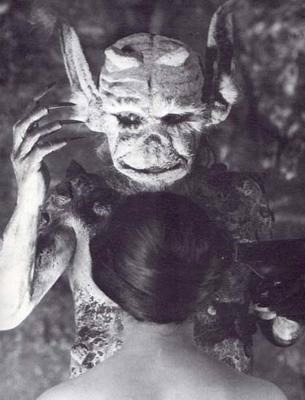
HAXAN, a Danish silent film made in 1922 by Benjamin Christensen, contains images you won't be able to get out of your mind. Intended as a documentary about the witch hysteria of the Middle Ages, with tableaus modeled after old woodcuts more disturbing and archetypal than most modern horror films. It's easy for horror movies to repulse or sicken, but after the bloody roller coaster ride, how many get under your skin and start to worry you...?
FIVE MILLION YEARS FROM EARTH, also found in Britain under the title QUARTERMASS AND THE PIT, is a Hammer film made in 1967 with Andrew Keir, James Donald and Barbara Shelley. Under a London alley called Hobb's Lane, workers unearth an unexploded shell that turns out to be a lost ship from an ancient, dying Mars-- with hominid fossils on board. Human aggression, the "killer ape" impulse that took over the Earth, is a genetic inheritance from the red planet. Our primordial fear of the Devil's horns is an imprinted memory of the Martian "locusts"' antennae, our genocidal wars a reenactment of their annual Martian culling of the weaker members of their herd. And the ship isn't dead, it's only sleeping...
THE DESIGNATED MOURNER, a play by Wallace Shawn, was filmed by David Hare with Mike Nichols, Miranda Richardson, and David de Keyser in 1997. The survivor of a government purge tries to justify himself to an unseen audience after he realizes that ''everyone on earth who could read John Donne was now dead." Imagine Winston Smith as an Edgar Allen Poe character confessing the murder of his own soul, telling us how he learned to stop worrying and love Big Brother, and yes, he really is glad that Julia's dead, because after all she just expected too much of us, didn't she, and I just want to be left alone to watch my TV and not have to think all the time...
(rough notes-- rewrite to follow) "Down these mean streets a man must walk who is not himself mean." -- Raymond Chandler
Christopher Frayling is a cultural historian (Spaghetti Westerns: Cowboys and Europeans from Karl May to Sergio Leone). While talking to Terri Gross on NPR about his book Once Upon A Time in Italy: The Westerns of Sergio Leone.talking with a guy about Sergio Leones westerns, how they broke away from the 'code of the west' kind of hero, and he let ddrop a pearl of wisdom in passing: for better or worse, when the hero lost his code in these movies, he became all about style, "looking good" while killing, and the hero's goal (rescuing the peasant farmer's kitten from the burning orphanage) became incidental. hey, i'm a guy, and i love a certain amount of that (Bogart in Casablanca, or Sigourney Weaver in Aliens 2, or Roddy Piper's immortal warning to aliens: "I have come here to chew bubblegum and kick ass, and I'm alll out of bubble gum.") And no one looks better than Chow Yun Fat when you need ten thousand bullets delivered. but each of those is a "code hero", fighting FOR something other than their own aggrandizement. the shift in movie heroes away from the code gives us the vicious pornography of Arnold Swartzenegger, current governonr of California USING AN INNOCENT BYSTANDER AS A HUMAN SHIELD (the audience is supposed to laugh when the body jerks) or Sylvester Stallone, the 5'" bodybuilder who bravely defended a Swiss girl's gym class against the Vietnamese, using an explosive arrow to turn an enemy soldier (enemy soldier? did anybody actually bother to declare war here? whose back yard was it, anyway?) into a bloody mist and the audience is supposed to cheer.
Godson Liam, aka Bondi, aka future editor of ORMONDROYD'S ENCYCLOPEDIA ESOTERICA, is being brought up properly with this "Chibi" style plush Godzilla-- and when he graduates from infancy to baby-boyhood, on his nursery shelf there awaits a more realistic (but still cuddly) twelve-inch high plush Godzilla kaiju to snuggle. God pity the bad dream that wanders into a bedroom guarded by the Lord of Monster Island, GODZILLA, KING OF MONSTERS!
TWILIGHT TALES author WAYNE ALLEN SALLEE taught his young niece Ashley Mavros to read by introducing her to uber-texts such as Forrest Ackerman's FAMOUS MONSTERS OF FILMLAND and the JOHN AGAR NEWSLETTER. MOLE PEOPLE synopsis from MST3K: "Smiling idiot John Agar takes Hugh Beaumont and Nestor Paiva beneath the surface of the Earth so that they have no place to run when he begins his windy pontificating through his muscled pie-hole. There they find Alan Napier and other thin men living out their sad existence in pleated skirts. Though aggressive at first, the pigmentless dress-wearers are cowed by Agar's mighty flashlight and shown the secret of their slaves, The Mole People. Actually, it's a matter of some controversy whether the mole creatures or their masters are the eponymous ones. Both could be considered "Mole People," as the former are indeed "moles" of a sort and the latter live among them - "Mole People." I became distracted by this and don't remember the rest of the movie, though I think Agar and friends escape. Without Nestor Paiva, no big loss. " As of this writing, there is no plush John Agar available.
 (And some days it takes more Stones than others...) Where Mythical Bestiary meets Contemporary Culture and Chews On Its Leg Until Covered with Slobber.


.jpg)